What a 1967 Farmers’ Almanac Said About Children and Good Manners

A vintage page from the 1967 Farmers’ Almanac offers a fascinating look at how children were once expected to behave with their parents in public. Some of the advice feels decidedly old-fashioned—but a few lessons may still be worth remembering.
“Times Have Certainly Changed!” declared a page published in the 1967 Farmers’ Almanac. Beneath the headline was a list of instructions titled “How Children Should Act With Their Parents in Public.”
Nearly six decades later, the page reads like a time capsule from an era when children were expected to stand for introductions, address adults formally, and carefully observe rules of public courtesy.
Some of the recommendations may sound rigid—or even amusing—to modern readers. Others reflect timeless ideas about respect, patience, and consideration.
Here is what the Almanac advised.
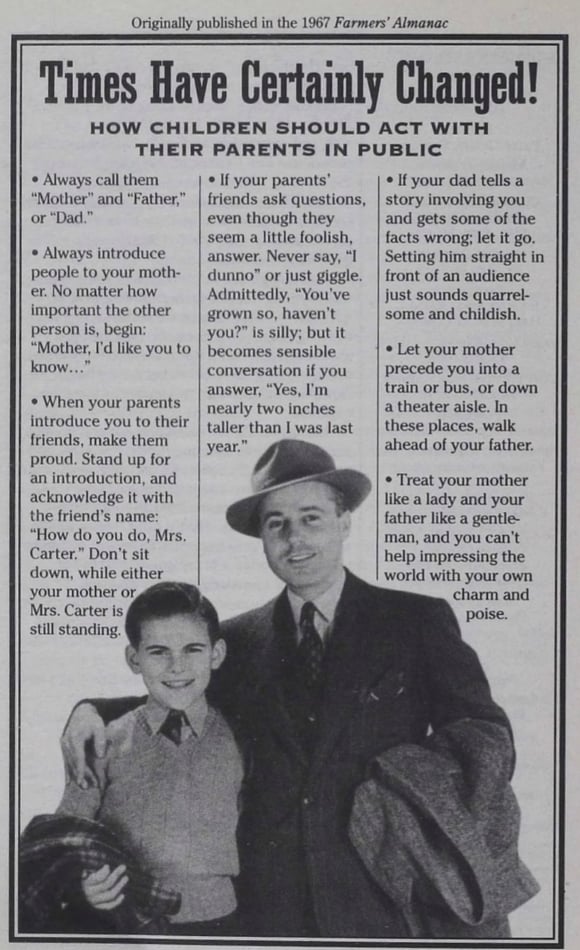
Call Your Parents “Mother,” “Father,” or “Dad”
The first rule instructed children to address their parents as “Mother,” “Father,” or “Dad.”
Today, families use all kinds of names and nicknames for parents. “Mom,” “Mama,” “Pop,” and many other variations are common. In 1967, however, more formal forms of address were often associated with respect and good upbringing.
The particular words may have changed, but the larger lesson remains familiar: Speak to your parents respectfully, especially when other people are present.
Introduce Your Parents First
Children were told that when introducing their mother to someone else, they should begin with their mother’s name or title:
“Mother, I’d like you to know…”
The page emphasized that the parent should be introduced first, regardless of how important the other person might be.
This reflects the elaborate social etiquette once taught in schools, families, and manners books. Introductions followed a hierarchy based on age, gender, position, and social standing.
Modern introductions are generally less formal, but the basic skill is still useful. A clear introduction helps everyone feel acknowledged and included.
Stand Up When You Are Introduced
The Almanac also instructed children to stand when their parents introduced them to friends.
They were expected to greet the adult by name—“How do you do, Mrs. Carter?”—and remain standing while either adult was still on their feet.
That level of formality is less common today. Still, looking up, putting away distractions, making eye contact, and politely acknowledging someone are modern versions of the same courtesy.
Answer Adults Politely—Even When the Question Seems Silly
One of the most entertaining parts of the page concerns the questions adults ask children.
The Almanac acknowledged that parents’ friends sometimes ask questions that seem foolish. Even so, children were told not to say “dunno” or giggle.
The article used the familiar observation, “You’ve grown so, haven’t you?” as an example. Rather than dismissing it, a child could turn it into a real conversation by responding with something like:
“Yes, I’m nearly two inches taller than I was last year.”
The wording may sound rehearsed today, but the underlying suggestion is practical: Give people something to work with. A thoughtful answer can transform awkward small talk into a pleasant exchange.
Do Not Publicly Correct Your Father’s Stories
The 1967 advice also warned children against correcting their father when he told a story and got some of the facts wrong.
“Let it go,” the Almanac advised, explaining that correcting him in front of an audience could appear quarrelsome and childish.
This is one of the more complicated recommendations. Children should certainly be allowed to speak honestly, especially when something important is being misrepresented. But the passage also points toward an enduring social lesson: Not every minor mistake needs to become a public argument.
There is often a kinder time and place to correct someone.
Let Your Mother Go First—Except When Safety Comes First
The article told children to allow their mother to enter a train, bus, or theater aisle before them. However, in those same places, they were advised to walk ahead of their father.
These rules came from older customs in which men and boys were expected to guide, protect, or assist women in public spaces.
Today, courtesy is generally less tied to gender. Holding a door, offering a seat, helping with a heavy bag, or allowing another person to pass first can be thoughtful regardless of who is involved.
Treat Your Parents Like a Lady and a Gentleman
The page ended with this instruction:
“Treat your mother like a lady and your father like a gentleman, and you can’t help impressing the world with your own charm and poise.”
The language belongs unmistakably to another era. Yet its main argument is straightforward: The way children treat their parents influences how others perceive their character.
Respectful behavior was presented not merely as obedience, but as a sign of confidence, self-control, and maturity.
Have Manners Really Disappeared?
It is easy to look at old etiquette rules and conclude that people were more polite in the past. The reality is probably more complicated.
Children in 1967 were not always perfectly behaved, just as children today are not universally rude. Every generation worries that customs are changing too quickly and that younger people are abandoning the values of the past.
What has changed most is the form that good manners take.
Few children today would be expected to call their parents “Mother” and “Father” in public. Formal introductions are less rigid, and young people are more often encouraged to express their own opinions.
But courtesy has not disappeared. It may now mean putting away a phone during a conversation, thanking the person who prepared a meal, listening without interrupting, or making sure no one feels excluded.
The rules evolve. The purpose remains much the same.
What Do You Think?
Which of these 1967 rules still makes sense today—and which ones should remain in the past?
Did your parents or grandparents teach you similar rules about introductions, standing when adults entered the room, or addressing older people formally?
Tell us the manners you were taught growing up.

- Tim Konrad

- Tim Konrad

- Tim Konrad
- Tim Konrad