Pull This Invasive Grass Before It Drops Up to 1,000 Seeds
A single Japanese stiltgrass plant can produce up to 1,000 seeds that may survive in the soil for years. Here’s how to identify it—and why early fall is the time to pull it.

See a pale green grass with a silvery stripe spreading through your yard or along the edge of the woods? Take a closer look. It could be Japanese stiltgrass—and a single plant can produce up to 1,000 seeds before it dies this fall.
Late September is an especially important time to watch for Japanese stiltgrass (Microstegium vimineum), an invasive annual grass that has spread across much of the eastern United States.
It doesn’t look particularly threatening.
In fact, Japanese stiltgrass can be easy to mistake for ordinary grass. But once established, it can spread across lawns, gardens, roadsides, trails, and woodland floors, forming thick mats that crowd out other plants.
And right now comes the most important part of its life cycle:
It’s producing seeds.
According to Penn State Extension, Japanese stiltgrass produces seedheads from late summer through October, with each plant capable of producing 100 to 1,000 seeds.
Those seeds can remain hidden in the soil for years.
So if you have Japanese stiltgrass growing on your property, one of the most useful things you can do this fall is remarkably simple:
Pull it before the seeds drop.
What Does Japanese Stiltgrass Look Like?
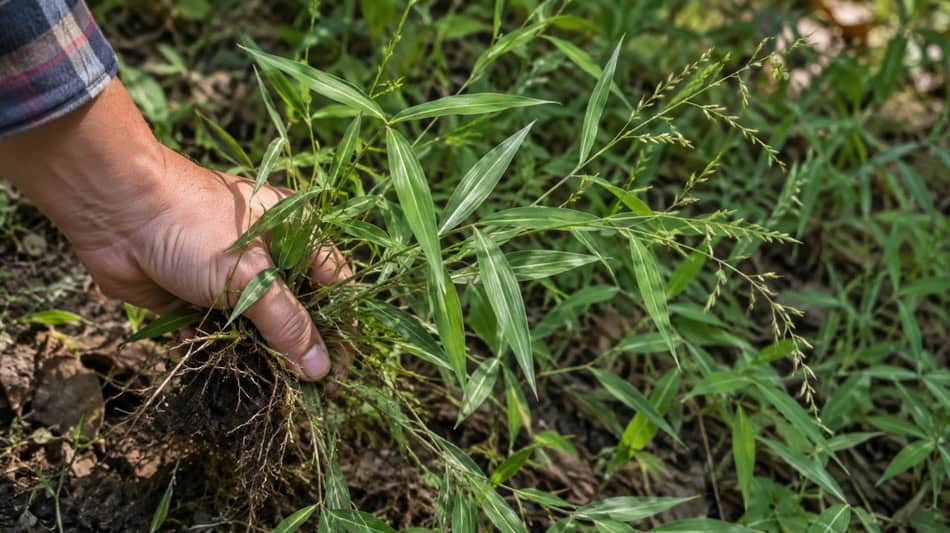
Once you know what to look for, Japanese stiltgrass is relatively easy to recognize.
The biggest clue is on the leaf itself.
Look for:
- Pale or light green leaves
- Leaves roughly 2 to 4 inches long
- A distinctive silvery stripe running lengthwise along the leaf
- Thin, wiry stems
- A sprawling, almost miniature-bamboo appearance
- Shallow roots
- Small seedheads appearing in late summer and fall
That silvery stripe is especially useful for identification.
According to Penn State Extension’s Japanese stiltgrass identification guide, the stripe is made up of reflective hairs and typically runs slightly off-center along the upper surface of the leaf.
Japanese stiltgrass can grow upright at first, but longer stems often fall over and spread across the ground, creating dense mats.
It also roots very shallowly.
That is good news if you find a small patch because it means the plants are usually surprisingly easy to pull by hand.
Why You Should Pull It Now
Timing matters with Japanese stiltgrass.
The plant is an annual, meaning the grass growing in your yard this year will eventually die after frost.
But killing the plant isn’t really the problem.
The seeds are.
Japanese stiltgrass spends spring and summer growing before producing flowers and seeds in late summer and early fall.
The University of Maryland Extension reports that seedheads typically begin forming from mid-September through October.
That makes early fall one of the most important times of year to check your property.
If those seeds mature and fall to the ground, next year’s problem has already begun.
And it may not be only next year’s problem.
Rutgers Cooperative Extension reports that Japanese stiltgrass seeds can remain viable in the soil for up to five years.
That’s why stopping seed production is so important.
A plant you pull today isn’t simply one less weed in your yard.
It could mean hundreds—or potentially 1,000—fewer seeds entering the soil.
How To Remove Japanese Stiltgrass
If you’re dealing with a small patch, you usually don’t need anything complicated.
Pull it.
Japanese stiltgrass has a weak, shallow root system and generally comes out of moist soil easily.
Grab the stems close to the ground and pull upward, removing as much of the plant as possible.
For homeowners already doing their September lawn care, this is a good weed to look for while walking the yard.
The most important thing is to remove it before mature seeds fall.
What If It Already Has Seedheads?
Be more careful.
If the plant has developed seedheads, avoid shaking or dragging it unnecessarily across your property.
The University of Maryland Extension recommends that plants with seedheads not be composted.
Instead, bag seed-bearing plants for disposal according to your local yard-waste rules.
This is also a good reason to identify stiltgrass before doing your final mowing of the year.
A mower can be useful for managing larger patches at the proper stage, but once mature seed is present, moving through an infestation may help spread it.
Why Does Japanese Stiltgrass Keep Coming Back?
You may pull every plant you can find this fall and still see Japanese stiltgrass next spring.
That doesn’t necessarily mean your efforts failed.
It means there may already be a seed bank hidden beneath the soil.
According to Rutgers Cooperative Extension, an individual plant can produce up to 1,000 seeds, and those seeds may remain viable for up to five years.
Some may germinate next spring.
Others can remain dormant.
This is why controlling an established stiltgrass patch often takes persistence over several seasons.
Think of your goal as slowly emptying a savings account—but instead of money, the account is filled with weed seeds.
Every year that you prevent new seeds from being deposited, you reduce the number available to sprout in future years.
Don’t Accidentally Spread It Around Your Property
Japanese stiltgrass seeds don’t always stay where they fall.
They’re small and remarkably easy to move.
Seeds can be transported by:
- Shoes and boots
- Lawn equipment
- Vehicle tires
- Animals
- Flowing water
- Mud and contaminated soil
Penn State notes that stiltgrass seed can spread on vehicles, equipment and contaminated soil, while water can transport seeds through ditches, streams and wet areas.
That means you can unknowingly move seeds from one side of your property to another.
If you’ve been walking, mowing, or working in an infested area, clean visible soil and plant debris from boots and equipment before moving into an uninfested part of the yard.
This becomes especially important during fall yard cleanup, when you’re also raking leaves and preparing the lawn for winter.
Where Does Japanese Stiltgrass Grow?
Japanese stiltgrass is often associated with moist, shaded areas, but it can tolerate a surprisingly broad range of conditions.
Watch for it along:
- Woodland edges
- Walking trails
- Roadways
- Drainage areas
- Ditches
- Shady lawns
- Garden beds
- Streams
- Disturbed soil
It can also creep outward from wooded areas and gradually spread into lawns and gardens.
If you live next to woods, pay particular attention to the transition zone between your lawn and the forest.
That’s often where invasive plants first become noticeable.
Be Sure It’s Japanese Stiltgrass Before Pulling It
One word of caution:
Not every grass with a similar shape is Japanese stiltgrass.
Several native grasses can be mistaken for it.
One important look-alike is Virginia whitegrass (Leersia virginica).
The easiest feature to check is that characteristic silver stripe.
Japanese stiltgrass typically has a shiny, silvery stripe running down the leaf. Virginia whitegrass does not.
Penn State also notes that whitegrass has a much larger flowering structure and patches of white hairs around the base of its leaves.
If you’re not sure what you have, take a close-up photograph and compare the leaves, stems, and seedheads with a reputable Extension identification guide before removing a large patch.
What Happens to Japanese Stiltgrass in Winter?
Because Japanese stiltgrass is an annual, frost eventually kills the growing plants.
The leaves may turn reddish-purple or brown in autumn before dying.
But don’t let that fool you into thinking the problem has solved itself.
The parent plant may be dead, but its seeds can be waiting in the soil for spring.
It’s similar to many other fall lawn chores: what you do before winter can make a major difference when growth resumes.
That’s also why autumn is a good time to consider whether you’re watering your lawn too late—or stopping too early and whether fallen leaves are helping or hurting your grass.
The Bottom Line
If you notice a patch of pale green, sprawling grass with a silvery stripe down its leaves, don’t simply assume it’s ordinary grass.
Take a closer look.
It could be Japanese stiltgrass.
And during late September and early fall, time matters.
A single plant can produce up to 1,000 seeds, and some of those seeds can remain viable in the ground for years.
For small patches, one of the best things you can do is also one of the easiest:
Pull it now—before those seeds hit the ground.
Japanese Stiltgrass At a Glance
What to look for: Pale green leaves with a silvery stripe
Where it grows: Lawns, woodland edges, trails, gardens, ditches, and moist disturbed areas
When it produces seeds: Late summer through fall
Seeds per plant: Up to 1,000
How long seeds can survive: Up to five years
Small infestation: Hand-pull before seeds mature
Seedheads already present: Handle carefully and don’t compost
Will it return next year? Possibly—seeds already in the soil can continue germinating for several years


- Farmers' Almanac Staff

- Farmers' Almanac Staff
- Farmers' Almanac Staff
- Farmers' Almanac Staff