
How Much Daylight Will Your State Lose Before Winter? A State-by-State Guide
How much daylight will your state lose before winter? See our state-by-state guide showing the dramatic difference in daylight between the fall equinox and winter solstice—from just over an hour in Hawaii to nearly six hours in Alaska.

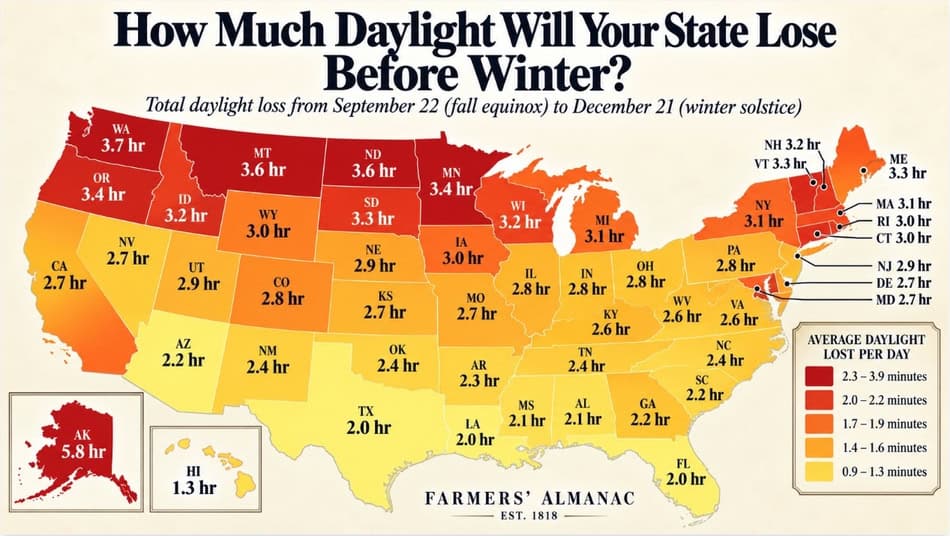
From the fall equinox to the winter solstice, every state in America loses daylight—but the farther north you live, the more dramatic the change. Here’s approximately how much daylight your state will lose between September 22 and December 21.
On the fall equinox, day and night are nearly equal across the United States. But from that point forward, daylight steadily retreats until we reach the winter solstice on December 21—the shortest day of the year.
Just how much daylight disappears during those three months depends largely on one thing: latitude.
Residents of Hawaii lose barely more than an hour of daylight over the course of fall. In Alaska, the seasonal change can amount to nearly six hours.
And for much of the northern United States, the difference between September and December is surprisingly dramatic.
How Much Daylight Does Your State Lose?
The figures below represent the approximate total decrease in daylight between September 22 and December 21. Because daylight varies considerably within larger states, we used the latitude of each state capital as a representative location.
| State | Approx. Daylight Lost |
|---|---|
| Alabama | 2.1 hours |
| Alaska | 5.8 hours |
| Arizona | 2.2 hours |
| Arkansas | 2.3 hours |
| California | 2.7 hours |
| Colorado | 2.8 hours |
| Connecticut | 3.0 hours |
| Delaware | 2.7 hours |
| Florida | 2.0 hours |
| Georgia | 2.2 hours |
| Hawaii | 1.3 hours |
| Idaho | 3.2 hours |
| Illinois | 2.8 hours |
| Indiana | 2.8 hours |
| Iowa | 3.0 hours |
| Kansas | 2.7 hours |
| Kentucky | 2.6 hours |
| Louisiana | 2.0 hours |
| Maine | 3.3 hours |
| Maryland | 2.7 hours |
| Massachusetts | 3.1 hours |
| Michigan | 3.1 hours |
| Minnesota | 3.4 hours |
| Mississippi | 2.1 hours |
| Missouri | 2.7 hours |
| Montana | 3.6 hours |
| Nebraska | 2.9 hours |
| Nevada | 2.7 hours |
| New Hampshire | 3.2 hours |
| New Jersey | 2.9 hours |
| New Mexico | 2.4 hours |
| New York | 3.1 hours |
| North Carolina | 2.4 hours |
| North Dakota | 3.6 hours |
| Ohio | 2.8 hours |
| Oklahoma | 2.4 hours |
| Oregon | 3.4 hours |
| Pennsylvania | 2.8 hours |
| Rhode Island | 3.0 hours |
| South Carolina | 2.2 hours |
| South Dakota | 3.3 hours |
| Tennessee | 2.4 hours |
| Texas | 2.0 hours |
| Utah | 2.9 hours |
| Vermont | 3.3 hours |
| Virginia | 2.6 hours |
| Washington | 3.7 hours |
| West Virginia | 2.6 hours |
| Wisconsin | 3.2 hours |
| Wyoming | 3.0 hours |
Values are approximate and based on representative state-capital latitudes. Day length varies within individual states.
Why Do Northern States Lose More Daylight?
It all comes down to the tilt of the Earth.
Earth’s axis is tilted about 23.5 degrees. As the Northern Hemisphere moves from fall toward winter, it gradually tilts farther away from the Sun.
The farther north you travel, the greater the seasonal swing in the length of the day.
That is why places like Montana, North Dakota, Washington, Minnesota, and Maine lose considerably more daylight during autumn than Florida, Texas, or Louisiana.
Alaska takes this effect to the extreme. Depending on where you are in the state, the difference can be enormous, with areas north of the Arctic Circle eventually experiencing periods when the Sun doesn’t rise at all.
How Much Daylight Do We Lose Each Day?
The fall equinox and winter solstice are roughly 90 days apart.
Across much of the continental United States, that works out to an average decline of roughly:
- Southern states: about 1.3–1.6 minutes per day
- Middle latitudes: about 1.7–2.0 minutes per day
- Northern states: about 2.0–2.4 minutes per day
- Alaska: approaching 4 minutes per day on average in our representative calculation
- Hawaii: less than 1 minute per day
But there’s an important catch.
You don’t lose exactly the same amount of daylight every day.
The rate of change varies throughout the season. Daylight generally changes relatively quickly around the equinox and then the daily change gradually slows as the winter solstice approaches.
That’s why the word average matters.
Where Does Daylight Disappear Fastest?
Among the Lower 48, some of the biggest autumn daylight losses occur across the northern tier.
Washington: about 3.7 hours
Montana: about 3.6 hours
North Dakota: about 3.6 hours
Minnesota: about 3.4 hours
Oregon: about 3.4 hours
Maine: about 3.3 hours
Vermont: about 3.3 hours
Compare that with:
Texas: about 2.0 hours
Florida: about 2.0 hours
Louisiana: about 2.0 hours
Hawaii: about 1.3 hours
That is a remarkable difference over just one season.
Does Daylight Saving Time Cause Us to Lose Daylight?
No.
When the clocks change in November, Daylight Saving Time doesn’t change how much sunlight we receive. It simply shifts the clock time at which sunrise and sunset occur.
Turning the clocks back can make the loss of evening light feel especially abrupt, but the shortening of the day has been happening gradually since the summer solstice.
Why Doesn’t the Earliest Sunset Happen on the Winter Solstice?
Here’s another seasonal curiosity: the earliest sunset of the year usually occurs before the winter solstice, while the latest sunrise often occurs afterward.
That’s because our clocks and the apparent movement of the Sun don’t line up perfectly from day to day. Earth’s tilted axis and slightly elliptical orbit combine to produce a phenomenon known as the equation of time.
The winter solstice still gives us the shortest overall period between sunrise and sunset, even though it isn’t necessarily the day with the earliest sunset.
The Good News: The Light Starts Coming Back
December 21 marks the turning point.
After the winter solstice, the Northern Hemisphere begins slowly gaining daylight again. At first the difference can be difficult to notice, but as January progresses, those extra minutes become increasingly apparent.
By the time spring arrives, the process has completely reversed.
So when those late-autumn afternoons begin feeling unusually dark, remember:
The farther north you go, the more quickly daylight disappears in fall—but after the winter solstice, every day brings a little more light.


- Farmers' Almanac Staff

- Farmers' Almanac Staff
- Farmers' Almanac Staff
- Farmers' Almanac Staff