
Will the Sun Set Before 5 PM Where You Live? Check Your State
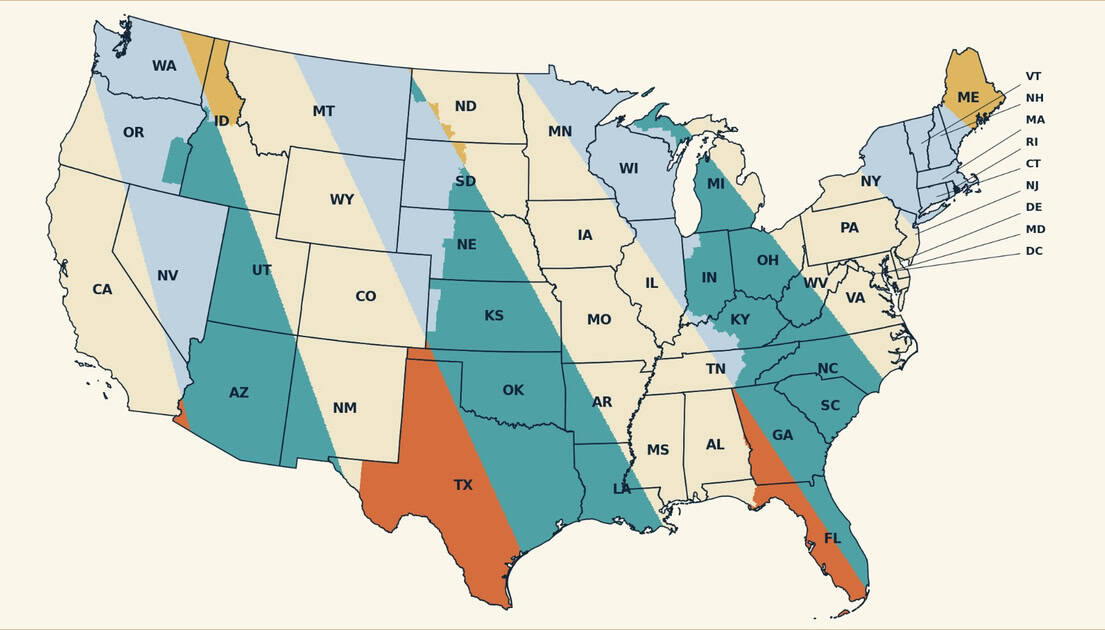
If you think the sun is setting ridiculously early these days, just wait until November 1.
That’s when Daylight Saving Time ends, and millions of Americans will suddenly find themselves watching the sunset before they’ve even finished the workday. In Boston, the sun will set at approximately 4:38 p.m. Chicago gets until about 4:45 p.m., and New York City until 4:53 p.m.
But the change won’t feel the same everywhere. In Atlanta, the sun won’t set until about 5:46 p.m., while Honolulu will still enjoy daylight until nearly 6 p.m.
So how early will the sun set where you live? We’ve put together a state-by-state guide showing sunset times for November 1 and November 15, 2026, so you can see just how quickly those November evenings are changing.
Quick Reference: November 2026 Sunsets
|
When Does Daylight Saving Time End in 2026?
Clocks fall back one hour on Sunday, November 1, at 2 a.m. local time in places that observe Daylight Saving Time.
The clock change doesn’t take away an hour of daylight. It moves that daylight earlier on the clock, shifting both sunrise and sunset.
For more on the rules and ongoing debate, see our 2026 Daylight Saving Time guide.
What Time Will the Sun Set in Your State?
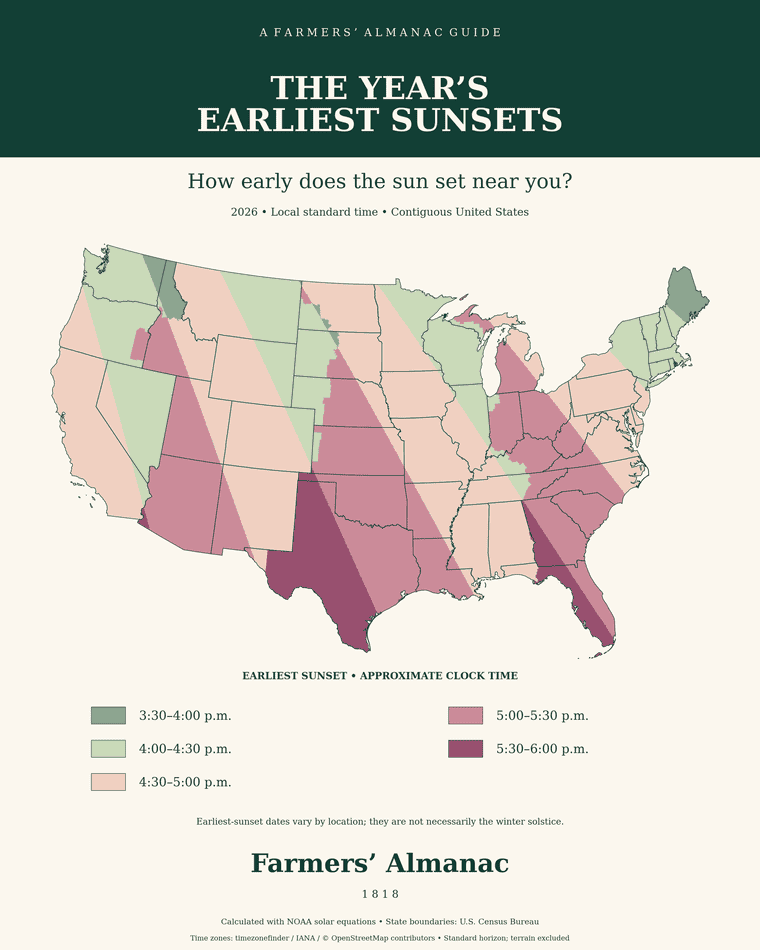
The table below shows local sunset times for November 1 and November 15, 2026. We used each state’s capital as a consistent reference point.
This distinction matters, especially in large states. Sunset in El Paso won’t happen at the same local clock time as sunset in Austin, and a resident of western Florida may see a noticeably different sunset time than someone in Tallahassee.
The times are calculated for the cities listed, rounded to the nearest minute. They are not statewide averages.
| State | City | Nov. 1 Sunset | Nov. 15 Sunset |
|---|---|---|---|
| Alabama | Montgomery | 4:55 PM | 4:45 PM |
| Alaska | Juneau | 4:10 PM | 3:39 PM |
| Arizona | Phoenix | 5:37 PM | 5:26 PM |
| Arkansas | Little Rock | 5:16 PM | 5:05 PM |
| California | Sacramento | 5:06 PM | 4:53 PM |
| Colorado | Denver | 4:59 PM | 4:45 PM |
| Connecticut | Hartford | 4:46 PM | 4:31 PM |
| Delaware | Dover | 5:02 PM | 4:48 PM |
| Florida | Tallahassee | 5:50 PM | 5:41 PM |
| Georgia | Atlanta | 5:46 PM | 5:35 PM |
| Hawaii | Honolulu | 5:55 PM | 5:50 PM |
| Idaho | Boise | 5:36 PM | 5:20 PM |
| Illinois | Springfield | 4:57 PM | 4:43 PM |
| Indiana | Indianapolis | 5:43 PM | 5:29 PM |
| Iowa | Des Moines | 5:10 PM | 4:55 PM |
| Kansas | Topeka | 5:22 PM | 5:09 PM |
| Kentucky | Frankfort | 5:41 PM | 5:28 PM |
| Louisiana | Baton Rouge | 5:17 PM | 5:08 PM |
| Maine | Augusta | 4:29 PM | 4:13 PM |
| Maryland | Annapolis | 5:06 PM | 4:53 PM |
| Massachusetts | Boston | 4:38 PM | 4:23 PM |
| Michigan | Lansing | 5:32 PM | 5:16 PM |
| Minnesota | St. Paul | 5:01 PM | 4:44 PM |
| Mississippi | Jackson | 5:11 PM | 5:01 PM |
| Missouri | Jefferson City | 5:09 PM | 4:56 PM |
| Montana | Helena | 5:14 PM | 4:55 PM |
| Nebraska | Lincoln | 5:24 PM | 5:09 PM |
| Nevada | Carson City | 4:59 PM | 4:45 PM |
| New Hampshire | Concord | 4:39 PM | 4:23 PM |
| New Jersey | Trenton | 4:57 PM | 4:43 PM |
| New Mexico | Santa Fe | 5:09 PM | 4:57 PM |
| New York | Albany | 4:49 PM | 4:33 PM |
| North Carolina | Raleigh | 5:20 PM | 5:08 PM |
| North Dakota | Bismarck | 5:28 PM | 5:10 PM |
| Ohio | Columbus | 5:30 PM | 5:16 PM |
| Oklahoma | Oklahoma City | 5:35 PM | 5:24 PM |
| Oregon | Salem | 5:01 PM | 4:44 PM |
| Pennsylvania | Harrisburg | 5:05 PM | 4:51 PM |
| Rhode Island | Providence | 4:41 PM | 4:26 PM |
| South Carolina | Columbia | 5:32 PM | 5:21 PM |
| South Dakota | Pierre | 5:32 PM | 5:15 PM |
| Tennessee | Nashville | 4:52 PM | 4:40 PM |
| Texas | Austin | 5:44 PM | 5:35 PM |
| Utah | Salt Lake City | 5:24 PM | 5:10 PM |
| Vermont | Montpelier | 4:41 PM | 4:24 PM |
| Virginia | Richmond | 5:12 PM | 4:59 PM |
| Washington | Olympia | 4:56 PM | 4:38 PM |
| West Virginia | Charleston | 5:27 PM | 5:14 PM |
| Wisconsin | Madison | 4:50 PM | 4:34 PM |
| Wyoming | Cheyenne | 4:55 PM | 4:41 PM |
All times are local to the listed city and rounded to the nearest minute. These are calculated astronomical sunset times under standard atmospheric conditions. Terrain, buildings, and local horizon conditions may affect when you actually see the sun disappear.
States spanning multiple time zones are represented by the capital’s local time zone. Phoenix represents most of Arizona, which does not change clocks; the Navajo Nation observes Daylight Saving Time.
Which Places Have Sunsets Before 5 PM on November 1?
An early sunset is already part of life in much of New England, the northern Midwest, and portions of the West when the clocks change.
A few November 1 examples:
- Augusta, Maine: 4:29 p.m.
- Boston, Massachusetts: 4:38 p.m.
- Chicago, Illinois: approximately 4:45 p.m.
- New York City: approximately 4:53 p.m.
- Denver, Colorado: approximately 4:59 p.m.
- Seattle, Washington: approximately 4:51 p.m.
By November 15, the list grows. Cities including Sacramento, Des Moines, Annapolis, Salem, Harrisburg, and Richmond have crossed the 5 p.m. threshold.
But the entire country isn’t experiencing the same thing. In Phoenix, sunset remains after 5 p.m. throughout November. Honolulu’s sunsets are later still.
Why Does the Sun Set So Much Earlier in Some States?
Latitude makes a big difference. As autumn progresses, northern places lose daylight more rapidly than southern ones because of Earth’s tilted axis.
That’s why November sunsets are especially early in places such as Maine and Alaska.
But latitude doesn’t explain everything.
Consider Nashville and Indianapolis. Nashville is farther south, but on November 1, its sunset is around 4:52 p.m. Indianapolis gets until about 5:43 p.m.
The difference largely comes from their positions within their time zones. Nashville follows Central Time, while Indianapolis follows Eastern Time. Clock time isn’t a direct measure of how far north or south a city lies.
A similar effect occurs within states that span multiple time zones, including Florida, Idaho, and Texas.
Our state-by-state guide to autumn daylight loss explains how latitude changes the amount of daylight lost between the equinox and winter solstice.
Does Sunset Mean It’s Completely Dark?
Not quite.
Sunset is the moment the sun’s upper edge disappears below the horizon, assuming a level horizon and typical atmospheric conditions. There’s usually still enough light to see outdoors for a while afterward.
The period immediately following sunset is called civil twilight. It ends when the sun’s center reaches six degrees below the horizon.
In many U.S. locations, civil twilight lasts roughly another half hour after sunset, although the duration varies by location and season.
That means a 4:45 p.m. sunset doesn’t necessarily mean complete darkness at 4:45.
Still, if you’re planning an afternoon walk, finishing yard work, or driving home around sunset, checking the local time is useful. Daylight can fade quickly as the evening progresses.
How to Find Your Exact Local Sunset Time
The table is a starting point, especially if you live some distance from your state capital.
For a specific city or town, use the U.S. Naval Observatory’s Sun and Moon data calculator. Enter your location and the date you want to check.
The Naval Observatory calculates sunrise and sunset using standard astronomical definitions, so the result is more precise for your location than a statewide figure.
And remember, November 1 isn’t the end of the seasonal shift. Sunset continues getting earlier in many places for several more weeks, even though the clocks won’t change again until spring.
If the early evenings are already getting to you, there’s at least one date worth looking forward to: the winter solstice on December 21. After that, the Northern Hemisphere’s total daylight begins increasing again.

- Maggie Konrad

- Maggie Konrad
- Maggie Konrad
- Maggie Konrad