

When two full Moons appear in a single month, the second one is usually called a Blue Moon. However, there is proof that this popular definition may be a misunderstanding picked up by mainstream media in the 1940s! Learn about different definitions for a Blue Moon, when the next one will occur, superstitions, and ways to celebrate these special full Moons!
What Is a Blue Moon? Definition, Dates, and Everything You Need to Know
A Blue Moon isn’t actually blue — but it’s one of the most fascinating lunar events in astronomy and folklore. Here’s everything you need to know, including the next Blue Moon dates, its history, symbolism, and how to celebrate.
What Is a Blue Moon?
A Blue Moon refers to an extra full Moon that occurs beyond the usual one per month or one per season. The term is also used colloquially to describe anything rare — as in “once in a blue moon.”
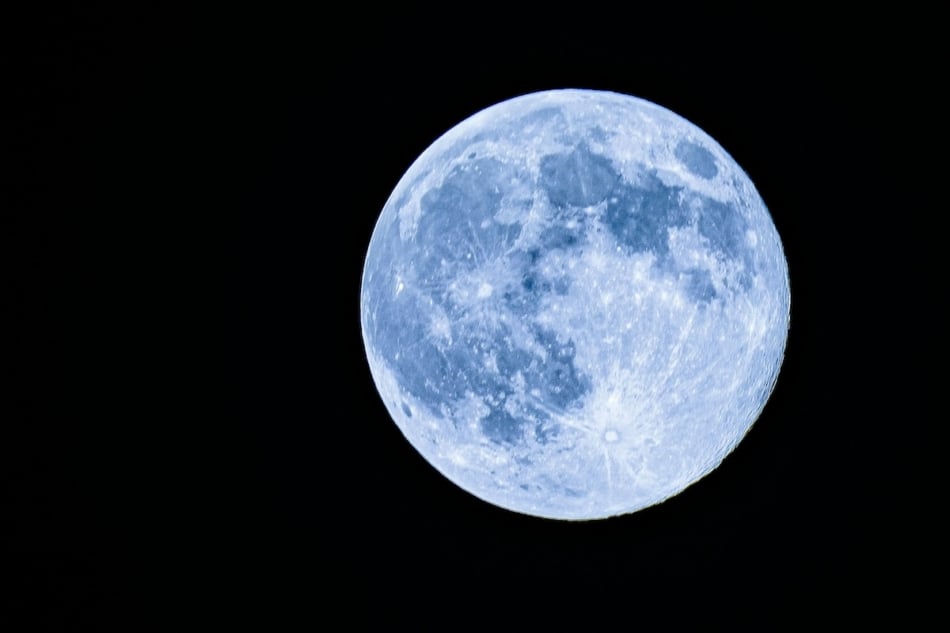
Despite the name, the Moon is not literally blue in color. The Moon can appear bluish on rare occasions due to specific atmospheric conditions, but the name has nothing to do with its appearance.
The History and Origin of the Term “Blue Moon”
The phrase “Blue Moon” has surprisingly deep roots. One of the earliest known written references appears in a 1528 religious pamphlet by Greenwich friars William Roy and Jerome Barlow, written during the Protestant Reformation. In it, common people were satirically described as being expected to believe anything their clergy told them — even that the Moon was blue. The expression was meant to convey something obviously absurd.
The term is also sometimes attributed to William Shakespeare, who wrote between 1585 and 1613 and used similar language to describe impossibilities.
One linguistic theory connects “Blue Moon” to the Old English word belewe, meaning “to betray.” Under this interpretation, the extra full Moon “betrayed” the normal expectation of one full Moon per month — a reading that many lunar calendar researchers find compelling.
The modern definition most people know today — the second full Moon in a calendar month — actually stems from a well-documented misinterpretation. Writer James Hugh Pruett, in the March 1946 issue of Sky & Telescope, incorrectly described the definition used by the Maine Farmers’ Almanac (unrelated to Farmers’ Almanac). Researcher Phillip Hiscock later uncovered this error and published his findings in the March 1999 issue of Sky & Telescope. According to the original almanac, the true definition was seasonal, not monthly.
Phillip Hiscock uncovered more about the origin of the term and published his findings in the March 1999 issue of Sky & Telescope magazine.
The Three Types of Blue Moons
1. Monthly Blue Moon
The most widely recognized definition today: when two full Moons occur within a single calendar month, the second is called a Blue Moon. This happens approximately every 33 months on average. Though popular, this definition is historically considered a misinterpretation.
2. Seasonal Blue Moon
The older and arguably more traditional definition: when a single astronomical season (spring, summer, fall, or winter) contains four full Moons instead of the usual three, the third full Moon is called a Blue Moon. This is the definition found in the original almanac tradition.
3. Astrological Blue Moon
A lesser-known type: when two full Moons occur while the Sun is in the same zodiac sign, the second is considered an Astrological Blue Moon. For example, both the June 21 and July 21, 2024 full Moons peaked while the Sun was in Cancer, making the July full Moon an astrological Blue Moon.
When Is the Next Blue Moon?
Here are the upcoming Blue Moon dates:
| Date | Type |
|---|---|
| May 31, 2026s | Monthly Blue Moon |
| May 20, 2027 | Seasonal Blue Moon |
| August 24, 2029 | Seasonal Blue Moon |
| August 21, 2032 | Seasonal Blue Moon |
| May 22, 2035 | Seasonal Blue Moon |
Note: According to NASA, the next monthly Blue Moon that is also a supermoon won’t occur until 2037.
Recent Blue Moons
- August 30, 2023 — Monthly Blue Moon (also a supermoon)
- August 19, 2024 — Seasonal Blue Moon
Can the Moon Actually Turn Blue?
Yes — rarely. Following major volcanic eruptions or large-scale wildfires, dust and ash particles roughly one micron in diameter can be propelled high into the atmosphere. These particles scatter red and yellow wavelengths of light, giving the Moon a faint blue or lavender hue.
Notable examples include the 1883 eruption of Krakatoa in Indonesia and the 1980 eruption of Mount St. Helens in Washington State — both of which produced visibly blue-tinted Moons. This optical effect is temporary and depends entirely on atmospheric conditions, not the Moon itself.
Blue Moon Symbolism and Folklore
Blue Moons carry rich symbolic meaning across cultures:
In Eskimo folklore, the Blue Moon represents sadness — the Moon keeping his distance from his lover, the Sun, to avoid overshadowing her, making him “blue” with longing.
In Medieval Europe, the Blue Moon was associated with disease, famine, and natural disasters, deepening its connection to sorrow and hardship.
In Eastern European, Middle Eastern, and Asian cultures, the color blue symbolizes protection from evil spirits. Blue amulets are traditionally used to ward off harm.
More broadly, blue represents water, loyalty, trust, and faithfulness — the origin of expressions like “true blue.”
Blue Moon Superstitions and Spiritual Significance
Blue Moons are considered powerful moments in many folk traditions:
- Gazing at a Blue Moon is said to bring abundance and good fortune.
- It is believed to be an auspicious time to communicate with ancestors, who may be more receptive to granting wishes during this rare event.
- Turning a coin over in your pocket during a Blue Moon is a traditional good-luck charm.
- Picking herbs, berries, or flowers during a Blue Moon is said to heighten their magical and medicinal potency.
How to Celebrate a Blue Moon
Whether you’re spiritually inclined or simply love a good lunar occasion, there are many ways to mark a Blue Moon:
Food and drink: Host a blue-themed dinner featuring blueberries, blue corn, blue cheese, or blue crab. Toast with blueberry lemonade or blue curaçao liqueur.
Flowers: Arrange a bouquet of blue blooms — larkspur, cornflower, bluebells, hyacinth, clematis, hydrangea, or periwinkle make stunning centerpieces.
Jewelry: Wear or gift pieces featuring blue gemstones such as sapphire (September’s traditional birthstone), blue topaz, aquamarine, lapis lazuli, or turquoise. Pairing with Moonstone adds a fitting lunar touch.
Style: Dress in blue, paint your nails a blue shade, or decorate your space in lunar-inspired blues for the evening.
Music: Play the classic 1934 song “Blue Moon” by Richard Rodgers and Lorenz Hart, or enjoy iconic covers by Mel Tormé, Elvis Presley, Frank Sinatra, or Rod Stewart and Eric Clapton.
Frequently Asked Questions About Blue Moons
How rare is a Blue Moon? A monthly Blue Moon occurs roughly every 2–3 years (about every 33 months). A seasonal Blue Moon occurs at a slightly different interval. The phrase “once in a blue moon” reflects this relative — but not extreme — rarity.
Is a Blue Moon actually blue? No. A Blue Moon looks like any other full Moon. However, the Moon can appear blue in color after major volcanic eruptions or wildfires that send fine particles into the upper atmosphere.
What is the difference between a Blue Moon and a supermoon? A supermoon occurs when a full Moon coincides with the Moon’s closest point to Earth in its orbit (perigee), making it appear larger and brighter. A Blue Moon refers to an extra full Moon in a month or season. The two can overlap, creating a Blue Moon supermoon.
What is the next Blue Moon? The next Blue Moon is May 31, 2026 (monthly). The next seasonal Blue Moon is May 20, 2027.
What does “once in a blue moon” mean? It means something that happens very rarely. The phrase originates from the infrequent occurrence of extra full Moons in a calendar month or season.
Have a question about the Blue Moon? Tell us in the comments below which definition you prefer — the monthly, seasonal, or astrological Blue Moon.

We can’t leave out the best cover version of the song “Blue Moon.” It is by The Marcels.
It sure is!
I read about the actual definition of a ‘blue moon’ quite some years ago, and came to the conclusion then that any mistake that has persisted in the media this many years is unlikely to ever be corrected. There will always be a spate of articles and TV news stories clamoring about the ‘Blue Moon!’ any time we have two full moons in one month. Which isn’t actually that rare, by the way. Some years it even happens twice.
All the phases are special in their own right. Let’s observe them all!!!
We agree!! We hope to be shedding more light (or a lot less, haha) on New Moons next!
Every Blue moon is both seasonal & monthly. Every Blue season has blue moon months so every 2.5-3 years/ season /month is a Blue moon 3rd moon is Blue if there is 1& 2 x2
13 is the uninvited one . Unfriendly 13 is a Blue moon .
This is a brilliant article! Admittedly, I had always followed the two full moons in a calendar month rule. However, I had then heard some old lore (possibly Celtic because of the lore surrounding a Sidh Moon/ Faerie Moon which supposedly refers to the second New Moon in a month) which stated if a calendar year had 13 Full Moons, the last Full Moon (thus in December) was considered the Blue Moon.
Considering what one of the other comments said about the Full Moon having bluish overtones in winter – it kind of makes sense too. Old lore is fascinating! I love how stories & traditions develop, and I love researching the roots of long-held ideas.
Thank you!
The Original saying, “once in a Blue Moon” was in reference to the Full Moon that occurred on the Winter Soltice. Being the middle of Winter in the northern hemisphere it was cold, thus the color Blue. Now, the “Once in a Blue Moon” was a rough measure of time of 17 1/2 years between these events. The term today was twisted to the 2nd full moon in a month by the Star Gazer on PBS back in the seventies. It’s really just the 2nd full moon in a month.
Hi Rod, it seems your information conflicts with ours, which came from an astronomer, so we stand by it.
I always have and will continue to use the “twice in one month” definition. It’s what I’ve always heard since I was a boy. I never heard of the 4 in a season deal until just recently, and I’ve been a sky and starwatcher since the 60s
“I would rather err with Galen than proclaim the truth with Harvey.”
I really like the article. I appreciate the information. Your article information will be passed on. Great job!
Thank you, Jodie! We’re glad you found it informative.
Interesting. Always wondered where that expression originated.