That Little Gray Bird Just Showed Up in Your Yard. It’s One of Winter’s First Arrivals

You may notice it first beneath the bird feeder rather than on it.
A small gray bird hops through the grass, flicking aside bits of leaves in search of seeds. When it darts toward the shrubs, two bright white edges flash on its tail. A few days later, there are half a dozen of them scratching around together.
If that scene suddenly looks familiar, your winter birds may be arriving.
Dark-eyed juncos are among the most abundant birds in North America, but across much of the eastern and central United States they’re largely winter visitors. Birds that spent the breeding season farther north begin moving south in fall, and their arrival in backyards has earned them the old nickname “snowbirds.” Cornell Lab of Ornithology notes that across much of the East, juncos appear as winter approaches and retreat north again in spring.
That doesn’t mean snow is coming tomorrow. But seeing your first junco of the season is a pretty reliable sign that the bird calendar has turned.
Why Juncos Suddenly Appear in Fall
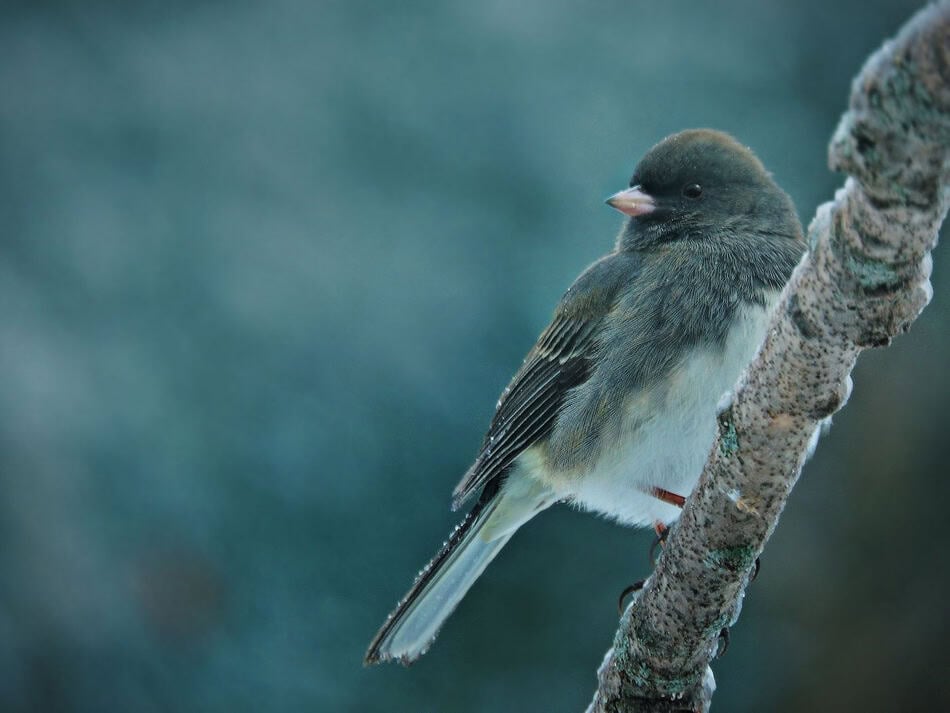
Dark-eyed juncos spend the year differently depending on where you live.
Many breed in forests across Canada and Alaska, then move south into the United States for winter. Others travel much shorter distances. Some populations in the West and in the Appalachian Mountains remain in the same general region year-round, sometimes shifting between higher and lower elevations rather than making a long migration. Cornell’s range map shows just how much the pattern changes across the continent.
That regional difference matters. In a backyard in Pennsylvania, Ohio, Missouri, or much of the eastern U.S., the first juncos of fall may genuinely be newcomers from farther north. In parts of the West, you may have had juncos nearby all summer without seeing much of them around the house.
Fall also changes where they spend their time. During winter and migration, juncos move into open woods, parks, roadsides, gardens, and backyards, putting them much closer to people than they may have been during breeding season.
The Easiest Way to Know You’re Looking at a Junco
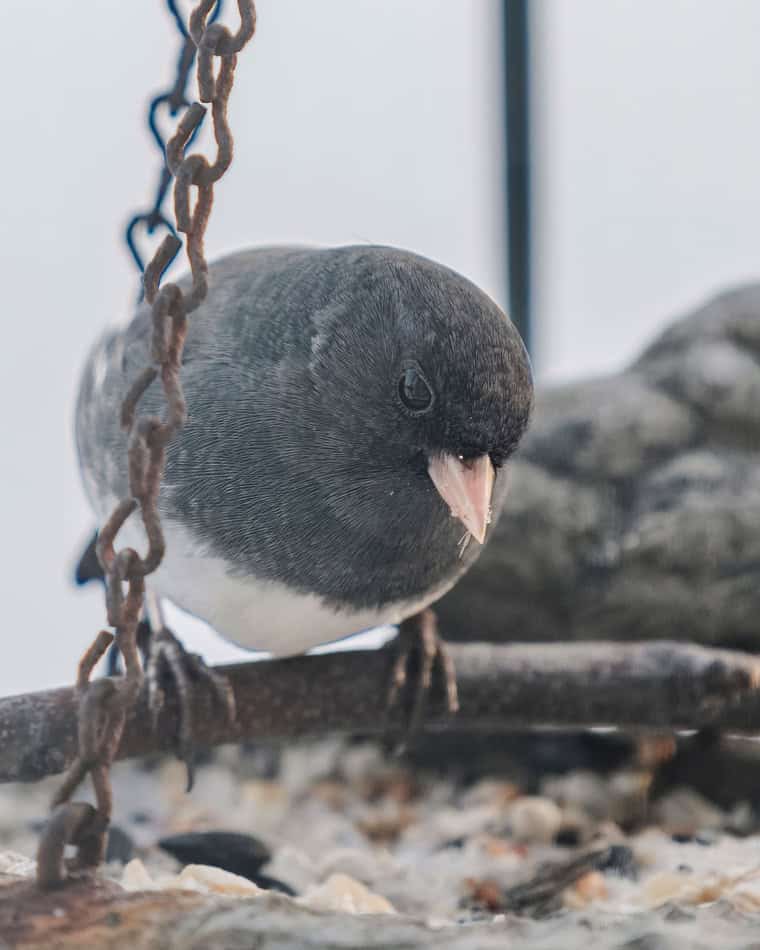
In much of the East, the common “slate-colored” junco looks almost as though someone dipped the top half of a small sparrow in charcoal paint. Its head and back are gray, its belly is pale, and its short bill is noticeably pink.
But don’t rely on gray alone. Juncos vary dramatically around the country.
Western “Oregon” juncos generally have dark hoods, brown backs, and warmer-colored sides. Other forms occur through the Rockies and Southwest. Cornell’s identification guide describes several recognizable regional forms that were once considered separate species.
There is one field mark that works surprisingly well across many of them: watch the tail when the bird flies.
Juncos have white outer tail feathers that flash conspicuously as they dart away. Once you learn that little white flick, spotting them becomes much easier.
Their behavior is another giveaway. Juncos spend a lot of time on the ground, hopping beneath shrubs and feeders and scratching through leaf litter for seeds. If you keep staring at the feeder itself, you may miss them completely.
Want Them in Your Yard? Look Down, Not Up
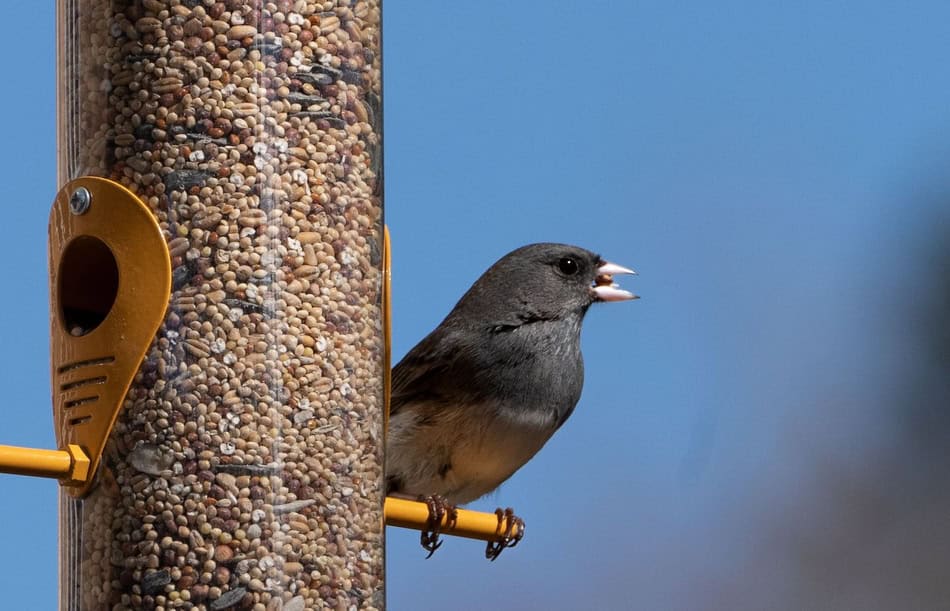
If juncos have arrived in your neighborhood, you don’t need an elaborate feeder setup to get a closer look.
Seeds make up most of their diet, and Cornell’s Project FeederWatch recommends millet for small ground-feeding birds such as juncos and sparrows. A little millet scattered on a clean ground-feeding area or offered on a low platform feeder is often more appealing to them than a feeder dangling several feet overhead.
They’ll also eat other small seeds, including hulled sunflower and cracked corn. If you already feed birds, watch the ground beneath the feeder. Juncos are perfectly happy cleaning up seeds other birds knock down.
Farmers’ Almanac has more ideas in our guide to the best foods for winter birds, including millet and cracked corn for juncos and other ground feeders.
You can help without buying anything, too. Let some seed heads remain standing instead of cutting every flower stalk down in fall, and leave a little natural cover around shrubs or quieter corners of the yard. Juncos naturally forage among low vegetation and leaf litter.
If you do put out feeders, keep them clean, replace damp or spoiled seed, and keep cats indoors. Ground-feeding birds spend a lot of time in exactly the places where an outdoor cat can stalk them. Project FeederWatch specifically recommends keeping cats indoors around feeding areas.
Does Seeing a Junco Mean Snow Is Coming?
This is where the “snowbird” nickname gets a little ahead of itself.
Juncos do move into much of the country as colder weather approaches, so generations of people understandably associated their arrival with winter. But the bird isn’t forecasting the next snowstorm.
Migration is a seasonal response, not a day-to-day weather prediction. A junco showing up in your yard means its annual movement is underway and winter is getting closer. It doesn’t tell you whether you’ll need the snow shovel this weekend.
Still, it’s easy to understand why people noticed the connection. Before weather apps and radar maps, seasonal changes in birds, plants, and animals were some of the most visible clues that the year was turning. Farmers’ Almanac still collects many of those traditional observations in our look at signs people have associated with a hard winter, while distinguishing folklore from an actual forecast.
One of the Nicest Signs That the Seasons Have Changed
Juncos aren’t flashy in the way cardinals or blue jays are. That’s part of their charm.
They simply begin appearing beneath the shrubs and feeders, usually in little groups, working their way quietly through the yard. By midwinter they can become such familiar company that it’s easy to forget they weren’t there a few months earlier.
Then spring comes, and across much of the country they vanish north again.
So if you spot a small gray bird hopping through the fallen leaves this October, take a second look before dismissing it as just another sparrow. Check for the pink bill. Wait for that flash of white in the tail.
Your snowbirds may be back.

- Maggie Konrad

- Maggie Konrad
- Maggie Konrad
- Maggie Konrad