Where Do Bats Go in Winter?

One of the strangest things about bats is how quickly they seem to disappear.
In August, they’re easy to spot at dusk, looping over the yard or zigzagging around a streetlight after insects. Then, a few cold nights arrive, and suddenly the evening sky is empty.
It’s tempting to assume they’ve all gone south. But for many bats, winter may be spent surprisingly close to where you saw them all summer.
A little brown bat in the Northeast, for example, may retreat to a cave or abandoned mine not far from its summer range. Big brown bats sometimes spend winter underground too, but they’re also known to hibernate in buildings. That means the bat that vanished from your backyard could, in some cases, be tucked into an attic or other sheltered space nearby. The U.S. Fish & Wildlife Service lists little brown, northern long-eared, tricolored, and big brown bats among species that commonly overwinter by hibernating.
What happens inside those winter shelters is more remarkable than simply “sleeping until spring.”
A Bat Can Spend Winter Running on Almost Nothing
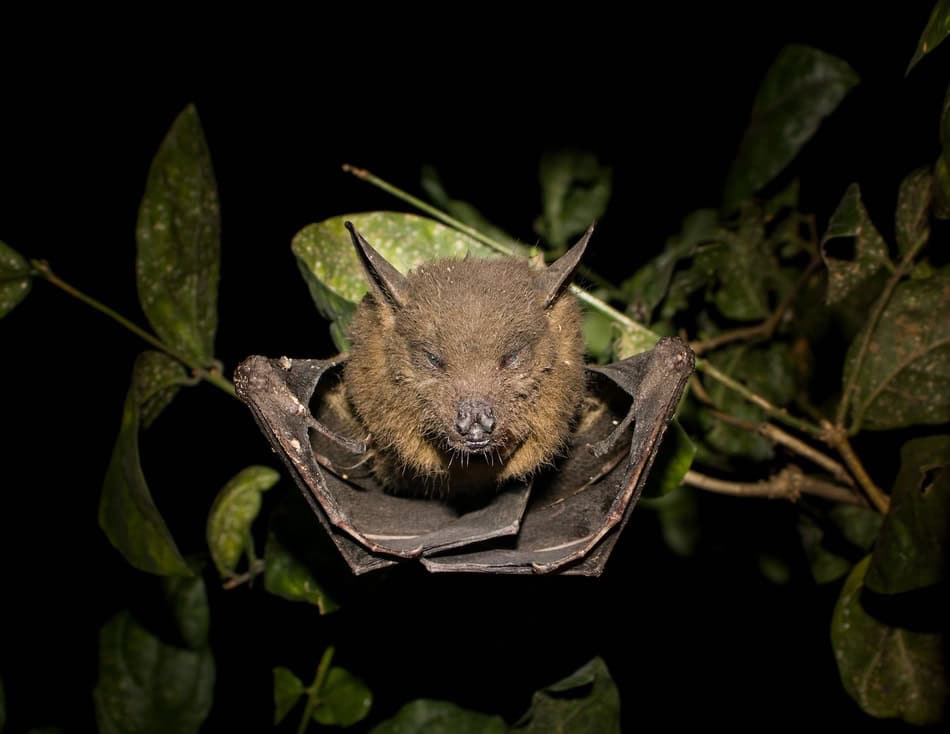
Most North American bats live largely on insects. Once cold weather shuts down that food supply, flying around looking for dinner would burn more energy than it was worth. So bats do the opposite.
During hibernation they enter long periods of torpor, dramatically slowing their metabolism. Their body temperature drops, and their breathing and heart rate slow along with it. Bat Conservation International says a hibernating bat can reduce its energy use by as much as 98 percent.
That is how an animal that normally spends summer nights in near-constant motion can survive for months on fat stored before winter.
But hibernation isn’t one uninterrupted sleep. Bats wake periodically, sometimes shifting position or responding to changing conditions before settling back into torpor. Those wake-ups are expensive. Every time a bat warms its body again, it uses some of the limited energy it needs to make it to spring.
That’s one reason winter bat caves are best left alone. A disturbance that seems minor to us can force a hibernating bat to burn energy it can’t easily replace.
And yet caves aren’t where every bat goes.
Some Bats Really Do Head South
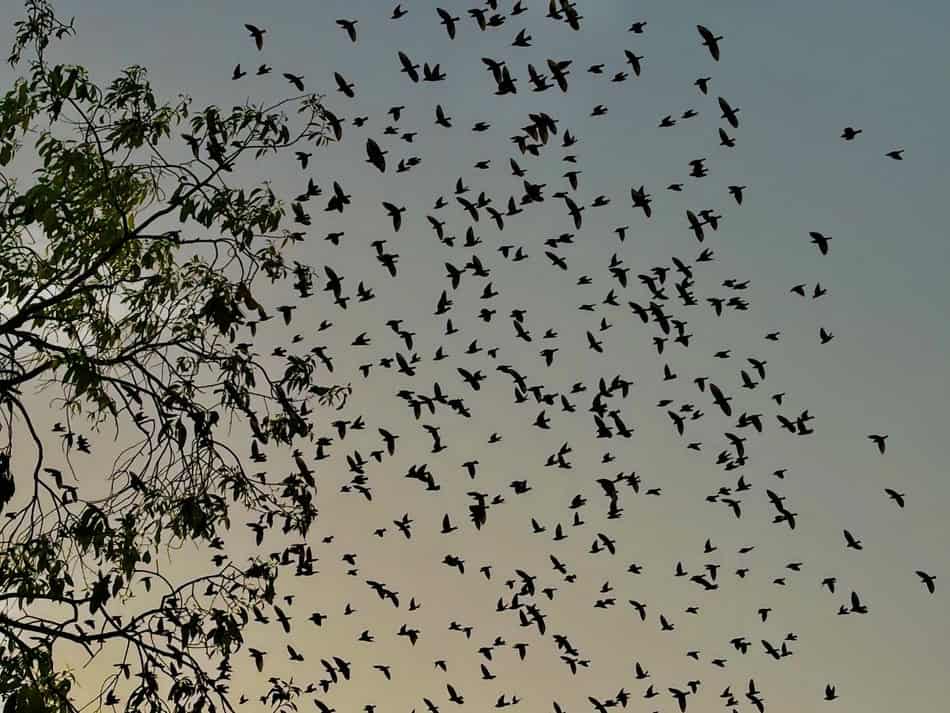
Hoary bats, eastern red bats, and silver-haired bats are among the North American bats known to migrate.
Most of us never notice them leaving. There’s no noisy V-shaped flock overhead, and much of the movement happens at night.
Their journeys also aren’t quite as simple as “fly south and stay active.” Some migratory bats use torpor once they reach their winter range. Hoary bats, for instance, can migrate and then slow their metabolism during cold stretches.
Eastern red bats are another good example of how much we still don’t know. Scientists know they migrate, but parts of their winter lives remain surprisingly difficult to follow. Bat Conservation International notes that researchers are still learning where some populations spend the colder months and how they behave once they get there.
So the usual answer that bats either hibernate or migrate is a little too tidy. Some stay close to home. Some travel long distances. Some migrate and then use torpor anyway.
Two bats feeding over the same pond in July could be hundreds of miles apart by January.
And Some Never Completely Disappear
Winter depends a lot on where you live.
In a northern state, weeks of freezing weather can leave bats with virtually nothing to eat. Farther south, a warm spell may bring insects back into the air for a night or two.
When that happens, bats may come out too.
The U.S. Fish & Wildlife Service notes that tricolored bats in parts of the southern United States may spend winter in places such as trees or culverts and can remain active during the season.
So a bat flying around on a mild January evening isn’t necessarily confused or in trouble. There may simply be food available.
That gets at the real reason bats seem to vanish so completely in fall. What disappears first isn’t necessarily the bats themselves. It’s the nightly feeding show we’ve been watching all summer.
Cold weather takes away the insects. Some bats respond by dropping their metabolism almost to a standstill. Others leave. Farther south, some wait for the occasional warm evening and head out to feed when they get one.
Then spring reverses the whole thing. Insects return, hibernating bats become active again, migrants work their way back north, and those familiar shapes start appearing in the evening sky.
For an animal that seemed to disappear for months, many bats were never very far away at all.

- Maggie Konrad

- Maggie Konrad
- Maggie Konrad
- Maggie Konrad