How Much Daylight Do We Lose in September? See the 2026 Map
September brings one of the year’s fastest changes in daylight. See how many minutes of sunshine cities across the U.S. lose during September 2026—and why northern locations like Seattle lose more than twice as much daylight as Miami.

Have you noticed the evenings suddenly getting shorter?
You’re not imagining it.
September is one of the most dramatic months of the year for changing daylight in the Northern Hemisphere. Between September 1 and September 30, 2026, Seattle loses about 98 minutes of daylight. Minneapolis loses nearly 89 minutes, Chicago about 80 minutes, and New York roughly 77 minutes.
Even Miami, far to the south, loses about 43 minutes of daylight during the month.
The big difference comes down mostly to one thing: latitude.
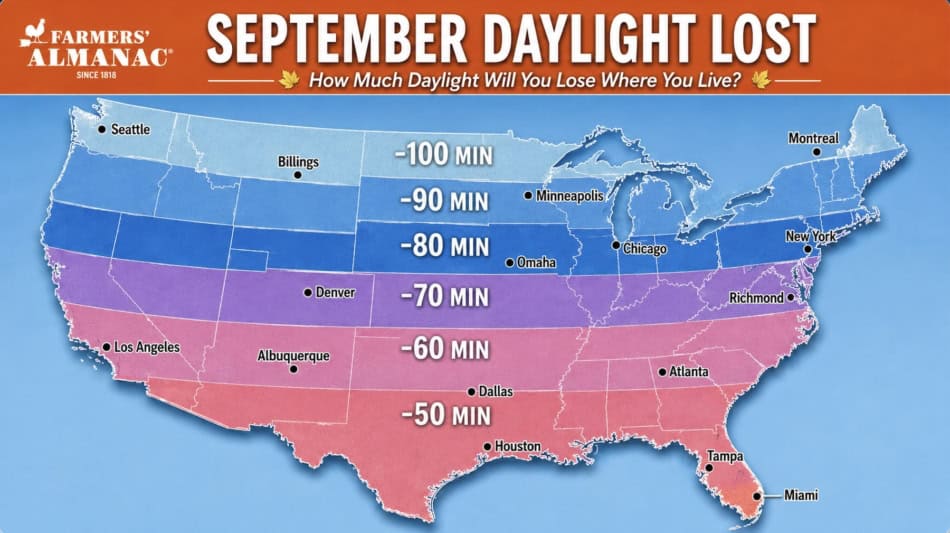
Our September daylight map shows just how quickly the amount of sunshine changes from north to south—and why autumn seems to arrive much faster in some parts of the country than others.
How Much Daylight Do We Lose During September?
Here’s the approximate change in daylight length from September 1 through September 30, 2026:
| City | Daylight Lost During September |
|---|---|
| Seattle | ~98 minutes |
| Billings | ~92 minutes |
| Montreal | ~91 minutes |
| Minneapolis | ~89 minutes |
| Chicago | ~80 minutes |
| Omaha | ~78 minutes |
| New York | ~77 minutes |
| Denver | ~74 minutes |
| Richmond | ~69 minutes |
| Albuquerque | ~63 minutes |
| Los Angeles | ~60 minutes |
| Atlanta | ~60 minutes |
| Dallas | ~57 minutes |
| Houston | ~51 minutes |
| Tampa | ~47 minutes |
| Miami | ~43 minutes |
That means someone in Seattle loses more than twice as much daylight during September as someone in Miami.
And much of that change happens quickly enough that you can actually notice it from week to week.

Why Do We Lose Daylight So Quickly in September?
The shortening days have nothing to do with Earth suddenly moving farther away from the Sun.
They are caused by Earth’s tilted axis.
Earth is tilted about 23.4 degrees relative to the plane of its orbit. As our planet travels around the Sun, that tilt changes the angle and duration of sunlight reaching each hemisphere. NASA explains that this axial tilt is what produces our seasons and the dramatic differences in daylight between summer and winter.
After the June summer solstice, the Northern Hemisphere gradually tilts less directly toward the Sun. The Sun follows a lower path through our sky, sunrises become later, sunsets become earlier, and our total hours of daylight decline.
That decline becomes especially noticeable as we approach the September equinox.
The Fall Equinox Is the Turning Point
In 2026, the autumnal equinox arrives on Tuesday, September 22 at 8:05 p.m. EDT, corresponding to 00:05 UTC on September 23, according to the U.S. Naval Observatory.
At the equinox, the Sun crosses the celestial equator heading south. From there, nights become increasingly longer than days across the Northern Hemisphere.
Read our complete guide to the 2026 Fall Equinox and First Day of Fall.
One interesting wrinkle: despite the name equinox, day and night are not exactly 12 hours long everywhere on the equinox. Atmospheric refraction and the way sunrise and sunset are measured give many locations slightly more than 12 hours of daylight. The National Weather Service explains why the truly equal day and night—sometimes called the equilux—can occur several days away from the equinox itself.

Why Northern Cities Lose More Daylight
Look at the map and one pattern jumps out immediately: the farther north you go, the faster daylight disappears.
That’s because changes in Earth’s tilt affect higher latitudes more dramatically.
Near the equator, day length remains fairly close to 12 hours throughout the year. Farther north, seasonal swings become much larger. The same places that enjoy wonderfully long summer evenings also pay for them with rapidly shortening days as autumn approaches.
That is why Seattle can lose roughly 98 minutes of daylight in September while Miami loses only about 43 minutes.
Minneapolis and Montreal lose close to an hour and a half. New York loses roughly an hour and 17 minutes. Atlanta and Los Angeles lose around an hour.
Latitude—not whether a city is in the East, Midwest or West—is doing most of the work.
What Do the Colors on the September Daylight Map Mean?
The bands on the Farmers’ Almanac map represent rounded amounts of daylight lost between September 1 and September 30.
Because daylight duration is closely tied to latitude, the boundaries generally run from west to east rather than following state borders.
For the corrected map, the approximate contour latitudes are:
| Daylight Lost | Approximate Latitude |
|---|---|
| 100 minutes | 48.2° N |
| 90 minutes | 45.2° N |
| 80 minutes | 41.8° N |
| 70 minutes | 38.1° N |
| 60 minutes | 33.9° N |
| 50 minutes | 29.3° N |
| 40 minutes | 24.2° N |
That last line is particularly interesting.
A true 40-minute daylight-loss contour falls around 24° north latitude, near the Florida Keys and south of nearly all of the continental United States.
Miami loses about 43 minutes, making it one of the few major U.S. cities that can reasonably be rounded into the 40-minute category.
Houston is much closer to 50 minutes, Tampa is around 47 minutes, and Dallas loses approximately 57 minutes, putting it nearer the 60-minute band.

September Daylight Loss by Region
Across the Pacific Northwest and northern tier, September can take away an hour and a half or more of daylight.
Across much of the northern Midwest and Northeast, losses generally fall around 75 to 90 minutes.
The central United States tends to lose roughly 60 to 75 minutes, while much of the southern tier loses around 50 to 60 minutes.
Only the extreme southern edge of the country approaches the 40-minute range.
That helps explain why September can already feel distinctly autumnal in Minnesota or Montana while parts of Florida and the Gulf Coast still feel very much like summer.
Why September Feels Like Fall Before the Weather Does
Daylight is one of autumn’s most reliable signals.
Temperatures can be fickle. September might bring a chilly morning one week and an 85-degree afternoon the next. In fact, our Farmers’ Almanac 2026 Fall Weather Forecast calls for widespread warmth to linger across much of the country early in the season.
But daylight marches steadily in one direction.
Sunset creeps earlier. Morning light arrives later. Shadows get longer. Even a warm September afternoon begins to look and feel different from one in July.
Plants and animals notice the change too. Shortening day length, or photoperiod, is one of several environmental signals involved in seasonal changes throughout the natural world.
It accompanies many of the familiar signs of autumn—from changing leaves to bird migration and shifts in animal behavior.
If you’re watching the season unfold, see our 10 Early Signs of Fall in Nature and our 2026 Fall Foliage Forecast.
Does Daylight Saving Time Cause Us to Lose Daylight?
No.
This is a common misconception.
Daylight Saving Time changes the clock. It does not change the amount of sunlight we receive.
The September decline shown on this map is astronomical. It happens because of Earth’s orbit and axial tilt.
In 2026, Daylight Saving Time remains in effect throughout September and October in most of the United States. The clocks don’t “fall back” until Sunday, November 1, 2026.
When that happens, sunset suddenly appears an hour earlier on the clock, but we haven’t actually lost an hour of sunlight overnight.
See our guide to Daylight Saving Time 2026 and when the clocks change.
How Can I Find the Exact Sunrise and Sunset Times for My Town?
Daylight totals can vary slightly from one location to another, even at similar latitudes.
For precise local sunrise and sunset times, the U.S. Naval Observatory’s Astronomical Applications Department provides calculated sunrise, sunset, transit and twilight data for locations throughout the United States.
Check exact sunrise and sunset times with the U.S. Naval Observatory
Remember that daylight length is the time between sunrise and sunset. It is not simply the amount by which sunset gets earlier; some of September’s lost daylight disappears from the morning as sunrise gets later.
And the Days Keep Getting Shorter
September may deliver one of autumn’s most noticeable changes in daylight, but it doesn’t stop when the month ends.
Across the Northern Hemisphere, daylight continues to decrease through October, November and most of December until we reach the winter solstice, the shortest day and longest night of the year.
Then the cycle reverses.
Almost imperceptibly at first, the days begin getting longer again.
That’s one of the reassuring rhythms of the Almanac year: the light is always changing—but it always comes back.
And as those September evenings begin arriving a little sooner, another unmistakable season is already getting underway.
See when colder weather may reach you with our 2026 First Frost Dates guide.
Frequently Asked Questions
How much daylight do we lose in September?
It depends strongly on latitude. During September 2026, major U.S. cities lose roughly 43 to 98 minutes of daylight. Seattle loses about 98 minutes, Chicago around 80 minutes, New York about 77 minutes, Atlanta around 60 minutes, and Miami roughly 43 minutes.
What city loses the most daylight in September?
Among the cities on our map, Seattle loses the most, at approximately 98 minutes between September 1 and September 30, 2026. Locations even farther north can lose substantially more.
Why does it get dark so much earlier in September?
Earth’s 23.4-degree axial tilt causes the Northern Hemisphere to receive progressively less daylight after the summer solstice. As September approaches the autumnal equinox, both sunrise and sunset change quickly, especially at northern latitudes.
How much daylight does New York lose in September?
New York City loses approximately 77 minutes of daylight during September 2026, putting it close to the map’s 80-minute band.
How much daylight does Chicago lose in September?
Chicago loses approximately 80 minutes of daylight between September 1 and September 30, 2026.
How much daylight does Miami lose in September?
Miami loses approximately 43 minutes, far less than northern U.S. cities but still enough to make the shortening days noticeable by month’s end.


- Farmers' Almanac Staff

- Farmers' Almanac Staff
- Farmers' Almanac Staff
- Farmers' Almanac Staff