

Outrageous Weather Myths Debunked: 6 Folk Sayings That Don’t Hold Up
Roosters crowing at night, dogs eating grass, pigs gathering straw. Can these things really predict the weather?
Quick Reference
- Roosters crowing at night: Not a rain forecast. Roosters crow whenever something wakes them.
- Pigs gathering leaves: Nesting instinct, not weather sensitivity.
- Dogs eating grass: Evolutionary diet behavior, not weather.
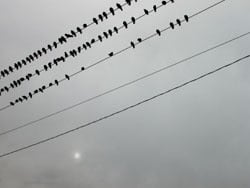
- Birds on a wire: Routine roosting, but a sudden flock during migration may flag a coming storm.
- Falling meteors: Independent of weather. The myth survives only because clear sky shows them better.
- Salt pork going sour: Bacteria, not barometers. Coincidence with rain made the saying.
- Best companion read: Almanac spring weather lore for the sayings that do hold up.
For millennia, our ancestors relied on popular lore to predict the coming weather. Some of these, like the color of the sky at night, or the position of the leaves on a tree, have some basis in reality. Others, like the following, are simply outrageous. Read each one, hear the science under it, and decide for yourself which folk sayings still earn a spot in the planning conversation.

If a rooster crows at night, there will be rain by morning.
Roosters crow whenever they want, day or night. The idea that roosters crow only at dawn is a misconception. The only reason roosters rarely crow at night is because they are diurnal animals that sleep at night. If a rooster does crow at night, any number of factors could be to blame. The animal could be sick, he may sense a predator, or he may just be feeling a bit antsy. Studies show many animals can sense bad weather, and it may be that some roosters do crow if rain is on the way, but the correlation certainly is not as cut and dry as this myth suggests.
Pigs gather leaves and straw before a storm.
Like many other animals, domestic pigs possess a nesting instinct, passed down to them from their wild ancestors. Gathering leaves, straw, and other soft materials is just an outgrowth of that instinct. In some pigs, particularly sows, this instinct may be stronger than in others. Regardless, the weather does not play any known role in the timing of when any given pig will exhibit this behavior.
When dogs eat grass, you can expect a severe storm.
Nearly every dog eats a little grass at some point, and some dogs eat it as often as they can get it. The timing of when a dog eats grass, or how much, has to do with evolution and with the individual dog. Dogs evolved as omnivores and scavengers. They eat both meat and vegetation, and historically found their food wherever they could get it. In the wild, dogs would have eaten grass regularly to supplement their nutrition. Grass probably tastes good to most dogs, like a fresh salad to humans. Many dogs will also eat grass when they have an upset stomach. Because most healthy dogs can eat grass without throwing it back up, some veterinarians believe that the texture of grass helps to induce vomiting when a dog is already feeling nauseated. None of this has anything at all to do with the weather.
Birds on a telephone wire predict the coming of rain.
Not exactly. If you live in an area with enough birds and enough wires, chances are you will see birds roosting on the wires at just about any time of the day or night. There is absolutely no known connection between this behavior and the weather. Birds in migration will often “stop over” in an area to wait out a bad storm in their path. If you notice a sudden increase in the number of birds in your town, whether they are on telephone wires or not, then it could well mean that a downpour is on the way.
A falling meteor predicts fair weather.
“Meteors” are just a name for debris from space that get caught in the Earth’s atmosphere and burn up from the friction. Several meteors enter our atmosphere every hour. At several times each year, during named annual meteor showers, you can see dozens of “shooting stars” per hour. But if you watch carefully enough, you can typically spot at least one or two sporadic meteors during any given hour of any night. Though the number of meteors that fall is completely independent of the weather, there may be a grain of truth to this myth. Meteors, like stars and planets, are often visible with the naked eye, but are best viewed when the sky is clear. Overcast conditions, which often mean rain is on the way, certainly make it more difficult to see meteors, or much of anything else in the sky. NASA’s meteors and meteorites overview walks through the same physics in plain language.
If salt pork turns sour, then be ready for a shower.
Like most superstitions, this saying was coined long before humans knew the scientific reasons for various natural phenomena. These days, we know that bacteria, and not weather, is the reason meat spoils. The reason this myth specifically mentions salt pork is that, prior to the invention of artificial preservatives or electric refrigeration, food was routinely preserved with salt. Unlike untreated meat, pork cured in brine will keep for several months or more. Because of its long shelf life, salt pork was generally eaten long before it had a chance to spoil. If left untouched for too long, even the best-preserved foods will eventually sour. If the timing of the spoiled meat’s discovery happened to coincide with a rain shower at one time or another, it was due to nothing more than chance.
Quick Verdict on Each Myth
| Myth | Verdict | Reason |
|---|---|---|
| Rooster crowing at night = rain | Mostly false | Roosters crow for many reasons. Bird sense of pressure is real but inconsistent. |
| Pigs gathering leaves = storm | False | Nesting instinct, not weather sensitivity. |
| Dogs eating grass = storm | False | Evolutionary diet and stomach behavior, no link to weather. |
| Birds on a wire = rain | Partly true | Routine roosting, but a sudden migration stop-over does flag a storm in their path. |
| Falling meteor = fair weather | Partly true | Meteors only show in clear skies; the link is visibility, not causation. |
| Salt pork going sour = rain | False | Bacterial spoilage. Pure coincidence when paired with weather. |
Why These Myths Stuck
- Memorable rhyme. “Salt pork sour, watch for a shower” is hard to forget. The pattern survives even when the science fails.
- Confirmation bias. Hearing a rooster at night and getting rain the next morning lodges in memory. The hundred times it does not match get forgotten.
- Mixed signal. A few of the myths brush against real animal behavior (pressure-sensitive birds, migration stop-overs) and the partial truth keeps the full myth in circulation.
- Cultural transmission. Farms passed sayings from grandparent to grandchild for centuries. The stories are part of the family record, not just the weather record.
Sayings That Actually Hold Up
- “Red sky at night, sailor’s delight.” Tied to weather systems moving west to east in mid-latitudes. The science is sound for many regions.
- “When leaves turn over, expect rain.” Wind patterns ahead of fronts do flip leaves of certain trees. Reasonable indicator.
- “Ring around the moon, rain by noon.” Cirrus cloud halos genuinely precede many storm systems by 24 to 48 hours.
- “Loud frogs mean rain.” Frogs respond to humidity and pressure, both of which often precede rain.
For more, see our roundup of spring weather lore and our woolly bear caterpillar forecaster piece.

Frequently Asked Questions
Do animals actually predict the weather?
Some do, within short windows. Birds, frogs, and ants respond to falling barometric pressure and rising humidity, both of which often precede storms. The signal is real but the lead time is usually only a few hours, not the day or week some myths claim.
Why do roosters crow at night?
A rooster crowing at night is usually responding to a disturbance: a predator, a noise, illness, or being startled awake. The folk reading that night-crowing predicts rain has only weak support, mostly tied to a few birds responding to barometric pressure shifts.
Why do dogs eat grass?
Most dogs eat grass for diet variety, taste, fiber, or to settle a mild stomach upset. None of those reasons relate to weather. Frequent grass eating with vomiting can indicate a real digestive issue and is worth a vet visit.
Do meteors really only fall on clear nights?
Meteors fall in roughly the same numbers regardless of weather. They are only visible from the ground in clear skies. The folk reading that a falling meteor predicts fair weather is really an observation about visibility, not causation.
Can you tell a storm is coming from animals?
Sometimes. A loud frog chorus, ant hills closed up, swallows flying low, and migrating birds suddenly stopping over can all signal a coming front. None of these are reliable enough on their own to forecast against. Pair the cues with a barometer or the long-range outlook for a real read.
Which weather sayings actually work?
Some classics hold up. “Red sky at night, sailor’s delight” matches the western movement of weather systems in mid-latitudes. “Ring around the moon, rain by noon” tracks cirrus halos that precede many storms by a day. Frog calls, ant behavior, and barometric pressure shifts all carry real signal.
Is it harmful to believe weather myths?
Mostly no. The myths are usually colorful and harmless. The risk is when a planting decision, a hike, or a winter trip rides on the saying instead of a real forecast. Use folklore for flavor and the Almanac long-range outlook for the actual call.
Want more weather lore? Find out if cows lie down when it’s about to rain or whether crickets chirps can act as natural thermometers.
Tell Us
What is the most outrageous weather myth you have heard? Drop it in the comments along with the science you have heard for or against. We collect them for the next round of debunking.


Jaime McLeod
Jaime McLeod is a longtime journalist who has written for a wide variety of newspapers, magazines, and websites, including MTV.com. She enjoys the outdoors, growing and eating organic food, and is interested in all aspects of natural wellness.
- Jaime McLeod

- Jaime McLeod
- Jaime McLeod
- Jaime McLeod





I really enjoyed the Bird Lore in this last email. I have heard of some but still find it all very interesting . THANK YOU.