

Quick Reference: Summer Solstice 2026
- Summer solstice 2026: Saturday, June 20 at 10:24 p.m. EDT (Sunday, June 21 at 02:24 UTC)
- What it marks: The first day of astronomical summer in the Northern Hemisphere
- Why it matters: The longest day of the year, the shortest noontime shadow, the most daylight
- Where the Sun sits: Directly overhead at 23.5 degrees north, the Tropic of Cancer
- Latin roots: Sol (Sun) plus sistere (to stand still)
- Calendar note: June 21, 2026 is also Father’s Day, an unusual double-up
The summer solstice 2026 arrives on Saturday, June 20 at 10:24 p.m. EDT (Sunday, June 21 at 02:24 UTC). That instant marks the first day of summer in the Northern Hemisphere, the longest day of the year, and the moment the Sun reaches its northernmost point in our sky: the imaginary line at 23.5 degrees north known as the Tropic of Cancer. Below: the exact timestamp in every U.S. time zone, the dates for the next five years, how the day actually works, how long the daylight runs from Miami to Anchorage, the traditions readers around the world keep on this date, and the unusual fact that this year the solstice doubles as Father’s Day.
When Is the Summer Solstice 2026?
The summer solstice 2026 happens at one shared instant for the entire planet. In Coordinated Universal Time it is Sunday, June 21, 2026 at 02:24 UTC. For most American readers, that clock-tick falls late on the Saturday night before. Here is the same moment in every U.S. time zone:
| Time Zone | Local Date | Local Time |
|---|---|---|
| UTC | Sunday, June 21, 2026 | 02:24 |
| Eastern (EDT) | Saturday, June 20, 2026 | 10:24 p.m. |
| Central (CDT) | Saturday, June 20, 2026 | 9:24 p.m. |
| Mountain (MDT) | Saturday, June 20, 2026 | 8:24 p.m. |
| Pacific (PDT) | Saturday, June 20, 2026 | 7:24 p.m. |
| Alaska (AKDT) | Saturday, June 20, 2026 | 6:24 p.m. |
| Hawaii (HST) | Saturday, June 20, 2026 | 4:24 p.m. |
Because the East Coast is just two hours and twenty-four minutes shy of the UTC tick, much of the country experiences the solstice on the Saturday evening before. The calendar headline still belongs to Sunday, June 21, which is the date most almanacs and news outlets will use. For your exact sunrise and sunset on either day, the U.S. Naval Observatory’s Sun and Moon Data tool is the authoritative reference.
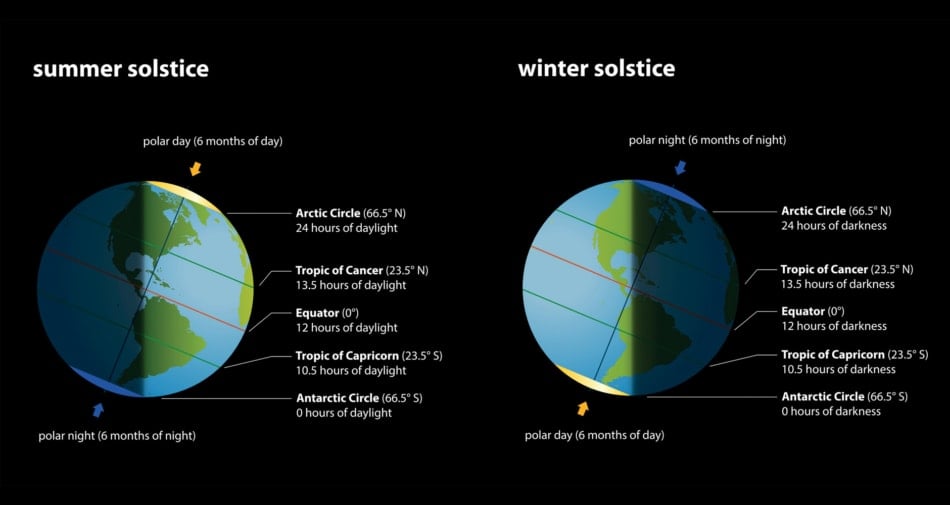
For those who live in the Southern Hemisphere, the same instant marks the winter solstice, the shortest day of the year and the start of astronomical winter. The solstice happens at one moment for everyone on Earth; only the season flips with the hemisphere.
RELATED: See the Farmers’ Almanac Summer Weather Forecast
Summer Solstice Dates for the Next Five Years
The summer solstice may fall on June 20, 21, or, more rarely, June 22. The exact moment drifts each year by roughly six hours, because the Earth’s orbit around the Sun is not a tidy 365-day round trip but closer to 365.25 days. Our calendar resets every leap year, which keeps the date hovering inside that narrow three-day window. Here is the calendar through 2030, drawn from NASA’s seasonal data:
| Year | Date (UTC) | Time (UTC) | Date (EDT) |
|---|---|---|---|
| 2026 | June 21 | 02:24 | Sat, June 20 at 10:24 p.m. |
| 2027 | June 21 | 08:11 | Mon, June 21 at 4:11 a.m. |
| 2028 | June 20 | 13:02 | Tue, June 20 at 9:02 a.m. |
| 2029 | June 20 | 18:48 | Wed, June 20 at 2:48 p.m. |
| 2030 | June 21 | 00:31 | Thu, June 20 at 8:31 p.m. |
Notice that the solstice slowly walks earlier through the leap-year cycle, then jumps back when the extra calendar day in February resets the count. June 22 has not been a solstice date since 1975 and will not return until 2203, so for the rest of any reader’s lifetime the question is only “June 20 or June 21.”
What Is the Summer Solstice?
The summer solstice is the instant the Sun, as seen from Earth, reaches its northernmost point in the sky for the year. At that moment the Sun sits directly overhead at noon along the Tropic of Cancer, an imaginary line encircling the globe at 23.5 degrees north of the equator. The name is borrowed from the Latin words sol (Sun) and sistere (to stand still). For a few days around the solstice, the Sun appears to pause its northward climb, hold its position at noon, then begin its slow slide back south. That apparent pause is where the name comes from.
The constellation Cancer the Crab gives the tropic its name. In ancient times the Sun stood in front of Cancer at the moment of the solstice; today, because of a slow wobble in the Earth’s axis called precession, the Sun is actually in Taurus on solstice day. The line on the map, however, kept the older name.
Day Length on the Solstice: How Much Daylight You Actually Get
The further north you live, the longer your solstice day. The Sun is up everywhere in the Northern Hemisphere longer than it will be at any other time of the year, but how much longer varies sharply by latitude. Here is the day length on June 20-21, 2026 for a sampling of cities, rounded to the nearest minute, drawn from timeanddate.com:
| City | Latitude | Sunrise | Sunset | Daylight |
|---|---|---|---|---|
| Miami, FL | 25.8 N | 6:30 a.m. | 8:15 p.m. | 13 h 45 m |
| Houston, TX | 29.8 N | 6:18 a.m. | 8:25 p.m. | 14 h 07 m |
| Atlanta, GA | 33.7 N | 6:25 a.m. | 8:51 p.m. | 14 h 26 m |
| Los Angeles, CA | 34.1 N | 5:42 a.m. | 8:08 p.m. | 14 h 26 m |
| Denver, CO | 39.7 N | 5:32 a.m. | 8:31 p.m. | 14 h 59 m |
| New York, NY | 40.7 N | 5:25 a.m. | 8:31 p.m. | 15 h 06 m |
| Chicago, IL | 41.9 N | 5:16 a.m. | 8:30 p.m. | 15 h 14 m |
| Minneapolis, MN | 44.9 N | 5:26 a.m. | 9:03 p.m. | 15 h 37 m |
| Seattle, WA | 47.6 N | 5:12 a.m. | 9:11 p.m. | 15 h 59 m |
| Anchorage, AK | 61.2 N | 4:21 a.m. | 11:42 p.m. | 19 h 21 m |
| Barrow (Utqiagvik), AK | 71.3 N | (no sunset) | (no sunset) | 24 h 00 m |
The pattern is clean. Every five degrees of latitude north buys you another half-hour of daylight on solstice day. By the time you reach the Arctic Circle (66.5 degrees north), the Sun does not set at all. Barrow, Alaska, the northernmost town in the United States, will not see a sunset between mid-May and the start of August.
Why Isn’t Summer on the Same Date Every Year?
The timing of the summer solstice is not based on a fixed calendar date or clock time. It actually depends on when the Sun reaches that northernmost point above the equator, which is a question of orbital position, not of any human calendar. The summer solstice may occur any time between June 20 and 22 each year.
The drift happens because one orbit of the Earth around the Sun takes about 365.2422 days, not a clean 365. Each non-leap year, the solstice falls about six hours later on the clock than the year before. When the calendar inserts February 29, the count resets by twenty-four hours and the solstice jumps a day earlier. Repeat across decades and you get the slow shimmy between June 20 and June 21.
The Astronomy: Tilt, Orbit, and Why the Earliest Sunrise Is Not on the Solstice
Some people believe that our seasons are caused by the Earth’s changing distance from the Sun. In reality, it is due to the 23.5-degree tilt of the Earth’s axis that the Sun appears above the horizon for different lengths of time at different seasons. The tilt determines whether the Sun’s rays strike at a low, glancing angle or a high, direct one. In June, the Northern Hemisphere is tilted toward the Sun, so the rays strike more directly and stay above the horizon longer. In December the same hemisphere is tilted away, the rays strike at a shallow angle, and the day shrinks.
One small surprise for solstice watchers: the longest day of the year is not the day of the earliest sunrise or the latest sunset. In the mid-latitudes of the United States, the earliest sunrise of the year falls about a week before the solstice and the latest sunset about a week after. The day length still peaks on solstice day, but the two end-of-day moments shift slightly because the Earth’s orbit is not a perfect circle and the Sun’s apparent motion through the sky speeds up and slows down across the year. This effect is captured in something astronomers call the equation of time, but for a backyard sky-watcher the takeaway is simple: do not be surprised if your earliest sunrise comes in mid-June and your latest sunset comes around the Fourth of July.
What Does the Term “Solstice” Mean?
The term “solstice” comes from the Latin words sol (Sun) and sistere (to stand still). On the solstice, the angle between the Sun’s rays and the plane of the Earth’s equator (declination) appears to stand still. This phenomenon is most noticeable at the Arctic Circle, where the Sun hugs the horizon for a continuous 24 hours, thus the term “Land of the Midnight Sun.” Here’s how the solstice differs from an equinox.
Summer Solstice Traditions Around the World
The summer solstice has been observed, celebrated, and worried over by cultures around the world for as long as people have kept track of the Sun. Many of the traditions that survive today still gather on the solstice itself or on the night before, often called Midsummer Eve.
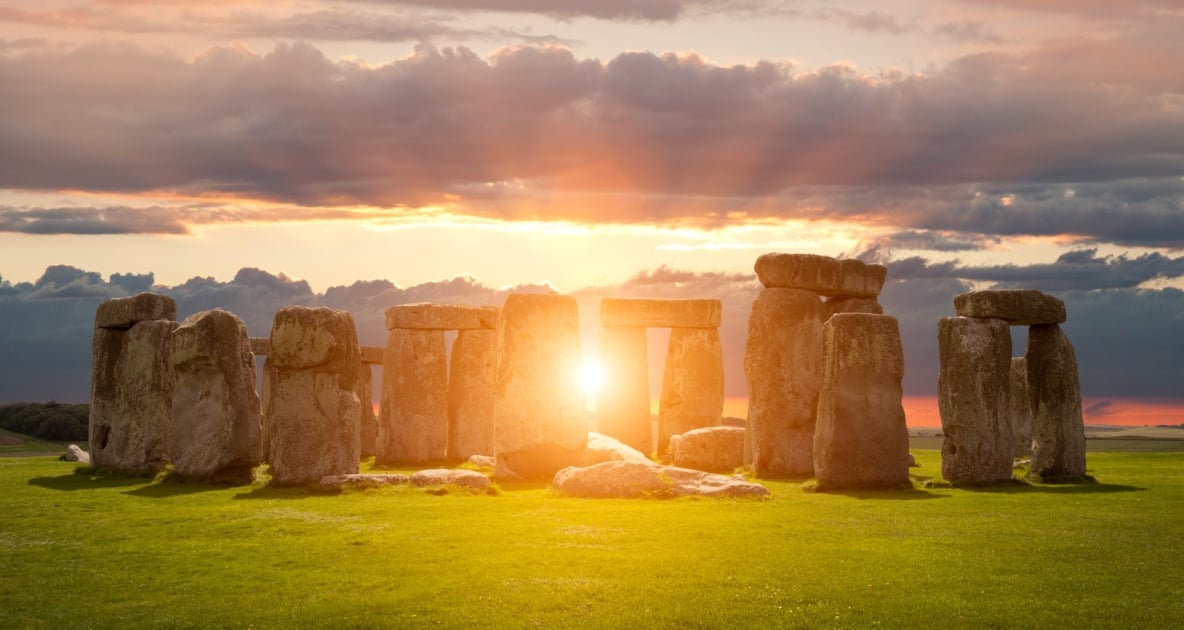
- Stonehenge, England. Every solstice morning, roughly ten thousand or more visitors gather at the prehistoric stone circle on Salisbury Plain to watch the Sun rise in alignment with the Heel Stone. English Heritage opens the site for an all-night vigil, and the crowd has been the same mix of druids, families, and curious travelers for decades.
- Midsummer, Scandinavia. Many European cultures hold what are known as Midsummer celebrations at the solstice, which include gatherings at Stonehenge and the lighting of bonfires on hilltops. In Sweden, Finland, Denmark, and Norway, Midsummer is a national holiday: maypoles, flower crowns, bonfires by the lake, and a meal that runs into the small hours of the bright night.
- Ancient Egypt. In Ancient Egypt, the summer solstice coincided with the rising of the Nile River. As it was crucial to predict this annual flooding, the Egyptian New Year began at this important solstice. The star Sirius reappearing in the dawn sky alongside the solstice Sun was the signal to expect the floodwaters.
- Hazel branches, Ireland. In centuries past, the Irish would cut hazel branches on solstice eve to be used in searching for gold, water, and precious jewels. The tradition lives on in dowsing, where a Y-shaped hazel branch is held loosely in both hands to “find” hidden water.
- Inti Raymi, Peru. In the Southern Hemisphere, June marks the winter solstice. The Inca empire held its largest festival of the year, Inti Raymi (the Festival of the Sun), on the June solstice at Cusco. Reconstructed reenactments have been performed every June 24 since 1944 and still draw tens of thousands of visitors.
- St. John’s Eve, Christian tradition. The Catholic feast day of St. John the Baptist falls on June 24, three days after the solstice. The night before, St. John’s Eve, absorbed many older Midsummer customs across Europe and Latin America: bonfires, herb gathering, blessings on fields and animals.
Fun fact: Be sure to look at your noontime shadow around the time of the solstice. It will be your shortest noontime shadow of the year!

The Solstice and Father’s Day 2026: A Calendar Double-Up
The summer solstice 2026 falls on Sunday, June 21. So does Father’s Day 2026. Father’s Day in the United States is anchored to the third Sunday in June, so once every several years the holiday lands on the solstice itself. The next time the two share a date is 2037.
For families planning a Father’s Day cookout, a fishing trip, or a long walk after dinner, the calendar is on your side: the most daylight of any day on the year, and a Sunday to spend it on. The Almanac’s Best Days Calendar rates June 21, 2026 favorably for outdoor entertaining and gathering with family. Pair the solstice sunset with a backyard fire pit and you have the kind of evening the old Midsummer traditions were built around.
The Solstice and Folk Weather Lore
For generations of Almanac readers, the solstice was a weather signpost as much as an astronomical one. A few of the old rules still earn their keep:
- “A wet solstice means a wet harvest.” Heavy rain on or around the longest day was taken as a sign that the rest of the growing season would run damp. Modern data does not strongly support the rule, but it kept generations of farmers checking the sky.
- “Cut hay before the solstice, save it after.” The traditional rule held that hay cut in the long, drying days just before the solstice cured best. The window is narrower than the rule sounds, but the underlying point (catch the dry stretch) is sound.
- “Midsummer thunder, mid-winter snow.” A loud thunderstorm on solstice day was said to foretell a sharp winter. This one survives in many cultures and is as much a calendar bookmark as a forecast.
The Farmers’ Almanac treats folklore as folklore: a record of careful observation, not a substitute for a current forecast. For the actual outlook this season, see our Long-Range Weather Forecast and the related daylight-saving daylight piece.
How to Spend the Solstice
The longest day of the year has a way of inviting plans. A short list:
- Watch the sunrise. Even in big cities, the solstice sunrise is a few minutes earlier than any other in the year. Find a clear eastern horizon and you are doing what people have done at Stonehenge for five thousand years.
- Mark your shortest shadow. Step outside at solar noon (roughly 1:00 p.m. local clock time in most U.S. zones during daylight saving) and look at your shadow. It will be the shortest one you cast all year.
- Sit outside until the last light goes. In the northern half of the country you will get a true blue hour that runs past 9:30 or 10:00 p.m.
- Light a fire. Bonfires on the solstice predate written history. A backyard fire pit, a few neighbors, and something to grill is the modern version.
- Plant the second succession. The week of the solstice is the traditional window for sowing the second round of summer beans, bush squash, and quick-turn greens. See the Gardening Calendar for the exact best days near June 21 in your zone.
Related Articles
What are the Dog Days of Summer?
Equinox vs. Solstice: What’s the Difference?
Join the Discussion
Are you looking forward to the summer solstice 2026? How do you plan to celebrate the longest day of the year? Will you mark Father’s Day in the long evening light, watch the sunrise from a favorite spot, or keep an older tradition you grew up with? Share in the comments below.

Frequently Asked Questions
When is the summer solstice 2026?
The summer solstice 2026 falls on Sunday, June 21 at 02:24 UTC, which is Saturday, June 20 at 10:24 p.m. EDT (9:24 p.m. CDT, 8:24 p.m. MDT, 7:24 p.m. PDT) for U.S. readers. It marks the first day of astronomical summer in the Northern Hemisphere and the longest day of the year.
What is the first day of summer 2026?
The first day of astronomical summer in 2026 is Sunday, June 21, the date of the summer solstice. The first day of meteorological summer, used by climate agencies for record-keeping, is always June 1.
Why is the summer solstice on June 21 in 2026 and not June 20?
The solstice happens at the same instant for the whole world, but that instant falls on different calendar dates depending on time zone. In 2026 it occurs at 02:24 UTC on June 21. East of UTC and at UTC itself the date is June 21; in the Americas the local clock has not yet rolled over, so most U.S. readers will experience the moment on Saturday evening, June 20.
How long is the longest day of the year?
It depends on your latitude. In Miami the solstice day runs about 13 hours 45 minutes of daylight; in New York about 15 hours 6 minutes; in Seattle about 15 hours 59 minutes; in Anchorage about 19 hours 21 minutes. Anywhere north of the Arctic Circle, the Sun does not set at all on solstice day.
Is the solstice the day of the earliest sunrise?
No, and that surprises a lot of readers. In the mid-latitudes of the United States, the earliest sunrise of the year falls about a week before the solstice, and the latest sunset about a week after. The day with the most total daylight is still the solstice itself; the two end-of-day moments just drift slightly.
What does “solstice” mean?
The word comes from the Latin sol (Sun) and sistere (to stand still). At the solstice the Sun appears to pause its northward climb in the sky for a few days, hold its position at noon, then begin its slow slide back south. That apparent pause is where the name comes from.
Does the summer solstice always fall on the same date?
No. The summer solstice may fall on June 20, 21, or, very rarely, June 22, depending on the year and your time zone. The exact moment drifts by about six hours each year and resets every leap year, which keeps the date hovering inside that narrow window.
Why does Father’s Day land on the solstice in 2026?
Father’s Day in the United States is set by rule, not by date: the third Sunday in June, every year. In 2026 that Sunday happens to be June 21, the same day as the summer solstice. The two share a date only every several years; the next overlap is 2037. See our full guide to Father’s Day 2026 for the long history of the holiday.

I am making a good salary from home $4580-$5240/week , which is amazing under a year ago I was jobless in a horrible economy. I thank God every day I was blessed with these instructions and now its my duty to pay it forward and share it with Everyone,
Here is I started… . . . . . .>>> Www.Work44.Com
Just FYI. Here in the Deep South, The first day of Summer is Memorial Day and the last day of Summer is Labor Day. We don’t really follow the solstice thing.
The summer solstice is proclaimed to be the longest day of the year. But if you substract sunrise time from sunset time, the longest day is in a week. Can you explain why it is not today? If you so desire, I can provide the answer.
Yes, tell us.
It has to do with the definition of sunrise and sunset. Sunrise is when the upper edge of the sun appears in the sky. Sunset is when the upper edge of the sun disappears. The time difference does not take into account the width of the sun. I thought this was interesting and I hope you and your followers feel the same. Enjoyed your article. Keep up the great work.
you just used up your 15 minutes of fame on trivialities ..
Here is another interesting article you may find interesting as well – https://www.farmersalmanac.com/latest-sunset-2
Your illustration above with the globes shows the Tropics of Cancer and Capricorn much too far from the equator. The Tropic of Cancer runs through the Florida Strait and cuts Mexico about in half. You show it cutting through the southern / mid-southern United States.
Thanks Jonathan, noted and will advise the stock service we got it from.
jumping in! i noted the equator is shown north of (or perhaps, conversely, the south american continent is shown south of) where it actually sits. the equator cuts trough ecuador (namesake), colombia and brazil. venezuela lies entirely in the northern hemisphere. in this diagram the equator appears to float on the caribbean sea…..
anywhams…. always lovely to read!… 🙂
Looks like the latitude lines are in the right place, it’s just the images of the continents that are distorted in size. Tierra del Fuego all but hits the south pole – no room for Antartica. Greenland just about extends to the North Pole. The latitude line issue extends from there. Saw this on an image search and was shaking my head, glad I wasn’t the only only bothered.
June is my favorite month of the year.. Today, June 20th, begins the summer solstice at 11:23 pm pst. It is said to be the longest day of the year, but it’s important to understand, that just like every other day of the year there are still only 24 hours on the solstice. Due to the earth tiltIng on its axis, closer to the sun, in the northern hemisphere the sun is visible for more hours, therefore making it lighter for more hours, and that makes the day seem longer. Make sense?
Yes that’s why it’s the longest day of the year, more sun or daylight. I also want to say that the first day of summer is June 21 and not June 20 this year unless you wrote this last year. The first day of summer does not always land on the same day every year. It begins every year between June 20 and June 21. It all depends when the sun is at it’s highest and it’s Northernmost point from the equator.
HE LITERALLY POSTED THIS A YEAR AGO
So we’re all googling summer solstice right now