The Perfect Storm of 1991: What Happened to the Andrea Gail?
In October 1991, an extraordinary combination of weather systems created one of the most infamous storms in Atlantic history. Here’s how the Perfect Storm formed, what happened to the Andrea Gail, and which parts of the famous movie were real.

In late October 1991, an extraordinary combination of weather systems came together over the North Atlantic and produced what became known simply as “The Perfect Storm.” The historic Halloween nor’easter battered the East Coast with huge waves, hurricane-force winds, coastal flooding, and dangerous seas—and claimed the fishing vessel Andrea Gail and all six men aboard.
The storm would later inspire Sebastian Junger’s bestselling book The Perfect Storm and the 2000 movie starring George Clooney and Mark Wahlberg.
But the real story was even more unusual than Hollywood made it seem.
The Perfect Storm began as a powerful extratropical storm, absorbed moisture and energy from Hurricane Grace, reached extraordinary strength south of Nova Scotia, and then—after its most destructive phase—eventually transformed into an unnamed hurricane.
The National Weather Service calls the event a highly unusual and record-setting storm for the northwest Atlantic. Read the National Weather Service’s history of the Perfect Storm
Here is what really happened.
The Perfect Storm of 1991: Quick Facts
- Dates: October 28–November 2, 1991
- Also called: The Halloween Storm, Halloween Nor’easter, and No-Name Storm
- Peak intensity: October 30, 1991
- Lowest pressure during its extratropical phase: About 972 millibars
- Andrea Gail: 72-foot commercial fishing vessel lost with six crew members
- Last reported position: Roughly 180 miles northeast of Sable Island, Nova Scotia
- Damage: More than $200 million in 1991 dollars
- Storm type: Began as an extratropical cyclone and ultimately evolved into an unnamed Atlantic hurricane
- Made famous by: Sebastian Junger’s 1997 book and the 2000 film The Perfect Storm
The storm remains one of the most famous events in American weather history. Explore more historic storms in the Farmers’ Almanac Weather History archive
What Was the Perfect Storm?
The Perfect Storm was an exceptionally powerful nor’easter that developed east of Nova Scotia on October 28, 1991.
Nor’easters themselves are not unusual along the East Coast. They form when strong atmospheric disturbances interact with sharp temperature contrasts and moisture over the Atlantic. The resulting low-pressure systems can produce high winds, heavy precipitation, coastal flooding, and enormous waves.
What made the 1991 storm extraordinary was the combination of several atmospheric ingredients occurring at almost exactly the same time.
A strong area of high pressure was building over eastern Canada. A developing low-pressure system was intensifying over the North Atlantic. And to the south was Hurricane Grace.
Then the systems began interacting.
NOAA meteorologist Bob Case described the circumstances as unprecedented. The developing nor’easter already contained the ingredients for a major storm, while the weakening Hurricane Grace supplied additional tropical moisture and energy. See NOAA’s satellite history of the 1991 Halloween Storm
That remarkable convergence inspired the name that would become famous:
The Perfect Storm.
Why Was It Called “The Perfect Storm”?
The word “perfect” did not mean that the storm was good.
It meant that the atmosphere had produced an unusually favorable combination of ingredients for creating an exceptionally powerful storm.
A strong Canadian high supplied cold, dry air from the north. A low-pressure system intensified southeast of the Canadian Maritimes. The warm Atlantic supplied heat and moisture. Hurricane Grace contributed tropical moisture and energy from the south.
Normally, any one of these ingredients might contribute to rough weather.
In late October 1991, they came together.
The result was a huge circulation capable of generating tremendous winds and waves over a broad area of the North Atlantic. NOAA’s Ocean Prediction Center describes the interaction of the high-pressure system, developing low, Hurricane Grace, and warm ocean as creating unusually favorable conditions for a life-threatening storm. See NOAA’s Ocean Prediction Center account of the Perfect Storm
Hurricane Grace Helped Create the Perfect Storm
One of the most important ingredients was Hurricane Grace.
Grace developed over the western Atlantic during late October 1991. As the hurricane weakened, the much larger extratropical storm to its north overtook it.
Tropical moisture and energy associated with Grace became incorporated into the developing North Atlantic cyclone, contributing to its rapid intensification.
By October 30, the Perfect Storm had reached a central pressure of approximately 972 millibars, an indication of an exceptionally intense extratropical cyclone.
And the storm was moving in an unusual direction.
Instead of continuing eastward into the Atlantic like many storms at that latitude, the system was blocked by enormous high pressure to its north and moved back toward the United States.
That helped drive water and enormous waves toward the coastline for an extended period.
Late October can still produce significant tropical activity in the Atlantic. For more background, see our look at when Atlantic hurricane season peaks and how long the season lasts. When Is Peak Atlantic Hurricane Season?
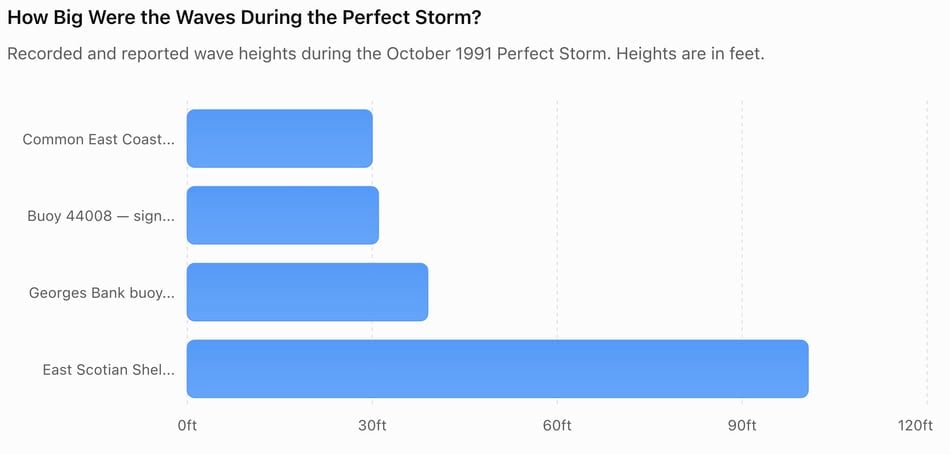
How Big Were the Waves During the Perfect Storm?
This is one reason the storm remains legendary.
NOAA has described waves associated with the event as reaching roughly the height of a 10-story building in portions of the North Atlantic. Watch NOAA’s satellite account of the enormous waves
The Ocean Prediction Center reports that storm surge reached approximately 4 to 5 feet above normal tides in some locations, while waves along portions of the coast reached around 25 feet.
Because the storm persisted through several tidal cycles, beaches, seawalls, homes, and waterfront structures were repeatedly battered.
Damage stretched from North Carolina north through New England and into Canada.
Even the Kennebunkport, Maine, home of President George H. W. Bush sustained significant damage.
The Perfect Storm was hardly the only frightening late-October weather event. Farmers’ Almanac has collected several other memorable Halloween storms from American weather history. Read about other memorable Halloween storms
What Happened to the Andrea Gail?
For many people, the story of the Perfect Storm is inseparable from the Andrea Gail.
The Andrea Gail was a 72-foot commercial swordfishing vessel based in Gloucester, Massachusetts.
In the fall of 1991, the boat was returning from fishing grounds in the North Atlantic when conditions began deteriorating rapidly.
The vessel’s final known communications came on October 28, 1991.
According to the National Weather Service, its last reported position was approximately 180 miles northeast of Sable Island, off Nova Scotia. Conditions in the region were rapidly worsening as the developing storm intensified.
The U.S. Coast Guard’s official investigation says the Andrea Gail disappeared somewhere in the North Atlantic between October 28 and October 30, 1991, with the loss of everyone aboard. Read the official U.S. Coast Guard Andrea Gail investigation
The boat itself was never recovered.
Who Were the Six Men on the Andrea Gail?
The six crew members lost aboard the Andrea Gail were:
Frank “Billy” Tyne Jr., captain
Robert “Bobby” Shatford
Dale “Murph” Murphy
Michael “Bugsy” Moran
David “Sully” Sullivan
Alfred Pierre
Their disappearance became the human story at the center of Sebastian Junger’s The Perfect Storm.
The Andrea Gail and its crew remain particularly closely associated with Gloucester, Massachusetts—a community with a centuries-old fishing tradition and a long history of lives lost at sea.
Do We Know How the Andrea Gail Sank?
No.
And this is one of the most important distinctions between the true story of the Perfect Storm and the Hollywood version.
There were no survivors from the Andrea Gail, and the vessel itself was never recovered.
The official U.S. Coast Guard investigation examined the circumstances surrounding the boat’s disappearance, but exactly what happened during the vessel’s final moments remains unknown. View the Coast Guard’s original Andrea Gail investigation
The boat may have been overwhelmed by enormous seas. It may have flooded, capsized, or experienced equipment or structural problems.
Several possibilities have been proposed over the years.
None can be proven conclusively.
That means depictions of the crew’s final hours after its last communications—including the dramatic final scenes in the movie—are necessarily reconstructions or dramatizations.
Was The Perfect Storm Movie a True Story?
Yes—but only partly.
The 2000 movie The Perfect Storm is based on Sebastian Junger’s nonfiction book about the real 1991 storm, the Andrea Gail, and other mariners and rescuers caught in the event.
The Andrea Gail was real.
Captain Billy Tyne and the five other crew members were real.
The storm was real.
Many of the remarkable rescue operations that took place during the storm were also real.
But because nobody survived from the Andrea Gail, there is no way to know precisely what happened aboard the vessel after its final radio communications.
The movie therefore dramatizes many scenes involving the boat’s final hours.
The National Park Service also maintains a detailed historical overview of the 1991 Perfect Storm and Andrea Gail disaster. Read the National Park Service history of the Perfect Storm
The Incredible Coast Guard Rescues During the Perfect Storm
The Andrea Gail was not the only vessel caught in the chaos.
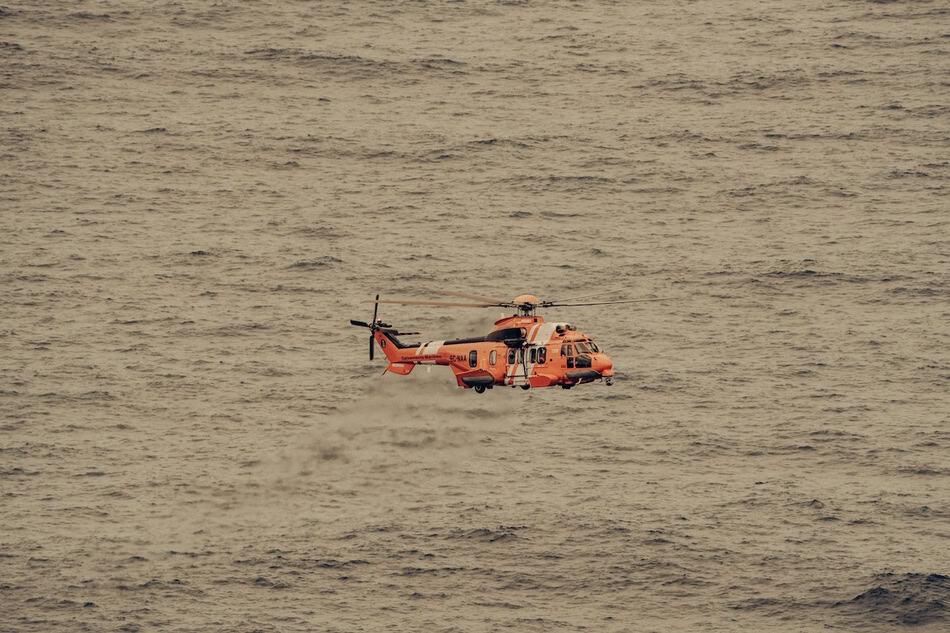
One of the storm’s most remarkable stories involved the U.S. Coast Guard cutter Tamaroa.
During the storm, Tamaroa helped rescue three people from the sailing vessel Satori approximately 75 miles off Nantucket.
Soon afterward, the cutter was sent to help members of a New York Air National Guard helicopter crew forced to ditch during another rescue mission.
Four of the helicopter’s five crew members survived.
The extraordinarily dangerous rescue operations became another major part of both Junger’s book and the Hollywood film.
The Perfect Storm Eventually Became a Hurricane
One of the most fascinating—and often misunderstood—parts of the Perfect Storm happened after its peak impact on the East Coast.
The powerful cyclone moved south over the relatively warm waters of the Gulf Stream.
As it did, its structure changed.
The storm gradually lost many of its original extratropical characteristics and developed a tropical structure.
By November 1, the system had evolved into an actual hurricane with maximum sustained winds of about 75 mph.
That would put the storm at Category 1 strength on the Saffir-Simpson Hurricane Wind Scale.
For an explanation of what Category 1 through Category 5 actually mean, see the Farmers’ Almanac guide to the Saffir-Simpson Hurricane Scale. See all five hurricane categories and their wind speeds
So the unnamed hurricane was not really a completely separate “third storm” that suddenly collided with the others.
It was the same larger storm evolving from an extratropical cyclone into a tropical cyclone.
That distinction helps explain just how meteorologically unusual the event was.
Perfect Storm Timeline
October 25–27
Hurricane Grace develops over the western Atlantic while a strong weather disturbance and cold front move across the northeastern United States.
October 28
A new low-pressure system intensifies east of Nova Scotia. The Andrea Gail makes its last known communications.
October 29
The developing extratropical cyclone draws energy and moisture from weakening Hurricane Grace.
October 30
The Perfect Storm reaches peak extratropical strength at approximately 972 millibars. Huge waves, strong winds, coastal flooding, and erosion pound portions of the East Coast.
October 31
The storm moves over warmer Atlantic waters and begins acquiring increasingly tropical characteristics.
November 1
The system becomes an unnamed hurricane.
November 2
The weakening tropical system moves toward Nova Scotia and eventually dissipates.
The National Weather Service preserves satellite imagery and additional historical material from the storm. Explore the National Weather Service Perfect Storm archive
Why Was the Hurricane Never Named?
The tropical portion of the Perfect Storm remained unnamed.
The system had already caused its most significant impacts while operating as an extratropical storm, and forecasters chose not to introduce a new hurricane name that could confuse the public after days of coverage of the Halloween Storm.
Today, tropical storms receive names when sustained winds reach 39 mph under the modern Atlantic naming system.
The history of naming hurricanes stretches back much farther than many people realize. Farmers’ Almanac has a full explanation of why hurricanes are named and how the naming system works. Why Are Hurricanes Named?
You can also see the current and upcoming Atlantic hurricane name lists. See the 2026–2030 hurricane names
How Much Damage Did the Perfect Storm Cause?
Damage from the storm exceeded $200 million in 1991 dollars.
Coastal communities experienced destructive surf, flooding, and severe beach erosion. Houses and businesses were damaged, boats were sunk, seawalls and piers were battered, and fishing equipment was lost.
The effects were not limited to New England.
Large swells associated with the storm extended far down the Atlantic coastline, with the Ocean Prediction Center reporting waves felt as far south as Florida, the Bahamas, and Puerto Rico.
The prolonged nature of the event made matters worse. Instead of enduring only one high tide or one round of large surf, some communities were battered through several tidal cycles.
Why the Perfect Storm Is Still Remembered
Plenty of stronger hurricanes have struck the United States.
Plenty of nor’easters have brought heavier snow.
But few storms have had a story quite like the Perfect Storm.
It combined an extraordinary meteorological evolution with one of New England’s enduring maritime tragedies.
Then Sebastian Junger turned that story into a bestselling book.
Hollywood followed.
And the words “perfect storm” entered everyday language as a phrase describing several unfortunate circumstances coming together at exactly the wrong time.
More than three decades later, the 1991 Perfect Storm remains one of the most famous storms ever recorded in the North Atlantic.
And at the center of the story remain six fishermen aboard the Andrea Gail who never returned home.
For more historic storms, hurricanes, blizzards, and unusual weather events, visit the Farmers’ Almanac Weather History archive. Explore Farmers’ Almanac Weather History
And during modern tropical storms, forecasts and warnings should always come from official sources. Farmers’ Almanac also offers a practical guide covering what to do before, during, and after a hurricane. Read our Hurricane Preparedness Guide
Frequently Asked Questions
When was the Perfect Storm?
The Perfect Storm developed on October 28, 1991, reached peak extratropical intensity around October 30, and continued evolving through early November.
What caused the Perfect Storm of 1991?
A powerful extratropical low interacted with strong high pressure over eastern Canada, warm Atlantic waters, and moisture and energy associated with Hurricane Grace. The unusual combination created an exceptionally intense North Atlantic storm.
What happened to the Andrea Gail?
The Andrea Gail disappeared in the North Atlantic between October 28 and October 30, 1991. All six crew members were lost. The vessel was never recovered, and exactly what caused it to sink remains unknown.
Was the Andrea Gail ever found?
No. The Andrea Gail itself has never been recovered.
How many people were aboard the Andrea Gail?
Six men were aboard the vessel: Captain Billy Tyne, Bobby Shatford, Dale Murphy, Michael Moran, David Sullivan, and Alfred Pierre.
How big were the waves during the Perfect Storm?
Huge waves occurred across the western North Atlantic. NOAA has described the storm as producing waves roughly 10 stories high in some areas, while very large seas and destructive surf battered the coastline.
Did Hurricane Grace cause the Perfect Storm?
Hurricane Grace was an important ingredient, but it was not the sole cause. The storm resulted from an unusual interaction between a developing extratropical cyclone, a powerful Canadian high-pressure system, warm Atlantic waters, and tropical moisture and energy associated with Grace.
Did the Perfect Storm become a hurricane?
Yes. After reaching peak intensity as an extratropical cyclone, the system moved over warmer water and eventually acquired tropical characteristics, briefly becoming an unnamed hurricane.
Is The Perfect Storm movie accurate?
The movie is based on real people, a real storm, and actual rescue operations. However, nobody survived from the Andrea Gail, so scenes depicting precisely what occurred aboard the vessel during its final hours are dramatizations.
Could another Perfect Storm happen?
Yes. The exact evolution of the 1991 storm was unusual, but powerful nor’easters, tropical systems, and hybrid storms continue to develop over the western North Atlantic.

- Tim Konrad

- Tim Konrad
- Tim Konrad
- Tim Konrad