

The Demon Wind:A Weather Folklore
The Japanese once believed the wind was controlled by a monster named Fūjin. Learn more!
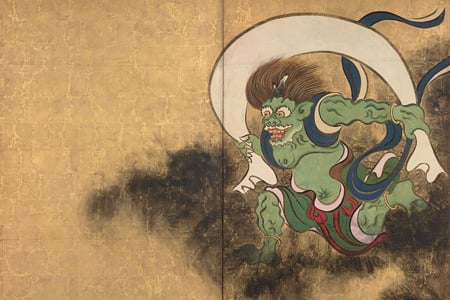
Quick Reference
- Who: Fujin, the Japanese demon of wind. Carries the wind in a bag slung over his shoulder.
- Look: Large lumbering figure, dark skin, disheveled hair, leopard-skin loincloth.
- Mood: Squeezes the bag in anger, releasing violent gusts that flatten the countryside.
- The science: Wind is air moving from high pressure to low pressure. Earth’s rotation bends the flow (the Coriolis Effect). Fastest gust on record: 253 mph on Barrow Island, Australia, April 10, 1996.
- Companion read: Our Anemoi and Daughter of the Wind folklore.
Long before modern science began to understand the processes that create our weather, people made up their own explanations. Many of these accounts were fantastic in nature, with evil or benevolent gods, monsters, and spirits controlling the elements. In this series, we explore some of these ancient myths and share the science behind them. Weather + mythology = weather-ology!
To early people, the wind must have been a terrifying mystery. One minute the air could be still and calm, and in the next, a violent gale could rise up and flatten buildings or uproot trees. Even more unsettling, this powerful force was invisible. It came without warning and, though the devastation it left behind could not be denied, the cause was never seen.

Fujin: The Demon Behind Every Gust
To explain the seeming caprices of the wind, the ancient Japanese personified it in the form of Fujin, a malicious demon. Portrayed as a large, lumbering figure with dark skin and disheveled hair, Fujin wore only a fur loincloth, often a leopard skin, and carried a large bag across his shoulders that contained the wind. When he became angry, he would squeeze the bag, and violent bursts of air would escape, battering the countryside.
Fujin’s image is one of the oldest in Shinto art. The most famous depiction is by the painter Tawaraya Sotatsu in his early 17th-century pair of folding screens “Wind God and Thunder God,” now a National Treasure of Japan. He travels with his brother, Raijin, the demon of thunder, who beats a ring of drums to make storms. The two are usually carved on either side of a temple gate, where they are said to keep evil spirits out and watch over the weather inside.
Today We Know Better
Today, we know that the wind is simply a part of nature, with no will of its own. Though it can be beneficial or devastating, it blows without regard for its effect on humans.
Wind occurs when there is a difference in air pressure between one area of the Earth’s surface and another. Air naturally moves from areas of higher pressure into areas of lower pressure. Sometimes the difference in pressure is minor, resulting in a gentle breeze. At other times, the difference is greater, resulting in violent winds that move faster than 250 miles per hour. The fastest wind ever recorded was clocked at 253 miles per hour on April 10, 1996, on Barrow Island, Australia, during Tropical Cyclone Olivia.
Because of the Earth’s rotation, however, the air does not move in a straight line from the point of highest pressure to the point of lowest pressure. The Earth’s rotation pushes the air to the right. This phenomenon, called the Coriolis Effect, causes air to flow clockwise around high pressure areas in the Northern Hemisphere and counter-clockwise around low pressure areas. The reverse happens in the Southern Hemisphere.
Before we knew about air pressure, though, the people of Japan had no explanation for wind other than the whims of a rampaging demon. And so, Fujin was born.
Wind Personified Across Cultures
Fujin is far from alone in the global pantheon of weather spirits. Almost every culture that lived at the mercy of the air gave it a face.
| Culture | Wind figure | Defining trait |
|---|---|---|
| Japanese | Fujin | Demon with a bag of wind |
| Greek | The Anemoi (Boreas, Notus, Eurus, Zephyrus) | One per cardinal direction |
| Iroquois (Seneca) | Dagwanoenyent | Daughter of the wind, witch in whirlwind form |
| Aztec | Ehecatl | Breath of life, creator |
| Polynesian (Maori) | Tawhirimatea | God of storms and weather |
The pattern is consistent. Strong wind shows up. Someone gets the blame. The science came much later. The National Oceanic and Atmospheric Administration (NOAA) publishes the modern catalog of high-wind events that, in another era, would have been written as a Fujin tantrum.

Frequently Asked Questions
Who is Fujin in Japanese mythology?
Fujin is the Japanese demon of wind. He is portrayed as a large lumbering figure with dark skin and disheveled hair, wearing a leopard-skin loincloth and carrying a large bag of wind across his shoulders. When he is angry, he squeezes the bag and the wind escapes in violent bursts.
Why does Fujin carry a bag?
The bag is the iconic image of his power. It contains all the wind in the world. The folklore explains capricious wind by saying Fujin is squeezing the bag harder, and gentle days by saying he has loosened his grip. The bag turns an invisible force into something a storyteller can show.
What is the Coriolis Effect?
The Coriolis Effect is the apparent deflection of moving air caused by Earth’s rotation. In the Northern Hemisphere, it bends winds to the right, so they flow clockwise around high-pressure systems and counter-clockwise around low-pressure systems. In the Southern Hemisphere, the direction is reversed.
What is the fastest wind ever recorded?
253 miles per hour, recorded on Barrow Island, Australia, on April 10, 1996, during Tropical Cyclone Olivia. That stands as the fastest non-tornadic wind ever measured at the surface.
What causes wind?
Wind is air moving from areas of higher atmospheric pressure to areas of lower pressure. Small pressure differences make a gentle breeze. Large differences make a gale. The Earth’s rotation bends the path through the Coriolis Effect, so wind almost never travels in a straight line from one pressure point to another.
Who is Fujin’s brother?
Raijin, the demon of thunder, is Fujin’s brother. He carries a ring of drums and beats them to make storms. The two are often carved together on the gates of Buddhist and Shinto temples in Japan, where they guard the entrance and watch over the weather inside.
Why do so many cultures personify the wind?
Because the wind is the most visible invisible force in daily life. It moved trees, knocked down homes, and pushed boats across oceans, all without showing itself. Almost every weather-aware culture gave it a face: Fujin in Japan, the Anemoi in Greece, Dagwanoenyent in the Iroquois nations, Ehecatl in the Aztec world, and Tawhirimatea among the Maori.
Tell Us
What is the strongest wind you have ever stood in? Tell us in the comments. For more wind folklore, see our Anemoi entry and Daughter of the Wind.


Jaime McLeod
Jaime McLeod is a longtime journalist who has written for a wide variety of newspapers, magazines, and websites, including MTV.com. She enjoys the outdoors, growing and eating organic food, and is interested in all aspects of natural wellness.
- Jaime McLeod

- Jaime McLeod
- Jaime McLeod
- Jaime McLeod





Thanks Dawn, I found all of that, but it doesn’t address Vicki’s question, which was why we call it a “sundog.” The origins of the name are Norse, but I know of no mythological significance to it.
Any wind over 15 mph is evil. We’re expecting high winds today/tonight and I’m already panicking. I hate wind. (Could you tell?)
Jaime, I enjoy reading about this kind of thing. Yesterday in our region we saw a huge Sundog, and I was explaining what it was to our foreign fellows who had never seen one before. They asked where the name came from, and other than knowing it’s Norwegian roots of Solhund, I couldn’t find any thing more about it. Why “dog”?
Vicki – I can’t seem to find the origin of the term “sundog,” beyond what you stated here. It doesn’t have any mythological significance that I know of. Sorry I can’t be of any more help.