When Cows Lie Down: 8 Old-Time Weather Signs That Hold Up
Quick Reference
- Cows lying down: when most of the herd is on the ground at once, expect rain in the next 12 to 24 hours. Cows seek dry ground ahead of damp weather.
- Ring around the moon: a halo means high-altitude ice crystals in cirrostratus clouds, often a 12 to 48 hour storm warning.
- Birds flying low: falling air pressure pushes insects toward the ground, and birds follow. Low-flying swallows often mean rain within hours.
- Red sky: red at night, sailor’s delight (storm passing east). Red in morning, sailor’s warning (storm coming west).
- Earth-smell, frog calls, and barometer body aches: all real human and animal responses to falling pressure ahead of rain.
There are mornings when you step outside and feel something has shifted before any forecast has said so. The air carries weight. The wind pauses. Birds act strangely. The trees seem to be listening. And then someone, usually the oldest person in town, says the same thing they have said for fifty years: storm is coming. Long before satellites and radar, farmers, sailors, hunters, and homesteaders read those signs every day. Some were superstition. Many turned out to be science. Here are eight old-time weather signs, what they mean, and how the modern science holds up under the folklore.
1. When Cows Lie Down, Pay Attention
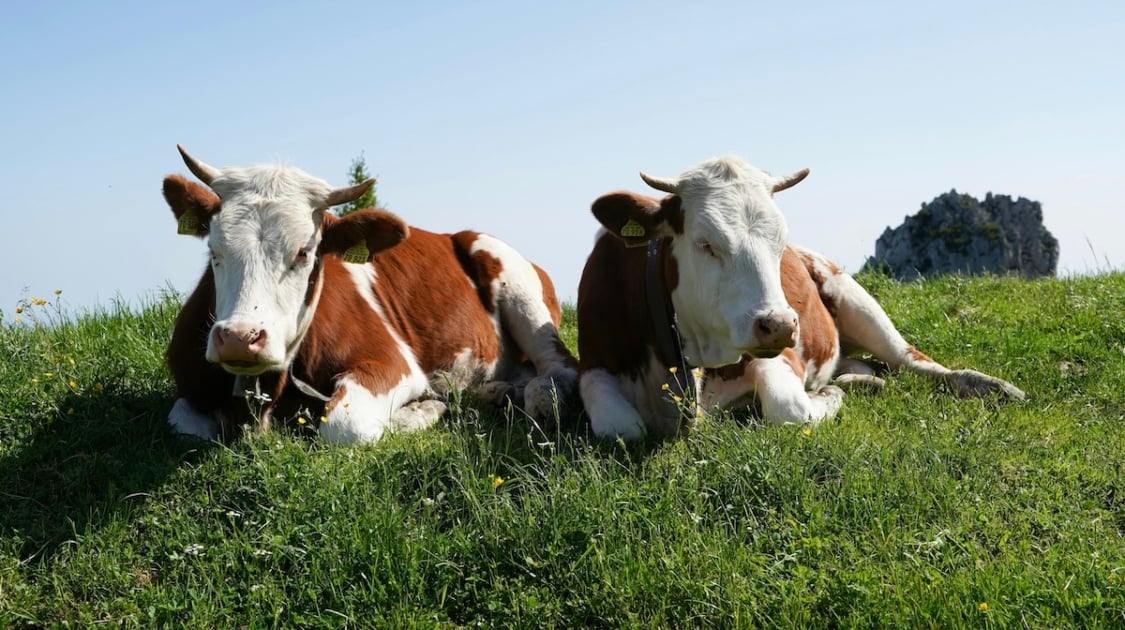
The most famous version of the rule is “if cows are lying down, rain is on the way.” The version is partially supported. Cows do not mind getting damp, but they prefer dry ground for the long stretches they spend ruminating. When barometric pressure drops ahead of a storm, soil moisture rises and the grass becomes wetter at root level. Cows, which can sense the pressure shift through inner-ear and pressure-sensitive tissues, often choose to lie down on the still-dry highest ground in the pasture before the rain arrives.
The rule is not foolproof. Cows lie down for many reasons, especially in mid-afternoon when they ruminate. The folklore signal is the timing and proportion: when most of the herd lies down at once, in the morning or late afternoon and not in their usual midday spot, that is the signal worth reading. UK and US dairy research has confirmed measurable shifts in cow lying behavior 6 to 24 hours before significant temperature or pressure shifts.
2. A Ring Around the Moon Means Rain or Snow
If you see a pale halo circling the moon at night, you are looking at one of the most reliable weather signals nature gives. The halo is caused by sunlight (reflected off the moon) refracting through ice crystals high in the atmosphere, generally in cirrostratus clouds. Cirrostratus typically arrives 12 to 48 hours before a frontal storm system, riding the warm front out ahead of the surface low. The folklore phrase is “ring around the moon, rain or snow soon.” It is one of the most dependable folk-weather signs in active use, with strong scientific backing.
The size and brightness of the halo correlate with how dense the ice-crystal layer is. A bright, sharp 22-degree halo (the most common kind) often means the front is moving in fast. A faint, soft halo can mean the front is far enough out that the storm may take 36 to 48 hours to arrive. Either way, the halo is a real meteorological pre-storm signal, not just a pretty sky.
3. When Birds Fly Low, Weather Will Blow
Swallows, sparrows, swifts, and barn swallows all show this behavior most clearly. Before a storm, you may notice them hunting unusually close to the ground, sometimes within a few feet of grass tops. The reason is the food. Insects rely on rising warm-air thermals to stay aloft. When barometric pressure drops ahead of a storm, the thermals weaken, and insects drift downward toward the ground. Birds follow the food.
The rule is well-documented in modern ornithology: low-flying birds in the late afternoon are often a 1 to 6 hour warning of rain. The opposite signal also reads: birds soaring at high altitude on a stable air mass usually means fair weather is holding. For more on bird-based weather reading, see our bird weather lore piece.
4. Red Sky at Night and in the Morning
The rhyme has traveled across centuries: “red sky at night, sailor’s delight; red sky in the morning, sailor’s warning.” The science is straightforward and accurate. Most weather in the temperate Northern Hemisphere moves from west to east. The sun rises in the east and sets in the west. So:
- Red at sunset (looking west): the setting sun is shining through clear air to the west, where the next weather is coming from. Clear west = clearing weather coming. “Sailor’s delight.”
- Red at sunrise (looking east): the rising sun is shining off clouds to the east, and dust or moisture in the air to the west (where the next weather is coming from) is doing the scattering. Storm clouds are likely arriving. “Sailor’s warning.”
The rule does not always work in the deep tropics, where weather moves east to west, or during periods of unusual atmospheric circulation. In most of the temperate U.S. and Europe, however, it is one of the most accurate folk-weather signs ever written.
5. When the Air Smells Like Earth, Rain Is Near
People who say they can smell rain coming are not imagining it. The earthy, mineral scent that arrives in the minutes before a summer rain has a name (petrichor) and a clear chemical mechanism. Petrichor comes from oils released by certain plants and from a compound called geosmin produced by soil bacteria. When humidity rises ahead of a storm, those compounds become airborne. They are detected by the human nose at extraordinarily low concentrations (humans can smell geosmin at five parts per trillion, which is more sensitive than sharks detecting blood in water).
The pre-storm earth smell typically appears 15 to 60 minutes before the first raindrop. Combine it with one of the other signs (cattle behavior, halo on moon, low-flying birds) and you have a multi-sensory forecast that beats the cell phone for the next hour.
6. Frogs Croaking Loudly Ahead of Rain
“When frogs croak loud, rain’s in the clouds.” The signal is real. Frogs and toads are amphibians whose skin is permeable to water, and they breathe through both lungs and skin. Their respiratory and reproductive activity peaks when humidity is high and air pressure is dropping. The rising humidity ahead of a storm activates breeding calls in many frog species; you hear an unusually loud chorus from the pond, the marsh, or the wet ditch about 6 to 24 hours before the rain arrives.
The signal is most reliable in spring and early summer breeding season. In late summer and fall, the chorus volume is more about water levels in the pond than about an approaching storm. Like cattle behavior, the frog signal works best as a layered signal alongside the sky and the barometer.
7. A Sudden Silence in Nature
The eeriest sign is one that does not announce itself with sound. Instead the world goes quiet. Birdsong stops mid-phrase. Cicadas and crickets cut out. Even the wind seems to pull back. Animals are sensitive to the rapid pressure drops that precede severe thunderstorms and tornadoes, and they retreat to shelter ahead of the system. The silence is the absence of the routine animal noise that fills every summer afternoon.
This signal has preceded many tornadoes, severe thunderstorms, and squalls. It is not a guarantee (sudden quiet can also follow a hawk passing overhead, or a dog wandering through), but combined with a darkening sky to the west and falling pressure on a barometer, the unnatural stillness is one of the most reliable severe-weather warnings available to a person without instruments. If a summer afternoon goes oddly quiet, head indoors and check the radar.
8. The “Itchy” Feeling Before a Storm
Restless, irritable, headachy, joints aching: these are all real human responses to falling barometric pressure. The body reads pressure changes through inner-ear pressure receptors and through swelling of inflamed joint tissue (which is why people with arthritis, old injuries, or migraines often say they can feel a storm coming before the forecast catches up). Studies in headache and joint-pain populations have confirmed measurable correlations between rapid pressure drops and symptom flares 12 to 48 hours before storm arrival.
Children are sometimes the most sensitive readers of all. Restlessness, sleep changes, and unexplained crankiness in young children are commonly reported in the hours before storm systems. Parents who have noticed the pattern often describe it as “the kids were impossible all afternoon, and then the storm hit at dinner.” The biology is real even when the parents have not heard of barometric-pressure sensitivity.

How to Use the Old-Time Signs Today
None of these signs replaces the modern forecast. The seven-day forecast and the long-range outlook are more reliable for any specific question about your week or your season. What the old-time signs do well is the part the forecast does not: the immediate next-hour to next-12-hour read of your specific patch of sky, in your specific yard, with your specific cattle and birds and frogs as live sensors.
- Layered reading is the trick. No single sign is a forecast. Three signs all pointing the same direction (cattle down, ring on the moon, low-flying birds) is a much stronger signal than any one of them alone.
- Know your baseline. Each sign needs a baseline (“normal” cattle behavior in your pasture, “normal” frog volume in your pond) before the deviation becomes legible.
- Pair with the forecast. If the radar shows a clear afternoon and the cattle are all down at once, check the longer-range forecast. The signs may be reading something the model did not catch yet.
- Take severe-storm signs seriously. Sudden silence + dark sky to the west = head indoors immediately, even if the official severe-weather alert has not arrived.
For more on the broader animal-weather tradition, see our animal weather folklore overview. For seed-shape winter forecasts, see persimmon seed weather prediction. For lightning and severe-weather safety guidance, the National Weather Service maintains a comprehensive lightning safety reference with the 30/30 rule and recovery guidance.

Frequently Asked Questions
Do cows really know when rain is coming?
Cows can detect falling barometric pressure through inner-ear and other pressure-sensitive tissue. Studies have documented behavioral shifts (especially lying-down patterns) 6 to 24 hours ahead of significant weather changes. The signal is strongest when most of the herd lies down at once on otherwise dry ground.
Why does a halo around the moon mean rain?
The halo is caused by ice crystals in cirrostratus clouds high in the atmosphere. Cirrostratus typically arrives 12 to 48 hours ahead of a frontal storm system, so the halo is a real pre-storm signal in most temperate weather patterns.
How accurate is “red sky at night, sailor’s delight”?
In the temperate Northern Hemisphere, where weather moves west to east, the rule is reliably correct. Red at sunset means clear air to the west (clearing weather coming). Red at sunrise means clouds and moisture to the west (storm approaching). The rule fails in tropical regions where weather moves east to west.
Why do birds fly low before a storm?
Falling air pressure ahead of a storm weakens the rising warm-air thermals that insects use to stay aloft. The insects drift toward the ground, and the birds that eat them follow. Low-flying swallows, sparrows, and swifts are often a 1 to 6 hour warning of rain.
Can people really smell rain?
Yes. The earthy scent that arrives 15 to 60 minutes before rain is called petrichor, made up of plant oils and a soil-bacteria compound called geosmin. Humans are extraordinarily sensitive to geosmin (down to five parts per trillion), more sensitive than sharks detecting blood in water.
Why do my joints hurt before a storm?
Falling barometric pressure causes inflamed joint tissue and old injuries to swell slightly more than usual. Studies in headache and joint-pain patients have confirmed measurable symptom flares 12 to 48 hours before storm arrival. The biology is real, not psychosomatic.
Should I rely on old-time signs instead of the forecast?
Use the signs as a layered local signal alongside the seven-day and long-range forecast. The forecast is more reliable for the week ahead. The old-time signs are most useful for the next-hour to next-12-hour read of your specific yard, where the forecast is necessarily less precise.

- Tim Konrad

- Tim Konrad
- Tim Konrad
- Tim Konrad