

10 Facts About the Hottest Place in North America: Death Valley
Here's a list of things you may not know about this land of extremes.
Quick Reference
- Where: Death Valley, California. Designated a National Park in 1994.
- Hottest reading ever: 134°F (57.1°C) at Furnace Creek, July 10, 1913.
- Rainfall: Under 2 inches per year, less than 2/3 of an inch in Furnace Creek.
- Lowest land in North America: Badwater Basin at 282 feet below sea level.
- Highest point in the park: Telescope Peak at 11,049 feet.
- Wildlife: 1,000+ plant species, bighorn sheep, coyotes, bobcats, kit fox, mountain lions.
Before you opened this article, you may already have guessed where the hottest place in North America is. Death Valley, California. For over 100 years of formal weather records, Death Valley keeps landing on top. Steady drought, snowy peaks, and rare flash floods make it one of the most extreme landscapes in the world. Despite the morbid name, a surprising diversity of life makes it home. Here are 10 fascinating facts about the hottest place in North America. Grab a tall glass of ice water before you dive in.
10 Fascinating Facts About Death Valley
- Death Valley averages less than 2 inches of rainfall per year. Furnace Creek averages about 2.36 inches; the central valley sees less. Some years bring under half an inch.
- Death Valley is a National Park. President Herbert Hoover declared it a National Monument on February 11, 1933. Congress re-designated it as Death Valley National Park in 1994. The park covers 3.4 million acres, the largest national park outside Alaska.
- The name comes from gold-rush pioneers lost in winter 1849 to 1850. According to the National Park Service, a group of 49ers got stuck in the valley believing it would be their grave. Two of their younger members, William Lewis Manly and John Rogers, scouted a route out over the Panamint Mountains. As the survivors climbed the western slope, one of them turned and said, “Goodbye, Death Valley.” The name stuck.
- Death Valley is the lowest land in North America. Badwater Basin sits 282 feet below sea level. The salt flats there extend for nearly 200 square miles. From the parking area you can look up at a sign on the cliff above that marks where sea level would actually be.
- The valley is also home to the highest peak in the park. Telescope Peak rises to 11,049 feet, often snow-covered through spring. You can stand in 110-degree heat at Badwater and see snow on the summit.
- The hottest temperature ever recorded was 134°F (57.1°C) at Furnace Creek on July 10, 1913. That record stands as the highest reliably measured temperature on Earth. Average summer highs at Furnace Creek run 113.9°F. Winter lows average 39.3°F. Death Valley’s heat comes from a combination of low elevation, deep dry valley walls, and surrounding mountain ranges that trap and reheat descending air. The result is what meteorologists call a thermal trap.
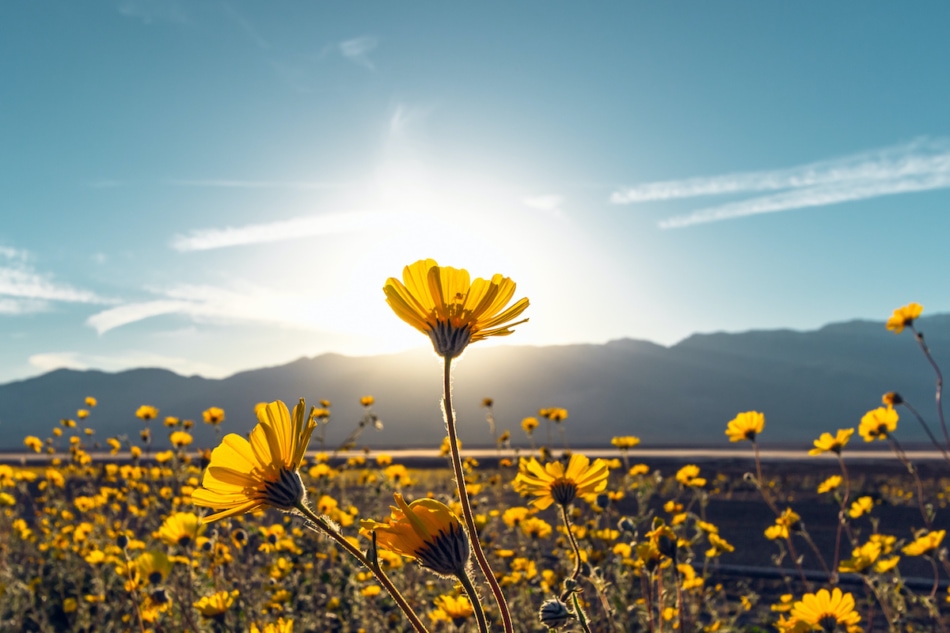
- Over 1,000 plant species grow there. Most years, the valley looks barren, but after winter rains the floor erupts into wildflowers. The peak Death Valley super bloom usually runs from mid-February through mid-April. Major super blooms in 2005, 2016, and 2024 drew tens of thousands of visitors.

- Big mammals live here. Bighorn sheep, coyotes, bobcats, kit foxes, and mountain lions all roam the park. Smaller residents include kangaroo rats, sidewinder rattlesnakes, desert tortoises, and roadrunners.
- The land was a seabed for hundreds of millions of years. The abundant layers of limestone, dolomite, and marble in the park’s mountain walls are marine sediments. Death Valley as a desert basin only formed in the last 2 to 3 million years through faulting and stretching of the Earth’s crust.
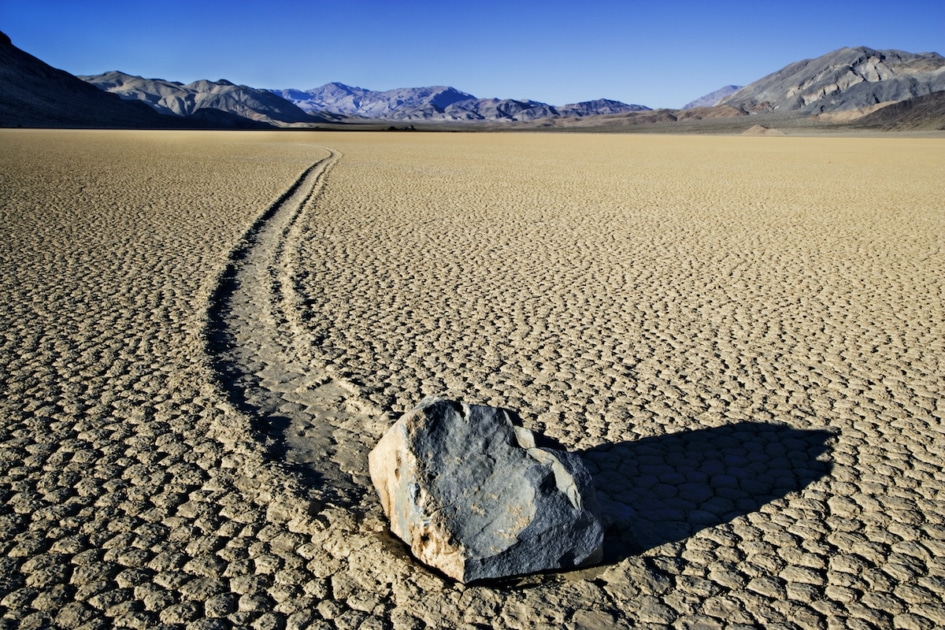
- The Racetrack Playa rocks “move on their own.” In a remote dry lakebed between the Cottonwood and Last Chance Ranges, dozens of rocks leave long trails across the playa floor as if pushed by invisible hands. The mystery was finally solved in 2014: thin sheets of ice that form on rare winter rains, combined with light wind, slide the rocks across the wet mud at about 5 meters per minute. The trails persist long after the ice melts.
When to Visit the Hottest Place in North America
| Period | Typical temperatures (Furnace Creek / valley floor) | Conditions | Recommended for |
|---|---|---|---|
| November to February | Highs 65-73 F; lows 38-46 F | Mild, clear days; cold desert nights; occasional rain | Peak visitor season; hiking, camping, stargazing, photography |
| March to mid-April | Highs 75-95 F; lows 50-65 F | Warming fast; wildflowers peak late March to early April after wet winters | Wildflower seekers and moderate hikers; book lodging months ahead |
| Late April to May | Highs 95-110 F; lows 65-75 F | Getting dangerously warm; high-elevation trails still comfortable | High-elevation trails only (Telescope Peak, Wildrose Canyon); experienced visitors |
| June to September | Highs 110-125 F; lows 85-95 F; record 130 F set July 2021 | Extreme heat; NPS discourages hiking below 5,000 ft elevation | Drive-through visits only; stay within 10 minutes of air-conditioned vehicle; carry abundant water and salty snacks |
| October to early November | Highs drop from about 100 F early to 65-75 F by November | Rapidly cooling; fewer crowds than spring | Good hiking returns; shoulder-season camping; second-best window for most visitors |

Frequently Asked Questions
Where is the hottest place in North America?
Death Valley National Park in California. Furnace Creek inside the park holds the world record of 134°F (57.1°C), measured on July 10, 1913.
Why is Death Valley so hot?
The valley sits below sea level, surrounded by mountain ranges. Air descending into the valley compresses and heats up. The high mountain walls also trap heat and block cooling marine air from the Pacific. The combination produces what meteorologists call a thermal trap.
Can you visit Death Valley in the summer?
Yes, but plan carefully. Daytime temperatures regularly exceed 115°F. Limit outdoor activity to dawn and dusk. Carry at least one gallon of water per person per day. Never hike at midday. The Park Service does not recommend long trail hikes in July or August.
When do the Death Valley wildflowers bloom?
Mid-February through mid-April most years. Super blooms occur in winters with above-average rainfall and well-timed October to December storms. 2005, 2016, and 2024 produced the most spectacular displays of the past two decades.
How did Death Valley get its name?
From a group of gold-rush pioneers stranded in the valley in the winter of 1849 to 1850. They believed they would die there. When two of their younger members scouted a way out and the group escaped, one survivor reportedly looked back and said, “Goodbye, Death Valley.” The name stuck.
What are the moving rocks of the Racetrack Playa?
Rocks ranging from pebbles to boulders that leave long trails across a dry lakebed in the remote north of the park. The mystery was solved in 2014: thin sheets of winter ice plus light wind push the rocks across wet mud at about 5 meters per minute. The trails remain long after the ice melts.
Have you ever visited Death Valley? Tell us about your experience in the comments below.


This article was published by the Staff at FarmersAlmanac.com. Any questions? Contact us at [email protected].
- Farmers' Almanac Staff

- Farmers' Almanac Staff

- Farmers' Almanac Staff

- Farmers' Almanac Staff


I remember that it was during the drought. I definitely went at a difficult time for the plants and animals. It was VERY hot during the day that I spent there. I had a good supply of water in my camel which I was glad of. I heard about the blooming that occurred a few weeks later. I’ve wanted to go back during another bloom, but I’ve been so busy first responding and dealing with hospice care for my husband and others and expenses as a volunteer and helping others that I haven’t been able to get back to the area, especially since Covid. I must get back East and South for Chicken Soup and Angels as part of the 3rd wave response team. Perhaps this coming early Spring the rains will favour my return to the area that isn’t work or volunteer related. A real vacation would be most welcome. I’d love to see a bloom and see the hummingbirds and more wildlife with less heat at that time of year.. Hopeful in Colorado,
Enjoy each marvelous day.
BearOOO and Missy BooBeary Muffin too
My husband and son lived there for a week! It was so hot! I could not tell you that it looked beautiful. We could not wait to get out of there.
I for one do like the heat and it was to hot for me. Now I would go back and take a good look at it. I’m sure it has changed it was in the 80’s when we were there.
Did you camp there? If so, tent or RV? I’m hoping to go during or after a good rain to see more critters and a wildflower bloom!
had the opportunity to visit on my honeymoon in the late 80’s. It’s truly an extraordinary place! we saw so many things! it was the the first week of may, so to say the least, it was HOT! 113 degrees when we got to Scotty’s castle. we hunted down all the ghost towns in the area, visited the sand dunes, the salt flats, then went to mount Charleston for a nice dinner and bottle of wine before returning to the vegas craziness! Death valley was a great time! I highly recommend it as it’s own destination! go check out all the ghost towns! And area 51!LOL!
Thanks bunches for your sharing about the ghost towns. I’ll add that to my wishlist of things that I will hopefully get to do next early Spring. I’m trusting that there will be a good rain so the desert will be in bloom! Did y’all camp there? If so, Tent or RV?
Enjoy each marvelous day.
Bear
Thanks for sharing informative information. Do hummingbirds actually live there or are they just passing through?