

Supermoon: What It Is, When It Happens, and How to See It
Quick Reference: Supermoon at a Glance
- What it is: a full or new Moon that lines up with perigee, the Moon’s closest point in its orbit, so it appears larger and brighter than usual.
- The 90% rule: in common use, a Moon at least 90% of the way to perigee at the time of a full or new phase qualifies as a supermoon.
- Why it looks bigger: at perigee the Moon is about 14% larger and up to 30% brighter than at apogee (its farthest point).
- What it does on Earth: a perigean spring tide, modestly higher high tides and lower low tides for a few days around the event.
- 2025 (most recent): three full Moon Supermoons: October 6 (Harvest Moon), November 5 (Beaver Moon), and December 4 (Cold Moon). New Moon Supermoons: October 21, November 20, December 19.
- 2026 and beyond: a typical year holds 3 to 5 supermoons by the 90% rule, usually in a late-year cluster. Check our full Moon dates and times page for the current year’s confirmed dates.
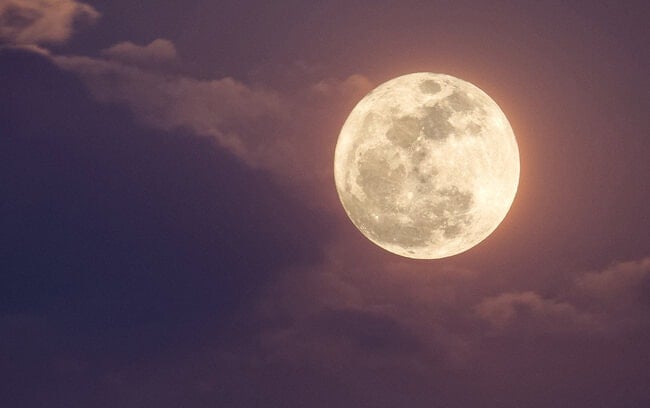
A supermoon is a full or new Moon that happens at, or very near, the Moon’s closest point to Earth. The most recent cluster of full Moon Supermoons fell in 2025: October 6 (Harvest Moon), November 5 (Beaver Moon), and December 4 (Cold Moon). See all full Moon dates, times, and names for the current year.
For an independent astronomy reference, see Encyclopaedia Britannica’s overview of supermoons and the perigee-syzygy alignment.
What Is A Supermoon?
Supermoons are caused by the shape of the Moon’s orbit, which is an ellipse, not a perfect circle. Each month, the Moon reaches its farthest point from the Earth (apogee) and its closest point (perigee). Apogee runs around 252,088 miles; perigee can come as close as about 221,438 miles. That swing of roughly 30,000 miles is what produces the size difference between an ordinary full Moon and a supermoon.
A “supermoon” occurs when the Moon is at least 90% of the way to its perigee position at the same time that it is in its “full” or “new” phase. If either of these phases occurs when the Moon happens to be exactly at perigee, the Moon is considered to be an “extreme perigean supermoon,” the kind of event that astronomers Richard Nolle and Fred Espenak track in detail.

Why New And Full Phases?
The reason these two phases are singled out is that each of them means the Sun, Earth, and Moon are in alignment, an arrangement astronomers call syzygy. When the Moon is full, it sits exactly on the opposite side of the Earth from the Sun. When the Moon is new, it sits between the Earth and the Sun. In both cases, the gravitational pull from the Moon and the Sun combine to create higher-than-normal tides, called “spring tides,” on Earth. When the Moon is also at perigee at this time, the effect is magnified into what is called a “proxigean spring tide.” For the deeper tidal mechanics, see our explainer on how the Moon affects the tide.
Full Moons get all of the attention around Supermoons because they reflect the Sun’s light, so the apparent size difference is dramatic. Supermoons during a new phase, by contrast, are invisible to the naked eye, the Moon is between us and the Sun, with its lit face turned away. In 2025, the New Moon Supermoons fell on the following dates: October 21, November 20, and December 19.
Fun fact: On Saturday, January 21, 2023, the New Moon was at its closest distance to Earth in nearly 1,000 years (992 to be exact).
What’s In A Name?
The term “supermoon” was coined in 1979 by astrologer Richard Nolle. It went viral in March 2011 when the Moon’s perigee brought it to 221,565 miles of Earth, within 127 miles of the absolute closest that it can come (the absolute closest the Moon can come is 221,438 miles from Earth, an exceedingly rare occurrence). NASA picked up the term, the press picked up NASA, and “supermoon” stopped being an astrology word and started being a household one.
In strict astronomical terms, the designation should only be applied to “extreme” perigees, in which the full Moon approaches a distance of 221,472 miles or less. Between the years A.D. 1500 to 2500, this condition is met only 14 times, or on average about once every 71 years. The last time the full Moon came this close to Earth was January 15, 1930 (221,454 miles), and the next time will be on December 6, 2052 (221,469 miles).
But if you follow the 90% rule noted above, you can have as many as three, and on some occasions even four or five, supermoons in a single year.
Supermoon vs. Regular Full Moon, by the Numbers
| Metric | Regular full moon | Supermoon |
|---|---|---|
| Average distance from Earth | 238,900 miles (384,472 km) | 221,667-226,000 miles (356,740-363,300 km) at perigee |
| Farthest possible (apogee) | About 251,000 miles (405,500 km) | A supermoon cannot occur at apogee |
| Closest possible (perigee) | About 226,000 miles (363,300 km) | Qualifies when within 90% of the perigee distance |
| Apparent diameter vs. average full moon | Baseline | Up to 7% larger than an average full moon; up to 14% larger than a micromoon (apogee full moon) |
| Apparent brightness vs. average full moon | Baseline | About 16% brighter than average; up to 30% brighter than a micromoon |
| Typical frequency per year | 12-13 full moons per year | 3-4 full supermoons per year, always in consecutive months |
| 2026 full supermoons | — | January 3 (362,312 km; already passed), November 24 (360,768 km), December 24 (356,740 km; closest of the year) |

Not All Supermoons Are Created Equal!
Just as the Moon’s orbit isn’t a perfect circle, perigee distance also varies slightly from month to month and year to year. Its perigee during one month may be slightly farther from the Earth than its perigee the next month. That is why supermoon brightness and apparent size from one event to the next can vary, and why even within a single year of three supermoons, one will usually be the “biggest” of the cluster.
Many people speculate that extreme supermoons can cause natural disasters such as earthquakes, volcanoes, and tsunamis. Most astronomers dismiss this line of thinking, though, arguing that the 2,000-mile difference (less than 1% of the Moon’s total distance from Earth) is minimal in the grand scheme of things and unlikely to cause much disruption on Earth, beyond the usual perigean spring tide. NASA, the U.S. Geological Survey, and university seismology programs have looked for a statistical link between lunar perigee and major earthquakes; the published evidence does not support a meaningful cause-and-effect.
Regardless of what you believe about a Supermoon’s impact on Earth, or what you call it, one thing is certain: if the sky is clear, the view of the rising Moon will always be amazing, so get outside and enjoy it. The best view is at moonrise, when the so-called “Moon illusion” makes the disk look even larger against trees, rooftops, and the horizon.

Supermoon FAQ
What is a supermoon, in plain English?
A supermoon is a full or new Moon that happens at, or very near, the Moon’s closest point to Earth (perigee). The most common working rule, the “90% rule,” counts a Moon at least 90% of the way to perigee when full or new as a supermoon. At perigee a full Moon looks roughly 14% larger and up to 30% brighter than at apogee.
How many supermoons are there in a year?
Most years contain three to five supermoons under the 90% rule. They usually cluster late in the calendar year because perigee shifts gradually around the orbit; the cluster moves earlier or later by a few weeks each year. Our full Moon dates page lists the current year’s confirmed dates and times.
Do supermoons cause earthquakes, tsunamis, or volcanic eruptions?
The published seismic evidence does not support a meaningful cause-and-effect. The perigean alignment is a real gravitational effect that produces somewhat higher and lower tides (“perigean spring tides”) for a few days, but the 2,000-mile distance change from a normal full Moon is less than 1% of the Moon’s average distance from Earth. NASA and university seismology programs have looked, and have not found a clear link to major quakes or eruptions.
What is the difference between a supermoon and a blood moon?
A supermoon is about geometry, the Moon happening to be near perigee at full or new phase. A blood moon is about color, the Moon turning a coppery red during a total lunar eclipse because sunlight is bending around the Earth. The two can coincide, the result is called a super blood moon, but they are independent phenomena.
When is the next supermoon in 2026?
A typical year holds three to five supermoons by the 90% rule, usually late in the year. For the current confirmed dates and exact times in your time zone, see our full Moon dates and times page. We update the cluster each summer once the perigee math is locked in for the year.
Why does the supermoon look so much bigger at moonrise?
Two reasons. First, at perigee the Moon really is closer (roughly 14% larger across than at apogee). Second, the “Moon illusion” makes a low Moon near the horizon look enormous compared to trees, buildings, and hills. The illusion is psychological, photographs side-by-side show the size is nearly the same as later in the night, but the effect is real for the viewer’s eye.
How do I photograph a supermoon?
Shoot at moonrise or moonset with a foreground object (church steeple, bridge, mountain ridge, sailboat mast) to give the disk scale. A 200 mm or longer telephoto lens compresses the foreground and Moon together. ISO 200, f/8, 1/125 second is a good starting exposure for a clear sky; bracket from there. A tripod helps. Avoid shooting straight up at the zenith, where there is nothing in the frame to give the supermoon its size.
Join The Discussion
What is your favorite phase of the Moon?
How do you plan to celebrate the next supermoon, by camera, by candle, or by tide chart? Share with your community here in the comments below.
Related Articles
How To Set Goals With The Moon



Joe Rao
Joe Rao is an esteemed astronomer who writes for Space.com, Sky & Telescope, and Natural History Magazine. Mr. Rao is a regular contributor to the Farmers' Almanac and serves as an associate lecturer for the Hayden Planetarium in New York City.

This article was published by the Staff at FarmersAlmanac.com. Any questions? Contact us at [email protected].
-
Farmers' Almanac Staff

-
Farmers' Almanac Staff

-
Farmers' Almanac Staff

-
Farmers' Almanac Staff


The supermoon may look especially large to you, however, if it’s very close to the horizon. But that has nothing to do with astronomy and everything to do with how the human brain works. This effect is called the “moon illusion” and may arise from at least a couple of different things. Scientists suggest that perhaps the brain is comparing the moon to nearby buildings or objects, or perhaps our brain is just wired to process things on the horizon as bigger than things in the sky.
I haven’t seen any thing kind of like that here in alabama lmao 🙂
I saw it okay last night in Australia. Very bright, couldn’t see any significant difference in size.
Awesome Moon,which I enjoy.It appeared brighter,not bigger,here in Maine.I saw it & took pics,which I posted.Thanks,I follow the Moons dates,names,& meanings!
Will we get the same effect here on the other side of the Earth? I’ll certainly be looking out for it anyway. Thanks for that info.
guess i miss supermoons in the pass i’ll see this one i hope!
does it have effect on the weather?
Ray, That’s controversial, but most meterologists say “no.” It will have an effect on the tides, though, making them higher than normal.
We have an “AWESOME” God and he sends us beautiful presents to enjoy. Hope we can see the moon in Indiana…waiting.
In 2011 God was tolerating us. 2019-2020…let’s just say it’s time we get some punishment for our bad behavior. God is some kind of pissed off at the moment
very kool just what i needed to brighten up this long cold winter thanks.
If you only knew then what you know now lol. Who would of EVER thought the entire world would be hiding from or quarantined from the COVID-19 global pandemic. I’ll see it on Tuesday, from the safety of a wide open field
Everyday there are awesome wonders of God. Some days are more AWESOMER 🙂
Thanks for posting this article for me Jaime!