

Earliest Sunset 2026: Why Days Feel Longer Sooner
The Sun starts staying up later this week. Learn more!
Quick Reference: The Earliest Sunset
- Earliest sunset: about two weeks before the winter solstice, on or near December 7 for much of the United States.
- Winter solstice (shortest day): December 21.
- Latest sunrise: about two weeks after the solstice, around January 2.
- Why: Earth’s elliptical orbit and the Equation of Time, not the solstice itself.
- Summer mirror: earliest sunrise about a week before the June 21 solstice, latest sunset about a week after.
The earliest sunset of the year does not wait for the shortest day. It arrives about two weeks ahead of the December 21 winter solstice, which is why your evenings start to feel a little longer well before winter officially begins. In 2025, that earliest sunset landed on Sunday, December 7. Here is what is happening overhead, and why sunset and sunrise refuse to line up neatly with the solstice.
When Is the Earliest Sunset?
As winter approaches, you may find yourself asking, “When is the earliest sunset of the year?” The shortest day, in terms of daylight, is December 21, the winter solstice. But the days actually begin to feel a bit longer two weeks before the solstice. That is because the earliest sunset happens before the solstice, and in 2025 it fell on Sunday, December 7. The exact date depends on your latitude, so a Gulf Coast reader and a Great Lakes reader will not mark it on the same day. You can read more about how sunrise and sunset shift by location if you want the finer points.
So shouldn’t the earliest sunset happen on the solstice itself? No. The solstice marks the least daylight overall, but the two ends of the day, sunrise and sunset, do not swing in step with it. The earliest sunset comes early, and the latest sunrise comes late.
Why the Earliest Sunset Comes Before the Solstice
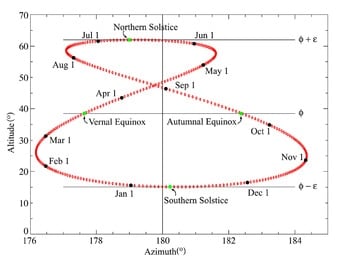
Because of Earth’s elliptical orbit around the Sun, the planet moves faster in January, when we are closest to the Sun, than in July, when we are farthest away. Thanks to that changing speed, the Sun’s path through the sky, charted day by day, appears to trace a lopsided figure-8. Astronomers call that pattern an analemma. See the diagram below.
If you would rather see the numbers for your own town, the National Oceanic and Atmospheric Administration keeps a free Solar Calculator that returns sunrise and sunset times for any date and location, and the concept behind the figure-8 is laid out in this overview of the analemma.

The Equation of Time
Because the Sun makes this odd pattern in the sky over the year, it is rarely on the meridian at exactly noon. More often than not, the Sun lines up with the meridian as much as 15 minutes before or after noon. Anyone with a sundial in the garden knows this discrepancy well. It has a name: the Equation of Time. It is simply the running gap between clock time and true solar time, and it swings back and forth across the calendar.
Earliest Sunset and Latest Sunrise Do Not Match the Solstice
The Sun’s looping path also explains why the earliest sunset and the latest sunrise fail to fall exactly on the solstices. Instead, the earliest sunset comes about two weeks before the winter solstice, while the latest sunrise comes about two weeks after it, around January 2. On December 21, the solstice, the Sun sits at the very top of the figure-8. On December 7 it is slightly to the right of that topmost point, so it reaches the eastern horizon a little sooner than on December 21. On January 2 it is slightly to the left of the lowest point, so it reaches the western horizon a bit later than on December 21.
The practical upshot is a small gift in early December: your afternoons stop getting darker about two weeks before the calendar says winter has arrived, even though mornings keep losing light into January. That is why the evenings feel like they are turning the corner first.
How Your Latitude Changes the Date
The earliest sunset is not stamped on one universal calendar square. The farther south you live, the earlier in the season your earliest sunset arrives, and the wider the gap between that date and the December 21 solstice. The farther north you live, the closer the two land together. The table below gives rough windows for common latitudes across the United States and southern Canada. Treat them as ballpark dates and confirm your own with the NOAA calculator above.
| Latitude (representative city) | When days start gaining noticeably | Minutes gained per week near solstice | Peak gain rate (mid-Jan to mid-Feb) |
|---|---|---|---|
| 25 N (Miami, FL) | Mid-January; the total annual swing is only about 3 hours 13 minutes; earliest sunset arrives around December 7, latest sunrise around January 5 | About 1 minute per week (gain is nearly imperceptible day-to-day near the solstice) | About 7-8 minutes per week |
| 30 N (New Orleans, LA / Houston, TX) | Early to mid-January; annual swing about 4 hours; gains become noticeable a bit sooner than at Miami | About 1 minute per week near the solstice | About 9-10 minutes per week |
| 35 N (Raleigh, NC / Albuquerque, NM) | Early January; annual swing about 5 hours; rate picks up clearly by the second week of January | About 1-2 minutes per week near the solstice | About 11-12 minutes per week |
| 40 N (New York City, NY / Denver, CO) | Early January; annual swing about 6 hours; daily change near December 15 is only about half a minute, but the rate roughly triples by early February (USNO) | About 1-2 minutes per week near the solstice | About 13-14 minutes per week |
| 45 N (Minneapolis, MN / Portland, OR) | Late December to early January; annual swing approaches 7 hours; people at this latitude tend to notice the shift earliest because the contrast between shortest and longest days is sharpest | About 1-2 minutes per week near the solstice | About 16-17 minutes per week |
| 50 N (Winnipeg, MB / Vancouver, BC) | Late December; annual swing exceeds 7 hours; even on cloudy days the difference is dramatic enough to feel by mid-January | About 1-3 minutes per week near the solstice | About 20-21 minutes per week |
What Happens at the Summer Solstice
The same mismatch shows up in June, only tighter. Around the summer solstice on June 21, the earliest sunrise arrives about a week before the solstice, near June 14, and the latest sunset comes about a week after it, near June 27. So the longest evening of the year does not fall on the longest day either. It trails a few days behind.
Why Two Weeks in Winter but Only One in Summer
Why two weeks in winter and only one in summer? It comes back to orbital speed. Earth moves slower in its orbit in summertime, because it is farther from the Sun, and faster in winter, because it is closer. Moving faster in December, the planet covers more ground along its orbit in the same number of days, which stretches the offset between the earliest sunset and the solstice to about two weeks. In the slower summer, the same effect shrinks to about one week. Same physics, different pace.

Earliest Sunset: Frequently Asked Questions
When is the earliest sunset of the year?
For much of the United States, the earliest sunset falls about two weeks before the December 21 winter solstice, on or near December 7. In 2025 it landed on Sunday, December 7. The precise date shifts with your latitude, so check a sunrise and sunset calculator for your own town.
Why is the earliest sunset before the winter solstice?
Earth’s orbit is elliptical, so the planet speeds up in winter and slows down in summer. That changing speed, combined with the tilt of Earth’s axis, pushes the earliest sunset ahead of the solstice and the latest sunrise after it. The solstice still marks the least daylight overall, but the two ends of the day do not line up with it.
What is an analemma?
An analemma is the lopsided figure-8 the Sun appears to trace in the sky when you chart its position at the same clock time every day for a year. It happens because Earth’s orbital speed changes and its axis is tilted. That figure-8 is the reason the earliest sunset and latest sunrise slip away from the solstice dates.
What is the Equation of Time?
The Equation of Time is the running gap between clock time and true solar time. Because the Sun rarely crosses the meridian at exactly noon, it can be as much as 15 minutes ahead of or behind the clock. Gardeners with sundials see this difference play out across the seasons.
Does the earliest sunset happen on the same date everywhere?
No. The date shifts with latitude. Farther south, the earliest sunset arrives earlier in the season and further ahead of the solstice, sometimes in late November. Farther north, it lands closer to the December 21 solstice. A location near 40 degrees north sees it around December 7 to 8.
When is the latest sunrise?
The latest sunrise comes about two weeks after the winter solstice, around January 2. That is why mornings keep getting darker into early January even though your evenings started lengthening back in early December. The summer mirror of this is the latest sunset, which falls about a week after the June 21 solstice, near June 27.


This article was published by the Staff at FarmersAlmanac.com. Any questions? Contact us at [email protected].
- Farmers' Almanac Staff

- Farmers' Almanac Staff

- Farmers' Almanac Staff

- Farmers' Almanac Staff





I read your explanation of the discrepancy between shortest day and earliest sunset’ latest sunrise but still don’t understand it. The figure 8 analemma remains a puzzle to me.
WHEN WE CHANGE THE TIME IN MARCH TO DAYLIGHT SAVING TIME WILL IT STAY THA
Looking at met office app for north england. The suset times are still getting earlier after 7th dec 22.
You all are insane, you claim the orbit changes speed?? You would feel that.
How much acceleration would occur in a speed change of such magnitude?
Scarbear, you have been traveling around the sun all your life, but we don’t feel it. And the earth turns around its axis once in 24 hours. You never feel that, either. God set it up intelligently enough that we don’t feel, every second of our lives, like we’re being yanked.
Orbit doesnt chage the speed. Earth does.
The story wasn’t about the shortest day of the year. It is about the latest sunrise. Is a big difference.
No god has anything to do with this. Science always wins in these silly arguments.
YOU ONLY WISH YOU WERE RIGHT!!!!! AND IM GUESSING SCIENCE IS WHY ALL THE CRAZY THING’S ARE HAPPENING IN THE WORLD THAT THE BIBLE SAYS IS GONNA HAPPEN IN THE LAST DAYS TOO^$$=+#^<;"*[$
Maybe schizophrenics like you should read a book like Victor Stenger’s God, The Failed Hypothesis; How Science Has Proved That God Does Not Exist! It’s high time that you got out of the 17th century and enter the 21st.
Plus, this all depends on how far north you live. If you look, some places like Seattle get their earliest sunset next week and Anchorage Alaska gets it on like the 17th. There is even a city in Alaska that doesn’t see the sun for nearly 2 months, So obviously it is all controlled by science, but that doesn’t mean that there is no God.
God created science as well!!!
“GOD” CREATED ALL THE LAWS OF PHYSICS AND ALL THINGS JUST FOLLOW THOSE LAWS, GO FIGURE.
If the days will be getting longer after December 21st and the suns angle will begin to get stronger slowly as the winter goes on, then why is that January and February is considered the “heart” of winter. The heart of winter is known to be the coldest time of the year. By memory, I remember many more blizzards and bitter cold temps in February. I dont get why January and February are the coldest months and why December isnt
Brenda, Here is an article that explains that: Why is January Always So Cold?
Hence, since most of the world’s population lives in the Northern Hemisphere, winter is not as unbearable? A little blessing from the Creator?
Just beautiful. My most favorite time of the year especially if there’s snow on the ground.