

Christmas Kissing Balls: The Original Mistletoe
Christmas kissing balls were once the fashionable way to deck the halls. Learn about this vintage tradition. Are they making a comeback?
Quick Reference: Christmas Kissing Balls
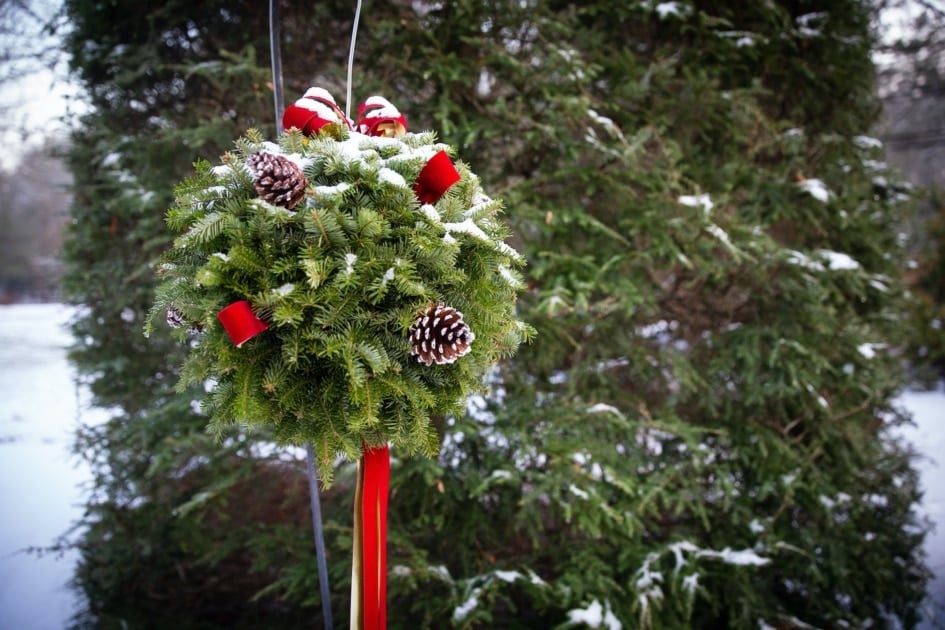
- What they are: round clusters of evergreen such as ivy, holly, and pine, tied with twine and hung in a doorway.
- Where they began: medieval Europe, as “holy boughs” with a figurine of the infant Jesus set in the center.
- Why “kissing”: Victorian versions swapped in love-symbol herbs like lavender, rosemary, thyme, and mistletoe, and couples kissed beneath them.
- The berry rule: pluck one berry for each kiss, and when the berries are gone, the kissing stops.
- Try it today: a foam or potato base, fresh greens, ribbon, and a hook, and you have a kissing ball of your own.
Hang a ball of greenery in the doorway, and everyone who passes under it earns a kiss. That is the old rule of the Christmas kissing ball, a decoration that predates the mistletoe sprig most of us know today. Wreaths, garland, and fresh-cut trees still fill our homes each December, but the kissing ball is the piece of holiday decor that quietly fell out of fashion. Here is where it came from, why it earned its name, and how you can bring the tradition back this year.
What Are Kissing Balls?
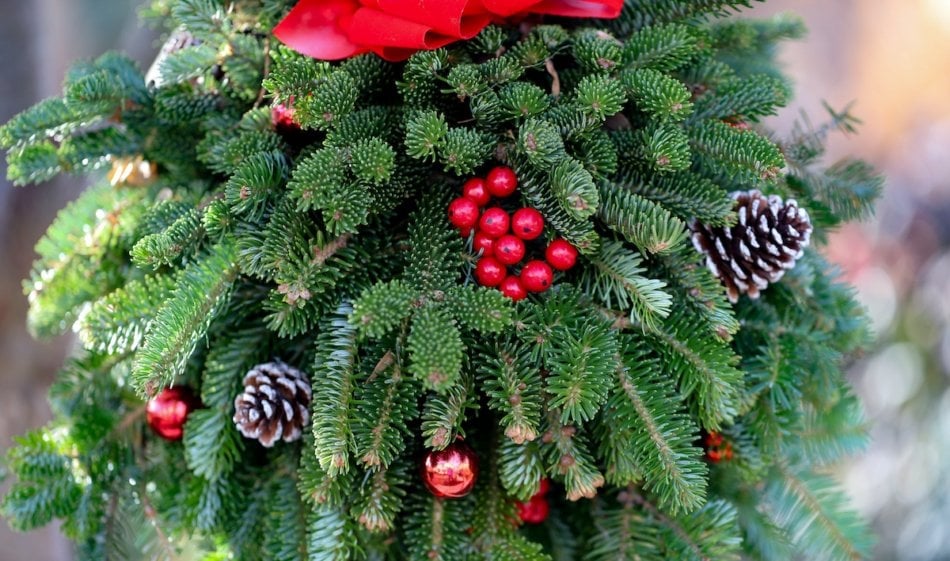
Kissing balls, or Christmas kissing balls, are round clusters of greenery made by tying together evergreen branches such as ivy, holly, and pine with twine. Traditionally, a figurine of the infant Jesus was nestled in the ball’s center. These “holy boughs” were then hung from entryways and doorways within the home, so that everyone who passed underneath would be gifted with blessings and good tidings.
The shape mattered as much as the greenery. A sphere has no beginning and no end, and to medieval households that stood for eternity and the promise carried in the season. Hung where family and visitors crossed paths, the holy bough was part decoration and part blessing over the threshold.
An On-Again, Off-Again Holiday Trend
While the holy bough has been around since the Middle Ages in Europe, it lost popularity several times in history, including in the 17th century as a result of growing Puritanism. The Puritans, who were devout Christians, banned holy boughs because they believed the Bible did not instruct the faithful to celebrate Christmas, and because evergreen decorations were tied to pagan rather than Christian customs.
Holy boughs came back into fashion in the Victorian era, but with a twist. Evergreen sprigs were woven around a potato or apple core instead of the Christ Child. In addition to evergreens, fragrant herbs were also worked into this new design. Many of these plants, including lavender, rosemary, thyme, and mistletoe, symbolized love and devotion, which is how the decorations came to be called “kissing” balls.
It then became custom for unmarried maidens to line up and await the chance to stand beneath a kissing ball, in the hope of getting a smooch from a potential suitor.
When standing under a kissing ball of holly or mistletoe, it was also customary for those receiving a kiss to pluck a berry from the plant. When all the berries were gone, no more kisses were to be given. It was a gentle way to keep the game in check, and a reason to gather the freshest, berry-heavy greenery you could find.


The Plants in a Kissing Ball and What They Meant
Every sprig in a Victorian kissing ball carried a message, which is part of why the decoration felt so personal. The herbs were chosen for meaning as much as for scent, and the old associations still hold up as a nice piece of folklore to share while you build one.
- Mistletoe: love and fertility, and the plant most tied to the stolen holiday kiss.
- Rosemary: remembrance and faithfulness, a herb long linked to loyalty and love.
- Lavender: devotion and calm, prized for its clean, lasting fragrance.
- Thyme: courage and strength, a fitting nudge for a shy suitor.
- Holly and ivy: everlasting life, thanks to leaves that stay green through the coldest weeks of the year.
Holly and ivy earned their place for a plain reason. When the rest of the countryside had gone brown and bare, they stayed green, which made them a natural symbol of life carrying on through the dark stretch around the winter solstice. That same evergreen logic runs through most of our oldest Christmas traditions.
The Mistletoe Tradition Takes Root
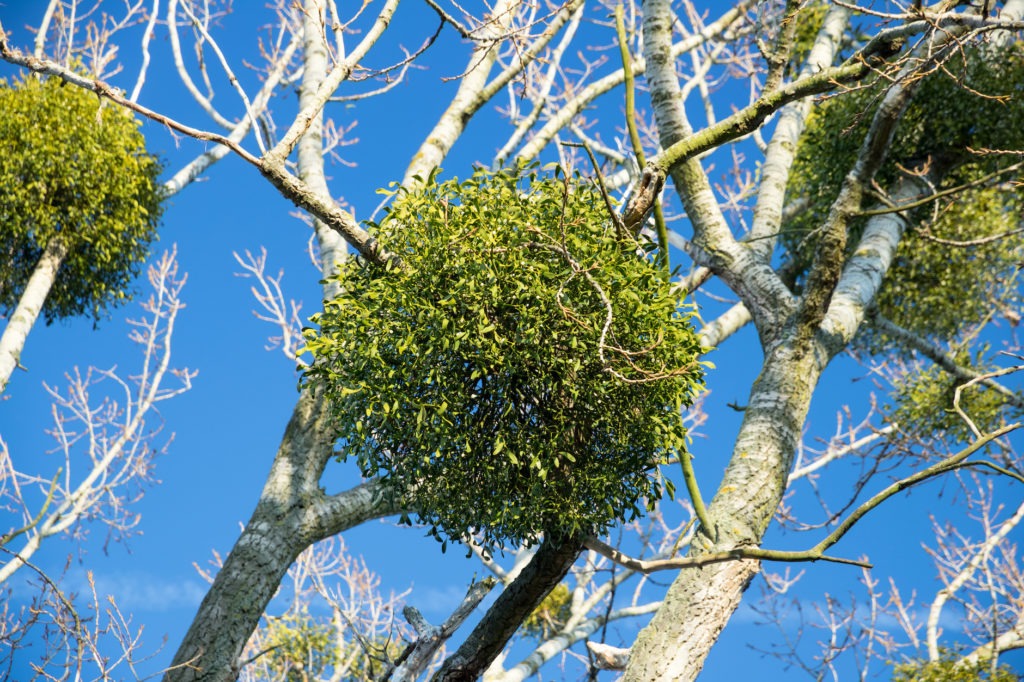
Eventually, mistletoe, which symbolizes love and fertility, replaced all other types of greenery found in kissing balls. The fact that mistletoe naturally grows in ball-shaped clumps is coincidental. At the same time, it became the traditional symbol of holiday affection that we know today.
There is a botanical wrinkle worth knowing. Mistletoe is a partial parasite that roots into the branches of host trees such as oak and apple and draws water and nutrients from them, according to the Encyclopaedia Britannica. Its white berries are toxic to people and pets, so the kissing-ball version is best hung well out of reach, or swapped for an artificial sprig if small children and animals are about. Do what is best for your household.
How to Make a Kissing Ball Today
You do not need a florist or a workshop to make one. A modern kissing ball follows the same idea as the Victorian version, just with a base you can buy or find in the pantry. Here is a simple way to build one at the kitchen table.
- Start with a base. A block of florist foam soaked in water works best, but a large potato or a foam craft ball will do the job the old-fashioned way.
- Trim your greens. Cut evergreen sprigs such as pine, cedar, boxwood, holly, or ivy into pieces about four to six inches long.
- Fill the ball. Push the stems into the base, turning as you go, until the whole sphere is covered and no base shows through.
- Add the fragrant herbs. Tuck in rosemary, lavender, or thyme for scent and for the old symbolism of love and devotion.
- Finish and hang. Wrap ribbon or twine around the ball, leave a loop at the top, add a bow or a string of fairy lights, and hang it in a doorway.
A fresh kissing ball will last longest in a cool spot away from heat vents, and a light misting every few days keeps the greens from drying out. If you would rather skip the upkeep, an artificial ball can come back out year after year.
While holiday kissing balls may harken back to Christmases of old, they are still as festive as ever. Today, both fresh and artificial kissing balls exist, and they are adorned with everything from bows and ribbons to fairy lights. They hang comfortably alongside the rest of the season’s greenery and the songs of the Twelve Days of Christmas.

Christmas Kissing Balls: Frequently Asked Questions
What is a Christmas kissing ball?
A kissing ball is a round cluster of evergreen greenery, such as ivy, holly, and pine, tied together with twine and hung in a doorway. It began in medieval Europe as a “holy bough” with a figurine of the infant Jesus at its center, meant to bless everyone who passed underneath.
Why is it called a kissing ball?
In the Victorian era the decoration was rebuilt around a potato or apple core and filled with herbs like lavender, rosemary, thyme, and mistletoe that symbolized love and devotion. Couples kissed beneath it, and unmarried maidens would wait under it in hope of a smooch from a suitor, which is how the name stuck.
What is the difference between a kissing ball and mistletoe?
The kissing ball came first and could be made from many kinds of greenery and herbs. Over time mistletoe, which symbolizes love and fertility and happens to grow in natural ball-shaped clumps, replaced the other greenery and became the single sprig most people hang today.
What is the berry rule under the mistletoe?
Tradition held that each person receiving a kiss would pluck one berry from the holly or mistletoe. When all the berries were gone, no more kisses were to be given. It was a simple, playful way to set a limit on the game.
How do you make a kissing ball at home?
Start with a base of soaked florist foam, a large potato, or a foam craft ball. Push four to six inch sprigs of pine, boxwood, holly, or ivy into the base until it is fully covered, tuck in fragrant herbs like rosemary or thyme, then wrap it with ribbon, leave a loop, and hang it in a doorway.
Is mistletoe in a kissing ball safe around children and pets?
Mistletoe berries are toxic to people and pets, so a fresh mistletoe kissing ball should hang well out of reach. If small children or animals are in the house, an artificial sprig gives you the tradition without the risk. Do what is best for your household.
Are kissing balls making a comeback?
They never fully disappeared. Both fresh and artificial kissing balls are still sold and made today, decorated with bows, ribbons, and fairy lights. Do you decorate with kissing balls? Let us know if you plan to include them in this year’s Christmas decor.


Tiffany Means
Tiffany Means is a freelance writer and a degreed meteorologist. She specializes in weather forecasting and enjoys making the subject of weather (and the science behind it) more relatable. She currently resides in the Blue Ridge Mountains of North Carolina.
- Tiffany Means

- Tiffany Means
- Tiffany Means
- Tiffany Means




PS….Wire or twine wrapped around middle of potato is left with a length for hanging with…
Kissing balls or boughs are easy peasy to make. Find your biggest and best Irish Potato..(arsh tater)…Gather your greenery from your yard, woodland, etc. First, wrap a wire or twine tight around the middle of the tater! Next, start cutting pieces of pine, balsam, mistletoe, hedgerow, etc..Try to angle it into a sharp a point as possible…Start pushing the pieces all around evenly into your potato…Use a ice pick if you need to make the hole before pushing the branch on into the potato…Check it all around and make sure it has no empty spots…Tie a ribbon bow and let hang down…The potato will serve as moisture for the branches and keep it fresh…At the end of the season, you can take the wire or twine off, bow and then drop the whole tater kissing ball in the compost…I sometimes change it up and put little bows on sticks pushed around too..These are really beautiful and any amateur artist/craft person can make one…I actually used to sell these quickly…LOL
Great info, thank you, b Ruth!
We hang up two kissing boughs every year!