

Meteorological Seasons vs. Astronomical Seasons Explained
Quick Reference: Meteorological vs. Astronomical Seasons
- Meteorological seasons: fixed three-month blocks. Spring begins March 1, summer June 1, fall September 1, winter December 1.
- Astronomical seasons: set by the equinoxes and solstices, so the start date shifts a day or two each year (winter falls on December 21 or 22).
- Why the split: whole calendar months make temperature records easier to compare from one year to the next.
- Southern Hemisphere: the seasons flip, so meteorological summer there begins December 1.
The seasons on your wall calendar and the seasons your local forecaster talks about do not start on the same day. Did you know that meteorologists define seasons differently than the average person? The seasons you know from the calendar are “astronomical,” but the seasons your meteorologist chats about on the evening news are “meteorological.”
For meteorologists, the seasons are defined by the months with the temperatures and weather most often associated with each. Summer, for example, runs from June through August, when temperatures feel most like “summer.” It is a small difference on paper, but it changes when spring, summer, fall, and winter officially begin.
The Four Meteorological Seasons
Meteorological seasons are tidy. Each one is a block of three whole months, and each starts on the first of the month. Here is how the calendar breaks down.
- Spring – Begins March 1 (March, April, May); ends May 31.
- Summer – Begins June 1 (June, July, August); ends August 31.
- Fall – Begins September 1 (September, October, November); ends November 30.
- Winter – Begins December 1 (December, January, February); ends on the last day in February.
Why Meteorologists Group Whole Months
The reason comes down to keeping good records. Weather scientists compare temperature and rainfall from one year to the next, and that job is far easier when every season is the same length and starts on the same date. Three whole calendar months give them clean, equal blocks to add up. The National Oceanic and Atmospheric Administration explains the same logic in its plain-English note on meteorological versus astronomical seasons.
Astronomical seasons are harder to tally. Because they hinge on the Earth’s orbit, they do not all run the same number of days, and their start dates drift from year to year. For a record keeper trying to line up decades of data, that wobble is a nuisance. Whole months solve it.

Seasons As We Know Them
Astronomers, on the other hand, like most people, define the seasons by the position of the Sun and the Earth’s tilt. (See the illustration below.) Winter in the Northern Hemisphere begins when the noontime Sun reaches its farthest point south in the sky, or when the Sun’s rays shine down from a point directly overhead as seen from the tropic of Capricorn (latitude 23.5 degrees south), known as the winter solstice. This happens on December 21 (or December 22, depending on the year). Later in the year, when the noontime Sun shines down on the equator at the vernal or spring equinox, spring begins.
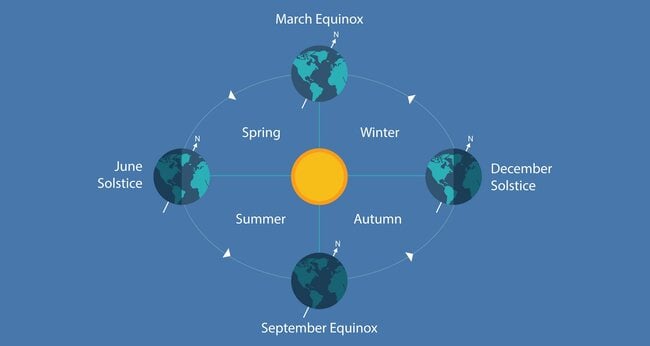
- Spring begins with the vernal equinox. At this point, the Earth moves from its maximum tilt away from the Sun to a point that is of equal distance from the Sun. The noontime Sun’s rays aim directly at the equator.
- Summer begins with the summer solstice. The Earth tilts farthest toward the Sun, and its rays are aiming directly at northern latitudes.
- Fall begins with the autumnal equinox. At this point, the Earth tilts away from its maximum lean toward the Sun, the opposite of its position in spring. Its rays aim directly at the equator.
- Winter begins with the winter solstice. The Earth tilts away from the Sun, and the Sun’s rays aim directly at southern latitudes.
Meteorological vs. Astronomical Seasons, Side by Side
Put the two systems next to each other and the gap is only a few weeks. Meteorological seasons open on the first of the month. Astronomical seasons wait for the Sun to reach the right spot, which lands around the 20th to the 22nd.
| Season | Meteorological dates | Astronomical dates (2026) | Basis |
|---|---|---|---|
| Spring | March 1 – May 31 (always fixed) | March 20 (vernal equinox, 14:46 UTC) to June 20 | Meteorological: aligns the three warmest spring months for consistent climate record-keeping. Astronomical: begins when the Sun crosses the celestial equator heading north; day and night are approximately equal length |
| Summer | June 1 – August 31 (always fixed) | June 21 (summer solstice, 02:22 UTC) to September 22 | Meteorological: covers the three statistically hottest months in the Northern Hemisphere. Astronomical: begins at the longest day; the Sun reaches its highest midday point in the sky |
| Fall (Autumn) | September 1 – November 30 (always fixed) | September 22 (autumnal equinox, 22:05 UTC) to December 21 | Meteorological: temperatures transition from summer peak to winter minimum. Astronomical: begins when day and night are again roughly equal and the Sun moves south across the celestial equator |
| Winter | December 1 – February 28 (February 29 in leap years) | December 21 (winter solstice, 20:50 UTC) to March 20, 2027 | Meteorological: the three coldest months; fixed dates make multi-decade climate comparisons reliable and reproducible. Astronomical: begins at the shortest day; days begin slowly lengthening after the solstice in the Northern Hemisphere |
| Who uses each system | Meteorologists, NOAA, NCEI, the World Meteorological Organization, agricultural planners, climate scientists; season lengths are fixed (90-92 days, aligned to whole calendar months) | Almanacs, general public, many media outlets, and cultural or religious traditions; lengths vary (89-93 days) because Earth’s orbit is elliptical, not circular | Neither system is wrong; they answer different questions: one tracks temperature patterns, the other tracks Earth’s geometry relative to the Sun |
Why the Seasons Lag Behind the Sun
Here is the part that trips people up. The longest day of the year is the summer solstice around June 21, yet the hottest weather usually arrives weeks later, in July and August. The same holds in reverse for winter. The shortest day comes in December, but January and February tend to be colder.
Land and water are slow to warm up and slow to cool down. They keep soaking up heat well after the Sun has passed its high point, so the warmth peaks after the solstice, not on it. Weather folks call this the seasonal lag. It is one reason the meteorological calendar, with its June-through-August summer, does a tidy job of capturing the three warmest months as a group.
Seasons in the Southern Hemisphere
Both calendars flip south of the equator. When the Earth’s tilt points the Northern Hemisphere toward the Sun for summer, it points the Southern Hemisphere away, into winter. So while June 1 opens meteorological summer in the United States and Canada, it opens meteorological winter in Australia, Argentina, and South Africa. Their meteorological summer begins December 1, right as ours begins winter.
Join The Discussion
What do you think? Should March 1 be the official start to spring and December 1, winter?
Share your thoughts in the comments below!

Meteorological Seasons: Frequently Asked Questions
What is the difference between meteorological and astronomical seasons?
Meteorological seasons are fixed three-month blocks that start on the first of the month, so spring begins March 1 and summer begins June 1. Astronomical seasons are set by the Earth’s position in its orbit and begin at the equinoxes and solstices, which land around the 20th to the 22nd. The two systems are only a few weeks apart.
When do the meteorological seasons start?
Meteorological spring begins March 1, summer June 1, fall September 1, and winter December 1. Each season is a block of three whole months. Meteorological winter ends on the last day in February, which is why it is the shortest of the four on the calendar.
Why do meteorologists use meteorological seasons instead of the calendar?
Whole calendar months make weather records easier to compare from year to year. Every meteorological season is the same length and starts on the same date, so scientists can add up temperature and rainfall in clean, equal blocks. Astronomical seasons shift a day or two each year, which complicates that kind of record keeping.
Do astronomical seasons always start on the same date?
No. Because they depend on the Earth’s orbit, the equinoxes and solstices drift by a day or two from year to year. The winter solstice, for instance, falls on December 21 or December 22 depending on the year. That is one reason meteorologists prefer the steadier meteorological calendar.
Are the seasons the same in the Southern Hemisphere?
No, they are reversed. When the Northern Hemisphere tilts toward the Sun for summer, the Southern Hemisphere tilts away into winter. So June 1 opens meteorological summer in the United States and Canada but meteorological winter in Australia and Argentina, and their summer begins December 1.
Which seasons should I plan around?
Both are useful, so use whichever fits the task. Gardeners and travelers often watch the astronomical calendar and the equinoxes, while weather trends and long-range planning line up neatly with the meteorological months. Do what makes sense for you, and share your own take in the comments.


This article was published by the Staff at FarmersAlmanac.com. Any questions? Contact us at [email protected].
- Farmers' Almanac Staff

- Farmers' Almanac Staff
- Farmers' Almanac Staff
- Farmers' Almanac Staff





I tried to join the “discussion”.
But my entry has been dismissed. With no explanation (even sent bcc to me by e-mail).
I guess my entry didn’t belong.
Think about how pathetic that is.
Malcolm,
Comments are reviewed and approved to avoid spam. Your comment was not “dismissed”.
Meteorological seasons are by far the best measurement for weather and climate. In most temperate regions….Northern hemisphere for example, the average maximum temperate peaks on around July 15th…6 weeks after June 1 and 6 weeks before Aug 31st. Same applies to each seasonal change…In january the coldest averages occur right on Jan 15th….6 weeks after Dec 1 and 6 weeks before Feb 28/9…
Thank you for sharing this information!
So you’re telling me that out of the blue the calendar derived by humans fits exactly with nature all the way through the year, all four seasons, year after year. I simply don’t believe you. Different years are different. Very different.
In fact, recently, nature has changed the way it is working over time throughout the year. Looking at an historical average isn’t working like it used to.
I think the seasons should start and end with the solstices and equinoxes. Let’s use nature as our guide.
We tend to agree! Makes sense. Thanks for sharing your thoughts here.
I think it should be left alone
i agree with you
I think the seasons should start and end with the solstices and equinoxes. Most years, (this one may be an exception), we have several winter weather days after March 1 and we have lots of days in the 90s after Sept. 1. The day that the earth begins to tilt the opposite direction is a good marker for a season change.
The weather certainly is changing but tradition seems to be the way to go. Thanks for sharing your thoughts here.
Sorry..but in most temperate regions….Northern hemi, the average maximum temperate peaks on around July 15th…6 weeks after June 1 and 6 weeks before Aug 31st. Same applies to each seasonal change…
Spring starts when the Circus are out
Summer starts, when you go out in shirt sleeves.
Autumn, when the leaves fall off.
Winter ,when it’s cold
Yeo, I say leave things alone. They are the way they are for a reason. We never should have let our gubmint start dictating things with “daylight savings time”, what a crock. Mother nature will do whatever it is she’s gonna do, and nothing man can do will ever change that. Same with this new “greenie revolution crap”. The earth has taken care of itself for a long time, just let it be, I say!
I say leave things alone
It totally makes sense.