Air Pollution And Poor Air Quality: Wildfire Smoke Playbook
Quick Reference
- Check first: your local Air Quality Index at AirNow.gov. Enter your ZIP code.
- AQI colours: Green 0 to 50 good, Yellow 51 to 100 moderate, Orange 101 to 150 unhealthy for sensitive groups, Red 151 to 200 unhealthy, Purple 201 to 300 very unhealthy, Maroon 301 and up hazardous.
- What actually reaches you: PM2.5 particles less than 2.5 micrometers across, a fraction of a hair’s width, small enough to cross into the bloodstream.
- Stay inside when AQI is above 100, and always if you have asthma, heart disease, or other respiratory conditions.
- Wear an N95 when outdoor time cannot be avoided, not a cloth or surgical mask.
- Close doors and windows, run air conditioning with fresh-air intake closed and filter clean.
- DIY air cleaner: tape a MERV 13 or higher HVAC filter to the back of a post-2012 box fan, arrow pointing into the fan.
- Avoid indoor smoke sources during a smoke event: candles, fireplaces, gas stoves, and vacuuming.
Hotter and drier weather in recent years has heightened wildfire activity across the globe, resulting in roughly twice as many forests being burnt than 20 years ago. Besides forest damage and property loss, hazardous air quality can cause serious harm, especially to those with pre-existing health challenges. The United States Environmental Protection Agency now warns that a single bad wildfire-smoke day can carry the same PM2.5 exposure as several months of average urban air. This guide keeps every original tip in the Almanac’s air-pollution playbook, adds the Air Quality Index colour chart in full, a DIY box-fan purifier build, a regional risk breakdown, and answers the seven questions readers ask most.

The Dangers Of Wildfire Smoke
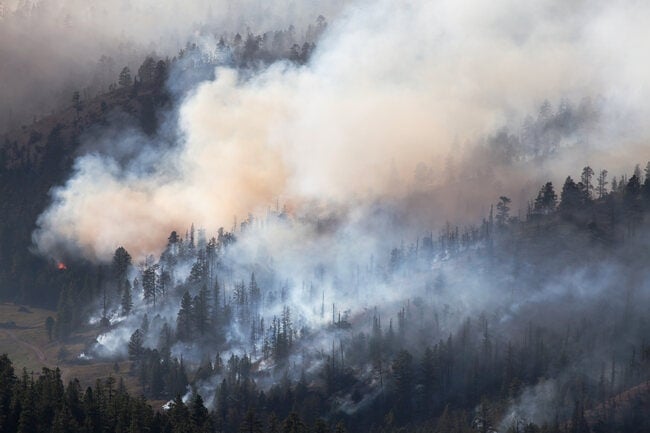
Wildfire smoke contains particulate matter (dust, dirt, soot), carbon dioxide, nitrogen oxide, and various volatile organic compounds that significantly compromise air quality in the burn area and areas downwind. Particulate matter is the primary public health concern for short and long-term exposure to wildfire smoke.
About 90 percent of the particle mass emitted from wildfires consists of fine particles, some of which are small enough to penetrate lung membranes, damage respiratory systems, and pass into the bloodstream. Fine particles designated as “PM2.5” are less than 2.5 micrometers in size, a fraction of the width of a human hair, and are small enough to stay suspended in the air for hours or days.
Short-term effects range from headache, fatigue, and eye irritation to respiratory tract disturbances such as coughing and shortness of breath. Increases in PM2.5 and ground-level ozone have also been linked to more serious disorders, including reduced lung function, intensified asthma, bronchitis, heart failure, and premature birth.
Hospitals report upticks in respiratory illnesses on days when air quality is poor. Long-term effects are linked to a host of issues, including chronic inflammation, and a greater risk of heart attack and stroke.
Air Pollution Ratings
When officials classify your air as “unhealthy” or “hazardous,” what does that mean? A nationwide measurement system called the Air Quality Index (AQI) is used to determine the severity of air pollution and categorises the health risks involved.
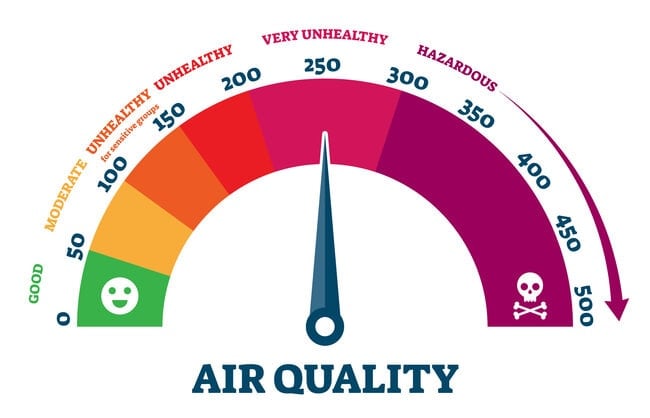
The Environmental Protection Agency (EPA) calculates the AQI based on five major pollutants: ground-level ozone, particulate matter, carbon monoxide, sulfur dioxide, and nitrogen dioxide. Ground-level ozone and airborne particles are considered the greatest health threat. The index runs on a value between 0 and 500 and uses six colour-coded categories. The lower the number, the cleaner the air.
| AQI | Category | What it means for you |
|---|---|---|
| 0 to 50 | Good (green) | Air quality is satisfactory. No precautions needed |
| 51 to 100 | Moderate (yellow) | Acceptable. Unusually sensitive people may want to limit long outdoor exertion |
| 101 to 150 | Unhealthy for sensitive groups (orange) | Children, older adults and those with heart or lung conditions should ease back |
| 151 to 200 | Unhealthy (red) | Everyone may feel effects. Sensitive groups should avoid prolonged exertion outdoors |
| 201 to 300 | Very unhealthy (purple) | Health alert. Everyone should limit time outdoors |
| 301 to 500 | Hazardous (maroon) | Emergency conditions. Stay indoors with windows shut if you can |
See Your Region’s Air Quality Score
See your region’s air quality at AirNow.gov. This index provides the latest AQI status in your area. Enter your ZIP code to get the current value and colour category, along with which pollutants are driving the number, who is at risk for health complications, and which activities are considered safe. Bear in mind that the Air Quality Index can fluctuate throughout the day as weather patterns move through and conditions change.
Air quality is considered “satisfactory” when the index is no more than 50, with 51 to 100 being “acceptable.” Anything higher than 100 could pose health risks, with EPA categorising any air quality index over 150 as unhealthy for the general public. Risk of health issues increases as pollution worsens.
What Can You Do To Stay Healthy?
While raging fires and pluming smoke may be beyond your control, there are steps you can take to reduce your risk from wildfire smoke.
- Check local air quality reports regularly and stay tuned for public health messages about smoke forecasts and safety measures.
- Stay inside if possible. Avoid outdoor, strenuous activity, particularly if you are older or have pre-existing health concerns.
- Wear a mask such as an N95 respirator when going outside during a wildfire-smoke event is unavoidable. Consider a mask any time conditions are listed as “poor.” A cloth or surgical mask is not enough to block PM2.5.
- Avoid activities that raise indoor air pollution, including burning candles, using fireplaces and gas stoves, and vacuuming without a HEPA filter. Vacuuming stirs up particles already inside the home.
- Keep doors and windows closed. Wildfire smoke seeps inside through the smallest gaps and drags indoor air quality down with it.
- Use air conditioning as needed. Keep the fresh-air intake closed and the filter clean. Upgrade to a MERV 13 or higher pleated filter for smoke season.
- Invest in air purifiers with HEPA filters to reduce fine particles indoors.
- Make your own air cleaner (see below). Commercial units often sell out during wildfire events, so health and air-quality agencies recommend DIY box-fan cleaners as a backup.
DIY Air Purifiers
Many health and air-quality agencies now publish instructions for DIY air cleaners as an affordable, accessible alternative when commercial units are back-ordered. The build is straightforward.
- Buy a 20-inch by 20-inch box fan, ideally a model made after 2012 with the added thermal safety features.
- Buy a 20-inch by 20-inch pleated HVAC filter, rated MERV 13 or higher. MERV 13 is the minimum for wildfire-smoke particles.
- Tape, bracket, or bungee-cord the filter to the back (intake side) of the fan. The airflow arrow on the filter frame should point toward the fan.
- Turn the fan on. Air pulls through the filter and returns cleaner into the room. Change the filter when it turns grey, or at the manufacturer’s recommendation.
Research is still being conducted on the effectiveness of removing fine particulate matter indoors using this method. Preliminary findings suggest a well-built box-fan cleaner can perform close to a small commercial HEPA unit for a fraction of the price. Safety concerns about unintended overheating have been tested across many studies and fan models, and no observable fire risks were recorded. As with any electrical device, use it with care and stick to newer model box fans (2012 or later) that include a thermal cutoff.
Disclaimer: Farmers’ Almanac does not give medical advice, nor does it recommend this method as a substitute for professional guidance.
Other Side Effects Of Wildfires
Poor air quality is not the only catastrophic side effect of wildfires. Water supplies can be negatively impacted during active burning and for years afterward. Water is a natural resource we depend on for drinking, irrigation, fishing, and recreation, with about 33 percent of the world’s largest cities depending on water supplied from forested watersheds.
Forests and trees reduce erosion and flooding and increase infiltration, which prevents sedimentation and other pollutants from reaching water supplies. Wildfires leave the ground burned, barren, and unable to absorb water, putting areas at increased risk of flooding, flash floods, and debris flows (mudflows). Cities are especially susceptible to flooding because they have high amounts of impermeable surfaces, such as sidewalks and roads, which cause more rain runoff.
Regional Risk: US And Canada Smoke Season
Join The Discussion
Has your community experienced air pollution from wildfires?
Does your town or city have poor air quality currently?
Share with your community here in the comments below.
Related Articles
9 Tips To Reduce The Threat Of Wildfires
10 Things You Should Never Burn In Your Fireplace

FAQ
What Air Quality Index number is considered dangerous?
Any AQI value over 150 is unhealthy for the general public, per the EPA. Between 101 and 150 the air is unhealthy for sensitive groups (children, older adults, people with heart or lung conditions). Above 300 is a hazardous health emergency and everyone should stay indoors.
Do cloth or surgical masks protect against wildfire smoke?
No. PM2.5 particles are far smaller than the weave of a cloth or surgical mask can filter. Only a well-fitted N95 or KN95 respirator provides meaningful protection. If N95s are not available, minimise outdoor time.
How do I make a DIY air purifier from a box fan?
Buy a 20-inch box fan (2012 or later, for the thermal cutoff) and a 20-inch by 20-inch MERV 13 pleated HVAC filter. Tape or strap the filter to the intake side of the fan with the airflow arrow pointing into the fan. Run on medium. Replace the filter when it turns grey.
Is it safe to exercise outside when the air is polluted?
Not when the AQI is above 100 for sensitive people, or above 150 for the general public. Exercise increases the volume of air you pull deep into your lungs, which increases PM2.5 exposure. Move workouts indoors or reschedule for a clean-air day.
Can I run my central AC when there is smoke outside?
Yes, and you should. Close the fresh-air damper, upgrade to a MERV 13 or higher filter, and run the fan continuously to keep the indoor air moving through the filter. A portable HEPA or DIY box-fan cleaner in the main living room adds another layer.
How do wildfires affect the drinking water supply?
About 33 percent of the world’s largest cities depend on water from forested watersheds. When a fire burns those forests, sediment, ash, and burned-off chemicals wash into reservoirs. Utilities can lose treatment capacity, and downstream communities face increased flash-flood and debris-flow risk for years after.
What indoor sources make air pollution worse during a smoke event?
Candles, wood-burning fireplaces, gas stoves without a vent hood on high, incense, and vacuuming without a HEPA filter all raise indoor PM2.5. Skip them during a smoke event, and cook simple meals that do not need the stove running for long.


Natalie LaVolpe
Natalie LaVolpe is a freelance writer and former special education teacher. She is dedicated to healthy living through body and mind. She currently resides on Long Island, New York, with her husband, children, and dog.
- Natalie LaVolpe

- Natalie LaVolpe
- Natalie LaVolpe
- Natalie LaVolpe