Water Glassing Eggs: How to Preserve Fresh Eggs for Up to a Year

Long before refrigeration, farm families had to figure out how to keep summer eggs eatable through the winter. Hens laid heavily in spring and summer, then nearly nothing through the short days of December and January. The solution was water glassing: a simple brine of pickling lime and water that sealed the shell pores and kept eggs fresh for up to a year. The method has been written up in farm bulletins since the 1800s and is having a comeback in homestead kitchens today.
Quick Reference
- What it is: preserving fresh, unwashed eggs in a pickling-lime and water brine that seals the shell pores and protects the bloom.
- How long they keep: up to 12-18 months, refrigerator-free, in a cool dark spot.
- What you need: fresh unwashed eggs (with bloom intact), food-grade pickling lime (calcium hydroxide), distilled water, a large glass jar with a non-metallic lid.
- The key: the bloom (natural protective layer on a freshly laid egg) must be intact. Store-bought, washed eggs do not work.
- Ratio: 1 ounce pickling lime per quart of distilled water.
- Best uses: baking, scrambled, hard-boiled (with shells they often crack; peel after instead). Not recommended for over-easy or sunny-side up.
What Is Water Glassing?
Water glassing is the practice of submerging fresh, unwashed eggs in a solution of pickling lime (calcium hydroxide) and water. The pickling lime fills the porous shell, creating a barrier that prevents air, bacteria, and moisture from entering. Eggs preserved this way can sit at room temperature in a cool, dark spot for 12 to 18 months. The original method used sodium silicate (“water glass,” hence the name), but pickling lime is the standard now and produces the same result with cleaner handling.
Advantages of Water Glassing Eggs
- No refrigeration required, frees up valuable fridge space.
- Long shelf life (12-18 months), preserves summer abundance for winter use.
- Cheap. Pickling lime costs about $5 and treats hundreds of eggs.
- Eggs come out tasting nearly identical to fresh. No vinegar tang, no salt cure.
- Reliable for power outages, off-grid living, or supply-chain hiccups.
Why Keeping the Egg’s “Bloom” Is Important
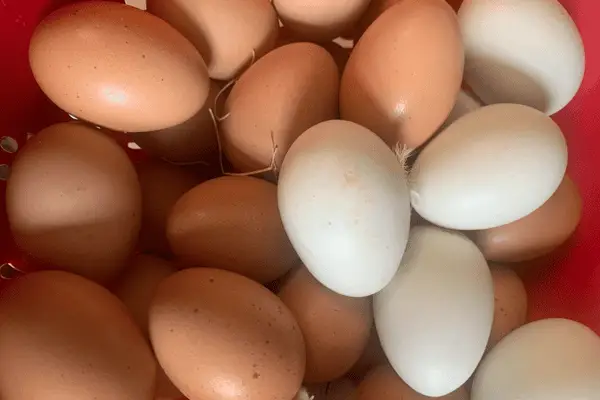
Every freshly laid egg comes out of the hen with a thin, natural protective layer called the bloom or cuticle. The bloom seals the thousands of tiny pores in the shell and keeps the egg fresh on the counter for several weeks. Commercial U.S. egg processing washes the bloom off, which is why store-bought eggs must be refrigerated. Most other countries do not wash eggs and store them at room temperature. Water glassing only works with bloom-intact eggs. Store-bought, washed eggs cannot be water glassed. You need fresh eggs from your own flock, a neighbor’s, or a farmer who sells them unwashed.
Instructions for Water Glassing Eggs
What You’ll Need
- Fresh, unwashed eggs (bloom intact, ideally within 1 week of being laid)
- Food-grade pickling lime (calcium hydroxide), available at canning supply stores
- Distilled water (tap water has minerals that can throw off the chemistry)
- A large glass jar (½-gallon or 1-gallon) with a plastic or glass lid (no metal, which corrodes)
- A non-metal stirring utensil (wooden or plastic spoon)
Directions
- Mix 1 ounce of pickling lime per 1 quart of distilled water in your jar. Stir until the lime is dissolved (it will not fully dissolve; some will settle at the bottom, which is fine).
- Gently lower fresh, unwashed eggs into the solution, pointed side down. The eggs must be fully submerged with at least 2 inches of brine covering them.
- Leave at least 2 inches of headspace at the top of the jar.
- Seal with a non-metal lid and store in a cool, dark spot (root cellar, basement, pantry).
- Wait at least 2 weeks before using the first egg. The lime needs time to seal the shells.
- To use an egg: lift one out with clean hands, rinse off the lime under running water, and use immediately. The egg goes off the protective barrier the moment it leaves the brine.
How to Eat Water Glassed Eggs
Water glassed eggs are best for any cooking where you do not need pristine, fresh-egg presentation:
- Baking: cakes, cookies, bread, muffins. Indistinguishable from fresh.
- Scrambled, omelets, frittatas: cook up identical to fresh.
- Hard-boiled: the shell may crack from absorbed water (a small percentage do); steam them instead of boiling for better luck.
- Less ideal: over-easy, sunny-side up, poached. The whites may spread thinner than fresh.
Crack each egg into a separate small bowl before adding to your recipe. This is a habit worth keeping even with fresh eggs; a rare bad egg will not ruin a batch.
Other Preservation Methods
Water glassing is one of several traditional egg-preservation methods. Freezing eggs (cracked and blended with salt or sugar) works for 8 to 12 months. Dehydrating eggs into powder gives years of shelf life. Pickling preserves the protein but changes the flavor entirely. Each has a place. Water glassing wins for room-temperature shelf life and minimal flavor change.
For a great deep-dive on the technique, see Lisa Bass at Farmhouse on Boone.
A Special Note About Raising Chickens
If you do not raise backyard chickens, you can still water-glass eggs by buying directly from a small local farm. Ask if they wash eggs before sale; most small producers can hold back a dozen unwashed for you. Backyard chicken keeping has grown sharply since 2020, with many cities and towns now allowing 3 to 6 hens on residential lots. A few hens produce more eggs in spring and summer than a typical family can eat, which is exactly when water glassing pays off.

Storage and Safety
Store the glassing jar in a cool, dark, stable-temperature spot. Avoid metal lids (the lime corrodes them). Check the jar monthly; if it looks cloudy, smells off, or any egg floats noticeably (a sign of decomposition), pitch the whole batch. A floating egg is rarely a problem in good water glassing but it is the universal sign of a bad egg in any preservation method. When in doubt, crack one open into a clear bowl and smell it before adding to your recipe.

Frequently Asked Questions
How long do water glassed eggs last?
Up to 12 to 18 months in a cool, dark spot. Many homesteaders report success well past a year. The eggs taste essentially the same as fresh when prepared in baked goods or scrambled.
Can I water glass store-bought eggs?
No. U.S. commercial egg processing washes the bloom (the natural protective layer) off the shells. Without the bloom, the lime cannot seal the eggs properly. You need fresh, unwashed eggs from your own flock or a small farm.
What does pickling lime do?
Pickling lime (calcium hydroxide) fills the pores in the eggshell and creates an oxygen and bacteria barrier. It is food-safe at proper concentration and has been used for canning, preserving, and water glassing for centuries.
Can I use a metal lid on the glassing jar?
No. The lime corrodes metal. Use a plastic or glass lid only.
Do water glassed eggs need to be refrigerated after taking out of the brine?
Use them right away after rinsing. Once out of the brine, they are like any fresh egg and should be used within a few days at room temperature or 2-3 weeks in the fridge.


Cameron Livesay
Cameron Livesay is the Grand Prize Winner of the 2022 Farmers' Almanac Recipe Contest. He is a talented baker and young entrepreneur who started his own business at ten years old. Cameron frequently gives back to his local community of Sykesville, Maryland, and inspires bakers everywhere. Learn more and support his creativity at SoulmanSweets.com.

This article was published by the Staff at FarmersAlmanac.com. Any questions? Contact us at [email protected].
-
Farmers' Almanac Staff

-
Farmers' Almanac Staff

-
Farmers' Almanac Staff

-
Farmers' Almanac Staff