How to Identify Animal Tracks: A Nature Detective Guide

Quick Reference: How to Read Animal Tracks
- Where to look: edge habitat, muddy riverbanks, wet sand, and fresh snow hold the clearest prints.
- Count the toes: 2 toes means deer or moose; 4 toes with claws means dog, fox, or coyote; 4 toes without claws means cat or bobcat; 5 toes means bear, raccoon, or a weasel-family animal.
- Read the gait: diagonal walkers (dogs, cats, deer), pacers (bears, raccoons, skunks, beavers), and bounders (weasels, squirrels, minks).
- Measure to be sure: print size and stride length tell look-alikes apart, such as a bobcat from a house cat.
- Watch for other sign: scat, worn trails, feeding marks, and gnawed branches finish the story the tracks begin.
From the 2003 Farmers’ Almanac | Animal tracking TIPS and TACTICS.
By Stephen Leahy
A freelance author located in Brooklin, Ontario.
There are legendary trackers who can glance at a gravel roadway and know where and when a mouse crossed the road, along with the mouse’s sex and age and what it had for lunch. Today that kind of skill seems almost magical, but hundreds of years ago a refined eye for tracks was needed for human survival. Like playing an instrument, tracking rewards practice. Once you master the basics and learn the refinements, your ability can be honed to remarkable levels.
New Jersey’s Tom Brown Jr. is world famous for his near-magical tracking skills. Taught by an Apache as a child, Brown spent decades developing them. He has been called upon to find more than 300 people lost in all types of wilderness, and has found nearly every one. Reportedly, Brown can look at a single footprint and tell how old a person is, his or her height and weight, whether the person is right-handed or left-handed, and much more.
RELATED: The Leave No Trace Story
Brown’s abilities, and animal tracking in general, rest on a simple idea: anything that moves through a forest or landscape changes it, and those changes reveal a lot about the animal or person. The trick is to recognize the changes, or clues, and then understand what they mean. Tracking is a lot like a detective game, in which the tracker finds the pieces of a puzzle and fits them together into a picture of the animal that left the tracks.
Tracking is a wonderful way to learn about animals and about nature. Children love the adventure of searching for clues, and they take naturally to role-playing games such as, “If you were this mouse, where would you go next?” That kind of question helps find the next track, and it deepens a child’s understanding of how an animal behaves.
Go Where the Action Is
Animals leave many signs of their presence, but the best are tracks, or footprints. To find them, go where animals are most likely to live, walk, or gather. One good place is what naturalists call “edge habitat,” the transitional zones between field and forest, forest and stream, or field and stream. Soft ground holds a print best, so head for muddy riverbanks, wet sandy spots, and snow-covered ground when you want a clear record of who passed by.
Know Them by Their Toes
Once you find a distinct track, count the toes. The number often reveals what kind of animal left it. Deer and moose leave two clear, semicircular hoof-like toes. Foxes, coyotes, dogs, and wolves leave oval prints showing four toes with claws and separate heel pads. Cats and bobcats do the same, except their tracks show no claw marks.
Related: Want To Know The Weather? Watch The Animals
Five-toed animals include weasels, minks, skunks, otters, raccoons, opossums, muskrats, beavers, porcupines, and black bears. Animals with four front toes and five hind toes include chipmunks, mice, voles, red and gray squirrels, and woodchucks.
Some animals are easier to name by the way they move. A squirrel gallops, pushing off on its back legs, landing on its front legs, then swinging its back legs around in front to push off again. That leaves a distinctive pattern. Rabbits, chipmunks, and others are gallopers too, so you still need other clues, such as the number of toes, to be sure.
There are three basic track patterns:
Diagonal walkers move a front foot and the opposite back foot at the same time. Dogs, cats, and deer walk this way. Members of the cat and fox families set their back feet directly into the prints left by their front feet, which leaves a tidy, tiptoe-like line.
Pacers move both legs on one side at the same time. Bears, raccoons, skunks, and beavers are pacers.
Bounders move both front feet and then both back feet. Weasels, squirrels, and minks do this.
Animals stick to their signature movement pattern about 95% of the time, but most can shift into another when they need to. A deer can jump to clear an obstacle, and gallop for extra speed.
Measure Twice, Identify Once
Often the only way to separate animals with similar prints and gaits is to measure the footprint, the stride, and the width of the trail. A coyote’s footprint runs about 3″ to 3 1/2″ long, while a fox’s is 2″ to 2 7/8″ (including the nails). A bobcat and a house cat leave prints close in size, but their walking strides are very different. The long-legged bobcat leaves a 10″ to 13″ distance between prints, while a house cat leaves only 6″ to 7″. Size also varies with an animal’s age and its home range. Coyotes in the East, for example, generally run larger than those in the West.
When tracks are faint, put your face close to the ground and look at them from the side, ideally with a light source on the far side of the prints. And do not forget to move or lift leaves out of the way to uncover a print hiding underneath.
Tracks are only part of the story. Animals leave other clues that let a nature detective work out who visited a place. To read those clues, learn as much as you can about the animal itself: what it eats, when it is active, how it behaves, and where it likes to live. One of the most useful clues is scat, or animal droppings. Getting to know an animal’s calling card makes tracking much easier.
Here are the measurements and clues that help when you sit down to identify a track or a piece of sign:
Reading Scat and Other Sign
A good tracker reads the whole scene, not just the prints. Beyond footprints and scat, animals leave feeding sign, worn paths, beds, and rub marks that all point to who was here. Roughly trimmed twigs, gnawed bark, dug-up soil, and shredded logs are as telling as a clear print in the mud.
- Scat: shape, size, and contents hint at the animal and its last meal. Tapered, twisted droppings often belong to a fox or coyote, while pellet piles point to deer or rabbits.
- Feeding sign: a pile of pine cone scales marks a red squirrel’s table, and cleanly clipped stems or browsed branches show where deer and moose have been eating.
- Trails and runs: deer and rabbits are creatures of habit and wear obvious paths, so a well-used run tells you an animal passes through often.
- Rubs and beds: torn bark on a tree or a flattened patch of grass shows where an animal marked its range or bedded down for the night.
Put the clues together the way a detective builds a case. One print may be uncertain, but a print beside a chewed branch, a worn trail, and a fresh dropping usually names the animal with confidence.
Best Times and Places to Track
Timing turns a hard hunt into an easy one. The clearest tracks appear right after a fresh snow or a light rain, when soft, damp ground takes a crisp print and older marks have been wiped clean. Early morning and the hour before dusk are the best times to look, since many animals move at first and last light and low sun throws long shadows into each track.
- After snow: a light dusting over firm ground records every visitor and holds the print for hours.
- After rain: muddy riverbanks and puddle edges are natural print traps once the shower passes.
- Dawn and dusk: low, raking light deepens the shadow inside a faint track and makes it pop.
- Edge habitat, year round: the seam between field and forest stays busy in every season.
Tracking is a slow, quiet pursuit, and the reward is a closer read on the wildlife sharing your patch of the country. If you plan your outings around the weather, our long-range weather forecast can help you pick the days most likely to leave a printable coat of snow or a soft, damp trail. Our Best Days calendar is another handy way to line up a morning outdoors.

Guides to Tracking Books
A field guide in your pack turns a good guess into a confident call. These three are longtime favorites among trackers:
A Field Guide to Mammal Tracking in North America by James Halfpenny, Johnson Books
Tracking & the Art of Seeing by Paul Rezendes, HarperCollins
Tom Brown’s Field Guide to Nature Observation and Tracking by Tom Brown Jr., Berkley Books
For a deeper reference on print shapes and gaits, the plain-English overview of an animal track is a handy companion to the field guides above.
Track Measurements
Sizes are for front paws (length x width) and stride lengths.
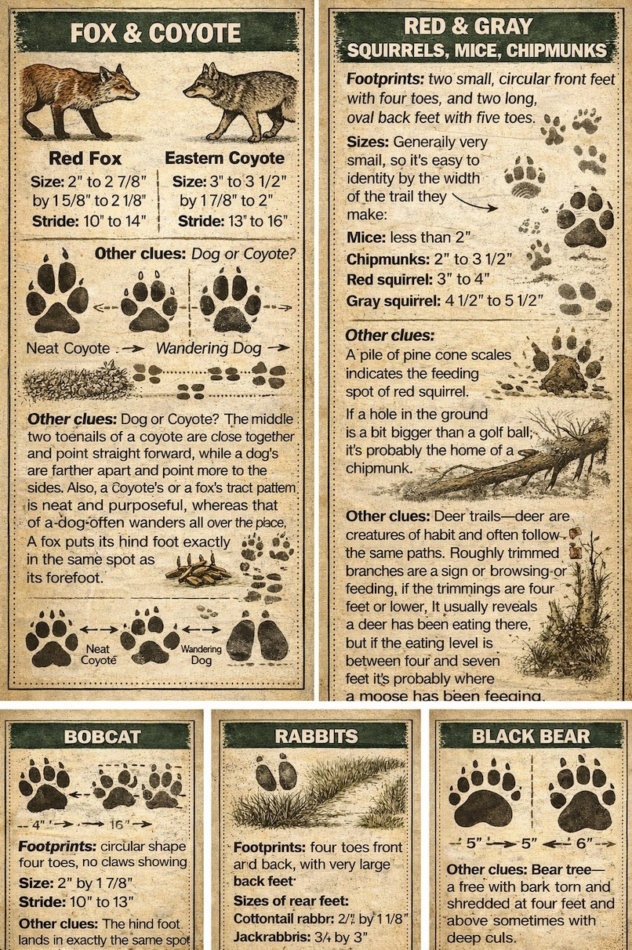
Fox & Coyote
Footprints: Oval shape, four toes, with claws showing
Red Fox: Size: 2″ to 2 7/8″ by 1 5/8″ to 2 1/8″
Stride: 10″ to 14″
Eastern Coyote: Size: 3″ to 3 1/2″ by 1 7/8″ to 2″
Stride: 13″ to 16″
Other clues: Dog or coyote? The middle two toenails of a coyote sit close together and point straight forward, while a dog’s are farther apart and point more to the sides. A coyote’s or fox’s track pattern is neat and purposeful, whereas a dog’s often wanders all over the place. A fox sets its hind foot exactly in the spot left by its forefoot.
Red & Gray Squirrels, Mice, Chipmunks
Footprints: two small, circular front feet with four toes, and two long, oval back feet with five toes.
Sizes: Generally very small, so it is easiest to identify by the width of the trail they make:
Mice: less than 2″
Chipmunks: 2″ to 3 1/2″
Red squirrel: 3″ to 4″
Gray squirrel: 4 1/2″ to 5 1/2″
Other clues: A pile of pine cone scales marks the feeding spot of a red squirrel. If a hole in the ground is a bit bigger than a golf ball, it is probably the home of a chipmunk. Tunnels in grass mean a mouse or vole highway. Something moving fast through the trees is likely a gray squirrel.
Deer, Moose, Elk
Footprints: semicircular shape, with two toes
Whitetail Deer: Size: 3″ by 2″
Stride: 18″ to 24″
Mule Deer: Size: 3 1/4″ by 2 1/2″
Stride: 21″ to 24″
Elk: Size: 4″ by 4″
Stride: 24″ to 32″
Moose: Size: 7″ by 4″
Stride: 30″ to 50″
Other clues: Deer are creatures of habit and often follow the same trails. Roughly trimmed branches are a sign of browsing or feeding. Trimmings four feet or lower usually mean a deer has been eating there, while an eating level between four and seven feet points to a moose.
Bobcat
Footprints: circular shape, four toes, no claws showing
Size: 2″ by 1 7/8″
Stride: 10″ to 13″
Other clues: The hind foot lands in exactly the same spot as the forefoot when walking.
Rabbits
Footprints: four toes front and back, with very large back feet
Sizes of rear feet:
Cottontail rabbit: 2 3/4″ by 1 1/8″
Jackrabbits: 3 1/2″ by 3″
Other clues: Rabbit runs. Look for well-worn paths 3″ to 8″ wide.
Black Bear
Footprints: five toes front and back with distinctive claws
Size: 5″ by 6″
Stride: 17″ to 23″
Other clues: A bear tree, with bark torn and shredded at four feet and above, sometimes with deep cuts.
A Simple Tracking Kit
You do not need much gear to start reading tracks. A few everyday items make the measurements above easy to take in the field and turn a walk in the woods into real detective work.
- A small ruler or tape measure for print size and stride length, the numbers that separate look-alikes.
- A pocket field guide to match prints and scat against confirmed examples.
- A notebook or phone to sketch or photograph a track with the ruler beside it for scale.
- A flashlight to rake low light across a faint print from the side, the same trick that works at dawn and dusk.
Start close to home in that edge habitat between field and forest, go slow, and let the clues add up. The more you look, the more the land tells you.

How to Identify Animal Tracks: Frequently Asked Questions
How do you identify an animal track?
Start by counting the toes: two toes means deer or moose, four toes with claws means dog, fox, or coyote, four toes without claws means cat or bobcat, and five toes means bear, raccoon, or a weasel-family animal. Then read the gait and measure the print and stride. When two animals look alike, the measurements and the other sign nearby settle it.
How can you tell a dog track from a coyote track?
Look at the toenails and the trail. A coyote’s middle two toenails sit close together and point straight forward, while a dog’s are farther apart and point more to the sides. A coyote also moves in a neat, purposeful line, whereas a pet dog tends to wander all over the place.
What are the three basic animal track patterns?
Diagonal walkers move a front foot and the opposite back foot together, like dogs, cats, and deer. Pacers move both legs on one side at once, like bears, raccoons, skunks, and beavers. Bounders move both front feet and then both back feet, like weasels, squirrels, and minks. Animals hold to their pattern about 95% of the time.
Where is the best place to find animal tracks?
Look in edge habitat, the transitional zones between field and forest, forest and stream, or field and stream. Soft ground holds the clearest prints, so muddy riverbanks, wet sandy areas, and snow-covered ground are the best places to search, especially right after a fresh snow or a light rain.
How do you tell a bobcat track from a house cat track?
Both leave a circular, four-toed print with no claws showing, and the prints are close in size at about 2″ across. The difference is the stride. A long-legged bobcat leaves a 10″ to 13″ gap between prints, while a house cat leaves only 6″ to 7″. Measure the distance between tracks to be sure.
What is scat, and why does it matter for tracking?
Scat is the tracker’s word for animal droppings, and it is one of the most useful clues in the field. The shape, size, and contents point to the animal and its last meal, so it works alongside prints, worn trails, and feeding sign to confirm who passed through. Getting to know an animal’s calling card makes tracking much easier.


- Farmers' Almanac Staff

- Farmers' Almanac Staff

- Farmers' Almanac Staff
- Farmers' Almanac Staff