

Do April Showers Really Bring May Flowers? The Folklore, the Climate, and the Real Science

Quick Reference: April Showers + May Flowers
- The phrase origin: 16th century English poem by Thomas Tusser (1557): ‘Sweet April showers / Do spring May flowers.’
- Climate truth: April is among the rainiest months in much of the Eastern US and Britain. Average rainfall 3 to 4 inches.
- Why showers help bloom: April rain wets soil, encourages bulb and perennial growth, which translates to May blooms.
- Where the rule fails: Mediterranean climates (California, Spain). April is the start of the dry season; bloom comes earlier.
- Tool: the Almanac’s Best Days planting calendar.
On this page
Related Almanac guides
Sources cited in this guide
April showers bring May flowers is one of the most-repeated English-language folk rhymes, and it has unusually strong basis in both meteorology and history. The phrase traces to a 1557 English poem by Thomas Tusser, was reinforced by genuine climate patterns across Britain and the Eastern US, and still holds true in most temperate regions today. This guide is the folklore origin, the NOAA precipitation data that supports it, and the climate zones where the rule does and does not work.
The 1557 Origin: Thomas Tusser
Per Britannica’s Thomas Tusser entry and English literature records.
- The poem. ‘A Hundreth Good Pointes of Husbandrie’ (1557) by Thomas Tusser, an English agricultural writer. Line: ‘Sweet April showers do spring May flowers.’
- Tusser’s context. Almanac-style agricultural advice book for English farmers. The poem was a memorable couplet to remember when rain timing favored planting.
- The shorter modern form. ‘April showers bring May flowers’ standardized in the 19th century English nursery-rhyme tradition.
- Why it stuck. Memorable, true to lived experience for most English speakers, and matched the seasonal pattern.
What NOAA Actually Says
Per NOAA precipitation climatology data.
- April rainfall (Eastern US). 3 to 4 inches average across most states east of the Mississippi.
- Among the rainiest months in the Eastern US and British Isles, though June often equals or exceeds it.
- Soil temperatures. April rain wets soil, accelerates bulb growth, and feeds the perennials that will bloom in May.
- The connection to May bloom. A wet April reliably correlates with stronger May bloom volume in tulips, lilacs, dogwoods, and most spring perennials.
- Where it fails. Mediterranean climates (California, Spain, Italy). April is the start of the dry season. Bloom peaks in March instead.
April Showers: Climate + History (Detail)
Below are the original sections on spring rains and whether April showers really bring May flowers.
Spring Rains
If there’s one season that would seemingly win the title of “rainiest,” it’s spring. In Northern Hemisphere spring, there are a number of goings-on in the atmosphere that increases our chance of rain. The jet stream, a ribbon of high-speed winds flowing miles overhead, migrates from its winter position over Mexico to its summer home over the southern border of Canada. This steers storm systems across the United States. The season’s more intense sunlight also contributes to storminess. The more heat there is in the atmosphere, the more opportunity there is for convection to spark rain and thunderstorms.
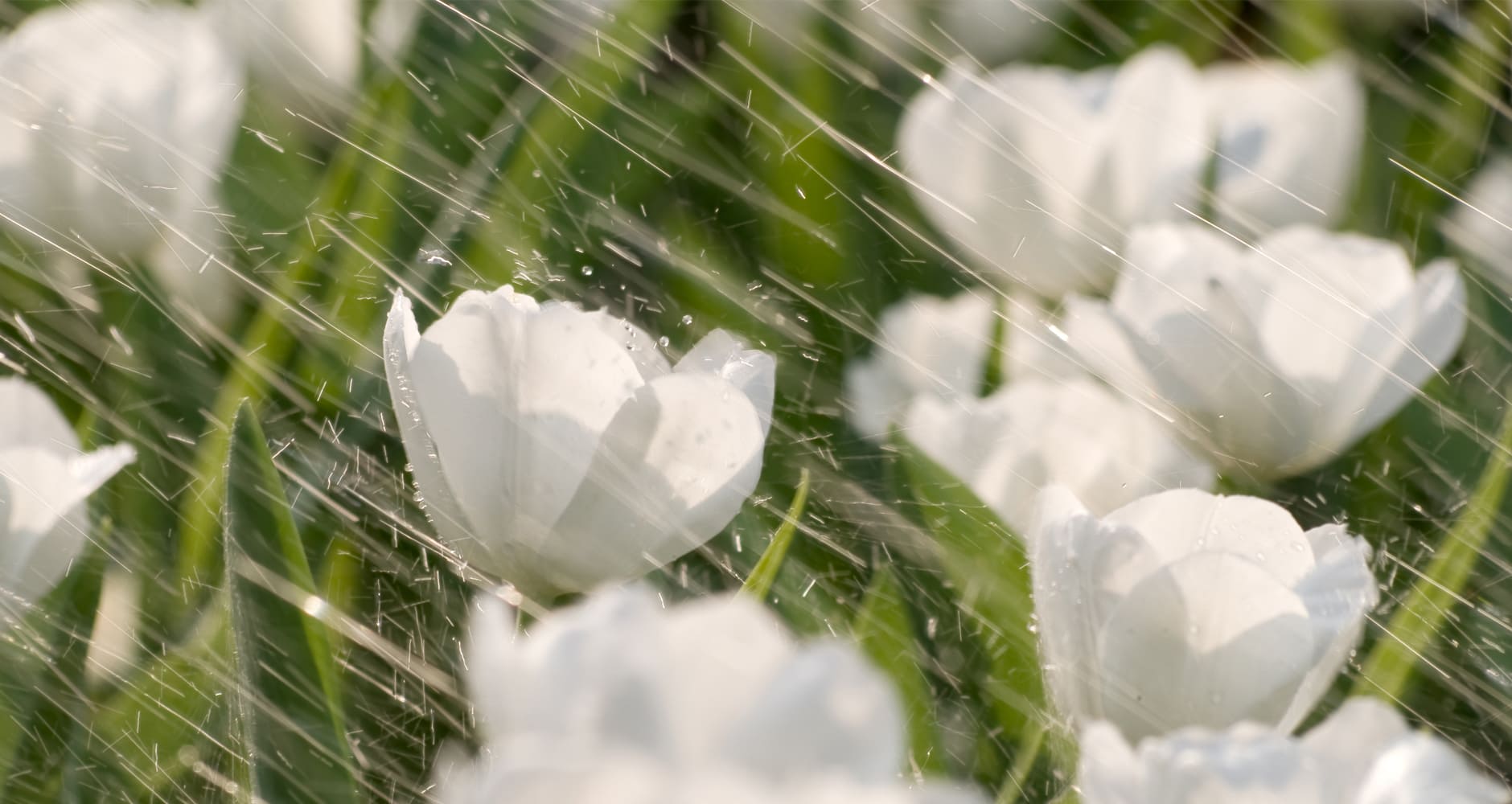
However, you might be surprised to learn that, according to NOAA’s National Centers for Environmental Information, June, not April, is the wettest month in the United States. (Based on the long-term average (1901-2000), June typically sees 3.15 inches of precipitation, whereas April ranks as 5th wettest at 2.52 inches.) However, since April is the first full month of astronomical spring (a season most of us associate with trees and flowers) and is also the rainiest month up to that point, the “April showers” reputation likely stuck.
Do April Showers Really Bring May Flowers?
It’s true: rains in April, the month that kicks off the growing season, provide spring-flowering plants with the nutrients needed to thrive in the months ahead.
And while scientists have proven that spring’s warming temperatures are also a key ingredient, recent studies of fruit trees, including flowering peaches and apricots, have shown that blossoms aren’t as fussy about temperature as are leaf buds. So, when it comes to flowering alone, it seems this centuries-old saying gets it right!
Wondering what the remainder of spring will be like in your neck of the woods? Check our long-range forecast here!


April Showers + May Flowers FAQ
Do April showers really bring May flowers?
Yes, in most temperate climates. The phrase traces to a 1557 English agricultural poem and reflects a real meteorological pattern: April rain wets soil and accelerates spring bulb and perennial growth, which translates to stronger May bloom volume. The rule works across the Eastern US and Britain. It fails in Mediterranean climates where April starts the dry season.
Where does the saying come from?
1557 English poem by Thomas Tusser called ‘A Hundreth Good Pointes of Husbandrie.’ The original line was ‘Sweet April showers do spring May flowers.’ The shorter modern form standardized in 19th century English nursery rhymes.
Is April actually the rainiest month?
In the Eastern US and Britain, April is among the rainiest (3 to 4 inches average) but June often equals or slightly exceeds it. In the Pacific Northwest, November to February are wetter. In Mediterranean climates (California, southern Europe) April is the start of the dry season.
What happens if April is dry?
May bloom volume drops measurably. UMN Extension data confirms wet Aprils correlate with stronger May bulb and perennial bloom. In dry years, bloom intensity drops 20 to 40 percent in tulips, lilacs, and many perennials.
Why is rain important for plant growth?
Rain wets soil, dissolves nutrients, and triggers root activity. Spring rain specifically wets soil deeply enough to support the rapid growth surge of bulbs (which break dormancy in early spring) and perennials (which break dormancy from the crown). Dry springs delay or weaken bloom.


Tiffany Means
Tiffany Means is a freelance writer and a degreed meteorologist. She specializes in weather forecasting and enjoys making the subject of weather (and the science behind it) more relatable. She currently resides in the Blue Ridge Mountains of North Carolina.
- Tiffany Means

- Tiffany Means
- Tiffany Means
- Tiffany Means





I learned today the cities with the most rain. Interesting!
I love april so much because easter.
Thanks for sharing that info, Clyde. Based on the 1901-2000 U.S. long-term average, I believe May is the nation’s second wettest month, so it makes sense that it would be THE wettest month for some states. Do you live in Arkansas? If so, I hope you have your umbrella at the ready! 🙂
Because of their Flood Abatement responsibilities, the U.S. Army Corps of Engineers (Hydrology Department) is one of the agencies that keeps records about rainfall and lake levels. I am retired from the Corps. May has been the wettest month in Arkansas according to their records.