

Astrology vs. Astronomy: What’s the Difference? (And Why They Disagree)
Do you know the difference between the astrological and astronomical positions of the Moon? Learn why the Farmers' Almanac includes both.
Quick Reference: Astrology vs. Astronomy
- Astrology is a folkloric system that divides the sky into 12 equal 30° slices named for zodiac constellations, fixed since antiquity.
- Astronomy is the science of objects in space; it tracks where bodies actually are using telescopes, math, and modern coordinate systems.
- Why they disagree: astronomy follows the real, uneven constellation boundaries; astrology uses equal slices that no longer match the sky.
- The 13th sign: astronomy includes Ophiuchus, the Serpent Bearer, which the Sun passes through; astrology does not.
- Precession: the Earth’s axis wobbles over a 26,000-year cycle, shifting the actual sky 1° every 72 years against fixed astrological signs.
- In the Almanac: we publish both placements every month, one for traditional Best Days lore, one for backyard skywatching.
If you have looked at the print version of the Farmers’ Almanac recently, you may have noticed that there are two different listings for the position of the Moon each month: one on the calendar page for that month, and one in a separate table at the front of the section. Because these two listings do not always agree, it can be confusing for readers who do not understand what the difference is. So what is the deal? Why two separate entries, and why do they not match up? Is our astronomer suffering from multiple personality disorder?
The answer is actually very simple. It all comes down to the difference between astronomy and astrology, two systems that share a lot of vocabulary, a lot of history, and almost nothing else.
What Astrology Is
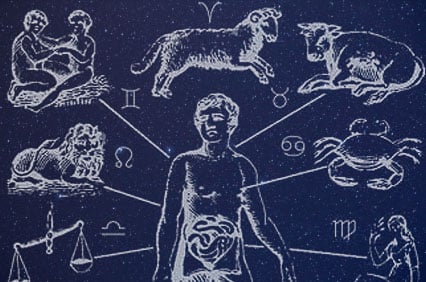
Astrology is an ancient practice that interprets the influence the Sun and Moon are said to have while they are in a specific sign of the zodiac. According to astrology, there are 12 divisions in the sky, measuring exactly 30 degrees each. Each of these divisions along the astrological circle is named after a major constellation found within it: Aries, Taurus, Gemini, Cancer, Leo, Virgo, Libra, Scorpio, Sagittarius, Capricorn, Aquarius, and Pisces. These are the 12 signs of the zodiac. Astrologers believe that the position of the Moon and Sun within these twelve divisions influences what happens on Earth, from the personalities of people born under a certain sign to the likelihood of certain kinds of undertakings to be successful.
The system was set down by Hellenistic Greek astronomers in Alexandria around the 2nd century BCE and has barely been edited since. That is its strength (consistency across two millennia of farm calendars and folk medicine) and its weakness (it does not get updated for what the actual sky has done since then).
What Astronomy Is
Astronomy, on the other hand, is the scientific study of matter in space. Astronomers do not try to interpret the meaning of the Moon or Sun’s position in the sky, only to describe it as accurately as possible. For that reason, astronomers do not divide the sky up into 12 equal slices, like a pie, but simply name the constellation the Moon sits closest to on any given night. In astronomical terms, the Sun can even wander into a few constellations that are not members of the astrological zodiac, such as Sextans, the Sextant, or Ophiuchus, the Serpent Bearer. The Sun actually spends more time crossing Ophiuchus each year (about 18 days) than it does crossing Scorpio (about 7 days), which is one of the most-cited oddities in modern astronomy outreach.
Modern constellation boundaries are not negotiable, either. The International Astronomical Union locked them in 1930, drawing 88 official regions that tile the entire celestial sphere. When a professional astronomer says the Moon is in Pisces, that is the IAU’s Pisces, not the astrologer’s 30-degree slice.
Why the Two Disagree
That is why it is perfectly possible, for example, for the Moon to be in Ophiuchus on an astronomical map while it is in Sagittarius on an astrological one. In addition, astrological placement is fixed throughout history and does not take into account the precession of the equinoxes (the “wobble” that the Earth’s axis describes over a 26,000-year interval), so the Sun’s place according to astrology often differs considerably from its physical place according to astronomy. Precession nudges the sky by one degree roughly every 72 years; over the 2,200 years since Hellenistic astrologers fixed the chart, the gap between the two systems has grown to about a whole sign.
| Feature | Astrology | Astronomy |
|---|---|---|
| What it studies | The belief that positions of the Sun, Moon, and planets at the time of birth influence personality and events on Earth | The scientific study of celestial objects, their physics, chemistry, motion, and origin, using observation and testable evidence |
| Zodiac system used | Tropical zodiac (Western): 12 signs of exactly 30 degrees each, anchored to the spring equinox; Aries always begins March 21 regardless of where the constellation is in the sky | IAU constellation boundaries (established 1930): 13 constellations cross the ecliptic; they cover unequal spans, from about 7 days for Scorpius to 45 days for Virgo |
| Sidereal zodiac (a third system) | Used in Vedic / Hindu astrology; anchored to fixed stars rather than the equinox; currently runs about 23-24 days behind the Western tropical system | Not used in modern astronomy; it tracks actual star positions more accurately than the tropical system, but still divides the sky into 12 equal signs rather than true IAU boundaries |
| Precession of the equinoxes | The Western system is built on the sky as it appeared roughly 2,000 years ago; Earth’s axis wobbles slowly, and that wobble has shifted the equinox point by about 24 degrees (nearly one full sign) since the 12-sign system was codified | Precession is a well-measured, predictable effect: the equinox point shifts roughly 1 degree every 72 years, completing a full cycle in about 26,000 years; the Sun is now in Pisces on March 21, not Aries as the tropical zodiac states |
| Ophiuchus: does it count? | No; Babylonian astronomers excluded Ophiuchus to keep 12 signs aligned with a 12-month calendar; neither Western nor Vedic astrology includes it | Yes, as a matter of geometry; the Sun passes in front of the constellation Ophiuchus from approximately November 30 to December 17 each year (about 18 days); the IAU recognizes it as one of 13 ecliptic constellations (NASA) |
| Scientific status | Not a science; controlled studies have not found that astrological predictions perform better than chance; NASA describes astrology as a belief system rooted in ancient cultural tradition, not evidence-based methodology | A natural science with peer-reviewed literature, reproducible predictions (eclipses, planetary positions), and direct practical applications including GPS satellite navigation and space mission planning |
How the Almanac Uses Both
Some Farmers’ Almanac readers are more interested in traditional lore and want to know the astrological position of the Moon, the input the old Best Days tables run on. Others are backyard astronomers and care about the astronomical position of the Moon: where will it actually be in the night sky, which constellation will frame it, what time will it cross the meridian? Some readers are equally curious about both, which is why you can find both the astrological place of the Moon and the physical, or astronomical, place of the Moon in your Almanac. That is the reason we list both in the print edition.
Practically, the rule of thumb is straightforward: if you are planting potatoes by Best Days, use the astrological placement (the Almanac’s calendar page). If you are setting up a telescope to find the Moon in the actual sky, use the astronomical one (the table at the front of the section).
Astrology vs. Astronomy FAQ
What is the difference between astrology and astronomy?
Astrology is a folkloric system that interprets influence from the Sun and Moon through 12 fixed 30° zodiac slices. Astronomy is the science of where bodies actually are in space, using real constellation boundaries and modern coordinates.
Are there 12 or 13 signs of the zodiac?
Astrology uses 12 equal signs. Astronomy uses 13 unequal constellations along the Sun’s path, because the Sun also passes through Ophiuchus for about 18 days each year.
What is the precession of the equinoxes?
It is the slow wobble of the Earth’s axis, completing one full circle every 26,000 years. Precession shifts the apparent position of the constellations by 1° every 72 years, which is why the astrological and astronomical zodiacs no longer line up.
Why does my astrological sign differ from the actual sky?
Because the astrological signs were fixed roughly 2,200 years ago, and the sky has shifted by about one whole sign since then. Your astrological Sun sign is the slice the Sun occupied at your birthday in 2nd-century BCE Alexandria, not the constellation it sits in today.
Why does the Almanac list both?
Because both serve real readers. Folk-tradition gardeners and Best Days users want the astrological placement; sky-watchers and amateur astronomers want the astronomical one. Listing both prevents confusion and respects both audiences.
Is astrology a science?
No. Astronomy is the natural science; astrology is a tradition. The Almanac publishes astrological placements because they drive the Best Days lore many readers use, not because we claim they predict events.
For more sky and calendar tools, browse our Moon Phases calendar, Best Days calendar, and the equinox vs. solstice explainer.


Caleb Weatherbee
Caleb Weatherbee is the official forecaster for the Farmers' Almanac. His name is actually a pseudonym that has been passed down through generations of Almanac prognosticators and has been used to conceal the true identity of the men and women behind our predictions.
- Caleb Weatherbee

- Caleb Weatherbee
- Caleb Weatherbee
- Caleb Weatherbee





I really enjoyed reading this article! It clearly explains the key differences between astrology and astronomy, especially regarding the Moon’s position. I love how the Farmers’ Almanac caters to both those interested in the astrological significance and the scientific, astronomical perspective. The distinction between the two is something many people overlook, and this article sheds light on that in an easy-to-understand way. Thanks for sharing such valuable insights!