

Coyotes on the Farm: How to Keep Livestock Safe
Keep coyotes at bay with these practical suggestions!
Quick Reference: Coyotes on the Farm
- What they are: Canis latrans, a member of the dog family, found throughout all of North America.
- Size: most weigh 25 to 40 pounds, with males generally larger than females.
- Biggest risk to a farm: predation of livestock, with sheep and fowl most at risk. Coyotes pose little threat to horses and cattle.
- Best defenses: good fencing, penning susceptible livestock and poultry at night, guard dogs, and prompt removal of dead stock.
- People and pets: keep pets fenced or supervised, never leave small children unattended, and remove pet food. Attacks on humans are rare.
Wild animals are part of what makes nature so magical, and watching them can be highly enjoyable. While it is important to coexist with animals in relative peace, they can cause countless problems when they take up residence in our homes or gardens. In this series, our Wildlife Management Specialist, Shawn Weeks, walks through some common household pests and shares strategies for keeping them under control without dangerous chemicals or poisons.
Today we take a look at Canis latrans, the coyote. Few sounds carry the open country at dusk like a coyote chorus, and few animals divide farmers and homeowners quite the way this one does. The coyote is clever, adaptable, and here to stay, so the smart play is to understand it and plan around it. Here is what the coyote is, how it lives, and how to keep livestock, pets, and family safe without reaching for poison.
Habitat and History
Originally, the coyote inhabited the western plains of the United States. The coyote now occurs throughout all of North America, one of only a few species of wildlife to do so. It is a member of the dog family of mammals, along with the fox and the wolf. The coyote is very adaptable, thriving in most habitats including grasslands and fields, forests, wetlands, and suburbia. That range is part of why you may hear one howling behind a barn in farm country and another trotting down a quiet street in town.
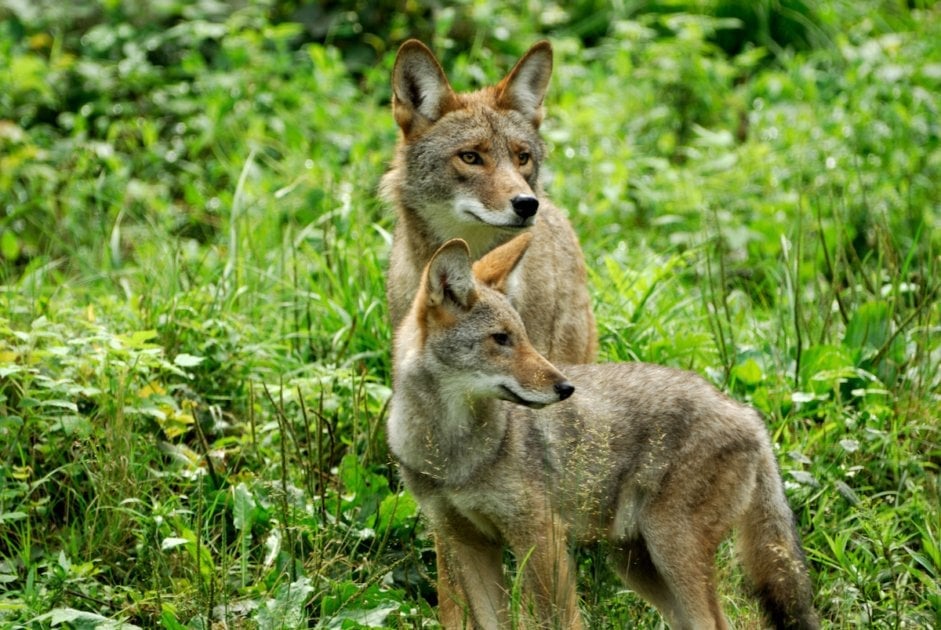
Coyotes resemble German Shepherds, although they have bushy tails, smaller feet, a long, tapered muzzle, and yellow eyes. They also appear more slender than a German Shepherd, and they have large, pointed ears. Most coyotes weigh from 25 to 40 pounds, with adult males being generally larger than adult females.
Their fur is usually grayish in color with some variations of red, black, or blonde, depending on the individual animal. They all have a white or cream-colored underside. Most coyotes also have dark hairs on their back and a black-tipped tail.
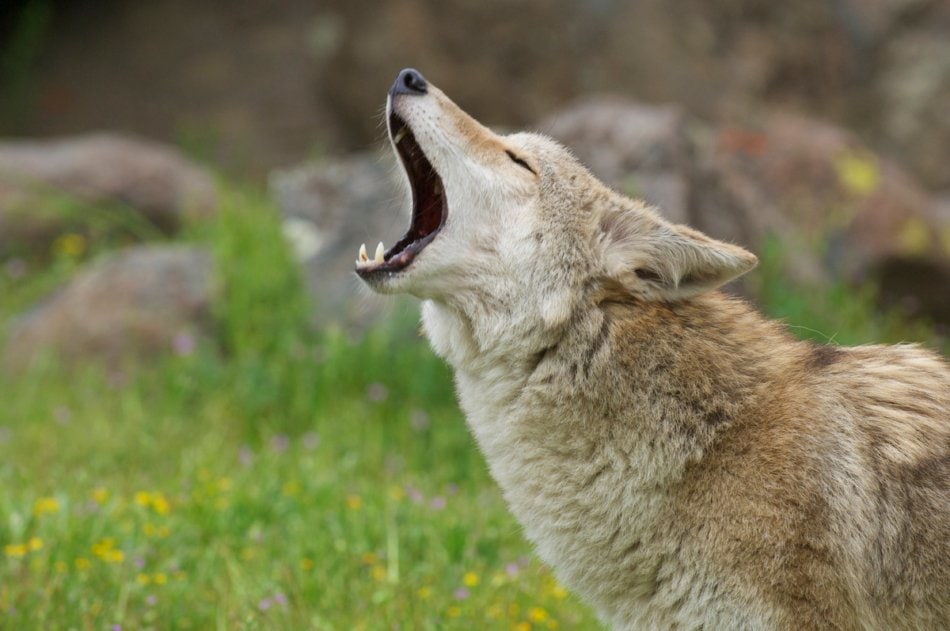
Coyotes use a variety of vocalizations to communicate. They howl, yelp, growl, bark, wail, and squeal. They are probably best known for their high-pitched cry, and they are most commonly heard at dusk and dawn. They have also been heard responding to sirens. Coyotes do not form packs, with the exception of mated pairs and their young. Mated pairs maintain their territories by scent marking and will defend that territory from other coyotes, as well as from fox.
Coyotes can run anywhere from 25 to 40 miles an hour. They are also excellent swimmers. Their sight, hearing, and sense of smell are very well developed, which is exactly why a coyote so often knows your barnyard better than you do.

Diet
Coyotes are opportunistic feeders that can survive on a variety of foods. They feed on rabbits, mice, voles, woodchucks, and on young livestock. They will also eat carrion, berries, fruits, vegetables, birds, and insects. That broad appetite cuts both ways on a farm: a coyote working the field edges keeps the rodent population down, but the same animal will help itself to a hen house or a newborn lamb if the chance is there. If you already battle rodents, our guide to controlling voles covers the same opportunists a coyote is hunting.
Reproduction
Coyotes do not normally mate for life. Some pairs may, however, stay together for a few years. Coyotes breed from January to March, and they give birth in approximately 63 days, anywhere from April to mid-May. The size of their litter depends on the age of the female and on environmental conditions. Generally speaking, they will give birth to between two and 12 pups. Both adults will care for the young and will relocate them if disturbed. The pups are weaned anywhere from six to eight weeks of age, and begin foraging and hunting with the adults between eight and 13 weeks old.
The young generally disperse in the fall to mid-winter. Young coyotes can and will travel far distances to find their own territories. Most eastern coyotes will not breed until their second year, while western coyotes will breed in their first year.
Adults can dig their own den, or they will enlarge the den of another animal such as a woodchuck or a fox. The female prepares and maintains the den. Knowing this rhythm matters on a working farm. The spring birthing window, April to mid-May, lines up with lambing and chick season, which is exactly when a hungry pair with pups to feed will press hardest against a fence.
Problems, Solutions and Health Concerns
Being members of the dog family, coyotes are susceptible to rabies, mange, distemper, and parasitic diseases in heavily populated areas. A coyote that looks sickly, patchy, or unafraid of people in daylight is worth reporting to your state wildlife agency rather than approaching.
The biggest problem with coyotes for humans is predation of livestock. Coyotes will attack a variety of livestock, with sheep and fowl being at the greatest risk. The other two problems of most concern are the predation of pets and the concerns for human safety. Coyotes pose little threat to horses and cattle.
It is a good idea to install fencing and to maintain it to keep coyotes at bay. Keeping susceptible livestock and poultry penned and secured at night is your best defense, since coyotes do much of their hunting at dusk and dawn. Guard dogs can also be used to keep coyotes at bay. For practical, science-based guidance on the same defenses, Utah State University Extension keeps a useful page on coyote management.
- Install good fencing and keep it maintained.
- Pen susceptible livestock and poultry, and secure them at night.
- Put a livestock guard dog to work where the risk is high.
- Remove dead livestock and poultry promptly, since coyotes eat carrion.
- Eliminate pet food and food scraps from the property.
You should always remove and dispose of dead livestock and poultry promptly and properly. Leaving it out will attract coyotes. Remember, coyotes eat carrion, the dead carcass of an animal.
Some parts of the country allow the trapping and/or shooting of coyotes if they are killing your livestock. Be sure to always seek proper permits and follow state and local regulations in regard to this method of defense. Rules vary widely by state, so a quick call to your local wildlife office before you act will save you trouble later.
Coyotes often attack and kill pets, such as cats and small dogs. The best policy to prevent this is to always keep your pets in a fenced-in area or under your direct supervision at all times. Homeowners should also keep pet food and food scraps eliminated from their property, or at least properly disposed of.
Coyotes are abundant across North America and, in a lot of places, have become accustomed to humans. People with small children should never leave them unattended in the yard or on the property where coyotes are common. Teach your children how to identify coyotes and to walk away (never run) into the house, or to climb up a swing or a deck if a coyote is approaching them. With that being said, it is rare for coyotes to attack humans.
As with many other wild animals, coyotes are opportunistic. We should always be on the offensive, and use common sense when managing our properties. Preventive measures are always our best solution for dealing with our wild neighbors. The same plan-ahead habit that protects a flock from coyotes protects skittish stock like our fainting goats from any predator that comes prowling.
When Coyotes Are Most Active
Coyotes keep to a rhythm, and once you know it you can time your defenses to it. They are most commonly heard, and most actively hunting, at dusk and dawn, which is the cheapest reason of all to pen poultry and vulnerable stock before dark. Their year follows a pattern too, and the table below lines up the season with what to watch for.
| Time or season | Activity level | Notes |
|---|---|---|
| Dawn and dusk (crepuscular hours) | Peak year-round | Primary hunting window; prey species also most active at these times |
| Nighttime (suburban and urban areas) | High | Coyotes shift toward fully nocturnal behavior where human pressure is heavy |
| Midday | Low to moderate | Daytime sightings increase during pupping season when adults must hunt more to feed pups |
| January to February (breeding season) | High and wide-ranging | Pairs become more vocal; males travel further to find mates; territory disputes increase |
| March to May (pupping season) | High, including daytime | Pups born late March to early May; adults hunt intensively; den sites actively defended; most likely period for bold behavior near humans |
| June to August (pup-rearing) | Moderate to high | Pups learning to hunt with adults; family groups move across larger areas; juveniles may appear disoriented |
| September to December (dispersal) | Moderate | Juvenile coyotes leave to establish their own territories; increased sightings of solo young animals |
Living With the Coyote Chorus
That high-pitched cry at dusk has unsettled folks for generations, and it has earned the coyote a steady place in American folklore, from trickster tales to the old belief that a howling coyote foretold a change in the weather. The animal is not going anywhere. It has spread to fill every corner of North America precisely because it adapts to whatever we put in front of it. The neighborly approach is the practical one: respect the animal, secure what it would take, and let it do the rodent control it does well out at the field edges. The coyote chorus often rises with the rising of the Moon, and if the sound has you curious, our list of full Moon dates and times is a fine companion for a night spent listening from the porch.
For further information, or advice in dealing with coyotes on your property, leave a comment below or e-mail me at [email protected].

Coyotes on the Farm: Frequently Asked Questions
How do I keep coyotes away from my livestock?
Install good fencing and keep it maintained, and pen susceptible livestock and poultry so they are secured at night, when coyotes hunt most. A livestock guard dog helps where pressure is high. Remove dead livestock promptly, since coyotes eat carrion, and keep pet food and scraps off the property.
What animals are most at risk from coyotes?
Sheep and fowl are at the greatest risk, and coyotes will also take young livestock, cats, and small dogs. They pose little threat to horses and cattle. Coyotes are opportunistic feeders that also eat rabbits, mice, voles, woodchucks, carrion, berries, fruits, vegetables, birds, and insects.
Are coyotes dangerous to people and pets?
Coyotes often attack cats and small dogs, so keep pets fenced or under direct supervision. It is rare for coyotes to attack humans, but never leave small children unattended where coyotes are common. Teach children to walk away, never run, into the house or up onto a swing or deck if a coyote approaches.
Can I trap or shoot a coyote that is killing my livestock?
Some parts of the country allow trapping and/or shooting coyotes if they are killing your livestock, but rules vary by state. Always seek the proper permits and follow state and local regulations before using this method. When in doubt, call your local wildlife office first.
When are coyotes most active?
Coyotes are most commonly heard and most actively hunting at dusk and dawn. They breed from January to March and give birth from April to mid-May after about 63 days, so the spring birthing window brings the heaviest pressure on lambs and chicks. Young coyotes disperse in the fall to mid-winter and travel far to find new territory.
How big do coyotes get, and what do they look like?
Most coyotes weigh from 25 to 40 pounds, with males generally larger than females. They resemble German Shepherds but are more slender, with bushy tails, smaller feet, a long tapered muzzle, large pointed ears, and yellow eyes. Their fur is usually grayish with red, black, or blonde variations and a white or cream underside.


Shawn Weeks
Shawn is a lifelong New Englander. He lives in Canton, Conn., with his wife Tami, mother, sister, and her three children. He and his wife have two grown children and two grandchildren. Shawn is an avid hunter, fisherman, and gardener. He is also a writer, a nuisance wildlife professional, small scale farmer, and scout leader. You can email him at [email protected].
- Shawn Weeks

- Shawn Weeks
- Shawn Weeks
- Shawn Weeks





Hello my son is doing a project about Coyotes and was asked when and where are coyotes pests any help?
hi, their is a pack of coyotes roaming my deer hunting land In new York, will these coyotes scare away the deer from my property?
Hello, I would love to have some direction and information on what to do with our coyote population (8) adults (4) young that lives in the area around the Prison where I work in California. The main issue is they are coming down from the foothills above us and walking around the parking lot without fear of the employees. The staff here has kept strict TN&R program with the Feral Kitty population and are proud of the dozen or so we have that we treat like family we don’t take home. The Executive Deputy Warden was pretty pissed when she saw a couple small kittens being carried off last Friday 6/21/13 and asked me if I could research some ideas we could take to keep the coyotes up in the hills before they are shot for coming down near the prison. We don’t want them to be killed and we surely don’t want our Feral Kitten population under attack by coyotes. Please Help!!! Thank You, Richard
Hi Richard,
Thanks for taking care of the feral cats, and also for understanding that coyotes are wild animals just following their natural instincts.
Here are some tips from the Humane Society on protecting feral cats from coyotes: http://www.humanesociety.org/animals/coyotes/tips/coyotes_pets.html
And on humanely discouraging coyotes from coming onto your property: http://www.humanesociety.org/animals/coyotes/tips/hazing_guidelines.html
You may be able to contact them for more suggestions.
Hello Shawn….I came across your site and was reading some interesting things from you and your readers. I live in Central Florida and yes we have coyotes. I am disabled and am not able to walk good and the new house we moved into the neighbors say to be careful because of the coyotes, Well, it has scared me and I fear for my pets. I have small dogs and cats. Opened the door this morning and could hear a bunch of them howling. It is not far away from the house unless the sound carries. My husband and I love the country life. Quiet and peaceful and just beautiful. But I do fear the coyotes. We have 25 acres and it is chain linked completely in. But as I read hear they can jump it. I am going to try the wolf urine and see how I do with that. Keep up the good work and will visit your site again.
we live in south Texas and have a BAD coyote problem…. every year, we lose all our baby animals to coyotes, and no matter what we do, we can’t seem to get rid of them. we have shot and snared a few over the past 4 years, but it obviously hasn’t helped at all… we own a 60 acre ranch will all kinds of livestock in different areas of the property. we have gotten guard llamas and donkeys, but they have turned out to be hay burners… we are considering a Great Pyrenees, but we are kind of hesitant after our other “””guard””” animals….. PLEASE HELPPPPP!!! thanks so much!
We live in Texas in a rural area on about 8 acres. We are surrounded by feral dogs, coyotes, bunnies, rats, etc. In fact, that’s one of the reasons I love living where we are because we are surrounded by wildlife. I guess I’m not the norm bcz I actually love the sound of the coyotes at night. They never get near enough to see and if we turn on a light or make a noise, they completely quiet. The only livestock we have are donkeys and they’ve never attacked any of them, probably bcz they have enough bunnies and rats to keep them fed. The only attacks and deaths we’ve had is feral dogs who hunt in packs and they are the most dangerous of all animals around here because they come out anytime of day to hunt and then back again if you don’t bury the dead deep enough, to finish feeding. I can understand the dismay of all the other commenters who have lost pets or livestock needless to say, but I wouldn’t trade living in the country for anything.
Tricia, you should take that deafening silence in response to your post as good evidence that your opinion is a little extreme even for this crowd.
Of all of the comments that popped into my head while reading your rant, this one seems to be the most relevant (and the most civil):
During the period from roughly 1980 to present, exactly 2 people have been killed by your unrestricted demons in the US and Canada.
During the same period, well over 600 people have been killed by domestic dogs.
And although the data isn’t readily available, it’s guaranteed that the number of cherished pets killed by coyotes is an even paler shadow of those killed by domestic dogs. Seems your Yorkie Poo, if not devil spawn him/herself, is at least closer kin than coyotes.
Seems that we peoples have really screwed the pooch (pun definitely intended) where this dominion over all the lesser creatures thing is involved. Shocking.
And just for the record, I’m all for controlling coyotes where we’ve invited them to become problem critters, as much for their sake as ours.
Here is what irks me to no end: We as dog owners are required to have our dogs get rabie shots and village tags, yet there are no “ordinances” when it comes to coyotes. The little bastards are allowed to roam free and if they kill a beloved pet? Oh well……Who makes these laws anyway?? It is infuriating that here in Illinois they are allowed to roam around with no consequences. Just last week (It’s 2013 now) there was a pack of them who jumped a guys fence in Riverside, IL and broke the glass on his patio door trying to get into the guys house – true story. I mean, what the hell? I am so sick and tired of hearing that “we must exist” with them, or “they were here first” Bullcrap. In the time of Adam and Eve man was given domain over everything that creepeth on the earth. How many beloved pets need to be killed or children for that matter before something gets done??? There are no restrictions on them – it is known they are predators, often times rabid have mange, and NOBODY does anything about it. Are you kidding me with this??? I love my dog. I have a small Yorkie poo. But “don’t hurt them” (coyotes)….”leave them alone” …….shooting them is against the law…….WHAT IS WRONG WITH PEOPLE???? Something has got to be done about this. I always keep up my dogs shots and such but these demons get to run free without fear of being hurt or trapped??? Really???
Wild animals don’t have to serve a purpose, although in this case they do because they deal with the rats that are attracted by human settlements. Domestic animals all share one common trait: we bred them to be dependant on humans. If you have a pet, you need to look after it. As for pests, I think we can agree that no species surpasses Homo Sapiens Sapiens to make life impossible or miserable for other species and even its own kind.
I live in the Clariemont are of San Diego only 4 miles from the ocean and there are plenty of coyotes here and they do run in packs. The other night I heard something get killed and ripped to shreds with the coyotes yelping and “screaming” all the time, it was really disgusting.
These coyote packs are more and more common, more and more brave and are killing local cats and small dogs.
I am all for wildlife but they are only here because of humans who live in the area and have the nerve to have pets and have trash cans.
I have lost any sympathy I had for these urban moochers. They have become dangerous to pets and children.
I know that they run in packs. i live on the edge of a wild life reserve. a large creek borders our land but its kinda in a gully. with cliffs and caves and all that. there are several large packs around here. i hear them every night and every morning. like clock work. the creek does a kind of horse shoe around us. they are in several spots surrounding us. and there are a lot of them. the howling starts on one end and works its way around the bend like they are talking to each other every night and morning. and sometimes they come so close that we can hear them in the house with windows and doors shut over the t v