

5 Fascinating Facts About Ravens: Intelligence, Speech, Folklore, and How to Tell Them from Crows
The dark, mysterious raven has been depicted in literature and legends through the ages. Learn more about this fascinating and intelligent creature!
Quick Reference: Ravens
- Species. Common Raven (Corvus corax) is the largest of the corvids in North America.
- Brain to body ratio. Among the highest of any bird; comparable to great apes in problem-solving tests.
- Lifespan. 10 to 15 years wild; 40+ in captivity.
- Sound. Capable of mimicking human speech, dog barks, and many other sounds in captivity.
- Tool: the Almanac’s Halloween folklore + animal group names.
On this page
Related Almanac guides
Ravens are among the most intelligent animals on the planet. They use tools, solve multi-step puzzles, mimic human speech, and play games for entertainment. They have been mythologized in cultures from Norse to Northwest Coast Indigenous to Edgar Allan Poe for the same reason: they actually do all the things the folklore says they do. This guide is 5 of the most fascinating things modern research has confirmed about ravens, plus the field marks separating them from common crows.
Why Ravens Are So Intelligent (the Research)
Per Smithsonian NMNH and NIH PubMed corvid cognition research.
- Brain-to-body ratio. Among the highest of any bird, comparable to great apes.
- Tool use. Documented using sticks to extract food from crevices and using objects as wedges and probes.
- Planning ahead. Lab tests show ravens save and use tools for future tasks, a level of forward planning previously thought unique to humans and great apes.
- Social intelligence. Recognize individual humans by face, remember whether each one is friendly or threatening, share that information with other ravens.
- Play behavior. Slide down snowbanks for entertainment; pass objects in flight to other ravens for sport. Play is a marker of high intelligence across species.
How to Tell a Raven from a Crow
Per Cornell Lab of Ornithology’s All About Birds raven guide.
- Size. Ravens are noticeably larger (24 to 27 inches). American crow is 17 to 21 inches.
- Tail shape in flight. Raven: wedge-shaped tail. Crow: fan-shaped tail.
- Voice. Raven: low croaking ‘cronk-cronk.’ Crow: sharper higher ‘caw-caw.’
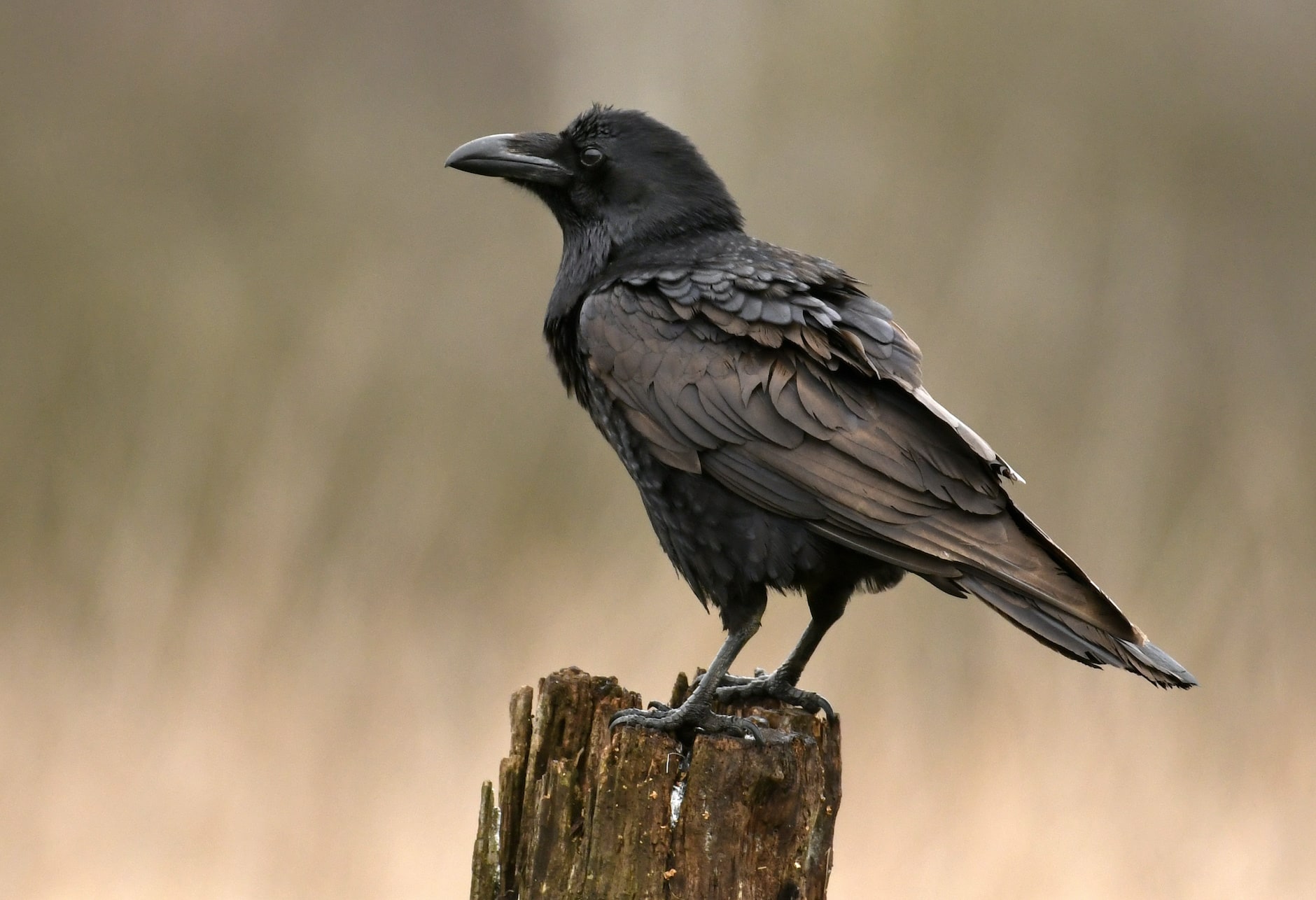
- Bill. Raven: heavier, hooked, with shaggy throat feathers (hackles). Crow: more slender, smoother.
- Flight. Raven: soars with eagle-like wing positioning. Crow: rarely soars; flaps consistently.
5 Raven Facts + Raven vs Crow ID (Detail)
Below are the original 5 detailed facts plus the raven vs crow comparison and bonus notes.
1. Ravens are playful creatures
Ravens are acrobats in the sky. They surf updrafts, fly upside down and even turn somersaults, just because they can. Young ravens have been seen playing a fun game of catch by dropping sticks while in flight and then quickly swooping to catch it before it hits the ground.
2. Ravens can talk and sing
They have a vast repertoire of 100 or more vocalizations. With their deep voice, ravens can mimic human speech and singing and can imitate other bird sounds. They call to inform their mate to join them when food is found.
2. Ravens are clever and intelligent
These clever and cunning birds often work as a pair to acquire food. One raven will lure a parent bird away from its nest, while the other swoops in to feed on the eggs or hatchlings. Ravens have been known to call and lead wolves to a carcass to tear through the tough animal hide, so it can easily dine on the soft innards. These smart birds have been known to pull an ice fisherman’s line up from the icy waters and dine on the caught fish.
4. Ravens eat anything they want
Being omnivores, ravens generally eat anything available. Ravens will dine on roadkill, or hunt their own prey for dinner. They also eat insects, eggs, seeds and berries, and even dung. These intelligent birds are known to store extra food away in secret hiding places for later. If a raven senses that another raven is watching where it is about to hide food, it will pretend to stash the food in one place, but will actually hide it in a different spot.
5. The Raven in Legend, Literature, and Lore

The raven has been symbolically depicted in literature and legends throughout history in cultures around the world. In the famous poem, The Raven, Edgar Allan Poe refers to the raven that taps on the narrator’s chamber door on a dark December night as a “grim, ungainly, ghastly, gaunt, and ominous bird of yore.” The bird’s ability to speak is revealed throughout the poem as the raven says “nevermore.” The raven’s appearance at midnight symbolizes death and a painful reminder of the lonely and sorrowful state of the narrator.
Did You Know…
The raven is a symbolic figure in numerous Native American legends. In some indigenous groups, tales portray the raven as being mischievous and an evil omen. In the Pacific Northwest, Native American mythology depicts the raven in a positive light, as being the creator of the world.

Ravens FAQ
Can ravens really talk?
Yes, in captivity. Like parrots, ravens have the vocal anatomy and intelligence to mimic human speech, dog barks, alarm clocks, and many other sounds. Wild ravens have a complex natural vocabulary of 30+ distinct calls but rarely mimic human speech without close exposure.
How smart are ravens?
Per NIH PubMed corvid cognition research, ravens score comparable to great apes on multi-step problem-solving tests. They use tools, plan for future tasks, recognize individual humans, and engage in play behavior. The corvid family (ravens, crows, magpies, jays) is the most intelligent bird group studied.
What is the difference between a raven and a crow?
Size (ravens are larger, 24 to 27 inches), tail shape (raven wedge, crow fan), voice (raven croaks, crow caws), bill (raven heavier with throat hackles), and flight (raven soars, crow flaps). Side-by-side they are easy to tell apart; from a distance the sound is the easiest cue.
Are ravens good or bad luck in folklore?
Both, depending on culture. Norse mythology: Odin’s two ravens (Huginn and Muninn) bring wisdom from across the world. Northwest Coast Indigenous: Raven is creator and trickster. European folk: often portends death or bad news. Modern: largely positive, especially in cities where ravens have adapted.
Where do ravens live in North America?
Across most of Canada, Alaska, the western US, the Rockies, the Sierras, and increasingly the Appalachians. Largely absent from the central US lowlands and southeast. Cornell Lab maps show ongoing eastern range expansion.


Deborah Tukua
Deborah Tukua is a natural living, healthy lifestyle writer and author of 7 non-fiction books, including Pearls of Garden Wisdom: Time-Saving Tips and Techniques from a Country Home, Pearls of Country Wisdom: Hints from a Small Town on Keeping Garden and Home, and Naturally Sweet Blender Treats. Tukua has been a writer for the Farmers' Almanac since 2004.
- Deborah Tukua

- Deborah Tukua
- Deborah Tukua

- Deborah Tukua


I saw a raven free fall off a light pole maybe 20’ high the other day. I’ve never seen that before. Later when I went to see if I could find it, the raven wasn’t there. I don’t think it could have flown after that though. I may have missed seeing it too, but I don’t think so. Any ideas?
Plenty of crows here in the southern half of Georgia but I’m not sure about ravens.
Interesting!
We just moved to our place near Yosemite in CA. We have Ravens that fly around & we started feeding them. We give them boneless chicken, a chicken egg & fresh raw meatballs. We place on a rock & he/she comes around 11am each morning and takes the food; sometimes eats a bit & other times taking it to the nest? The raven does a hoppy dance thing before taking the food & we wonder why…also if other predators come we chase them away so they don’t take the food first. If we put it out late, we see the raven flying about, seemingly waiting for brunch! Anyway, we love our raven; maybe someday we will be gifted.
I have a pair of ravens that are sleeping in my barn. I believe it is a convenient and close for them to steal the duck eggs from the pond area and feed on the horse manure. Not sure whether I want them there or not. Every now and again I will lose a duck too, not sure whether the ravens are the killers or the resident eagle…………. but the ravens are the ones that get caught ravaging the carcass. Any suggestions.
I found a injured young raven in July of 2019. He couldn’t fly..not sure if it was his wing or rib that was messed up..i was at a busy casino. I had given him ice and some cracker pieces. He was breathing hard and panting. I debated for several hours..not wanting to mess with nature. but asked him if he wanted to come.with me. My husband was tired of it. Grabbed a box and put him in it. I raise peacocks about 44 of them. Blues, whites, pied, green. Some are free range. I have learned the whites do not well free because the other birds beat them up and pick on them. So i bring the raven home, put him in a standard peacock coop..(which he hates)(he is terrified..every time I come near it he almost wounds himself in the chicken wire to get away. I opened the door to his pen about 5 months later when I saw him fly inside the pen. He stayed around as a free bird.I would say “where is my raven?” When i fed my peacocks and he would come walking…trying to fit in…while being shooed away by other birds. He became more confident and pushed his way through the pecking order..One day 2.more ravens showed up…I am assuming these are females. I had a wounded expensive white female pied peahen in a coop. She had a heat lamp and i gave her extra attention and made sure she ate every day..I have a bunch of animals, 3 kids and own a shop so I am usually in a hurry. My son called me one day and told me she had died. I asked how and he said he thought the cats did it. I thought very strange and when i came home looked at hours of footage on the security cameras. I couldn’t believe it but saw the raven find an open slot in her coop and slaughter her for about 45 minutes. Peacocks are pretty large birds..The other day when I went to feed, i found my favorite male pied peacock Bruce slaughtered and licked clean.I am blown away..this also happened in a blind spot so the camera didn’t catch anything. I think it was the OTHER raven and not my raven but we cannot do this anymore. Peacocks are easy, beautiful, mild tempered creatures. I can’t let anything terrorize and kill them. Has anyone ever heard of a raven killing a bird as large as a peacock?
Hi Leah, wow, such a sad story. Here you were trying to something nice and it didn’t turn out well. We haven’t heard of this behavior, but perhaps a specialist might know. It’s always wise to call Animal Control if you find an injured wild animal. You just never know.
For anyone reading this take heed, if you find a wounded wild animal – best to take it to a vet, unless it’s too dangerous to do so.
We recommend that if you find wounded wildlife, do not attempt to transport it, but to call wildlife officials, which can be connected through your local police.
The sad problem is by doing that your dooming most wild animals to a death sentence. That includes baby Deer, Raccoons or most any other kind of wild animal. Thankfully here in Arkansas, there are no laws that I’m aware of regarding us taking care of wild life, unless it’s taking care of baby Deer now, due to the wasting disease. 🙁 I have had good success with many types of wild animals over many years and love when they are well enough to release. 🙂 I’m a nurturer and feel blessed with each experience. <3 If you can do this, you may save the life of your wild thing….. Find a REHAB-ER!!!! They are often trained, and LOVE caring for wild things to release back into the wild. They try hard to save everything given to them. Wild life officials seem to me not to have the time to give to most injured wild things and like I said, if you call them…. Most times the animals are killed. That includes Raccoons and Possums. I am on a Raccoon page, A Possum Page, A Spider page and a Snake Page. Each of these Rehabbers, LOVE their babies as much as you love your Cats or Dogs. 🙂 <3
we lost our peacock to a mink, the biggest thing our local ravens have killed is a small duck.
Come to Interior Alaska. We have ravens and finches year round and jays in May-July all through the towns. They are everywhere.
Well written article. From experience, I believe #3 and #4 feed another trait I see ravens do a lot, and that is curiosity worse than a cat. Starting a couple of years ago, there was this larger older raven that will sit on the poles and trees around my house, hold raven-to-human conversations with me, my wife, my neighbors, come down to see what we’re doing inside our houses, and even went in my neighbor’s entry way.
<3
Love this…. 🙂
I am fascinated with this bird but would love for someone to tell me is it good luck or bad luck God knows I dont need anymore bad…..I wanted to get a car decal with the bird and the word “Nevermore”
Hi Margaret, we found some information for you on raven symbolism: https://corbiemitleid.com/divination/spirit-guides/are-ravens-good-omens-or-bad-omens/
I never knew that ravens can be used as pets
hello