

Why You Should Go Nuts For Brazil Nuts
These three-sided, impossible-to-open, dark-shelled nuts could very well be one of the world's greatest superfoods. Learn more about Brazil nuts and see how they grow!
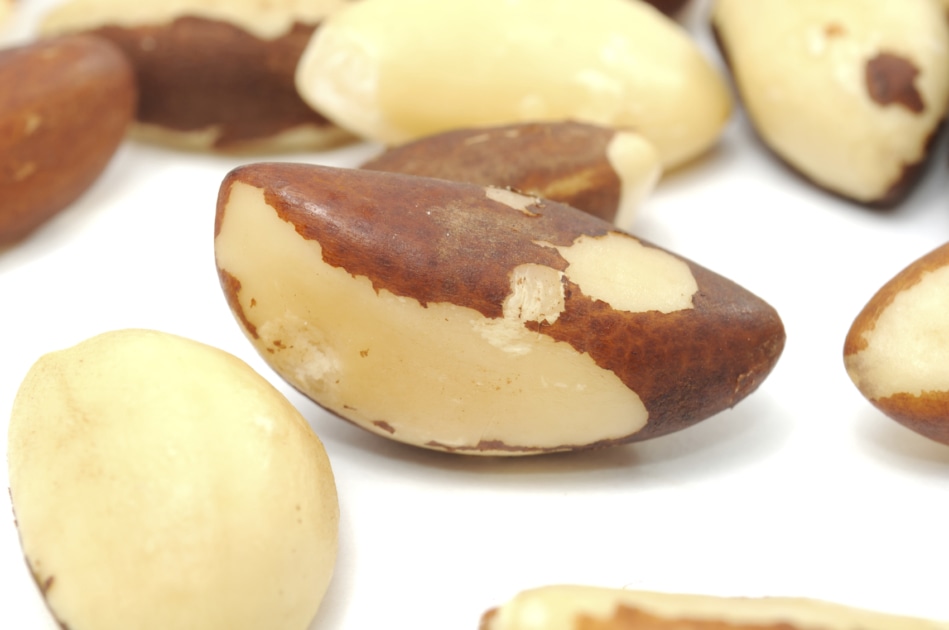
Quick Reference: Brazil Nuts
- Selenium powerhouse: one Brazil nut delivers 95 to 175 mcg, more than the U.S. RDA of 55 mcg. Two a day is plenty.
- What it grows on: the wild Amazonian Bertholletia excelsa tree, 100 to 165 ft tall. Pods drop with the force of a coconut.
- Where they come from: not Brazil mostly. About 50% from Bolivia, 40% Brazil, 10% Peru. Plantation-grown trees underperform.
- The pollinator riddle: orchid bees pollinate, which need fragrant orchids, which need agoutis to spread seeds. Remove any one and the tree fails.
- Complete protein: all 9 essential amino acids, rare among nuts.
- Storage: high oil content. Sealed jar in fridge or freezer to prevent rancidity.
Brazil nuts could very well be one of the world’s greatest superfoods. If you have ever tried to crack one open, then you can definitely attest to the super strength of their hulls. As it turns out, the fight to crack that shell is totally worth it. Science has proved that Brazil nuts come with a few amazing health benefits. Not only that, but you will be surprised to learn about the weird way these nuts grow and how they are harvested. For dietary numbers, the National Institutes of Health publishes the selenium fact sheet that drives most of the nutrition advice below.
The Strange Way Brazil Nuts Grow
One of the strangest things about Brazil nuts, Bertholletia excelsa, is the way they grow. Rather than producing singular nuts like many nut trees, Brazil nut trees produce large, woody capsules that look a lot like a coconut. Once you break through that tough shell (which is even harder than cracking open the nuts themselves), you will find anywhere between 8 and 24 Brazil nuts inside.
If you think the coconut-style pods are odd, the requirements that Brazil nut trees need to survive and reproduce are even stranger. These trees have incredibly specific ecological requirements that involve orchids, bees, and a small mammal called the agouti.
The Brazil nut tree needs orchid bees to pollinate its flowers so that it can produce the nuts. Those orchid bees need to be near fragrant orchids so that they can attract mates and reproduce. The final piece of the puzzle is the agouti, a small animal similar to a guinea pig; the only animal around with teeth sharp enough and jaws strong enough to crack open the woody husk and get to the nuts inside. Agoutis will eat a few of the nuts and then bury the rest for later, effectively planting the Brazil nut seeds.
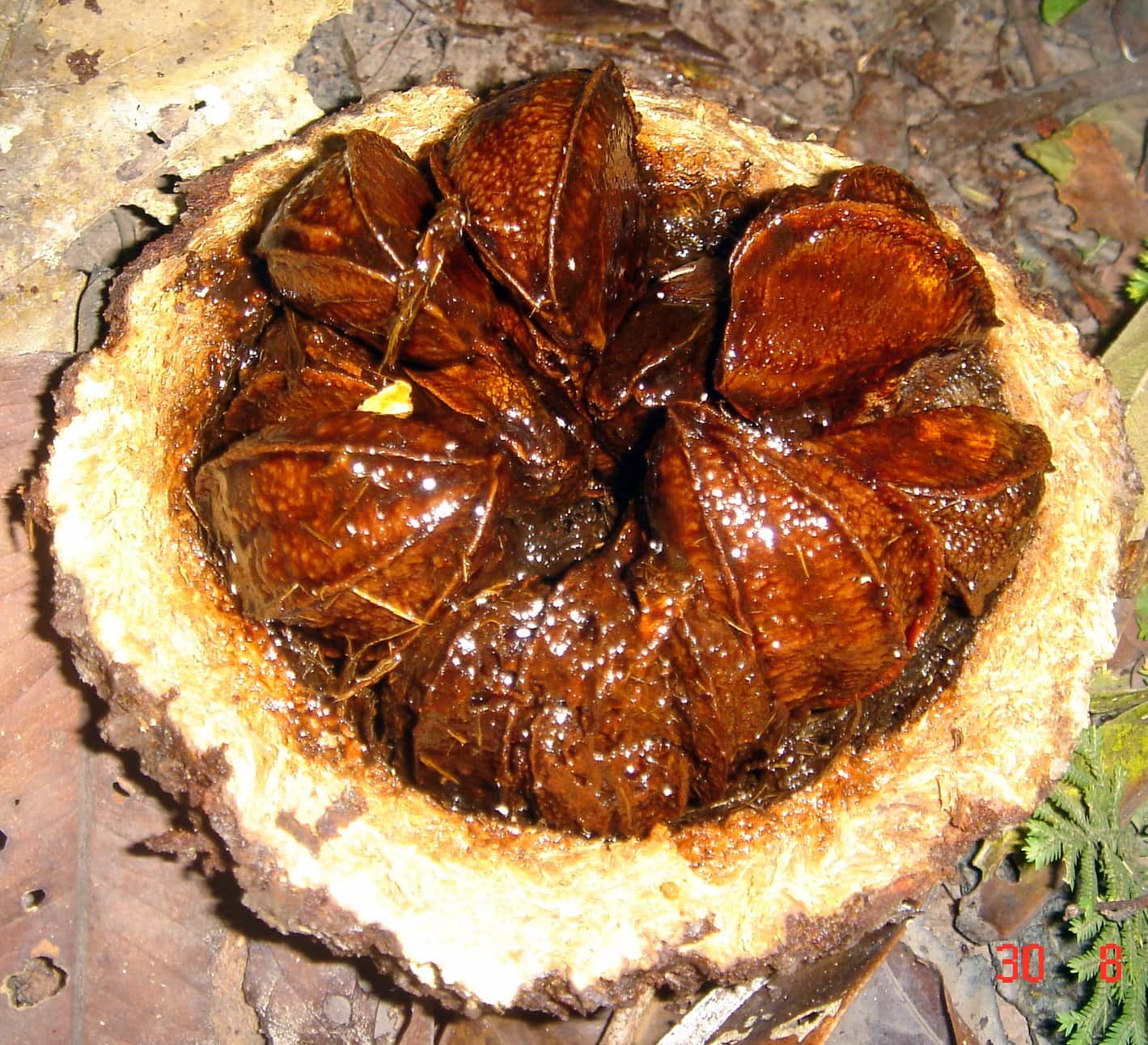
Scientists have found that if you remove even one of these pieces of the puzzle, agoutis, orchids, or orchid bees, then Brazil nut trees simply cannot survive or reproduce. The trees are also so dependent on intact rainforest that they are considered an “indicator species” for healthy Amazon canopy.
Harvesting Brazil Nuts
It sounds odd, but most of the world’s Brazil nuts do not come from Brazil. Only 40 percent come from Brazil, while 50 percent come from Bolivia and another 10 percent come from Peru. A small portion of these nuts are grown on plantations, but for the reasons listed above, plantations simply are not capable of producing many nuts. Instead, Brazil nuts are harvested by castanheiros, migrant workers willing to brave the Amazonian forest and the dangers of falling Brazil nut pods (which weigh up to 5 pounds and fall from 100+ ft) to collect Brazil nuts.
The Amazing Health Benefits of Brazil Nuts
One of the most surprising things about these delectable nuts is that they come with a variety of health benefits. A study published in the Journal of Nutrition and Metabolism showed that one serving (4 to 6 nuts) per month not only drastically lowered cholesterol levels but also kept them down.
- They are great for the heart. These nuts are packed with calcium, potassium, and magnesium, which helps keep blood pressure under control. They are also loaded with monounsaturated and polyunsaturated fats (good fats), which are known to lower risks for cardiovascular disease.
- Brazil nuts are an excellent source of selenium, a disease-preventing antioxidant. They also contain plenty of thiamine, a vitamin that supports the nervous system, and copper, which is essential for cell energy and tissue growth.
- They are one of the few non-meat foods that contain all nine amino acids that humans need, making them a complete protein source.
- Even though Brazil nuts are a healthy source of fat, too much of a good thing can be bad. A serving of six Brazil nuts contains 185 calories and about 29 percent of your daily requirement for fat: approximately 4.3 grams of saturated fat, 6.9 grams of monounsaturated fat, and 5.8 grams of polyunsaturated fat. All of these fats are good for you as long as you stay within daily limits. A serving of six also has 5.1 milligrams of omega-3 fatty acids and 5,809 milligrams of omega-6 fatty acids, both linked to a reduced risk for heart disease, lowered blood pressure, and reduced inflammation.
If Brazil nuts are so great, why do not more people cook with them? These days some people are. Look around online and you will find recipes for Brazil nut milk, fruit cakes with Brazil nuts, and much more. Before modern use, there were several things that made Brazil nuts uncommon, not the least of which is the difficulty in harvesting them.
Brazil nuts, because of their high oil content, tend to go rancid if kept for too long. To maximize their shelf life, store shelled Brazil nuts in a cool, dry place in a sealed container. They can even be stored in the refrigerator or freezer to further preserve them.
Brazil Nuts: Daily Dose Cheat Sheet
| Metric | Value | Notes |
|---|---|---|
| Serving size (1 nut) | Approximately 5 g | A standard 1 oz (28.35 g) serving equals roughly 6-8 nuts. (USDA FoodData Central, FDC ID 170569) |
| Calories (per 1 oz / 28 g serving) | Approximately 186 kcal | Derived from 659 kcal per 100 g. High energy density due to fat content. (USDA FoodData Central, FDC ID 170569) |
| Total fat (per 1 oz serving) | Approximately 19 g | 66 g fat per 100 g, predominantly monounsaturated and polyunsaturated fats. (USDA FoodData Central, FDC ID 170569) |
| Selenium per single nut | Approximately 96 mcg (USDA average) | Highly variable. Documented range in research: 0.03 to 512 mcg per gram depending on soil selenium content and geographic origin. A single nut can range from negligible to well above the RDA. (USDA FoodData Central; ZRT Laboratory) |
| Selenium per 1 oz serving (6-8 nuts) | Approximately 544 mcg (USDA average) | This exceeds the adult Tolerable Upper Intake Level (400 mcg) in a single standard serving. Do not rely on this as a consistent dose due to natural variability between individual nuts. (USDA FoodData Central, FDC ID 170569) |
| Recommended Dietary Allowance (RDA) for adults | 55 mcg/day | Same for men and women aged 19 and older. Pregnant women: 60 mcg/day; breastfeeding women: 70 mcg/day. (NIH Office of Dietary Supplements, Selenium Fact Sheet for Health Professionals) |
| Tolerable Upper Intake Level (UL) for adults | 400 mcg/day | Set by the Institute of Medicine. Applies to adults 19 and older. UL is lower for children and adolescents. (NIH Office of Dietary Supplements; NCBI Bookshelf NBK225470) |
| Nuts needed to reach the UL (using USDA average) | Roughly 4-5 nuts | At the USDA average of approximately 96 mcg per nut, the 400 mcg UL is reached at about 4 nuts. Because real-world content varies widely, even 1-2 nuts from high-selenium soil could exceed the UL. (NIH ODS; ZRT Laboratory) |
| Selenosis risk | Real; onset with chronic excess | Regular overconsumption causes selenosis: early signs include garlic-odor breath, metallic taste, brittle nails, and hair loss. Severe cases involve nausea, nerve damage, and kidney failure. Adverse effects documented above approximately 1,500 mcg/day. (NIH ODS) |
| Magnesium (per 1 oz serving) | Approximately 107 mg (28% DV) | One of the richest nut sources of magnesium. Supports muscle and nerve function. (USDA FoodData Central, FDC ID 170569) |
| Thiamine / Vitamin B1 (per 1 oz serving) | Approximately 0.18 mg (15% DV) | Supports energy metabolism. (USDA FoodData Central, FDC ID 170569) |
| Copper (per 1 oz serving) | Approximately 0.5 mg (56% DV) | Important for iron metabolism and connective tissue formation. (USDA FoodData Central, FDC ID 170569) |

Brazil Nuts FAQ
How many Brazil nuts should I eat a day?
One to two. A single Brazil nut already covers more than the U.S. daily target for selenium. Eating six or more daily for weeks can cause selenium toxicity (hair loss, brittle nails, breath like garlic).
Where do Brazil nuts come from?
Wild trees in the Amazon basin. About 50 percent of the global crop comes from Bolivia, 40 percent from Brazil, and 10 percent from Peru. Plantations underperform the wild trees.
Why are they so hard to crack?
The woody outer pod is even harder than the nut shell inside. In the wild, only the agouti (a large Amazonian rodent) has teeth strong enough to open it. At home, a sturdy nutcracker and patience do the job.
What makes the agouti so important?
It is the only animal that cracks open Brazil nut pods. After eating a few nuts, the agouti buries the rest as a winter cache. Forgotten caches sprout into the next generation of trees.
Are Brazil nuts a complete protein?
Yes. They contain all nine essential amino acids in measurable amounts, which is rare for a plant food. Pair them with rice or beans and you have an excellent vegetarian protein.
How should I store Brazil nuts?
In an airtight jar in the fridge for a few months, or the freezer for up to a year. The high oil content means a warm pantry will turn them rancid in weeks.
Can I be allergic to Brazil nuts?
Yes. Tree-nut allergies often include Brazil nuts. The protein 2S albumin is a known allergen. Anyone with a tree-nut allergy should treat them with the same caution as cashews or walnuts.
For more nut-and-seed reading from the Almanac kitchen, see our companion guides: maple syrup facts, where do peppercorns come from?, and discover fresh figs.



Amber Kanuckel
Amber Kanuckel is a freelance writer from rural Ohio who loves all things outdoors. She specializes in home, garden, environmental, and green living topics.
- Amber Kanuckel

- Amber Kanuckel

- Amber Kanuckel
- Amber Kanuckel





I have to say i absolutely love fresh brazil nuts in their shells. They have a wonderfull almost coconutty creaminness flavour and bite. Unfortunately for the longest time now, years and years in fact all we get at Christmas time are stale Brazil nuts on our shelves sold by Western Mixers Produce & Nuts. Inc sold under their branding “Treasured Harvest” from America. You can tell exactly how stale they are by their weight. The lighter the shells the less moisture is still in the kernal, also the kernals have an air space in the middle where the nut has shrunk these are too old to sell already and do not taste at all fesh and nice. These have a musty bland nastiness, plus the odd truly rancid one.
I miss the lovely brazil nuts we got before unfortunately these are the only ones we have been getting. They aren’t hard to crack with a nut cracker not like almonds and along wth Pecan nuts in their shells make lovely ornamental healthy and tasty Christmas treats.
Bring back fresh Brazil nuts please!
How do you crack them?
They are carried at Walmart in my area. Shelled and in a zippere plastic bag. Some in produce, some with the baking nuts.
Hi Rae, just make sure they pass the “sniff” test. If they smell rancid, return them. Like all nuts, Brazil nuts can spoil if not properly stored or packaged.
I have always liked these nuts! But I had a job that i had to sort them, Well, their was everything in them including big long black hairs! I didn’t eat them for a long time! I will buy them once in a while, Will never forget that job! But they are very good for you!!
I love eating the Brazil nuts so does my wife they have a great taste to them. True they are hard to crack so my wife makes me crack hers for her. She buys the mixed nuts and I have to pick all the Brazil nuts out for her.
Your wife is a lucky woman.
The price jumped so high that the fruit stand that used to have them stopped having them. People stopped buying them because they were so expensive.
The people that would love to eat them can’t afford them,
Hi Jewel, if you can find a store that sells them in bulk, you can just grab five or six for a reasonable price and reap the nutritional benefits.
I have ALWAYS loved Brazil nuts & now there’s even MORE reason to love them. Since I haven’t made the effort to eat them as much, I have been diagnosed with high cholesterol & diabetes.
I am going to buy some soon & start making a habit of eating them.
Good response….I am like you….I eat 3 a day