

Why Are Roosters on Weathervanes? A 1,200-Year-Old Story
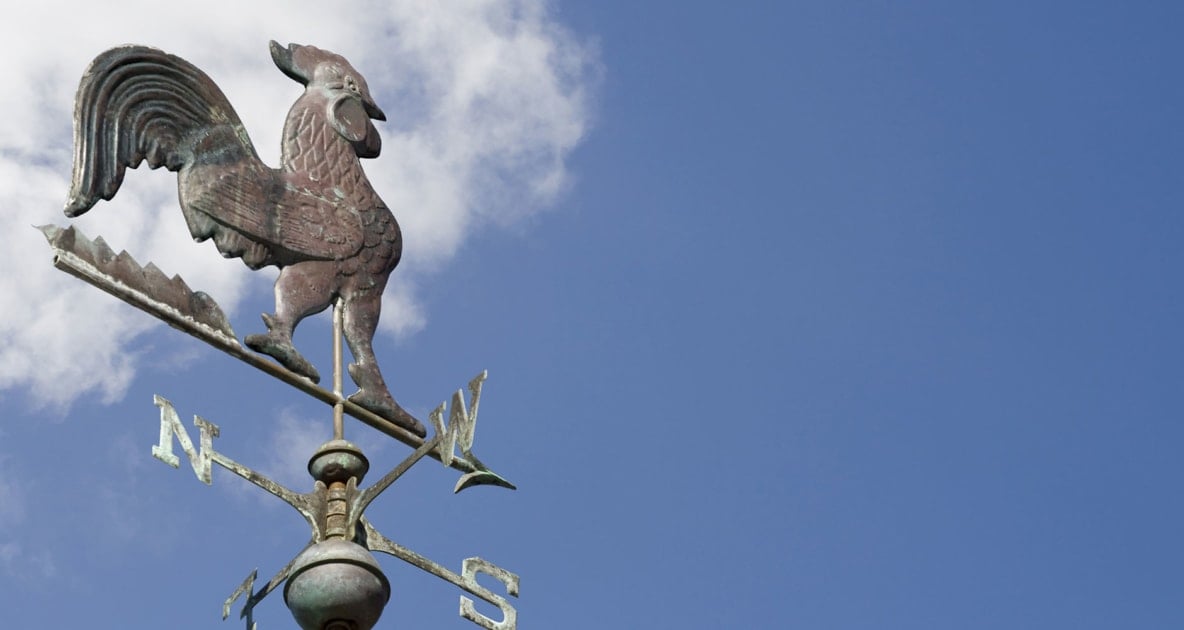
Quick Reference
- Why a rooster: the rooster became the symbol of St. Peter after the Last Supper passage in which he denied Jesus three times before the cock crowed.
- Who put it there: Pope Gregory I called the rooster “the most suitable symbol for Christianity” between 590 and 604 AD. Pope Nicholas made it official in the 9th century, decreeing all churches display the rooster.
- The oldest surviving rooster weathervane: the Gallo di Ramperto, copper, made between 820 and 830 AD. Currently in the Museo di Santa Giulia in Brescia, Italy.
- How to read one: the rooster (with arrow) points into the wind, showing where the wind is coming from, not where it is going.
- The components: the vane (rooster + arrow), the mast (vertical pole), and the directionals (the four-letter compass markers below). The directionals stay still; only the vane rotates.
Drive past any old American barn, New England town green, or European church steeple, and odds are good you will spot a rooster perched on top of a vertical pole, swinging in the wind. The rooster weathervane is so deeply embedded in Western architectural tradition that most people stop noticing it. But there is a story behind it, and the story runs back more than 1,200 years to a papal decree, an Italian copper-smith, and a biblical passage about a rooster crowing three times. Here is why the rooster ended up on top of every church and barn in Europe and America, and how to read one when you see it.
Ancient Origins of Weathervanes
The weathervane predates the rooster by centuries. The earliest weather-direction indicators were strings or strips of cloth tied to the tops of buildings. As the wind shifted, the strips streamed out in the direction the wind was going. The English word “vane” itself comes from the Old English fana, meaning “banner” or “flag,” which is exactly what the early devices were.
The first known mechanical weathervane in the form we recognize today was atop the Tower of the Winds in Athens, Greece, dated to the 1st century BC. The tower was capped with a bronze figure of Triton, the Greek sea-god, holding a rod that rotated to point in the direction the wind was coming from. The Tower of the Winds (still standing, near the Roman Agora in Athens) is the original of the architectural form: an octagonal tower with weather-direction indicators on top.
From Greece, the weathervane spread across Europe over the next several centuries. By the early Middle Ages, weathervanes were standard equipment on European church towers, civic buildings, and noble estates. The rotating figure on top varied: a cross, a saint, a knight, an animal, or some combination. There was no single standard.
The Rooster Becomes a Christian Symbol
The rooster’s path to the top of every church in Europe runs through a New Testament passage. In all four canonical Gospels (Matthew 26, Mark 14, Luke 22, John 13), Jesus tells his disciple Peter that Peter will deny knowing him three times before the rooster crows the next morning. Peter denies it. Within a few hours, after Jesus has been arrested, Peter does exactly what was predicted: three denials, three different challenges from bystanders, and then the cock crows in the courtyard. The Gospel narrative has Peter weeping bitterly when he realizes what he has done.
Because of this passage, the rooster became, in the early Christian church, the symbol of St. Peter and (by extension) of repentance, vigilance, and the call to face one’s failings. The cock’s crow at dawn was read as a daily reminder of Peter’s denial and his ultimate redemption. Early Christian art frequently paired Peter with a rooster.
Pope Gregory I Endorses the Rooster
The decisive theological move came from Pope Gregory I (also called Gregory the Great, who served as pope from 590 to 604 AD). In Gregory’s writings, the rooster is described as “the most suitable symbol of Christianity.” His reasoning combined the St. Peter association with the rooster’s daily crow at dawn (read as a metaphor for Christ’s resurrection from the night of death). The combination made the rooster, in Gregorian theology, the most fitting emblem for the church itself.
Gregory’s endorsement was not yet a formal decree to put roosters on every church. That came later. But in the centuries following Gregory’s pontificate, churches across Europe began voluntarily placing rooster figures on their towers and steeples in line with the symbolic meaning Gregory had popularized.
Pope Nicholas Makes It Official
The formal decree came from Pope Nicholas I (whose pontificate ran 858 to 867 AD). Nicholas issued a directive that all churches must display the rooster on their steeples or domes as a symbol of Peter’s denial and the daily call to vigilance. The decree formalized what was already a widespread practice and made it canonical.
The 9th-century timing is consistent with what archaeologists have found. The oldest surviving rooster weathervane in existence is the Gallo di Ramperto, a copper rooster dating to between 820 and 830 AD. The Gallo di Ramperto originally sat atop the bell tower of the San Faustino Church in Brescia, Italy. It survived 1,200 years (one of the few medieval architectural ornaments to make it intact through wars, fires, and renovations) and is now housed in the Museo di Santa Giulia in Brescia. The figure is roughly 15 inches tall, hand-hammered from copper, and shows clear stylistic similarities to other 9th-century Italian copper work. It is the closest direct evidence we have of what the earliest rooster weathervanes looked like.
From Church to Barn
Over the medieval and early modern centuries, the rooster spread from church towers to civic buildings, to country estates, and eventually to barns and farmhouses. The papal decree’s strict church-only application loosened over time. By the 1600s, rooster weathervanes were a standard sight on European farms, often hand-forged by local blacksmiths in the same workshops that produced horseshoes and tools.
European settlers carried the tradition to the Americas. By the 18th century, rooster weathervanes were a standard feature of New England churches and farms. Other animals (horses, fish, eagles, deer, pigs) became regional variations, but the rooster remained the most common nationally. The American folk-art weathervane tradition reached its peak in the 19th century, with itinerant tinsmiths producing decorative weathervanes for every farm and parish in their territory. Many of those antique weathervanes are now collected as folk art; well-preserved 19th-century rooster weathervanes can sell for tens of thousands of dollars at auction.

How to Read a Weathervane
For the broader weather-watching tradition that includes weathervanes alongside seasonal lore, see the Farmers’ Almanac long-range forecast and our rainbows piece. A modern weathervane has three parts:
- The vane: the rotating figure on top, usually a rooster mounted on or paired with an arrow. The vane spins freely on its mast.
- The mast: the vertical pole the vane rotates on.
- The directionals: four fixed letters or markers below the vane, indicating the four cardinal compass points (N, S, E, W).
The reading rule is the part most people get wrong. The arrow (and the rooster) points into the wind, toward the direction the wind is coming from. So if the rooster is pointing north, you have a north wind, meaning the wind is blowing from the north (toward the south).
Wind direction is named by where the wind is coming from, not where it is going. A “northeast wind” comes from the northeast and blows toward the southwest. A “south wind” comes from the south. The convention dates from sailing-ship navigation, where the origin of the wind was the only thing that mattered for setting sails.
Modern meteorologists still use the same convention. When a TV forecaster says the wind will be “out of the west at 15 mph,” they mean the wind is coming from the west and blowing toward the east. The weathervane’s rooster, pointing west in that case, would be doing exactly its 1,200-year-old job correctly.
Other Weathervane Designs
The rooster is dominant but never universal. Other animals appear in regional or trade-specific weathervane traditions:
- Horse: common on stables, racetrack buildings, and farmsteads associated with horses.
- Fish: common in coastal communities, ports, fish markets, and on Christian buildings (the fish is also an early Christian symbol, “ichthys”).
- Eagle: common on government buildings, especially in the U.S., and on Civil War-era structures.
- Deer or stag: common in hunting lodges and Adirondack-style buildings.
- Pig: common on butcher shops and farms specializing in pork.
- Whale: common in whaling-era New England ports.
- Indian or Native figure: a 19th-century American folk-art tradition, now considered offensive in many contexts and rarely produced in modern reproductions.
The rooster has held its dominance partly because of the deep theological origin and partly because the rooster’s tail-and-head profile produces an unusually clear visual silhouette at distance. A rooster pointing north looks unambiguously different from one pointing east. Other animal figures sometimes have less obvious orientation, especially when seen from far below.
For more on the bird-related weather traditions, see our bird weather lore piece. For broader animal weather folklore (including barnyard and farmyard signs), see animal weather folklore. For the broader history of the weathervane as architectural ornament, the Encyclopedia Britannica’s weather vane reference covers technical and cultural history.

Frequently Asked Questions
Why is there a rooster on weathervanes?
The rooster became the symbol of St. Peter after the New Testament passage in which Peter denies Jesus three times before the cock crows. Pope Gregory I called it “the most suitable symbol of Christianity” around 600 AD, and Pope Nicholas I made it official church practice in the 9th century.
How old is the oldest surviving rooster weathervane?
The Gallo di Ramperto, a copper rooster made between 820 and 830 AD, is the oldest known surviving example. It originally sat atop the San Faustino Church in Brescia, Italy, and is now housed in the Museo di Santa Giulia in Brescia.
Which way does a weathervane point?
The vane (rooster + arrow) points into the wind, showing the direction the wind is coming from. If the rooster points north, the wind is coming from the north (a “north wind”).
What is the oldest weathervane ever?
The bronze Triton figure atop the Tower of the Winds in Athens (1st century BC) is the oldest known mechanical weathervane. The tower itself is still standing near the Roman Agora in Athens.
Why are weathervanes also called weathercocks?
Because the rooster (or “cock,” in older English usage) has been the dominant figure on top of the device for so many centuries that the device became synonymous with the bird. “Weathercock” and “weathervane” mean the same thing.
Are antique weathervanes valuable?
Yes. Well-preserved 19th-century American rooster weathervanes can sell for tens of thousands of dollars at folk-art auctions. The most expensive verified sale was a 19th-century copper Indian-figure weathervane that sold at Sotheby’s for $5.84 million in 2006.
Why is the wind named for where it comes from?
The convention dates from sailing-ship navigation, where the origin of the wind was the only relevant fact for setting sails. The convention persisted through modern meteorology. A “south wind” is a wind coming from the south.


Amber Kanuckel
Amber Kanuckel is a freelance writer from rural Ohio who loves all things outdoors. She specializes in home, garden, environmental, and green living topics.
- Amber Kanuckel

- Amber Kanuckel

- Amber Kanuckel
- Amber Kanuckel





Am I missing something? This does not make sense, there is nothing in the article about “Americana”: <>
We have a train weather vane since my husband does garden railroading with G scale trains in our yard. Thanks for the info on them. It was very interesting.
Thanks once again for your interesting article on the weathevane, its meaning and message beihind it. Your articles are always so interestin and positive.
Why do some weathervane have an “O” on it and what is its meaning?
Just heard a clip about “o” on a weathervane and wondered what it meant and if that told the age of it.
I would think that if the wind was coming from the north the weathervane and rooster would turn to whatever way the wind blows it; but certainly not into the wind.
The weathervane is made to point into the wind. The front facing side weighs less than the back facing side. Thus, the heavier side faces opposite the side the wind is coming from.
Living in New England, I always saw the red barn, weather vane roosters…never wondered if they were of an origin …thank you for this article and actually all of them.
Even before we got home (…just did…) from a three week journey to Europe (…long beautiful story as to why…), and hiking through the countryside in Germany where some good friends lived, I asked about the rooster on churches. They had some good explanation…and yours was even better…thank you!!! In France, Switzerland and Germany…the latter where we were for a week with our 98yo hero of a brother-in-law who was in the first landing craft on Normandy on DDay 75 years ago…I noticed that roosters seemed to be more on Protestant churches than any other…is that correct…or what I just paying enough attention? And…keep up your good work in here…….thanx!!!
Thanks, Wes! We appreciate the feedback. Glad you had such a nice adventure!
‘@Keith- Poseidon was the father of Triton. Triton was the messenger of the Sea, which is probably why he was associated with wind/on weather vanes.
The three-pronged weapon you’re thinking of is a typically referred to as a trident. Easy mistake for you to make, trident and Triton being similar words and both associated with Poseidon, but it’s good form to make sure you’re not the one that’s wrong before calling out someone else 😉
I enjoyed the article. Thank you for the interesting information.
Why must everyone take something written for simple pleasure and turn it into a religious criticism. So what lady or man who commented about the Catholics, get a life. And so what who cares if poseidon holds a Triton or if the Triton is stuck up your @$$.
Amber Kanuckel, this is such a well-written, clear, concise, informative, and above all, fun article to read. Thank you so much for the history of weathervanes, the story of the roosters inclusion, and especially the last bit on how to read one. Great stuff, Amber!