

van Gogh’s Starry Night: The Real Stars in the Sky
One of the most recognizable and reproduced pieces of art in the world is van Gogh's Starry Night masterpiece. See what astronomers and art historians say were the visible stars and planets that inspired the Dutch painter back in 1889.
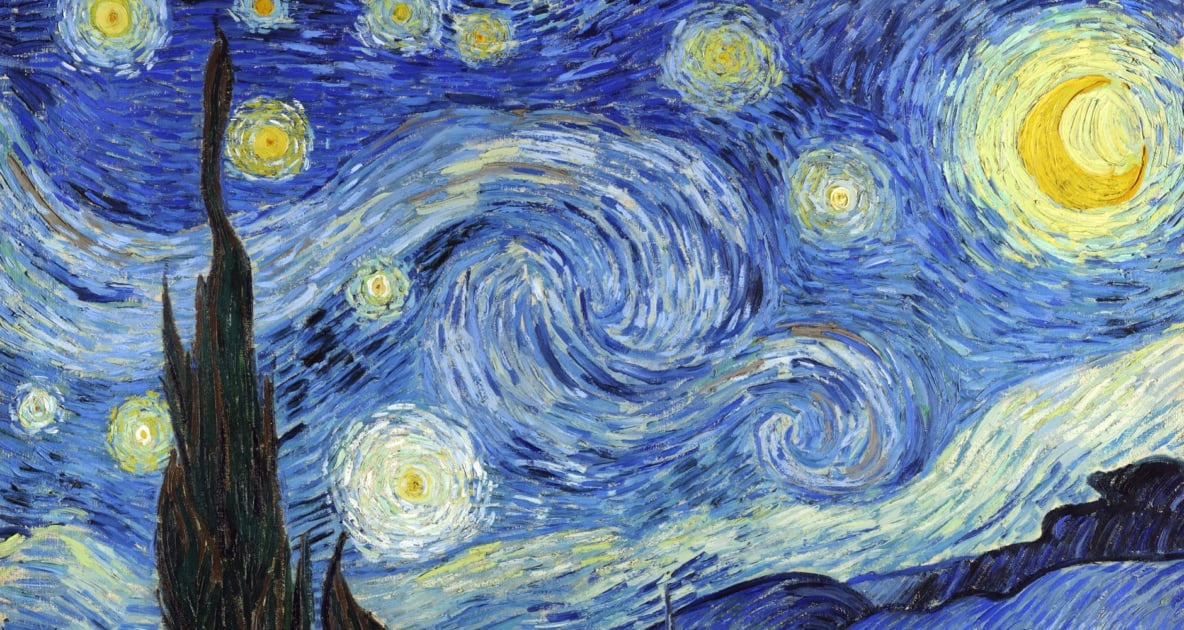
Quick Reference: The Real Sky in van Gogh’s Starry Night
- Painted: finished June 19, 1889, at the Saint-Remy-de-Provence asylum in southern France.
- Brightest object: Venus, the bright “star” to the right of the cypress tree.
- The Moon: painted as a crescent with a halo, though it was really a waning gibbous near Last Quarter.
- Constellations present: Capella, Cassiopeia, and Pegasus.
- Where it hangs now: the Museum of Modern Art in New York, since 1941.
On June 19, 1889, the Dutch post-impressionist painter Vincent van Gogh finished his Starry Night masterpiece. The swirling blues and glowing orbs look like pure imagination, yet astronomers who have studied van Gogh’s Starry Night say the sky he painted holds real stars and at least one bright planet. Here is what he was looking at, and how you can find some of the same lights tonight.
The most widely known bit of information about van Gogh, of course, is that he cut off his left ear, which happened one December night near Christmas, 1888. The details of that event are still hotly debated. Was it because of unrequited love? A fight with fellow painter Paul Gauguin? History does not dispute that van Gogh suffered a mental breakdown, which led him to voluntarily commit himself the following May to Saint-Remy-de-Provence, an asylum in Southern France.
View From A Window
From the barred window of his room in the former monastery, which overlooked a courtyard, van Gogh could see the eastern sky. That view inspired him to paint.
The hospital staff did not allow van Gogh to paint in his bedroom, but he was allowed to sketch with charcoal, and he did so every day. He wrote to his brother Theo about the view outside his window, which he captured at different times of day and under different weather, through clouds, rain, and sun. Eventually he finished the piece using oil paint on canvas. What he set down was not a snapshot but a memory of the sky, reworked from his sketches and reshaped by his own hand.

What Did van Gogh See From His Asylum Window?
An art history professor at UCLA, with the help of astronomers, set out to identify the objects in the night sky depicted in Starry Night as van Gogh saw them from that asylum window in 1889. The scholar behind the study was the late Albert Boime, whose research matched the painted sky to the real one over Saint-Remy.
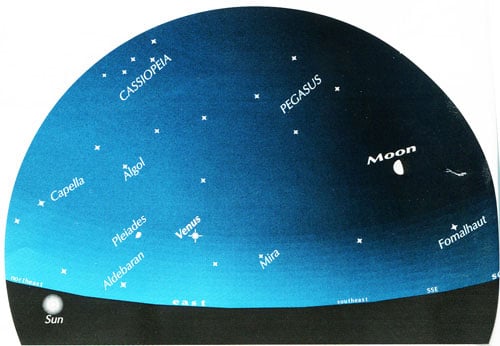
They determined that the scene could have been at 4 a.m. on June 19th. One of van Gogh’s brightest stars in his painting, to the right of the cypress tree, would have been Venus. In the upper right-hand corner is van Gogh’s Moon, which is not astronomically correct. The Moon would have been waning gibbous, just before Last Quarter at that time, yet van Gogh took some artistic liberties and painted it as a crescent Moon with a bright halo. The other stars and constellations, such as Capella, Cassiopeia, and Pegasus, are all there in the piece.
The Real Stars Behind van Gogh’s Starry Night
Once you know where to look, the painting reads almost like a star chart. The single brightest point, glowing to the right of the dark cypress, is Venus. In June 1889 the planet was riding high as the Morning Star, the last light to fade as dawn came up, which is exactly the role it plays in the painting. You can still catch Venus in that same guise today, and our guide to the visible planets explains when it shows as a morning or an evening star.
The rest of the glowing orbs are not filler. Capella, one of the brightest stars in the northern sky, sits in the constellation Auriga the Charioteer. Cassiopeia, the tilted “W” that wheels around the North Star, is there too, along with the great square of Pegasus. Van Gogh did not paint them with a surveyor’s accuracy, but he kept the shape and the feel of the eastern sky he studied night after night. For a plainer map of these same shapes, our guide to the constellations is a good place to start.
The Moon He Changed
The one object van Gogh clearly reshaped is the Moon. Astronomers say it should have been a waning gibbous sliding toward Last Quarter, better than half full and shrinking. Instead he painted a slim crescent wrapped in a bright halo, tucked into the upper right corner. Nobody knows for certain why, but the crescent gives the corner a curl of light that answers the great spiral in the center of the sky. It was a painter’s choice, not an error of memory.
The Moon runs through the same eight phases every month, from new to full and back again, whether or not anyone paints it. If you want to know which phase is overhead tonight, our explainer on the phases of the Moon lays out the cycle, and if you would rather chase a streak of light, our guide to meteor showers lists the year’s best nights.
See These Stars and Planets Yourself
You do not need an asylum window or a paintbrush to see what van Gogh saw. Venus is the easiest target of all, bright enough to spot from a city sidewalk in the hour before sunrise or after sunset, depending on the season. Cassiopeia and Capella climb the northern and eastern sky through the cooler months, and Pegasus rides high in autumn.
- Give your eyes 20 minutes in the dark to adjust, away from porch lights and screens.
- Find Venus first. It is the brightest thing in the sky after the Moon and does not twinkle the way stars do.
- Use the crescent or gibbous Moon as a signpost, then work outward to the fainter stars.
- A clear, dry night beats a warm one. Check the forecast before you head out.
For a month-by-month rundown of which planets are up and when, keep our full Moon dates and times close at hand. Half the pleasure is knowing that the sky over your own backyard is the same one that stopped a painter in his tracks more than a century ago.
So the next time you see a print of Starry Night, or the real thing (the original painting has hung at the Museum of Modern Art since 1941), remember van Gogh, the ultimate stargazer, and step outside to find Venus for yourself.

van Gogh’s Starry Night: Frequently Asked Questions
What stars and planets are in van Gogh’s Starry Night?
Astronomers who studied the painting identified the bright object to the right of the cypress tree as the planet Venus. The constellations Capella, Cassiopeia, and Pegasus also appear in the sky, along with a crescent Moon in the upper right corner.
When and where did van Gogh paint Starry Night?
Van Gogh finished the painting on June 19, 1889, while he was a patient at the Saint-Remy-de-Provence asylum in southern France. He painted the eastern sky he could see from the barred window of his room, working from daily charcoal sketches.
Is the Moon in Starry Night astronomically correct?
No. On the night in question the Moon would have been a waning gibbous, just before Last Quarter. Van Gogh took artistic liberty and painted it as a slim crescent with a bright halo instead, which is one of the few clear departures from the real sky.
How do we know which stars van Gogh painted?
An art history professor at UCLA, the late Albert Boime, worked with astronomers to reconstruct the sky over Saint-Remy in June 1889. By matching the painted objects to the calculated positions of stars and planets, they concluded the scene fits roughly 4 a.m. on June 19th.
Can I see the same stars and planets that inspired van Gogh?
Yes. Venus is easy to spot as the brightest point in the sky near sunrise or sunset, and Cassiopeia, Capella, and Pegasus are visible to the naked eye on a clear, dark night. Give your eyes about 20 minutes to adjust and start with Venus.
Where is the original Starry Night painting today?
The original has hung at the Museum of Modern Art in New York City since 1941. Countless prints and reproductions circulate, but the canvas van Gogh painted at Saint-Remy lives at MoMA.


This article was published by the Staff at FarmersAlmanac.com. Any questions? Contact us at [email protected].
- Farmers' Almanac Staff

- Farmers' Almanac Staff

- Farmers' Almanac Staff

- Farmers' Almanac Staff



It would be nice if you named the “art history professor” and maybe even gave a link to his original study… One of the main tricks to detect fake information online is that there is no named author or link to the original study… It’s too bad your present post seems to be one of those “fake news” when it would be so simple to add some information to it like the original researcher’s name and link to his study…
Under point 8 you write that he took artistic liberties and painted a crescent but I think it was in fact a waxing gibbous. The waxing gibbous started around June 7 and lasted until June 12-13. If his window was oriented towards the East, there is a good chance he could have seen it between 3 and 9 pm. But it is definitely not a crescent. Had it been a crescent, the darker yellow would have occupied the right side of the Moon, not the left. That is unless one looks at it from the Southern hemisphere.
THERE ARE SO MUCH COOL FACTS
I do know that Van Gogh was taking digitalis. That “drug” can make glowing circles appear around lights (stars). Thus his rendition of the stars at night!