

July Weather Lore: Dog Days, St. Swithin’s Day, and Cloud-Watching Folk Forecasts
July is the start of many summer events that prompted a wave of weather folklore sayings. See the list!
Quick Reference: July Weather Lore at a Glance
- Dog Days of Summer: July 3 to August 11, traditionally tied to the rising of Sirius, the Dog Star, with the Sun.
- July 4, Knee-High by the Fourth: old corn-crop benchmark; modern hybrids beat it easily by a wide margin.
- July 15, St. Swithin’s Day: rain on July 15 supposedly means 40 more days of rain (English origin).
- July 25, Puffy clouds rule: tall cumulus on this day is said to foretell a snowy winter.
- July 26, St. Anne’s Day: rain on St. Anne’s supposedly continues “for a month and a week.”
- Old mariner rule: wind from the west is best; east is bad luck for “neither man nor beast.”
If you dive into any dictionary to explore the meaning of “lore,” you will find it described as a body of knowledge, often traditional or anecdotal, that revolves around a particular subject. At Farmers’ Almanac, we are enthusiasts of weather lore, and July’s anecdotes have a special charm: dog stars, Saint days, corn benchmarks, cloud-watching, and mariner verses, all stitched into one of the most weather-rich months on the calendar. For independent background on the season, see Encyclopaedia Britannica’s entry on the Dog Days.
The Dog Days of Summer Kick Off
July 3 marks the beginning of the “Dog Days of Summer.” Spanning from July 3 to August 11, this period marks when the Sun aligns with Sirius, the Dog Star, in the constellation Canis Major. In ancient times (Greek, Roman, and Egyptian alike), people believed that this celestial event resulted in scorching hot weather when Sirius and the Sun worked together to amplify the heat. The astronomy has shifted slightly over the centuries (precession means Sirius rises at a slightly different time now than in Pliny’s day), but the calendar window stuck. For an independent reference on the star itself, see Britannica’s entry on Sirius.
Important July Dates And Their Weather Lore Connections
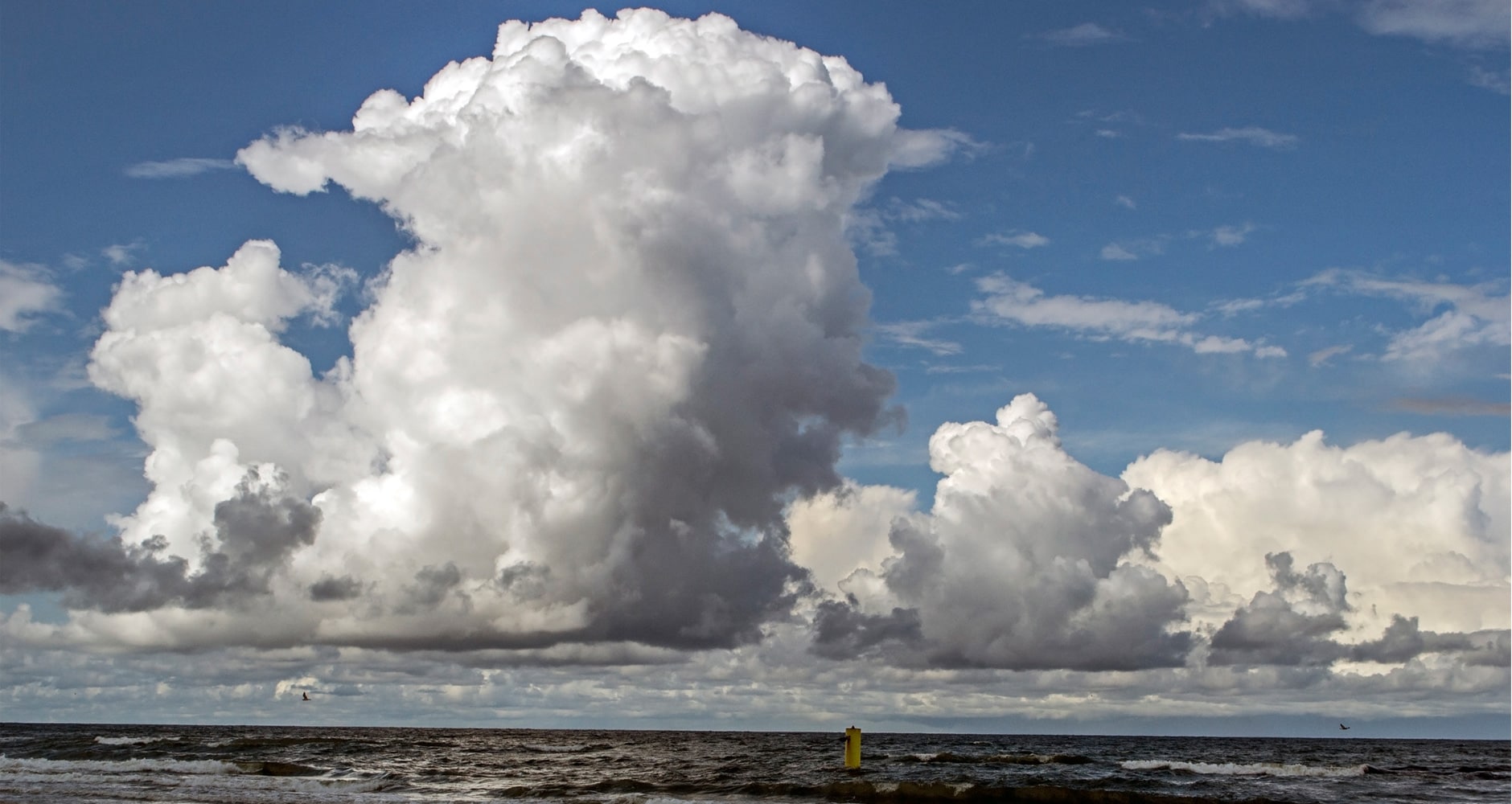
July 4, Knee-High By The Fourth of July. This is an old saying once used by farmers to measure the success of their corn crops; if it had grown knee-high by Independence Day, it was a good sign and meant they could count on high yields for the year. Today, due to advances in agriculture, hybrid seed, growing techniques, and better disease and pest control, corn farmers can expect plants to reach 6 to 8 feet by July 4 in much of the Corn Belt, according to the Iowa Corn Growers Association. Now, knee-high does not quite measure up; it would be a worrying signal, not a hopeful one.
July 15, St. Swithin’s Day. If on St. Swithin’s Day ye do rain, for forty days it will remain. Tied to a 9th-century English bishop of Winchester; the verse has hung on for centuries in British and American farm calendars.
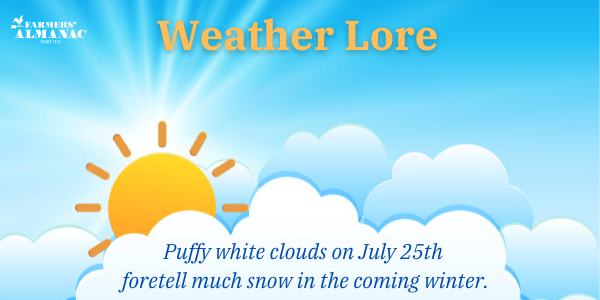
July 25. Puffy white clouds on this day foretells much snow in the coming winter. A classic cloud-watching folk forecast that aligns mid-summer atmospheric instability with winter precipitation.
July 26, St. Anne’s Day. Rain on St. Anne’s will continue for a month and a week. Catholic-calendar lore tied to the feast of Anne, the mother of the Virgin Mary, also a patron saint of homemakers and rain.
But there are many more sayings, gathered over centuries from sailors, farmers, hunters, and homemakers who watched the sky for a living.
July Weather Lore, Quick Reference Table
More July Weather Lore: You Heard Any Of These?
If ant hills are high in July,
winter will be snowy.
If the sky beyond the clouds is blue,
Be glad, there is a picnic for you.
When wind comes before rain,
Soon you may make sail again.
For I fear a hurricane;
Last night the moon had a golden ring,
And tonight no moon we see.
When the moon is in the north,
The skillful fisher goes not forth;
When the wind is in the east,
‘Tis good for neither man nor beast;
When the wind is in the south,
It blows the flies in the fish’s mouth;
But when the wind is in the west,
There it is the very best.

July Weather Lore FAQ
What are the Dog Days of Summer?
In Farmers’ Almanac tradition, the Dog Days run July 3 to August 11, the period when Sirius, the Dog Star, rises and sets with the Sun. The ancient Greeks and Romans believed this combined “heat” of the two stars caused the hottest, most sultry weather of the year. The astronomy has shifted slightly due to precession, but the calendar window has held for two thousand years.
Is “knee-high by the Fourth of July” still a good benchmark for corn?
No. Modern corn hybrids paired with current agronomic practice typically reach 6 to 8 feet by the Fourth of July in much of the U.S. Corn Belt. Knee-high corn on July 4 would now be a worrying sign of late planting, drought stress, or replant. The old benchmark dates to 19th-century open-pollinated varieties and a different growing season.
Does the St. Swithin’s Day rule actually work?
In British and American climate data, no. Meteorologists have looked for a statistical link between rain on July 15 and the following 40 days and have not found one. The verse persists because mid-July sets up a Northern Hemisphere weather pattern (the so-called “summer monsoon trough” in some regions) that often runs for several weeks before breaking. The signal in the data is the pattern, not the date.
What does “puffy white clouds on July 25 forecast a snowy winter” actually mean?
It is a folk reading of atmospheric instability. Tall cumulus clouds in late July often mean a moist, lifting air mass over the area. The folk reasoning was: a moist, active summer atmosphere implies a moist, active winter, with more precipitation falling as snow when temperatures drop. The statistical link is weak, but the saying captures a real-world feeling about the year’s “tone.”
Why is east wind “good for neither man nor beast”?
In coastal British and American settings, an east wind often brings damp, raw weather in from the Atlantic, makes the fish bite poorly, and signals an approaching low-pressure system. West and south winds, by contrast, tend to bring fairer, warmer weather. The “good for neither man nor beast” line is a mariner’s shorthand for “settle in; nothing pleasant is coming today.”
What about high ant hills meaning a snowy winter?
European farmstead lore reads tall, well-built ant hills in July as a sign of busy worker ants stocking up for a cold winter. Entomologists disagree on the cause-and-effect; the size of an ant hill depends mostly on colony age, soil type, and rainfall. But the saying remains one of the most-quoted forecasting rules in old farm calendars.
What is the July full Moon called?
The July full Moon is most commonly called the Buck Moon, after the time of year when young male white-tailed deer in eastern North America have started to regrow their antlers in velvet. Other traditional names include the Thunder Moon (for July thunderstorm season) and the Hay Moon (haying season). See our July full Buck Moon page for the current year’s date.
For more July-side reading, see our pieces on July birth-month symbols, St. Swithin’s Day in detail, and the full story of the Dog Days.
Know any other weather lore sayings associated with July? Share them with us here.



This article was published by the Staff at FarmersAlmanac.com. Any questions? Contact us at [email protected].
- Farmers' Almanac Staff

- Farmers' Almanac Staff

- Farmers' Almanac Staff

- Farmers' Almanac Staff

When the smoke rolls up the hill it brings water to the mill. My grandmother always said that as the fog rolled up the mountains.
My grandfather taught me when I was very young that if you see cows laying down it is going to rain. If you see cows standing in a circle with heads in, it is going to be very high winds, or other bad weather, like blizzards. So far from what I have seen in over 30 years, it is true.
Hi Patsy,
Ahh the wisdom of our grandparent. Thanks for sharing. We had heard of the laying down one but not the circle. Thanks for sharing.
Also if cows are laying down. It’s not a good fishing day
Knee high by the 4th of July, or as high as an elephant’s eye
My Dad used to say “Rain at 7…Sun by 11.”
Seemed to be true. I would wash my clothes on a rainy morning and hang them on the clothes line by lunch time and bring them in, all dried, by supper.
My dad used to say, “In time, we will only know the changing of the seasons by the falling of the leaves.”
I love the almanac
Thanks, Jennifer! We love fans like you!
I always heard it doesn’t rain the nights of July but if it does it will realy be a good heavy rain
This one is good anytime/any month — Rain on Monday … rain on four more days of the week.
Red at night sailors delight
Red in the morn sailors be warned
Once you hear the song of the cicada, it signals the return of the monsoon weather pattern and 6 weeks until the first frost. I heard a cicada last night for the first time.