

Moon Landing Anniversary: The Date, the Crew, and Why It Still Matters
Quick Reference: The Apollo 11 Moon Landing
- Date: Sunday, July 20, 1969.
- Time of landing: 4:17 p.m. Eastern Time.
- First step on moon: 10:56 p.m. Eastern Time, July 20, 1969.
- Crew: Neil Armstrong (commander), Buzz Aldrin (lunar module pilot), Michael Collins (command module pilot).
- Mission length: 8 days, 3 hours.
- Anniversary: celebrated each July 20 as National Moon Day in the US.
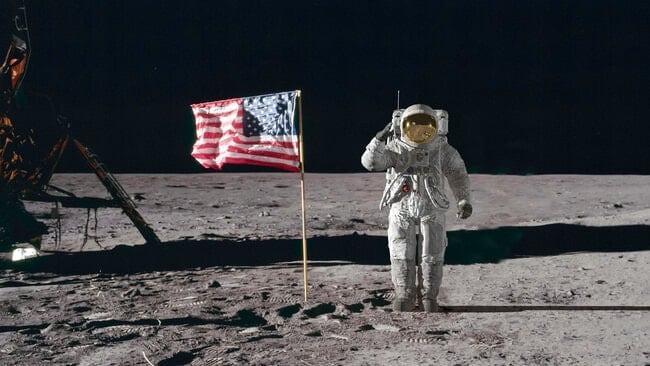
On July 20, 1969, two American astronauts walked on the surface of the moon. Neil Armstrong stepped off the Lunar Module Eagle at 10:56 p.m. Eastern Time and said, “That’s one small step for [a] man, one giant leap for mankind.” Each year on July 20 the United States marks National Moon Day. Here is a refresher on the date, the crew, the mission, and why the moon landing still matters more than 50 years later.
The Three Astronauts
Apollo 11 was the fifth crewed Apollo mission and the first to land on the moon. The mission lasted 8 days and 3 hours.
- Neil Armstrong (mission commander, first human to walk on the moon). Civilian test pilot, former Korean War naval aviator. Died 2012.
- Buzz Aldrin (lunar module pilot, second human to walk on the moon). Air Force fighter pilot, MIT astronautics PhD. Still living.
- Michael Collins (command module pilot, remained in lunar orbit). Air Force test pilot. Died 2021.
The Sequence of Events
- July 16, 1969 9:32 a.m. ET: Launch from Kennedy Space Center.
- July 19 1:21 p.m. ET: Apollo 11 enters lunar orbit.
- July 20 4:17 p.m. ET: Lunar Module Eagle lands at Tranquility Base.
- July 20 10:56 p.m. ET: Armstrong steps onto the moon.
- July 21 1:54 p.m. ET: Eagle lifts off the moon.
- July 24 12:50 p.m. ET: Splashdown in the Pacific Ocean.
Why It Still Matters
The moon landing was the most expensive scientific project in human history up to that point, and it produced foundational technology that is still in daily use: digital flight computers, integrated circuit miniaturization, satellite communications, freeze-dried food preservation, and the global positioning standards that became GPS. The moon itself returned 842 pounds of lunar rock and soil that scientists are still analyzing for clues about the origin of Earth and the early solar system.
The most enduring legacy may be cultural. The image of Earth rising over the lunar horizon (taken by Bill Anders on Apollo 8 the year before) is widely credited with helping launch the modern environmental movement. The Almanac’s 1969 edition closed with the line: “The next generation will not need to look up to dream.”

Frequently Asked Questions
When is National Moon Day?
July 20 each year, the anniversary of the Apollo 11 landing.
Have humans returned to the moon since 1969?
Yes, five more times. The last crewed lunar landing was Apollo 17 in December 1972. NASA’s Artemis program plans to return crewed missions to the moon in 2026 or later.
How long did Armstrong and Aldrin stay on the moon?
About 21.5 hours total, with 2.5 hours of EVA (extravehicular activity) on the lunar surface.
Where can I see Apollo 11 artifacts?
The original Apollo 11 command module is at the Smithsonian National Air and Space Museum in Washington, DC. Moon rocks brought back are on display at NASA centers and major museums worldwide.



Edward Higgins
Edward Higgins is a freelance writer, artist, home chef, and avid fly fisherman who lives outside of Portland, Maine. He studied at Skidmore College and Harvard University. His article 10 Best Edible Insects appears in the 2020 Farmers' Almanac.
- Edward Higgins

- Edward Higgins
- Edward Higgins
- Edward Higgins





My daughter was born in January 1969. I sat in front of our TV, holding her in my lap, My thought was when she is older she will be able to say she saw the moon landing. OH NO, INSTEAD someone managed to spread the idea that the landing was fake & had “footage” that supported their idea.i was shocked to hear that & know others believed it too.
1969, I was 15 years old living in the suburbs of Birmingham glued to the TV as I watched in total amazement. Also amazing that year, but not to the magnitude of the moon landing, the Mets won the World Series and the Beatles released their last album, Abbey Road.