Saturn Is at Its Brightest of 2026, With Its Rings Barely Open

Quick Reference: Saturn at Opposition
- Opposition: Sunday, October 4, 2026, at 8:32 a.m. EDT
- Best nights: the whole first week of October
- Distance: 8.43 astronomical units, about 1.26 billion km
- Light travel time: 70 minutes each way
- Ring tilt: 7.5 degrees, about a quarter of the maximum
- Where to look: rising in the east around sunset, highest near midnight
Saturn reaches opposition at 8:32 a.m. EDT on Sunday, October 4. Opposition means the Earth passes directly between Saturn and the Sun, so Saturn sits opposite the Sun in our sky. It rises as the Sun sets, stays up all night, and is as close and as bright as it gets all year.
You do not need the exact date. Any clear night in the first week of October gives you essentially the same view.
The Thing Worth Noticing This Year: the Rings
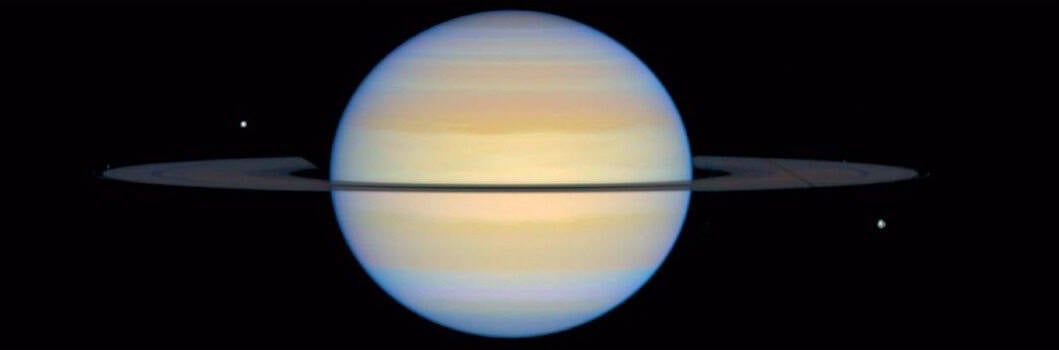
Saturn’s rings are not always presented to us the same way. The planet is tilted on its axis, so as the two orbits carry on we see the ring plane from changing angles. Sometimes they are wide open. Sometimes they vanish.
They vanished on March 23, 2025, when the ring plane passed straight through our line of sight and the rings all but disappeared in a telescope. They are opening again, but slowly. At this opposition the tilt is 7.5 degrees, roughly a quarter of the maximum.
| Year | Ring tilt at October opposition | How it looks |
|---|---|---|
| 2023 | 10.1 degrees | wide open |
| 2024 | 4.5 degrees | closing fast |
| 2025 | 1.5 degrees | edge-on in March |
| 2026 | 7.5 degrees | reopening |
| 2027 | 13.4 degrees | half open |
| 2029 | 22.8 degrees | nearly full |
| 2031 | 26.5 degrees | widest |
So this is an unusual few years to be looking. A narrow ring is a harder sight than a wide one, but it is also the view most people alive have never had, and the planet will not present it again for nearly three decades.
When Saturn Rises Where You Are
| City | Rises | Sets |
|---|---|---|
| New York | 6:37 p.m. | 6:54 a.m. |
| Chicago | 6:31 p.m. | 6:49 a.m. |
| Denver | 6:41 p.m. | 6:57 a.m. |
| Los Angeles | 6:35 p.m. | 6:49 a.m. |
Saturn sits close to the celestial equator this year, at about 2 degrees of declination. That is good news for everyone: it climbs to a decent height whether you are watching from Minnesota or from the Gulf coast.
How to Actually See It
- With your eyes: a steady yellowish point in the east after dark, noticeably not twinkling the way a star does.
- With binoculars: not round. Steady 10x binoculars on a fence post show an oval, which is the rings, though not separated from the disc.
- With a small telescope: from about 25x the rings show clearly as rings. This year expect a tight line rather than a wide hoop.
- Best time: around midnight, when it is highest and you are looking through the least air.
- Look for Titan: its largest moon shows in small telescopes as a faint star close by, shifting position from night to night.

A Note on the Distance
At opposition Saturn is 1.26 billion kilometres away. Light needs 70 minutes to cross that gap, so the Saturn you look at on October 4 is the Saturn of an hour and ten minutes ago. Sunlight reaching it left the Sun about 70 minutes before that.
Our visible planets guide tracks where the rest of them are this month.
Frequently Asked Questions
When is Saturn at opposition in 2026?
At 8:32 a.m. EDT on Sunday, October 4, 2026. Because opposition falls during daylight in North America, the nights either side of it give the same view.
What does opposition mean?
It means the Earth passes between Saturn and the Sun, putting Saturn opposite the Sun in our sky. The planet rises at sunset, stays up all night, and is at its closest and brightest for the year.
How far away is Saturn at opposition?
About 8.43 astronomical units, which is roughly 1.26 billion kilometres. Light takes about 70 minutes to travel that distance.
Why do Saturn’s rings look thin in 2026?
Because the ring plane passed through our line of sight on March 23, 2025, and the rings are still only part way through reopening. At this opposition they are tilted about 7.5 degrees, around a quarter of the maximum. They will not be fully open again until about 2031.
Can you see Saturn’s rings with binoculars?
Not as separate rings. Steady binoculars at about 10x show Saturn as an oval rather than a point, which is the rings blending with the disc. Seeing them as rings needs roughly 25x, which means a small telescope.
Where should I look for Saturn?
Low in the east around sunset, climbing to its highest near midnight and setting around sunrise. It is a steady yellowish point that does not twinkle like a star.
Read Next

Josh Morley grew up in Liverpool, where checking the sky before you leave the house is less a habit than a survival skill. He has spent his working life with data, and he came to the Farmers' Almanac by way of the thing the two have in common: the weather is the largest dataset any of us live inside, and most of us read it every day without noticing.
- Josh Morley

- Josh Morley
- Josh Morley
- Josh Morley