

Snow Fleas: The Harmless Springtails That Pop Out During Thaws
Isn't cold weather supposed to kill pests? Some. But don't panic. Here's what you need to know about these tiny creatures that make their homes in the snow banks in your yard.
Quick Reference
- What they are: Springtails (Hypogastrura nivicola). Hexapod arthropods, more closely related to crustaceans than insects.
- Where: Tree trunks, snow banks, leaf litter, especially during late-winter thaws.
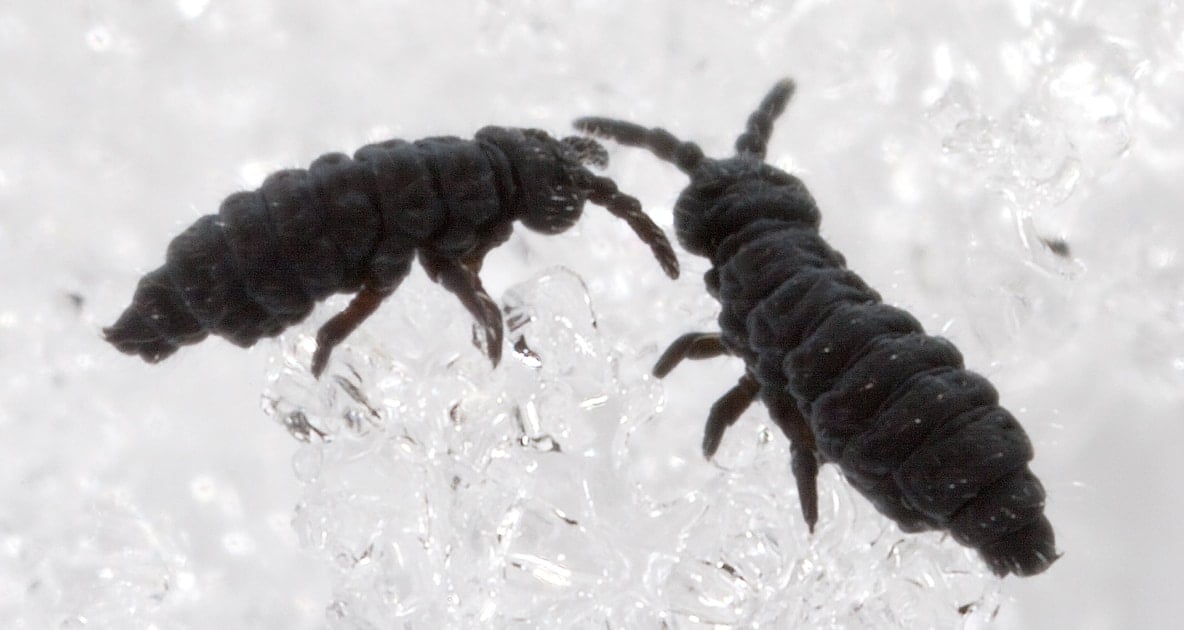
- Size: 2 to 3 mm long, blue-black.
- Do they bite? No. Not parasitic. Safe for people and pets.
- Superpower: A glycine-rich antifreeze protein that prevents ice from forming in their bodies.
One of the great pleasures of cold weather is the disappearance of bugs. Most of the creepy crawlies that make spring and summer trying, stinkbugs, fleas, ticks, mosquitoes, head underground or into dormancy when temperatures drop. But there is one tiny exception that comes out in the snow: the snow flea. They look alarming, they jump like the real thing, and they are everywhere in late-winter snowbanks. Here is the good news. They are not actually fleas, they do not bite, and finding them in your yard is a sign of a healthy garden ecosystem.
What Are Snow Fleas?
Snow fleas are not fleas. They are not even technically insects, though they look like bugs. These wingless creatures are properly called springtails. Their scientific name is Hypogastrura nivicola (the most common northern species) or Hypogastrura harveyi, depending on region.
Springtails are classified as hexapods, a subgroup of arthropods. They have six legs like insects, but researchers now believe they are more closely related to crustaceans (think shrimp and crabs) than to actual flies, fleas, or beetles.
Why Are They Called Snow Fleas?
Two reasons. The first is appearance. They look enough like fleas that the resemblance is unmistakable. The second is the jump. Snow fleas have the same explosive jumping ability that real fleas have. They use it the same way: to escape predators and to move long distances in a hurry.
The mechanism is different. Real cat or dog fleas jump using huge spring-loaded hind legs. Snow fleas have a tail-like appendage called a furcula that they hold tucked under their body. When threatened, the furcula releases like a tiny catapult, launching the springtail several inches forward. That release is where the name “springtail” comes from.
How High Can They Jump?
Several inches in a single leap, despite being only 2 to 3 mm long. Scaled up to human size, that would be a 30-foot standing jump. The motion looks like a popping bean against a white snow background, which is how most people first notice them.
Do They Bite?
No. Snow fleas are not parasitic. You and your pets are completely safe. If you garden at all, you have probably encountered thousands of springtails in your lifetime without realizing it. In summer they sit on top of rich topsoil and leaf litter, doing the work of breaking down organic matter. Because they are so small and dark, most people never spot them.

Why Do They Come Out in the Snow?
This is the part that has caught the attention of biologists. Unlike most insects, springtails do not go dormant for winter. They keep moving and feeding through the coldest part of the year. They can do this because they produce their own antifreeze, a protein rich in the amino acid glycine.
The glycine protein binds to forming ice crystals and prevents them from growing large enough to puncture cell walls. The result is a body that stays liquid down to temperatures that would freeze most insects solid. On warmer winter days, when surface snow melts slightly, springtails rise to the top of the snow in search of new food sources. That is when you see them: small dark dots that suddenly cover a snowbank.
What Do They Eat?
Decaying organic matter. Fallen leaves, fungal mycelium, bacterial film on soil particles, and microscopic debris from tree bark. They are essential soil-builders. Each springtail processes a tiny amount of material, but a healthy yard hosts millions of them. Over a year, they accelerate the decomposition that turns leaf litter into rich topsoil. If you see snow fleas, your soil is alive and active.
Are Snow Fleas a Good Sign or a Bad One?
A good one. Their presence indicates that your yard has:
- Healthy leaf litter and organic matter underneath the snow
- Soil biology active even in deep winter
- No widespread pesticide contamination (springtails are sensitive to it)
- Adequate moisture (they need a slightly damp environment)
If you spot tiny blue-black dots cavorting on top of the snow this winter, leave them. They are working for you.

Frequently Asked Questions
What are snow fleas?
Tiny wingless hexapods properly called springtails (Hypogastrura nivicola). They are more closely related to crustaceans than insects. They look like fleas, jump like fleas, but do not bite.
Do snow fleas bite people or pets?
No. Snow fleas are not parasitic. They feed on decaying organic matter in soil and leaf litter. You and your pets are entirely safe.
Why do snow fleas appear in winter?
They produce a glycine-rich antifreeze protein that prevents ice from forming inside their cells. On warmer winter days when surface snow melts, they rise to the surface in search of new food.
Are snow fleas a sign of a problem?
The opposite. They indicate a healthy yard with active soil biology, plenty of leaf litter, and no significant pesticide contamination. Leave them alone.
How do I get rid of snow fleas?
You probably do not need to. They are beneficial, harmless, and live in the soil year-round. If you must reduce their visible numbers, simply leave the leaf litter mostly alone (they will stay out of sight) and avoid broad-spectrum pesticides that disrupt soil life.
How big are snow fleas?
About 2 to 3 millimeters long, blue-black in color. Most easily spotted against fresh white snow, especially on late-winter thaw days.
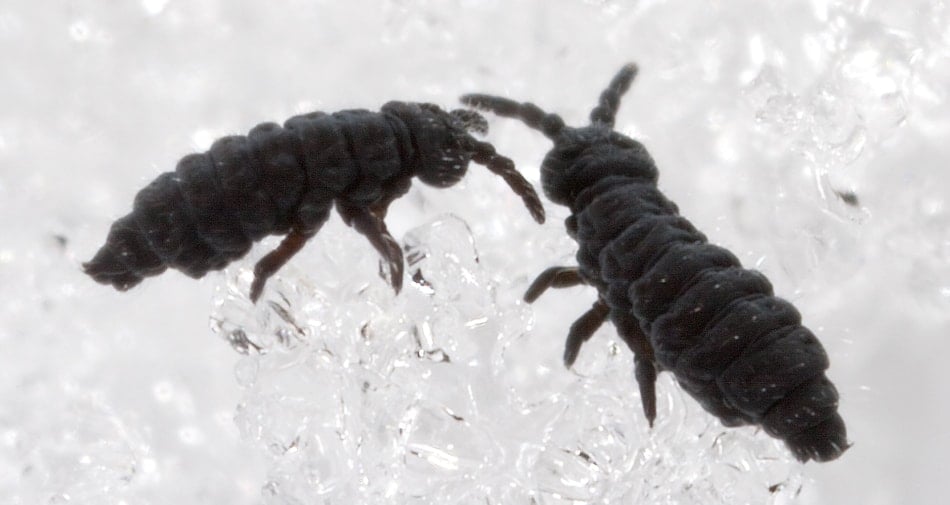
Photo by Chris Crowley. The snow fleas pictured were photographed in Orford, NH, using a 5x macro lens during a January spring-thaw event.


Amber Kanuckel
Amber Kanuckel is a freelance writer from rural Ohio who loves all things outdoors. She specializes in home, garden, environmental, and green living topics.
- Amber Kanuckel

- Amber Kanuckel

- Amber Kanuckel
- Amber Kanuckel





Snow fleas do bite there a nightmare like bed bugs. Don’t play in the snow and take off everything before you go get inside. I’ve lived in Nevada for 50 years and never had had them.
No they do not bite
They get in my eyes and are coming in through every window in my home and under baseboards and I’m in a Brad new house! It’s a total nightmare. I have to change the sticky pads for rodents in my window sills constantly for the last several months and it’s almost July on the 90’s. There’s construction behind me but I’m disabled and not able to move freely so this is a nightmare. My. If company sprays constantly. I’ve had all my windows checked. My home is spotless. I wake up covered in them and now they are the size of pincher bugs. I’m not encouraged.
Nice article! I saw them once in East Winthrop Maine. I was cutting wood early March And the whole side field was loaded with them. Thought it was an old wives tale snowfleas.
thanks for the info I must of encountered 1 that got into the house because I had a good look at 1 that I picked off my shoulder under my top that did bite me , must of felt trapped so they do bite, my first fear was it laying eggs in my pores. just the thought creeps me out but reading your article gave me a piece of mind so I’m not to worried any more with the help of your write up so thankyou for the info.
Great article! This is what we are encountering right now throughout our yard. It’s the first time ever, I have never seen something like this before, or even heard of them. I’m glad to hear that they are beneficial and not harmful.
These must be what the birds are enjoying on the snow.
I live in So Cal in the Inland Empire. I have these in my backyard all of the time. Definitely no snow here. Glad to know what they are.
I live in Northern Mi. The snow has been gone for several weeks now and we are experiencing unusually warm weather, I have Snow fleas all over my deck. The deck is made of pressure treated lumber and 30 years old. Hopefully the snow fleas are not ingesting any of the preservatives in the wood. I’m thinking of hosing the deck to get them back on the ground. Do you have a better idea
Hi Susan, either hosing or sweeping them off would probably be a good idea.
Dude, I was JUST about to say the same thing! (well not the infestation part) In the early/mid 80’s when I was a child, I lived in Interlochen Michigan on Riley road. One day during the winter, I remember seeing these weird fleas jumping around in this ice wall like structure that was left from us shoveling snow to the shed from the back yard a few days prior and it began to melt then freeze again. I have never seen them again anywhere else since and I lived all over the states since then. Here in Brooklyn NY they are definitely NOT here.
March 9 th Sandgate Vt
Wow, great picture, Patti! Thanks for sharing!
Just found these in my driveway today on a warm winter day . In the melted snow in my cars tracks- Southern Vermont
I found “tons”of these on top of my dryer and in the utility sink next to my dryer. I don’t know how they got in my basement. how do I get rid of them