Spotted Lanternflies: Where They Came From & How to Stop Them
Spotted lanternflies have spread rapidly across the United States—but where did they come from, how did they get here, and can we stop them? Here’s what you need to know about their spread, their eggs, and what homeowners can do to help.

Spotted lanternflies have spread rapidly across the eastern United States since they were first discovered in Pennsylvania in 2014. Where did they come from? How did they get here? And, perhaps most importantly, is there anything we can do to stop them?
If you live in parts of the Northeast, Mid-Atlantic, or increasingly the Midwest and Southeast, you’ve probably seen them.
Gray wings covered with black spots. A flash of brilliant red when they jump. Hundreds clustered around a tree trunk. Sticky residue on patios, decks, cars, and plants.
The spotted lanternfly (Lycorma delicatula) has become one of the most recognizable invasive insects in America.
And it is still spreading.
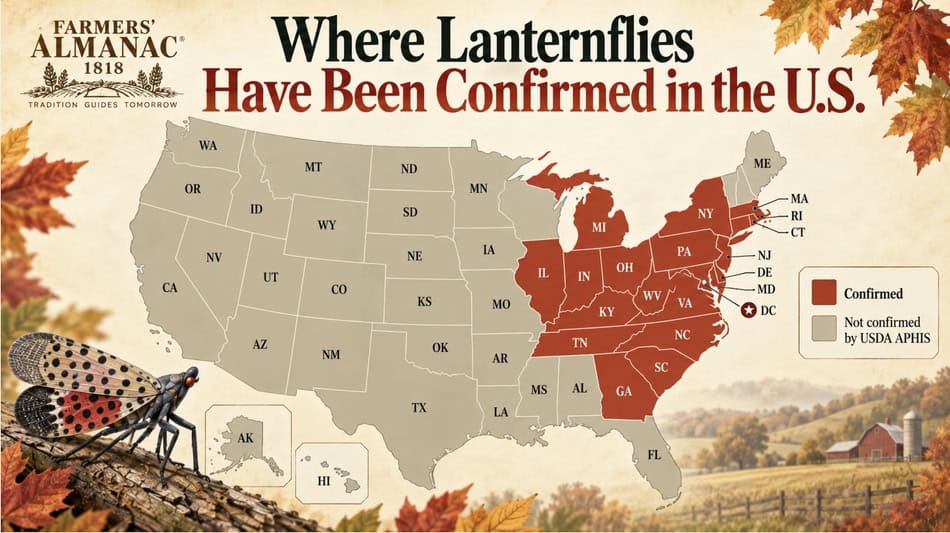
According to the U.S. Department of Agriculture, established spotted lanternfly populations have now been reported in 19 states and Washington, D.C. See the USDA’s current spotted lanternfly information and distribution
But this insect wasn’t always here.
In fact, the story of the spotted lanternfly in America begins thousands of miles away—and probably with something as small as a cluster of eggs hidden on imported goods.
What Is a Spotted Lanternfly?
First, an important clarification:
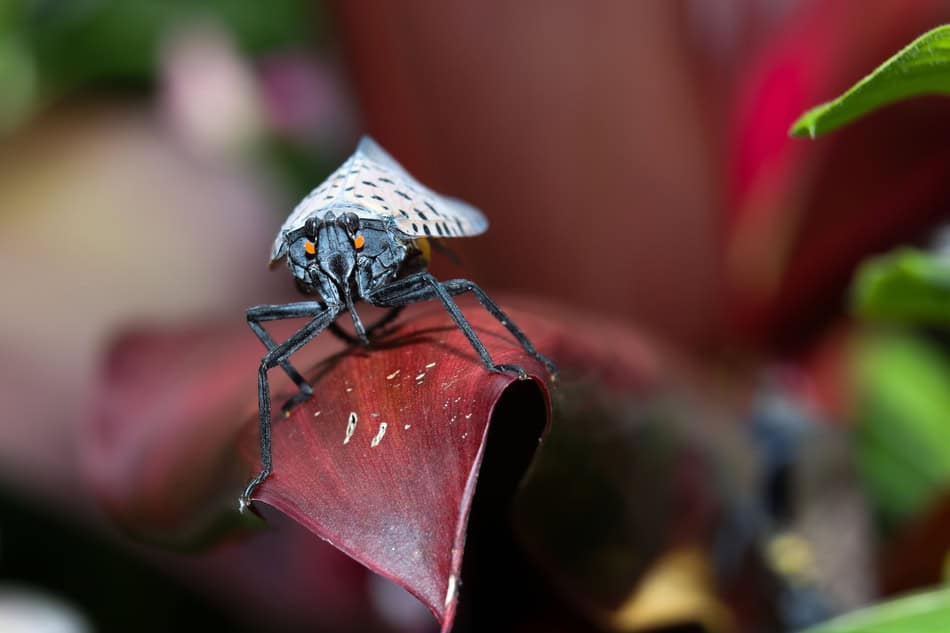
A spotted lanternfly isn’t actually a fly.
It is a type of planthopper, an insect related to cicadas and aphids that feeds by piercing plants and sucking sap.
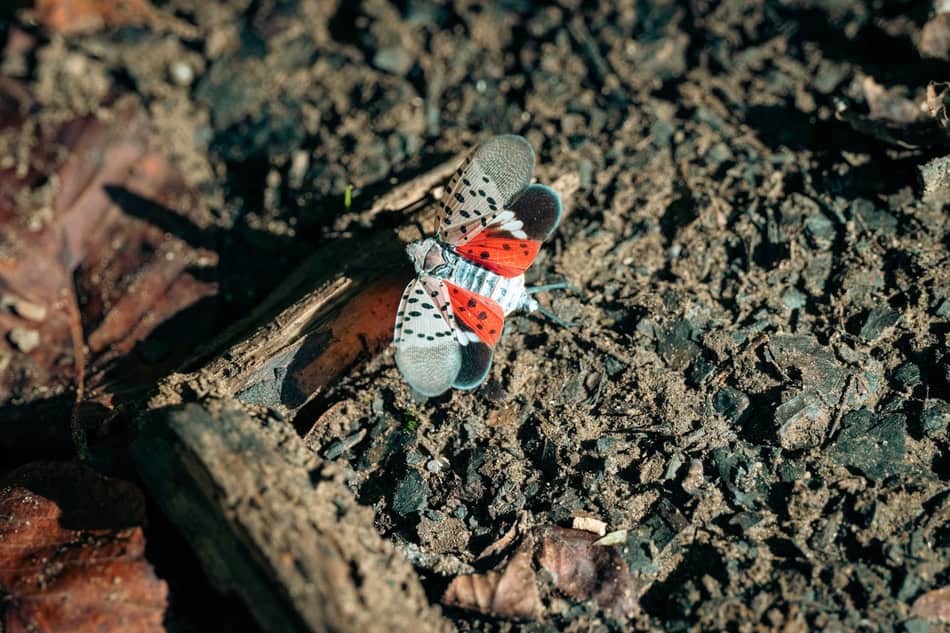
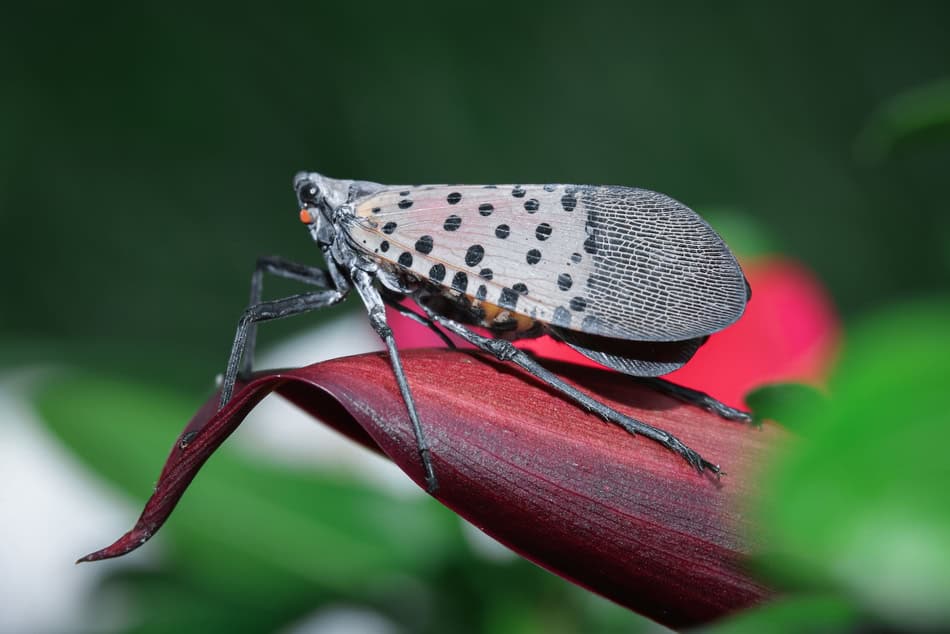
Adult spotted lanternflies are about an inch long. Their folded outer wings are grayish-tan with black spots, which provides surprisingly effective camouflage against tree bark.
When they open their wings, however, they reveal dramatic patches of red, black, and white.
Young spotted lanternflies look completely different. Early nymphs are black with white spots; later nymphs develop bright red coloring before becoming adults.
If you’re trying to determine whether the insect in your yard is actually a lanternfly, see our complete Spotted Lanternfly identification and control guide. See the Farmers’ Almanac Spotted Lanternfly Guide
Spotted lanternflies do not bite or sting people or pets.
Their problem is what they do to plants.
What Do Spotted Lanternflies Eat?
Spotted lanternflies feed on the sap of many different plants.
Their favorite host is another invasive species: tree-of-heaven (Ailanthus altissima).
They also feed on grapevines, maples, black walnut, willow, fruit trees, hops, and numerous ornamental and hardwood species.
Grapevines are particularly vulnerable. Large infestations can weaken vines and cause significant problems for vineyards.
As lanternflies feed, they release a sugary liquid called honeydew.
That sticky honeydew can coat:
- Decks and patios
- Cars and outdoor furniture
- Leaves and branches
- Sidewalks and driveways
- Anything located beneath an infested tree
Honeydew also encourages the growth of a dark fungus known as sooty mold and attracts ants, wasps, bees, and other insects.
For more advice on dealing with insects and other unwanted garden visitors, see our Natural Garden Pest Control Guide. Read our Farmers’ Almanac Garden Pest Control Guide
Where Did Spotted Lanternflies Come From?
Spotted lanternflies are native to Asia, with their original range centered largely in China and neighboring parts of Asia.
They later became invasive in South Korea and Japan.
Genetic research into the lanternflies now living in the United States provides an intriguing clue about how the American invasion happened.
Studies of spotted lanternfly DNA indicate that the American population appears to have originated from a single introduction associated with South Korea, although the insect’s deeper ancestral origins trace back to China.
In other words, the lanternfly appears to have made its way from China into other parts of Asia before one population eventually reached the United States.
But it certainly didn’t fly across the Pacific Ocean.
People unknowingly carried it here.
How Did Spotted Lanternflies Get to the United States?
The first known U.S. spotted lanternfly infestation was discovered in Berks County, Pennsylvania, in 2014.
The USDA says the pest likely arrived on goods shipped from overseas.
Investigators have long suspected that egg masses may have entered Pennsylvania attached to imported materials such as stone.
And once you see a spotted lanternfly egg mass, it becomes easy to understand how that could happen.
The females don’t just lay eggs on trees.
They will lay them on almost any hard outdoor surface, including:
Stone, bricks, vehicles, trailers, campers, firewood, patio furniture, grills, bicycles, lawn equipment, pallets, railroad cars, and building materials.
The eggs are then covered with a grayish material.
Fresh egg masses can resemble wet putty.
As they age, they may look like nothing more than a smear of dried mud.
Each egg mass commonly contains around 30 to 50 eggs.
That makes lanternfly eggs very easy to transport without anyone realizing they’re there.
How Are Spotted Lanternflies Spreading So Quickly?
Spotted lanternflies can jump and fly short distances.
But humans are responsible for much of their long-distance spread.
Penn State notes that the continuing expansion of spotted lanternflies is caused by a combination of natural dispersal and accidental human transportation, particularly along highways and rail corridors.
Imagine this:
A camper sits beneath an infested tree during October.
A female spotted lanternfly lays an egg mass underneath it.
The family drives the camper 300 miles away during winter.
Spring arrives.
Dozens of lanternflies hatch in a community that may never have had them before.
The same thing can happen with trailers, trucks, firewood, landscaping materials, patio furniture, equipment, and vehicles.
That’s why one of the most important spotted lanternfly rules is remarkably simple:
Don’t give them a ride.
Where Are Spotted Lanternflies in the United States?
As of 2026, the USDA reports spotted lanternfly populations in 19 states and Washington, D.C.
They have been reported in Connecticut, Delaware, Georgia, Illinois, Indiana, Kentucky, Maryland, Massachusetts, Michigan, New Jersey, New York, North Carolina, Ohio, Pennsylvania, Rhode Island, South Carolina, Tennessee, Virginia, and West Virginia.
That does not mean every part of every state is heavily infested.
Some states contain relatively localized populations, while lanternflies have become common across much larger areas of other states.
Several states maintain spotted lanternfly quarantine areas designed to reduce accidental transportation into new regions.
For the most current distribution information, check the USDA’s national spotted lanternfly page. See the current USDA Spotted Lanternfly status
Why Are Spotted Lanternflies Bad?
Early reports about spotted lanternflies sometimes gave the impression that these insects would kill nearly every tree they encountered.
The reality is more complicated.
Spotted lanternflies can be a serious agricultural pest—particularly for grapes and vineyards—and large infestations place significant stress on plants.
However, Penn State researchers emphasize that spotted lanternfly is generally a plant stressor, and the insect by itself does not necessarily kill a healthy mature landscape tree.
For homeowners, one of the biggest problems is often the sheer size of an infestation.
Hundreds or thousands of lanternflies can gather on trees and buildings.
Their honeydew can cover decks and lawn furniture.
Sooty mold can blacken surfaces.
Wasps may gather around the sugary deposits.
And during peak infestations, spending time outside can become downright unpleasant.
Agriculturally, however, the concern is more serious.
Grapes are among the crops most vulnerable to heavy spotted lanternfly feeding, which is why vineyards have been a major focus of monitoring and control programs.
What Is the Government Doing About Spotted Lanternflies?
The strategy has evolved.
When lanternflies were confined to a relatively small area of Pennsylvania, completely eliminating them seemed considerably more realistic.
Now that populations are established across numerous states, the national strategy increasingly focuses on:
Slowing the insect’s spread, detecting new infestations early, protecting vulnerable agricultural areas, preventing accidental transportation, improving control methods, and supporting research into long-term biological controls.
The USDA’s Spotted Lanternfly Five-Year Strategy for fiscal years 2024–2028 has three primary goals: limiting the continued advance of the insect, supporting research into management and risk reduction, and coordinating public and industry education. Read the USDA Spotted Lanternfly Five-Year Strategy
Federal and state agencies are using combinations of:
Quarantines, roadside and railroad monitoring, trapping, insecticide treatments, public reporting programs, agricultural management, egg-mass destruction, and inspections of vehicles and goods leaving infested regions.
But researchers are also pursuing something potentially much more powerful.
Could a Tiny Wasp Eventually Control Spotted Lanternflies?
This may become one of the most important developments in the fight against lanternflies.
When an invasive species arrives in a new country, it often leaves many of its natural predators and parasites behind.
Without those natural controls, its population can explode.
Scientists have therefore searched the lanternfly’s native range for insects that naturally prey upon it.
One promising candidate is a tiny parasitoid wasp called Dryinus sinicus.
This wasp attacks young spotted lanternfly nymphs.
USDA Agricultural Research Service scientists published new research in 2026 describing Dryinus sinicus as a promising potential biological-control agent for spotted lanternflies. Read about USDA research into Dryinus sinicus
However, scientists can’t simply release a foreign wasp into the American environment.
Researchers must first determine whether it could harm native insects.
USDA scientists are conducting host-specificity testing and evaluating methods for raising the wasps in large numbers before any potential release is considered.
That caution is important.
Introducing one problem species to control another without understanding the ecological consequences could create an entirely new invasive-species problem.
How Can You Help Stop the Spread of Spotted Lanternflies?
Ordinary homeowners can play an unusually important role in slowing this invasive pest.
1. Check Your Car Before Traveling
If you live in or visit an infested area, inspect your vehicle before leaving.
Look around:
Wheel wells, bumpers, roof racks, truck beds, trailers, campers, bicycles, boats, and anything stored outdoors.
Adults and nymphs can hitchhike during warm weather, while egg masses can travel during fall and winter.
2. Don’t Move Firewood
Moving firewood is one of the easiest ways to transport invasive insects and their eggs.
A good rule is:
Buy it where you burn it.
3. Look for Spotted Lanternfly Egg Masses
Late fall through early spring is an excellent time to search for eggs.
Look for gray or brown patches resembling dried mud on:
Trees, stones, deck furniture, sheds, grills, trailers, vehicles, fences, and outdoor equipment.
Penn State’s updated 2026 guidance says an egg mass averages roughly 30 to 50 eggs. See Penn State’s Spotted Lanternfly Egg Mass Guide
4. Destroy Egg Masses You Can Safely Reach
Egg masses can be thoroughly crushed or scraped into a container containing rubbing alcohol or hand sanitizer.
Don’t simply scrape them onto the ground and assume they’re dead.
And don’t climb a tree to reach them.
Penn State researchers found that on the mature test trees they studied, less than 2% of lanternfly egg masses were within about 10 feet of the ground. Most were higher in the canopy.
Destroy what you can safely reach.
5. Consider a Circle Trap
Lanternfly nymphs frequently crawl up tree trunks.
A circle trap uses screening wrapped around the trunk to funnel climbing lanternflies into a collection container.
Cornell Integrated Pest Management recommends traps as one tool for reducing lanternfly numbers. See Cornell’s Spotted Lanternfly Management Guide
Sticky bands can also catch lanternflies, but uncovered sticky material can accidentally trap birds, butterflies, bats, and other wildlife. If sticky bands are used, they should be protected with an appropriate wildlife barrier.
6. Learn to Recognize Tree-of-Heaven
Spotted lanternflies are especially attracted to tree-of-heaven.
But don’t simply cut one down.
Tree-of-heaven has an aggressive root system. Cutting the trunk alone can stimulate the roots to send up numerous new shoots, potentially turning one tree into an entire thicket.
Proper control usually involves treating the root system and following local Cooperative Extension recommendations.
7. Report Lanternflies in New Areas
If spotted lanternflies are already common throughout your area, officials may no longer need reports of every insect.
But finding one far beyond the known established range can be extremely important.
Take a photograph, record the location, and contact your state agriculture department or use the USDA’s reporting resources. Report or identify a spotted lanternfly through USDA resources
Early detection gives officials a much better chance of containing an isolated infestation.
Should You Kill Spotted Lanternflies?
When practical, yes—particularly where the population is new.
But smashing individual adults isn’t going to eliminate a large established infestation.
Think about the numbers.
One female can produce multiple egg masses, each containing dozens of eggs.
Killing a few adults helps.
Destroying an egg mass helps.
But preventing an egg-covered trailer from traveling 300 miles may help far more.
The overall goal is not simply to kill as many lanternflies as possible.
It is to slow their spread into places they haven’t reached yet.
Do Home Remedies Kill Spotted Lanternflies?
You’ll find plenty of homemade lanternfly sprays online involving dish soap, vinegar, salt, essential oils, and other household ingredients.
Use caution.
Products that haven’t been designed or labeled for use on plants can damage leaves, kill beneficial insects, or cause other unintended problems.
For established garden pests, the best approach is usually integrated pest management: correctly identify the pest first, use mechanical controls when possible, protect beneficial insects, and use properly labeled pesticides only when needed.
That’s the same general philosophy behind our Farmers’ Almanac guide to combating garden pests naturally. See 22 Ways to Combat Garden Pests Naturally
Penn State’s 2026 professional guidance makes another important distinction:
Killing individual spotted lanternflies with insecticides can be relatively easy.
Managing an established infestation is much harder.
Will Cold Winter Weather Kill Spotted Lanternflies?
Adult spotted lanternflies die as winter arrives.
Unfortunately, the next generation is already waiting.
Spotted lanternflies overwinter as eggs.
Females generally lay egg masses during fall. Those eggs remain attached to trees, stones, vehicles, and other surfaces throughout winter before hatching in spring.
So a bitterly cold winter doesn’t necessarily mean the lanternfly problem is over.
In fact, winter can be one of the best times for homeowners to fight back.
With leaves off the trees and the adults gone, egg masses are easier to spot and cannot jump or fly away.
Do Spotted Lanternfly Populations Eventually Decline?
Here’s a bit of encouraging news.
Areas that experience enormous lanternfly infestations don’t necessarily remain that way forever.
Populations in some of the longest-infested portions of Pennsylvania have declined sharply after initially exploding, although numbers can fluctuate again in later years.
Scientists are studying why.
Possible factors include food availability, weather, predators, diseases, plant health, population density, and other natural controls.
That doesn’t mean spotted lanternflies disappear completely.
But today’s overwhelming infestation may not remain overwhelming forever.
Can We Ever Eradicate Spotted Lanternflies From the United States?
Complete nationwide eradication now appears extremely difficult.
The insect has simply spread too far.
With established populations reported in 19 states and Washington, D.C., locating and destroying every spotted lanternfly and every hidden egg mass would be an enormous undertaking.
That’s why the national approach has shifted toward containment, management, research, and slowing the spread rather than assuming every established population can be eliminated.
But that doesn’t mean we’ve lost the fight.
Consider the difference between an insect reaching a major grape-growing region next year versus 10 or 20 years from now.
Every year its spread can be delayed gives farmers more time to prepare.
It gives scientists more time to develop better control methods.
It gives researchers more time to investigate biological controls such as Dryinus sinicus.
And isolated new infestations may still be small enough to contain.
Eradication everywhere may no longer be realistic. Preventing the next invasion still is.
The Most Important Thing You Can Do
The spotted lanternfly invasion demonstrates how easily invasive species can travel in today’s interconnected world.
It probably began in America with something almost invisible:
A few egg masses attached to imported goods.
Those insects multiplied.
Then cars, trucks, trains, campers, trailers, firewood, landscaping materials, and ordinary human travel helped carry their descendants farther.
More than a decade later, lanternflies have established themselves across a large part of the eastern United States.
There may never be one simple cure.
Instead, controlling spotted lanternflies will require a combination of quarantines, inspections, public reporting, trapping, agricultural management, scientific research, biological controls, and homeowners checking what they’re carrying before they travel.
So this fall, take an extra look at your patio furniture.
Check the camper before putting it away.
Inspect the trailer before taking a long trip.
And if you notice what looks like a little patch of dried mud where it shouldn’t be, take a closer look.
It could contain dozens of next spring’s spotted lanternflies.
And stopping those lanternflies before they travel may be far more important than stepping on the adults already hopping around your yard.
Have spotted lanternflies reached your area yet? Tell us where you’re seeing them in the comments.


- Farmers' Almanac Staff

- Farmers' Almanac Staff
- Farmers' Almanac Staff

- Farmers' Almanac Staff