The Truth About the Origin of OK: A New England Joke

Quick Reference: The Origin of OK
- Short answer: “OK” comes from an 1830s New England craze for jokey initialisms and misspellings, “OK” for “oll korrect.”
- First print appearance: The Boston Morning Post, March 23, 1839, in a piece by editor Charles Gordon Greene.
- What sealed it: Martin Van Buren’s 1840 re-election campaign and his “Old Kinderhook” nickname.
- Van Buren’s role: Elected 8th President in 1836; born in Kinderhook, New York; the Old Kinderhook Club adopted OK as its rallying cry.
- H. L. Mencken’s verdict: “The most shining and successful Americanism ever invented.”
- Correct spelling: O.K. or OK. Both are acceptable, capital letters are preferred, periods are optional.
- Source: Richard Lederer, contributing editor for the Farmers’ Almanac, from the 1999 edition.
By Richard Lederer
Richard Lederer is a contributing editor for the Farmers’ Almanac and a well-known author, speaker, and verbalist.
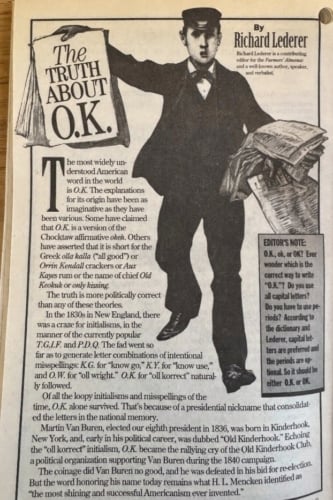
The most widely understood American word in the world is O.K. The explanations for its origin have been as imaginative as they have been various. Some have claimed that O.K. is a version of the Choctaw affirmative okeh. Others have asserted that it is short for the Greek olla kalla (“all good”) or Orrin Kendall crackers or Aux Cayes rum or the name of chief Old Keokuk or only kissing.
The truth is more politically correct than any of these theories.
The 1830s New England Initialism Craze
In the 1830s in New England, there was a craze for initialisms, in the manner of the currently popular T.G.I.F. and P.D.Q. The fad went so far as to generate letter combinations of intentional misspellings: K.G. for “know go,” K.Y. for “know use,” and O.W. for “oll wright.” O.K. for “oll korrect” naturally followed.
Of all the loopy initialisms and misspellings of the time, O.K. alone survived. That is because of a presidential nickname that consolidated the letters in the national memory.
The dating is specific. Linguist Allen Walker Read spent the 1960s tracing OK back to its first print appearance and settled the question in a series of papers in the journal American Speech. He documented the phrase first appearing in the Boston Morning Post on March 23, 1839, in a piece by editor Charles Gordon Greene about a lighthearted anti-Bell Ringer group. That single-column entry is the earliest verified use in print anywhere in the world.
RELATED: The History of Uncle Sam
Old Kinderhook: How Van Buren Locked OK Into American English
Martin Van Buren, elected our eighth president in 1836, was born in Kinderhook, New York, and, early in his political career, was dubbed “Old Kinderhook.” Echoing the “oll korrect” initialism, O.K. became the rallying cry of the Old Kinderhook Club, a political organization supporting Van Buren during the 1840 campaign.
The coinage did Van Buren no good, and he was defeated in his bid for re-election. But the word honoring his name today remains what H. L. Mencken identified as “the most shining and successful Americanism ever invented.”
A Timeline of OK

The Debunked Origin Theories, Ranked
OK is such a useful word that dozens of folk etymologies have grown up around it. All are wrong. Here are the ones you have probably heard, and the reason each fails the historical record.
- Choctaw okeh: Choctaw does have an affirmative that sounds close, and President Woodrow Wilson later spelled OK as “okeh” for that reason. But the Boston Morning Post citation predates any documented Choctaw-to-English borrowing by decades.
- Greek olla kalla: Translates to “all good.” A tidy fit, but no evidence it entered American speech before 1839.
- Orrin Kendall crackers: Civil War-era hardtack maker. Post-dates the phrase by 20 years.
- Aux Cayes rum: Refers to a Haitian port, Aux Cayes. Sailors’ slang, but again, the print record does not back it.
- Chief Old Keokuk: Sauk leader, born around 1780. Charming folk etymology, but no documentary link to the phrase.
- “Only kissing”: Charming, wrong.
None of these hold up against the Boston Morning Post citation, which sits in bound archives at libraries including the Library of Congress. Linguist Allen Walker Read did the archival footwork that ended the debate.
Where OK Went From There
OK spread by telegraph. The word was short, unambiguous, and easy to spell over a wire. Railroad operators adopted “OK” as the standard signal that a message had been received clean. From there it moved into shipping, into international radio, and eventually into computer science: the OK button on your screen is a direct descendant of the 1839 Boston Morning Post joke.
Today OK sits near the top of every list of the most widely recognized words on Earth. It is spoken and understood in almost every language, from Japanese to Swahili to Icelandic. For a word that started as a New England newspaper joke, that is a remarkable career. Ray Geiger, who edited the Farmers’ Almanac for 60 consecutive editions, loved to point out that Americans invented very few durable words. OK is the durable one.
OK in the Farmers’ Almanac Tradition
The Farmers’ Almanac has been in continuous publication since 1818, older than the OK story by exactly 21 years. Our archives show the phrase appearing in Almanac columns as early as the 1860s, usually in the calendar margins as a shorthand for “all clear, good to plant.” By Ray Geiger’s editorship in the mid-twentieth century, OK was doing exactly what the Almanac wanted a word to do: signal, plainly and briefly, that the reader could go ahead and act.
Richard Lederer’s original piece appeared in the 1999 Farmers’ Almanac. We keep it in the archive because it is a small, self-contained lesson in how one American word survives and another does not. If you enjoy this kind of language history, dip into our planting calendar for the seasonal shorthand farmers still use, or the long-range weather forecast, which uses its own vocabulary of accuracy and honesty on every page.

Frequently Asked Questions About the Origin of OK
What does OK actually stand for?
OK stands for “oll korrect,” a jokey misspelling of “all correct” that came out of an 1830s New England fad for initialisms and intentional misspellings. It first appeared in print in the Boston Morning Post on March 23, 1839.
Who first used OK in print?
Editor Charles Gordon Greene of the Boston Morning Post, in a piece dated March 23, 1839. Linguist Allen Walker Read documented the citation in a series of papers published in the journal American Speech in the early 1960s.
Why did OK stick and the other initialisms did not?
Martin Van Buren’s 1840 re-election campaign. Van Buren was born in Kinderhook, New York, and was nicknamed “Old Kinderhook.” His supporters formed the Old Kinderhook Club and adopted “OK” as their rallying cry. Van Buren lost, but the phrase stuck.
Is OK from a Native American language?
No. Choctaw has an affirmative “okeh” that sounds similar, and President Woodrow Wilson later used that spelling. But the Boston Morning Post citation predates any documented Choctaw borrowing by decades. The origin is the 1830s New England initialism fad, confirmed by archival research.
What is the correct spelling: O.K., OK, or okay?
According to Richard Lederer and standard dictionaries, capital letters are preferred and the periods are optional. So it should be either O.K. or OK. “Okay” is a later spelled-out variant that entered use in the twentieth century.
What did H. L. Mencken say about OK?
H. L. Mencken called OK “the most shining and successful Americanism ever invented.” Mencken was the leading American language critic of the early twentieth century and authored The American Language, the standard reference on US English.
How did OK spread around the world?
By telegraph. The word was short, unambiguous, and easy to spell over a wire. Railroad operators adopted OK as the standard signal that a message had been received clean. From there it moved into shipping, radio, and eventually computer science. The OK button on your screen traces back to the 1839 Boston Morning Post joke.
EDITOR’S NOTE:
O.K., ok, or OK? Ever wonder which is the correct way to write “O.K.”? Do you use all capital letters? Do you have to use periods? According to the dictionary and Lederer, capital letters are preferred and the periods are optional. So it should be either O.K. or OK.

- Tim Konrad

- Tim Konrad

- Tim Konrad

- Tim Konrad