Quick Reference: Columbus Day 2026
- Columbus Day 2026: Monday, October 12, 2026
- Rule: The second Monday of October, every year
- Federal holiday since: 1937, signed into law by President Franklin D. Roosevelt
- Shifted to a Monday: 1971, under the Uniform Monday Holiday Act of 1968
- Same calendar date as: Indigenous Peoples' Day, where observed
- Federal offices, banks, post offices: Closed
- Next five years: Oct 12 (2026), Oct 11 (2027), Oct 9 (2028), Oct 8 (2029), Oct 14 (2030)
Columbus Day 2026 falls on Monday, October 12, 2026. The rule is fixed: the holiday lands on the second Monday of October each year, which puts it anywhere between October 8 and October 14 on the calendar. Columbus Day has been a federal holiday in the United States since President Franklin D. Roosevelt signed it into law in 1937, and it has been a Monday observance since 1971 under the Uniform Monday Holiday Act of 1968. In 2026, the federal Columbus Day observance shares its date with Indigenous Peoples' Day, which a growing number of states and cities now mark on the same Monday.
When Is Columbus Day 2026?
Columbus Day 2026 is Monday, October 12. That date matches the exact day Christopher Columbus first reached the Bahamas in 1492, a coincidence that only happens occasionally under the second-Monday rule. Columbus Day is observed in the United States on the second Monday of October, and it recognizes the historic voyage and arrival of Italian explorer Christopher Columbus, who sailed to the Americas on October 12, 1492. Federal offices, post offices, the bond market, and most banks are closed; state offices, schools, and private workplaces follow their own rules, which we list further down.
Columbus Day Dates for the Next Five Years
| Year | Columbus Day | Day of week |
|---|---|---|
| 2026 | October 12 | Monday |
| 2027 | October 11 | Monday |
| 2028 | October 9 | Monday |
| 2029 | October 8 | Monday |
| 2030 | October 14 | Monday |
The earliest Columbus Day can fall is October 8; the latest is October 14. Because the day of the week is fixed to a Monday, the long weekend is built in for the jurisdictions that observe it. If you are planning travel or a long weekend, those windows are the dates to circle.
The History of Columbus Day
The story of Columbus Day starts with the voyage it commemorates. Christopher Columbus, an Italian-born navigator sailing under the Spanish crown, made landfall in the Bahamas on October 12, 1492. The day was first marked in the United States in 1792, when New York's Society of St. Tammany held a ceremony for the 300th anniversary of the landing. It was a local event, not a national one.
The 400th anniversary in 1892 was the moment Columbus Day went national. President Benjamin Harrison issued a proclamation calling on Americans to mark the anniversary with patriotic ceremonies, public exercises, and the new Pledge of Allegiance, written for the occasion. Schools, churches, and cities across the country took part.
Colorado became the first state to make Columbus Day an official holiday in 1907. The Colorado measure was championed by Angelo Noce, a Genoese-born journalist and Italian-American activist in Denver who lobbied state lawmakers for years to recognize Columbus as a patron figure for Italian immigrants. Other states followed; by the 1930s thirty states observed the day.
The federal holiday came in 1937. Columbus Day was declared a national holiday in 1937 by President Franklin Delano Roosevelt, fixed to October 12. It stayed on October 12 for more than thirty years. Then Congress passed the Uniform Monday Holiday Act of 1968, which moved several federal holidays to Mondays to create predictable three-day weekends. Since 1971, Columbus Day has been observed annually as a federal government holiday on the second Monday of October. All federal offices are closed in recognition of the day.
This holiday is not only celebrated in the United States, but also in Italy, Spain, and other countries in South America. However, the celebrations in those countries center around Hispanic culture and indigenous peoples, and the date is often known as Daía de la Hispanidad (in Spain) or Daía de la Raza (in much of Latin America).
The Famous Voyage of Christopher Columbus
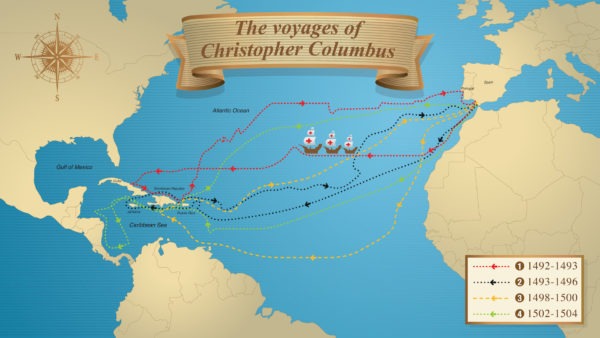
As early as 1420, Portuguese explorers were sailing south along the West African coast and around the Cape of Good Hope, South Africa, transporting riches of the land: gold, spices, and other goods from Africa and Asia to Europe. Instead of sailing around the huge continent of Africa as the Portuguese were doing, Columbus thought he could find a more direct route by sailing west.
Understanding that the world was round and not flat, Columbus had no fear of venturing into uncharted waters. After securing financial support from King Ferdinand and Queen Isabella of Spain, he set sail in August of 1492 with three ships, the Niña, the Pinta, and the Santa María. He crossed what he called the "Ocean Blue," the Atlantic Ocean. Thinking he had reached Asia on October 12, 1492, Columbus actually landed at an island in the Bahamas. Continuing the voyage, he spotted Cuba, assuming it was China. For the next few months, Columbus sailed and explored the Caribbean islands in search of riches to bring back to Spain.
He founded a colony for Spain in the Americas on the island of Hispaniola (present-day Dominican Republic and Haiti) with 39 of his men before returning to Spain in January 1493. Columbus sailed across the Atlantic three more times. On his third voyage, Columbus finally realized that he had never reached Asia, but had landed on a continent he had not previously known existed.
Leif Erikson: The First To Reach America?
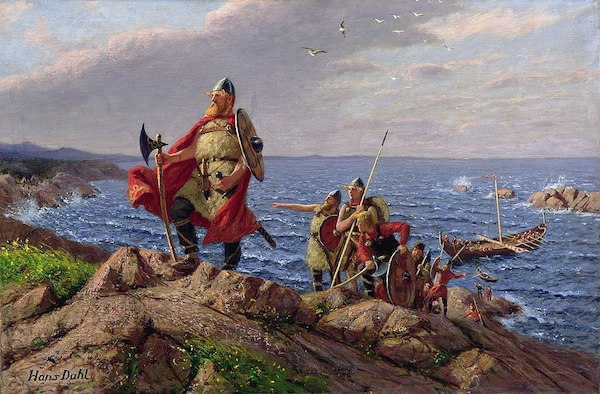
Was Columbus the first European to set foot on North America? No. Viking explorer Leif Erikson reached the continent of North America around the year 1000, almost 500 years before Christopher Columbus was born. Erikson is the first European explorer known to reach North America. After sailing across the Atlantic, he landed at what is now known as Canada, at a place the Norse sagas call Vinland and which modern archaeologists place at L'Anse aux Meadows in Newfoundland. In 1964, President Lyndon Johnson declared October 9 as Leif Erikson Day, although it is not a national holiday.
So why is there a Columbus Day if he was not the first European to reach this continent? The answer is impact, not chronology. Vast transatlantic trade possibilities and colonization played a key part in the significance and enthusiasm of Columbus' findings. His four voyages raised world-wide awareness and interest in the "New World" and all it had to offer. The Erikson voyages were known to a small Norse audience and largely forgotten; the Columbus voyages reshaped the map of the world that European powers used from 1492 onward.
How the Columbus Day Date Is Decided
The rule is simple: the federal Columbus Day observance is the second Monday in October. That rule has been in place since 1971, the first year the Uniform Monday Holiday Act of 1968 took effect. Before 1971, Columbus Day was observed on October 12, the calendar anniversary of the landing, regardless of the day of the week.
The Uniform Monday Holiday Act was signed by President Lyndon B. Johnson on June 28, 1968 to give federal employees predictable three-day weekends and reduce mid-week absenteeism. Four federal holidays were moved to Mondays under the act: Washington's Birthday, Memorial Day, Columbus Day, and Veterans Day. Veterans Day was later returned to November 11 by a 1975 amendment; Columbus Day stayed on the second Monday of October.
Title 5 of the United States Code, Section 6103, still lists "Columbus Day" for the second Monday in October. A presidential proclamation traditionally accompanies the holiday each year, and recent presidents have issued proclamations for both Columbus Day and Indigenous Peoples' Day on the same Monday, a federal pattern in place since 2021.
Columbus Day or Indigenous Peoples' Day?
Many readers have asked whether Columbus Day is a holiday our nation should continue to celebrate. The question is raised as historical details of the Columbus years are weighed. Along with colonization and new transatlantic trade routes came disease, brutality, enslavement, and death for indigenous peoples in the Caribbean and, later, across the Americas. Both sides of the conversation, Italian-American heritage celebration on one hand and recognition of indigenous peoples on the other, are part of the modern observance.
The proposal to reclaim the date traces to 1977, when a United Nations conference on discrimination against indigenous populations in the Americas, held in Geneva, suggested that the second Monday of October honor indigenous peoples instead of Columbus. The proposal did not change any laws, but it set the framing every later observance would build on.
In the early 1990s, Indigenous Peoples' Day was introduced, with South Dakota being the first state to rename Columbus Day in 1990 (as Native Americans' Day). Berkeley, California followed in 1992, marking the 500th anniversary of Columbus's voyage, and is the first US city on record to adopt the name Indigenous Peoples' Day. In various cities and states across the nation, it is now celebrated in addition to, or instead of, Columbus Day to bring awareness of the rich cultural heritage and contributions of the Native American people.
As of 2026, the states and the District of Columbia that officially observe Indigenous Peoples' Day (or an equivalent name) on the second Monday in October include Alaska, Hawaii, Maine, New Mexico, Oregon, South Dakota (as Native Americans' Day), Vermont, Wisconsin, and the District of Columbia. Florida continues to observe Columbus Day; several states observe both. The state-by-state picture continues to shift, so check your own state's official calendar before assuming offices or schools are closed.
In 2019, Washington, D.C. passed a resolution to recognize the second Monday in October as Indigenous Peoples' Day instead of Columbus Day. The National Congress of American Indians, founded in 1944, responded with this statement,
This change allows the opportunity to bring more awareness to the unique, rich history of this land that is inextricably tied to the first peoples of this country and predates the voyage of Christopher Columbus. It also acknowledges American Indians and Alaska Natives as thriving, contemporary sovereign nations who hold their rightful place among the American family of governments.
To learn more, check local listings of National Indigenous Peoples' Day celebrations or these ways to celebrate virtually. Our own companion piece, When Is Indigenous Peoples' Day?, covers the state-by-state status in more detail.
Federal Holiday Status
Columbus Day is one of eleven federal holidays in the United States. Federal offices, federal courts, post offices, and the bond market are closed; most banks follow the federal schedule. The New York Stock Exchange stays open, and UPS and FedEx deliver as usual. State and local observance varies, with many states shifting to Indigenous Peoples' Day on the same date and several observing both. A presidential proclamation is traditionally issued each year by the sitting president, with proclamations for both Columbus Day and Indigenous Peoples' Day issued together since 2021.
How Columbus Day Is Observed
The biggest single observance in the United States is the Columbus Day Parade in New York City, organized by the Columbus Citizens Foundation and running up Fifth Avenue. It draws roughly 35,000 marchers and a much larger crowd of spectators, making it one of the largest celebrations of Italian-American heritage in the country. Other significant parades run in San Francisco (the oldest continuously held Columbus Day parade, since 1869), Chicago, Boston, and Philadelphia.
Beyond the parades, the day looks like any federal Monday holiday. Federal offices, post offices, and most banks are closed. Public schools vary by district: some close, some hold a regular school day with classroom discussion of the history. State offices follow state law, and the stock markets stay open. In Italy the day is celebrated as recognition of an Italian-born explorer; in Spain it is Daía de la Hispanidad, the country's national day; and in much of Latin America the date is marked as Daía de la Raza, the "day of the race," and increasingly as Daía de la Resistencia Indígena in Venezuela, Nicaragua, and Argentina.
The Italian-American Heritage Connection
The modern American Columbus Day is, in large part, an Italian-American holiday. The 1892 national observance under President Benjamin Harrison came in response to anti-Italian sentiment in the United States, most notably the 1891 lynching of eleven Italian immigrants in New Orleans. Columbus became a symbol of Italian contribution to the founding of the Americas, and Italian-American communities held the line on the holiday for decades, lobbied state legislatures, and built the parade traditions that still run today.
Angelo Noce's 1907 Colorado campaign is one early chapter. The Knights of Columbus, a Catholic fraternal order founded in 1882, lobbied Roosevelt heavily in the 1930s; their letter-writing campaign is widely credited with helping push the 1937 federal-holiday signing across the line. For many Italian-American families, the second Monday of October is a heritage day, and the parades are the public face of it. Holding that piece of the story alongside the indigenous-peoples piece is the work of the modern holiday; both are real, both have a public claim on October 12, and the Almanac's job is to lay out the facts.
Plan the Second Monday of October
Mark Monday, October 12, 2026 on your calendar if you observe Columbus Day, Indigenous Peoples' Day, or both. A few practical notes:
- Federal offices and post offices are closed; plan mail and shipping around it.
- Most banks are closed; the NYSE and NASDAQ stay open.
- Schools vary by district. Check ahead if you have school-age children.
- The NYC Columbus Day Parade runs up Fifth Avenue, typically from 44th Street to 72nd Street, starting around midday.
- The Hunter's Moon usually rises within the same week. Our full Moon page has the to-the-minute timestamp.
- Columbus Day weekend is peak foliage season across the Northeast; rural roads in Vermont, New Hampshire, upstate New York, and Maine fill up.

Frequently Asked Questions
When is Columbus Day 2026?
Columbus Day 2026 is Monday, October 12, 2026. The rule is the second Monday of October, and in 2026 the calendar lands that Monday on the same date as the historic 1492 landing.
Why is Columbus Day on a Monday and not October 12?
From 1937 to 1970, Columbus Day was observed on October 12, the calendar anniversary of the landing. The Uniform Monday Holiday Act of 1968 moved several federal holidays, including Columbus Day, to fixed Mondays to create predictable three-day weekends. The change took effect in 1971, and Columbus Day has been the second Monday of October ever since.
Is Columbus Day a federal holiday?
Yes. Columbus Day has been a federal holiday since President Franklin D. Roosevelt signed it into law in 1937. Federal offices, federal courts, post offices, and the bond market are closed. The NYSE and NASDAQ stay open. State and local observance varies.
What is the difference between Columbus Day and Indigenous Peoples' Day?
Columbus Day is the federal holiday on the second Monday of October, recognizing Christopher Columbus's 1492 voyage. Indigenous Peoples' Day is a holiday on the same Monday that honors the original inhabitants of the Americas. As of 2026, Indigenous Peoples' Day is officially observed in Alaska, Hawaii, Maine, New Mexico, Oregon, South Dakota (as Native Americans' Day), Vermont, Wisconsin, and the District of Columbia. Some states recognize both.
Was Columbus the first European to reach the Americas?
No. Viking explorer Leif Erikson reached North America around the year 1000, almost 500 years before Columbus was born, landing at what is now Newfoundland. Erikson is recognized with Leif Erikson Day on October 9 by a 1964 proclamation from President Lyndon Johnson, but Leif Erikson Day is not a federal holiday. Columbus Day commemorates the voyage that opened sustained European contact with the Americas, not the first European landing.
Who pushed Columbus Day to become a national holiday?
Several waves of advocates. President Benjamin Harrison's 1892 proclamation marked the 400th anniversary as a national event. Italian-American activist Angelo Noce got Colorado to adopt the first state Columbus Day holiday in 1907. The Knights of Columbus lobbied through the 1930s for federal recognition, which President Franklin D. Roosevelt signed in 1937.
Are banks and the stock market closed on Columbus Day?
Most banks are closed because they follow the federal holiday schedule. The bond market is closed. The New York Stock Exchange and NASDAQ stay open. Post offices are closed; UPS and FedEx deliver as usual.
When is Columbus Day 2027?
Columbus Day 2027 is Monday, October 11, 2027. The 2028 date is Monday, October 9; 2029 is Monday, October 8; and 2030 is Monday, October 14.
Join the Discussion
How does your community mark the second Monday of October? A parade, a school lesson, an Indigenous Peoples' Day observance, both, neither? Tell us in the comments below, and tell us what you would like added to this page next year.

Deborah Tukua
Deborah Tukua is a natural living, healthy lifestyle writer and author of 7 non-fiction books, including Pearls of Garden Wisdom: Time-Saving Tips and Techniques from a Country Home, Pearls of Country Wisdom: Hints from a Small Town on Keeping Garden and Home, and Naturally Sweet Blender Treats. Tukua has been a writer for the Farmers' Almanac since 2004.
- Deborah Tukua

- Deborah Tukua
- Deborah Tukua
- Deborah Tukua