Dried Fruit Decorations: How to Dry Citrus for Gifts
Oranges, lemons, and limes add a natural touch to winter decorations. Here is our easy guide for how to dry fruit for garland, gifts, and drinks.
Quick Reference: Dried Fruit Decorations
- What to use: firm oranges, lemons, and limes, sliced one-quarter inch thick.
- Fastest way to dry: microwave on defrost, in 5 to 15 minute rounds between paper towels.
- Oven method: 200 degrees Fahrenheit for about 3 hours, turning every hour.
- Air fryer method: the dehydrate setting at 135 degrees Fahrenheit for 6 to 8 hours.
- Make into: garlands, tree ornaments, gift toppers, potpourri, and jars for mulled drinks.
Oranges, lemons, and limes add a warm, natural touch to winter decorations, and drying them is an easy weekend project as the holidays draw near. Here is our step-by-step guide for how to dry fruit and turn it into garlands, tree ornaments, gift toppers, and more. The materials cost very little, the methods are simple, and the results last from one season to the next.
How to Dry Fruit and Make a Garland: 3 Easy Steps
With a few craft supplies, such as star anise, cinnamon sticks, cloves, wooden beads, wire, twine, and yarn, you can make a dried citrus wheel garland and matching ornaments for your tree, wreath, or gift packages. Work through the three steps below in order: prepare the fruit, dry it, then string it up.
1) Prepare Oranges, Lemons, and Limes for Drying
- Rinse and dry firm, unblemished citrus fruits of your choice.
- Slice one end off whole oranges, lemons, and limes.
- Using a sharp knife or mandolin, cut the fruit uniformly into one-quarter inch thick slices. Cut off the other end and discard it.
Uniform slices matter more than they look. Even, one-quarter inch rounds dry at the same rate, so you are not pulling a few crisp wheels off the rack while the rest are still damp in the middle.
2) Choose a Drying Method for Your Fresh Fruit
You can hang the slices to air dry, but for faster results you can microwave, bake, or air fry your citrus. All three methods do the same job: drive out the moisture so the fruit will not mold. The National Center for Home Food Preservation has a plain-English overview of drying fruit at home if you want to understand why low, slow heat works best.
Microwave
- Lay sliced citrus on a stack of three absorbent paper towels.
- Cover with another paper towel and microwave using the defrost setting for 5 to 15 minutes.
- Remove from the microwave.
- Flip the slices onto new absorbent paper towels.
- Cover with a new paper towel and microwave for another 5 to 15 minutes.
- Carefully remove the steaming-hot towels.
- If needed, microwave on the defrost setting for another minute or two.
- Check every minute to avoid burning.
- Using a spatula, transfer the citrus slices to a wire rack to cool.
Put in the Oven
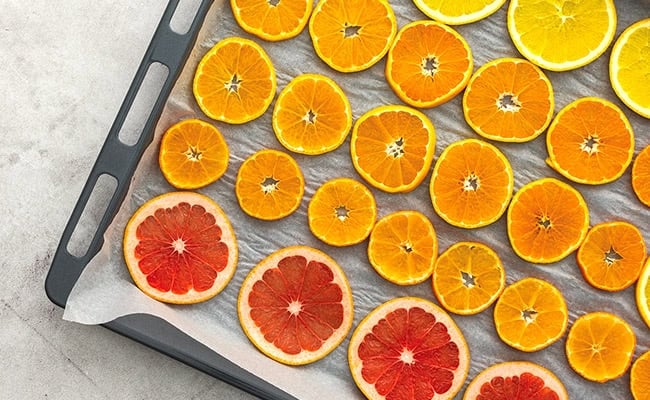
- Preheat the oven to 200 degrees Fahrenheit.
- Place the citrus slices on a baking tray in the oven for about 3 hours.
- Turn the slices and check every hour.
- Lemons and limes dry a little faster than oranges.
- Transfer the dried slices to a wire rack to cool.
Air Fryer Dehydrating
- Using the dehydrate setting, most fruits can be dehydrated in 6 to 8 hours at 135 degrees Fahrenheit.
- Place the orange slices into the air fryer basket or tray.
- Check progress after six hours.
- Orange slices will take a full 8 hours to dry.
- Remove once dried, and cool on a wire rack.
3) Assemble Your Dried Fruit Garland
Tools Needed
- A large sewing needle.
- A spool of waxed thread or string.
- Wooden beads.
Instructions
- Tie a bead onto one end of the waxed thread and cut the thread to your desired length.
- Thread a citrus wheel through one side near the rind and out the other side.
- Continue stringing citrus wheels onto the garland. You could also string a decorative bead between each citrus wheel.
- Tie and knot a bead to the other end to secure it.
- Hang the garland on your Christmas tree, kitchen window, mirror, or mantle for the holidays.

Make Your Dried Citrus Last
A well-dried citrus slice will keep as a decoration for years, not just one season, as long as you store it right. The enemy is leftover moisture, which is why the low, slow heat matters. A slice is fully dry when it feels stiff and leathery with no soft, cool spot in the center. If it still bends easily, give it more time on the rack or another round in the oven.
- Let slices cure on the wire rack for a day or two before you store or string them, so any hidden moisture escapes.
- Pack decorations flat in an airtight container or a zip-top bag between sheets of paper towel.
- Keep them somewhere cool, dark, and dry. Attics and damp basements invite mold and fading.
- A stray silica gel packet tucked in the box helps pull down humidity in storage.
Colors soften over time, which many folks find part of the charm. If a slice ever turns spotty or smells musty, it took on moisture somewhere along the way, and it is best to toss it and dry a fresh one.
More Ideas!
Tree Ornaments or Gift Wrapping Adornments
- Poke a hole near the rind, using a toothpick if needed, and thread twine through it.
- Tie a 2 to 3 inch cinnamon stick above the wheel and thread a wooden bead over the cinnamon stick.
- Tie a loop to hang the ornament on a tree.
- To dress up gift wrapping, tie twine around a gift box and affix the ornament to the twine.

Add to Potpourri or Existing Garlands and Wreaths
Dried fruit slices work well in potpourri. Add a drop of essential oil for a stronger scent. You can also tuck a few slices into an artificial or real evergreen garland or wreath to add a pop of color. Use craft glue or wire to attach them.
RELATED: Top 5 fragrant Christmas trees
Think Drinks
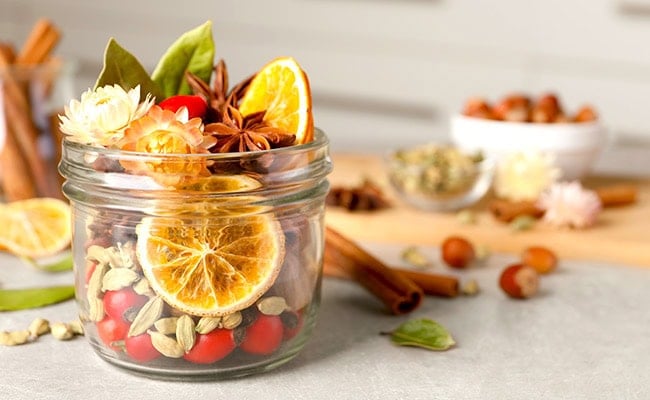
Dried oranges add a touch of festivity to mulled cider and wine, tea, and cocktails. Package them as a “cocktail in a jar” by placing them in a glass jar with other dried fruit, a few spices, and a recipe card. If the slices are headed for a drink rather than the tree, dry clean, edible fruit for that batch and keep it food-safe, since anything you sip should be handled like the ingredient it is.
Best Citrus and Spices for Drying
Any firm citrus will dry, but each brings its own color and scent to the finished piece. Here is a quick guide to what pairs well with what, whether you are after a bright garland or a fragrant jar of potpourri.
| Item | Prep method | Oven temp (F) | Drying time | Result and use in decor |
|---|---|---|---|---|
| Orange slices | Cut 1/4-inch thick rounds with a sharp or serrated knife; blot firmly with paper towels to remove surface moisture; arrange in a single layer on a parchment-lined baking sheet | 200 | 3-5 hours, flipping every 30-45 minutes | Translucent amber-gold discs with a jewel-like glow when lit; string into garlands, wire onto wreaths, or use as gift toppers; scent is mild and warm |
| Lemon slices | Same as orange: 1/4-inch rounds, blot dry, single layer on parchment | 200 | 3-5 hours, flipping every 30-45 minutes | Pale yellow to golden; bright, cheerful color in holiday arrangements; slightly thinner flesh than orange so drying time may run shorter |
| Grapefruit slices | Cut 1/4-inch rounds; blot thoroughly (grapefruit holds more moisture); arrange in a single layer | 200 | 6-8 hours, flipping every 30-45 minutes | Large, dramatic pink or pale-yellow rounds; striking focal point in wreaths and centerpieces; thicker flesh requires longer time to fully dry |
| Lime slices | Cut 1/4-inch rounds; blot dry; single layer on parchment | 200 | 3-5 hours, flipping every 30-45 minutes | Deep green rind with pale interior; provides strong color contrast alongside orange and lemon; smaller diameter makes good filler in arrangements |
| Apple slices | Core and cut into 1/4-inch rounds or half-rings; dip immediately in a solution of 1 tablespoon lemon juice per 1 cup cold water to prevent browning; blot dry; single layer on parchment | 200 | 2-3 hours, flipping every 30 minutes | Warm caramel to beige tones; adds rustic texture to garlands and wreaths; lemon juice dip is essential to prevent oxidation discoloration |
| Whole cinnamon sticks | No prep needed; already fully dried at purchase | No oven step required | Ready to use | Bundle 3-5 sticks with twine for gift toppers or tuck into wreaths alongside citrus; strong spice scent complements dried citrus well in sachets and potpourri |
| Whole star anise | No prep needed; already fully dried at purchase | No oven step required | Ready to use | Geometric eight-point shape adds visual interest; wire or glue into wreaths and ornament clusters; pairs well with orange slices for a classic holiday palette |
| Whole cloves (for pomanders) | No prep needed; already fully dried at purchase. For pomanders, stud cloves into a whole fresh orange in a pattern before drying the whole fruit at 200 F for 3-5 days. | No oven step for loose cloves; 200 F for whole pomanders | Ready to use (loose); 3-5 days total for whole orange pomander | Stud into dried orange slices or a whole orange pomander for a traditional spiced decoration; intense fragrance lasts for months; small size works best as a textural accent |
Planning to make several as gifts? It never hurts to pick a good day for a big project. The Almanac’s Best Days calendar is a folk-planning tool generations have used to time their tasks, and a slow afternoon of drying and stringing is exactly the kind of thing it was made for.
History Behind Dried Fruit and the Holidays
Orange may not be the first color that comes to mind when you think of Christmas, but oranges and the holiday have a distinct connection. Years ago, citrus fruit was more a luxury than an everyday snack. As a gift, citrus was exotic and appreciated, since it came from faraway tropical places and arrived just as the days grew shortest around the winter solstice.
During the Great Depression, receiving an orange or other citrus fruit was a special treat. It was so special that many families still tuck an orange into holiday stockings today. When you hang a dried orange wheel on the tree, you are carrying that old tradition forward in a new shape.
RELATED: 11 Crazy Holiday Traditions
Join the Discussion
What are some of your favorite ways to use dried fruit as decorations? Share your thoughts with your community here in the comments below. We love seeing how folks put their own spin on an old holiday craft.

Dried Fruit Decorations: Frequently Asked Questions
How do you dry oranges for decorations?
Rinse firm oranges, slice them one-quarter inch thick, and dry the slices using one of three methods: the microwave on defrost in 5 to 15 minute rounds, the oven at 200 degrees Fahrenheit for about 3 hours, or an air fryer on the dehydrate setting at 135 degrees Fahrenheit for 6 to 8 hours. Cool the slices on a wire rack before you string them.
What is the fastest way to dry citrus slices?
The microwave is the quickest. Lay the slices between paper towels and run them on the defrost setting in 5 to 15 minute rounds, flipping and swapping the towels between rounds, and checking every minute near the end so they do not burn. It is hands-on but far faster than the 3 hour oven or the 6 to 8 hour air fryer.
How long do dried citrus decorations last?
Kept cool, dark, and dry, well-dried citrus slices can last for years and come out again each holiday season. Cure them a day or two after drying, then store them flat in an airtight container, ideally with a silica gel packet. The colors soften over time, which many people consider part of the charm.
Can you use dried fruit decorations in drinks?
Yes, dried oranges add festivity to mulled cider, wine, tea, and cocktails, and they make a nice “cocktail in a jar” gift with spices and a recipe card. If a batch is meant for sipping rather than the tree, dry clean, edible fruit and handle it as food, since anything that goes in a glass should be kept food-safe.
Do dried orange slices go moldy?
They can if they are not fully dried or if they take on moisture in storage. A finished slice should feel stiff and leathery with no soft, cool center. If one turns spotty or smells musty, it picked up moisture somewhere, so toss it and dry a fresh one rather than hanging it.
Why are oranges associated with Christmas?
Citrus was once a rare luxury shipped from faraway tropical places, so an orange was a prized winter gift. During the Great Depression, receiving one was a special treat, and many families still tuck an orange into holiday stockings. Hanging a dried orange wheel on the tree carries that tradition forward.


Deborah Tukua
Deborah Tukua is a natural living, healthy lifestyle writer and author of 7 non-fiction books, including Pearls of Garden Wisdom: Time-Saving Tips and Techniques from a Country Home, Pearls of Country Wisdom: Hints from a Small Town on Keeping Garden and Home, and Naturally Sweet Blender Treats. Tukua has been a writer for the Farmers' Almanac since 2004.
- Deborah Tukua

- Deborah Tukua
- Deborah Tukua
- Deborah Tukua