

When Is Diwali 2026? Dates, History, and the Five Days
Quick Reference: Diwali 2026
- Main day (Lakshmi Puja): Sunday, November 8, 2026
- Full five-day festival: Friday, November 6 to Tuesday, November 10, 2026
- The rule: The main day falls on the new moon (Amavasya) of the Hindu month of Kartik
- Also known as: Deepavali, Deepawali, the Festival of Lights
- Celebrated by: More than one billion people worldwide, primarily Hindus, Sikhs, and Jains
- Largest celebration outside India: Leicester, United Kingdom
Diwali 2026 lands on Sunday, November 8, with the full five-day festival running Friday, November 6 through Tuesday, November 10. The main day, called Lakshmi Puja, is always the new moon of the Hindu month of Kartik, which is why the Gregorian date shifts each year between mid-October and mid-November. More than one billion people will mark the Festival of Lights in 2026, and the rituals, lamps, and feasts that anchor the week are the same ones kept for centuries.
When Is Diwali 2026?
Diwali 2026 is observed across five days, from Friday, November 6 to Tuesday, November 10, with the main day on Sunday, November 8, 2026. That third day is the most significant: it is the night of Lakshmi Puja, the new moon of Kartik on the Hindu lunar calendar, and the official first day of the new year in many regional traditions. Lamps are lit at dusk, family gatherings stretch late, and fireworks ring out across the night.
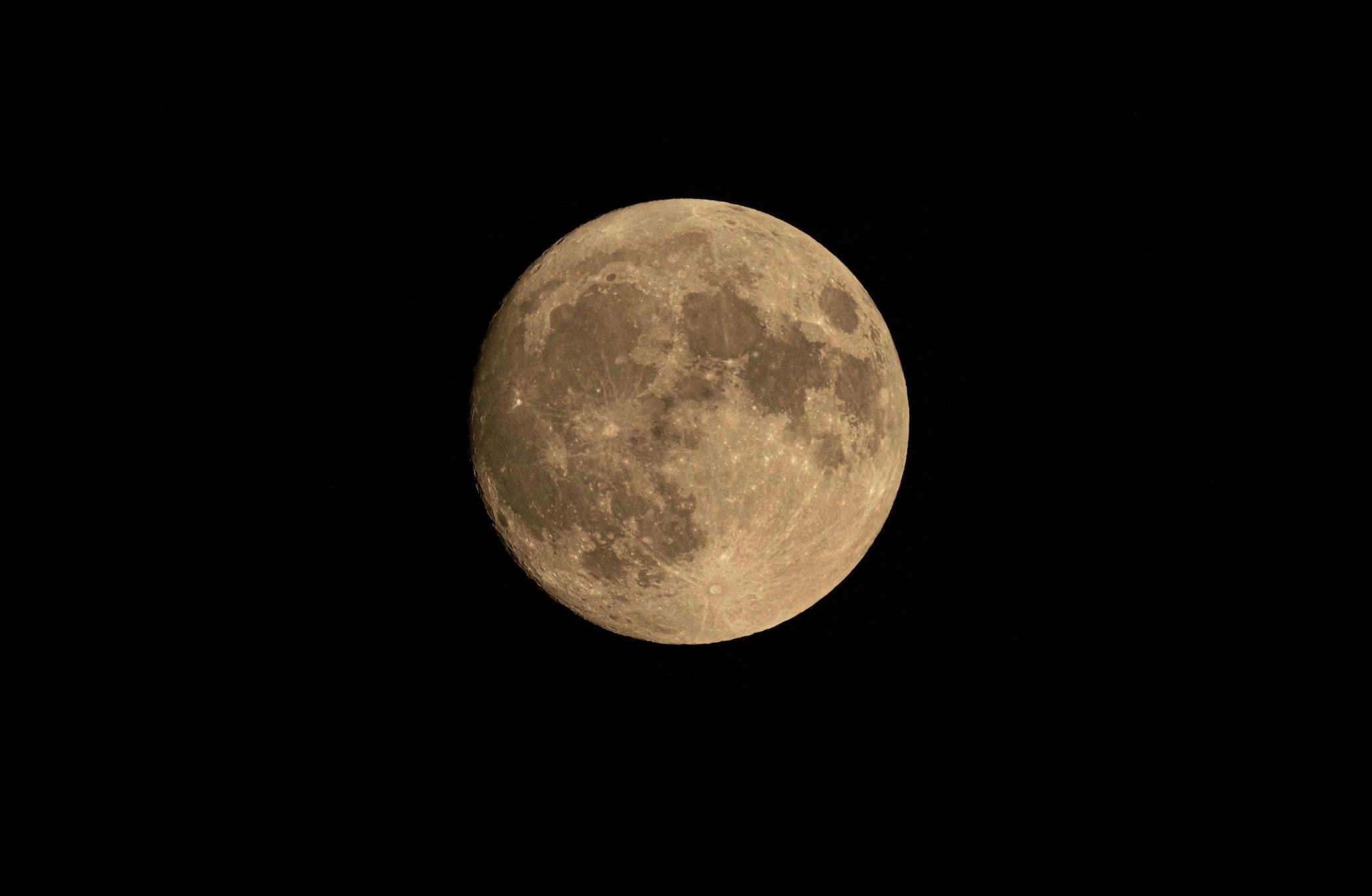
The dates change every year because Diwali follows the Hindu lunisolar calendar, keyed to the new Moon rather than to a fixed Gregorian day. A lunar month is roughly 29.5 days; a solar year is 365.25. That gap is why Diwali drifts about eleven days earlier each year until a periodic calendar adjustment swings it back. The festival lands anywhere from mid-October to mid-November.
Diwali Dates for the Next Five Years
| Year | Main Day (Lakshmi Puja) | Five-Day Span |
|---|---|---|
| 2026 | Sunday, November 8 | November 6 to November 10 |
| 2027 | Friday, October 29 | October 27 to October 31 |
| 2028 | Tuesday, October 17 | October 15 to October 19 |
| 2029 | Monday, November 5 | November 3 to November 7 |
| 2030 | Saturday, October 26 | October 24 to October 28 |
If you are planning travel, a family visit, or a temple service years in advance, those are the dates to circle. Note that 2028 is a noticeably early year because of the lunisolar drift; by 2030 the calendar has begun to swing back toward early November. For night-of-the-new-Moon viewing, our full Moon dates and times page covers the rest of the lunar year in the same to-the-minute format.
What Is Diwali?
Diwali is the Hindu five-day festival of light. Also known as Deepavali or Deepawali, the name means “row of lights” in Sanskrit, the sacred language of Hinduism. The holiday celebrates the triumph of light over darkness at the beginning of a new year. In ancient legends, the season is associated with the end of harvest and the bounty of the year, and the official holiday likely arose from a combination of older harvest observances.
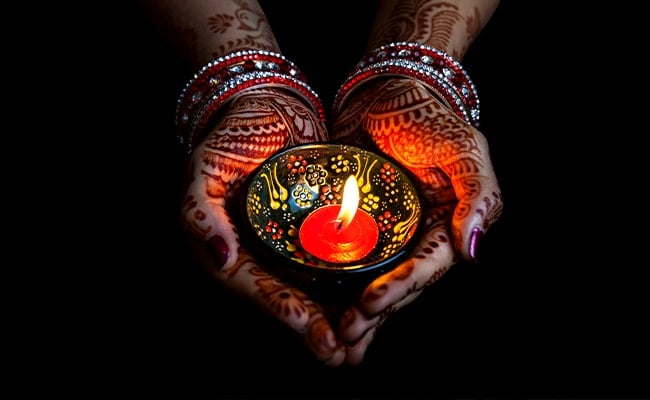
The central idea is plain: where there is light, there is no space for darkness. Light is therefore the heart of the festival, and small clay lamps called diyas are lit to illuminate the home and to invite Lakshmi, the goddess of prosperity, into one’s life for the year ahead.
Depending on the regional interpretation, Diwali celebrates the marriage of Lakshmi to Vishnu, the god of protection, and honors both deities. Other traditions mark it as the return of Lord Rama to Ayodhya after fourteen years of exile. Still other local readings commemorate the victories of specific historical battles or other “light over dark” turning points in regional history. Each day of the five carries its own emphasis: a different way to welcome the new year, refresh one’s life, and reconnect with family. The rhythm parallels the Western stretch from Thanksgiving to New Year’s Day.
The Five Days of Diwali
Diwali is celebrated across five consecutive days, with each day carrying its own significance and its own rituals. For 2026, the days fall as follows:
Day 1, Dhanteras (Friday, November 6, 2026)
The opening day is for cleaning, decluttering, and clearing space in the home and in oneself for the light and prosperity to come. Many families also shop for gold or silver on Dhanteras, a tradition tied to honoring Lakshmi and Lord Dhanvantari, the god of health and well-being. A new metal coin or piece of jewelry brought home on this day is a good-luck anchor for the year.
Day 2, Naraka Chaturdashi / Choti Diwali (Saturday, November 7, 2026)
Day two, sometimes called Choti Diwali (“little Diwali”) or Naraka Chaturdashi, is given to decoration. The clay diyas are lit and placed in rows or clusters to drive out every shadow: along entrances, in corners, on windowsills, and around the household shrine. Rangolis are drawn at the door, and flowers, fruit arrangements, and fresh garlands fill the home.
Day 3, Diwali / Lakshmi Puja (Sunday, November 8, 2026)
The third day is the main day. It is the new moon of Kartik on the Hindu lunar calendar, the night of Lakshmi Puja, and in many regional traditions the official first day of the new year. Family gatherings are large, the meal is long, gifts are exchanged, prayers are offered to Lakshmi for prosperity in the year ahead, and fireworks displays rise over towns and cities after dark.
Day 4, Govardhan Puja / Padwa (Monday, November 9, 2026)
The fourth day is reserved for visiting, particularly family members and friends in nearby homes. Some regions observe it as Govardhan Puja, commemorating Krishna’s lifting of Mount Govardhan to shelter villagers from a storm; others mark it as Padwa, honoring the bond between husband and wife. Less elaborate than the main day, but never small: feasts and gift exchanges remain part of the visit.
Day 5, Bhai Dooj (Tuesday, November 10, 2026)
The fifth and final day belongs to siblings. Brothers and sisters offer prayers to protect and guide one another for the year ahead. Sisters often apply a tilak to their brothers’ foreheads, brothers bring gifts, and the day closes with a shared meal. It is the quietest of the five, by design.
The History and Religious Significance
Diwali is Hindu in origin but shared by several faiths that trace their roots to the Indian subcontinent. Each tradition reads the lights through a slightly different story, and most homes hold more than one at once.
- Hindu tradition. For many Hindus, Diwali celebrates the return of Lord Rama, his wife Sita, and his brother Lakshmana to Ayodhya after fourteen years of exile and the defeat of the demon king Ravana. The people of Ayodhya are said to have lit rows of oil lamps to guide them home. Other traditions emphasize the worship of Lakshmi on the night of the new moon.
- Jain tradition. Jains observe Diwali as the anniversary of the nirvana, or final liberation, of Lord Mahavira, the twenty-fourth Tirthankara, in 527 BCE.
- Sikh tradition. Sikhs mark the day as Bandi Chhor Divas, the release of the sixth Guru, Guru Hargobind, from imprisonment in the Gwalior Fort in 1619, along with fifty-two princes he refused to leave behind. The Golden Temple in Amritsar is illuminated on the night.
- Buddhist tradition. Some Newar Buddhists in Nepal observe Diwali to mark the conversion of the emperor Ashoka to Buddhism in the third century BCE.
The throughline across every reading is the same: a victory of light over darkness, of knowledge over ignorance, of good over evil. Britannica’s overview of Diwali is a good plain-English starting point if you want to read further on any one of the traditions.
How the Date Is Decided
The rule, in plain English: Diwali’s main day is the new moon (Amavasya) of the Hindu month of Kartik. That falls in October or November on the Gregorian calendar. The full five-day festival begins two days before the new moon, on the thirteenth lunar day of the dark fortnight of Ashwin, and ends two days after, on the second lunar day of the bright fortnight of Kartik.
The Hindu calendar is lunisolar, which is why the date moves. Lunar months stay tied to the phases of the Moon; an extra month (Adhik Maas) is added every two or three years to keep the calendar in step with the seasons. The earliest Diwali can land is in mid-October; the latest in mid-November. Regional observance can shift the exact day by one, depending on when local astronomers calculate the new moon in the local sky.
How Diwali Is Celebrated
Diwali is, at its core, a home festival. A few of the traditions that almost every household keeps:
- Diyas and lights. Small clay lamps filled with oil and a cotton wick, set in rows along entrances, windowsills, and around the household shrine. Electric string lights have joined the tradition; the diya is still the heart of it.
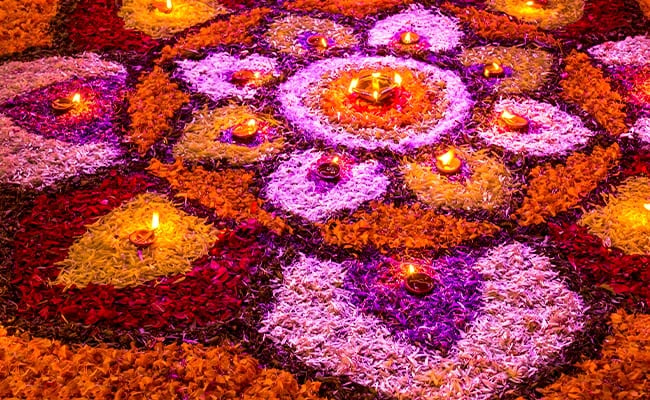
- Rangoli at the door. Geometric or floral patterns drawn at the threshold using colored rice flour, dry rice, chalk powder, flower petals, or colored sand. A welcome to Lakshmi and a welcome to guests.
- Sweets and savories. Trays of laddoo, gulab jamun, barfi, jalebi, kaju katli, and chakli pass between households all week.
- The main meal. A traditional vegetarian feast: samosas, pakoras, biryani or pulao, dal, naan or roti, paneer dishes, a sweet course, and chai.
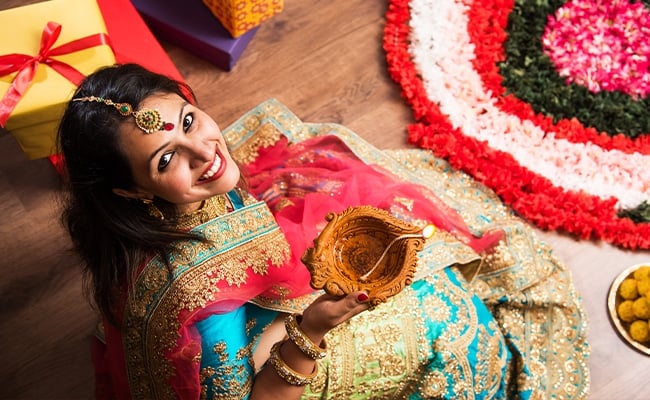
- New clothes. Many families buy new outfits for the main day, often traditional Indian dress: sarees, lehengas, kurtas.
- Gifts. Sweets, dried fruit, silver coins, household goods, jewelry, passed in every direction: family, staff, neighbors, the family priest.
- Fireworks. Communal displays after dusk on the main day. Some Indian cities have moved toward greener, lower-pollution celebrations; the firework tradition remains widespread.
- Lakshmi Puja. The household puja on the main evening: prayers, offerings, and an oil lamp left burning through the night to welcome the goddess of prosperity.
If you are joining in for the first time, the simplest move is the most welcoming: light a diya at your own door at dusk on the main day, share a sweet with a neighbor, and offer the words Shubh Diwali or Happy Diwali.
Diwali Around the World
Diwali is celebrated wherever the Indian diaspora has settled, and that is now nearly everywhere. The form changes from country to country; the lights do not.
- India. The largest and most varied celebrations, with regional names and emphases changing between states. A public holiday across the country.
- Nepal. Observed as Tihar, a five-day festival that also includes Kukur Tihar (honoring dogs) and Gai Tihar (honoring cows). Sister-brother bonds anchor the closing day.
- Sri Lanka. Public holiday, observed by the Tamil Hindu community as Deepavali.
- Singapore and Malaysia. Diwali (Deepavali) is a public holiday in both, with major celebrations in the Little India districts of Singapore and Kuala Lumpur.
- Trinidad and Tobago, Guyana, Suriname, Fiji, Mauritius. All public holidays. Mauritius and Fiji in particular trace large Hindu diaspora populations to nineteenth-century indenture, and Diwali is one of the largest holidays on each national calendar.
- United Kingdom. The Leicester Diwali is the largest celebration outside India, with light switch-ons, parades, and tens of thousands of attendees along the Belgrave Road. London, Birmingham, and Manchester also hold significant events.
- United States and Canada. Growing observance year over year. In 2022, the US Postal Service issued a Diwali stamp; in 2023, New York City made Diwali a public school holiday. Major community celebrations are held in Edison, New Jersey; Cary, North Carolina; Houston; the Bay Area; Toronto; and Brampton, Ontario.
- Australia and New Zealand. Community celebrations in Sydney, Melbourne, Auckland, and Wellington.
How to Celebrate Diwali
Regardless of one’s faith, Diwali is a welcoming holiday. A few ways to bring rich Indian traditions into the week even if you are new to them:
- Make rangoli at your front door. Food coloring on dried rice, or chalk scraped with a rough edge for colored powders, will work; small beads, flower petals, and beans round out the patterns.
- Cook a traditional Indian dish (or order one from a local Indian restaurant): samosas, naan, chutney, biryani, butter chicken, tandoori chicken, or the fudge-like barfi.
- Attend a local Indian music performance, or visit a gallery of Indian art to learn more about the culture behind the holiday.
- Visit a local Hindu temple. Most welcome respectful visitors on Diwali night.
- Plan a small, safe fireworks display on the third night and share the brightness with neighbors.
- Reconnect with distant family or friends. Diwali is a reason to mend the bonds you let drift through the busy year.
- Light a single diya at your door at dusk on the main day. The smallest version of the tradition is also the oldest.
Offering Diwali Wishes for Prosperity
Whether you celebrate Diwali yourself or want to wish others well, there are many ways to share Diwali wishes and greetings. Simple phrases like “Happy Diwali!” “Have a joyful Diwali!” or “Have a blessed Diwali!” are always welcome. You can also reach for something a little more personal:
- May the festival’s lights guide you through difficult times.
- May Diwali bring enough light to banish all darkness from your life.
- Hope, happiness, and wealth to you this Diwali.
- May your year be as colorful as the Diwali colors.
- Wishing you a new year as bright as the Diwali fireworks.
- Have a cozy, warm, and bright Diwali.
- May the lights of Diwali burn away your troubles.
- May Lakshmi bless you this year in more ways than you can count.
- May Diwali’s light burn brightly with you throughout the year.
- Hoping your Diwali is as sweet as the treats you eat to celebrate it.
- Carry Diwali’s light with you to remember on darker days this year.
- May this Diwali begin a joyous and prosperous year for you and yours.
These greetings can be offered in person, written on a card, or shared in a holiday note. The point is the same either way: to extend the light, and the wish for a good year, to the people who matter to you.
Plan Your Diwali
Mark Sunday, November 8, 2026 on the calendar for the main day, and block out Friday, November 6 through Tuesday, November 10 for the full five. A few small habits make the week easier to host:
- Clean the house in the days leading up to Dhanteras. The pre-festival clean is part of the ritual, not a chore around it.
- Stock up on diyas, candles, and oil two weeks ahead. Local Indian grocery stores and online sellers sell out close to the main day.
- Plan the sweet course early. Laddoo, barfi, and gulab jamun keep well; chakli and other fried savories keep for a week in an airtight tin.
- If you are hosting non-celebrating guests, share a short note with the schedule. A friendly heads-up about the fireworks, the timing, and what is on the table makes the night easier for everyone.
- Plan the fireworks responsibly. Outdoor displays, local-ordinance hours, supervised lighting, and a bucket of water nearby. The brightness is the point; a safe brightness is the better one.

Frequently Asked Questions
When is Diwali 2026?
Diwali 2026 is celebrated across five days, from Friday, November 6 through Tuesday, November 10. The main day, Lakshmi Puja, is Sunday, November 8, 2026.
How long is Diwali?
The full festival is a five-day event, with each day carrying different significance: Dhanteras, Choti Diwali (Naraka Chaturdashi), Diwali / Lakshmi Puja, Govardhan Puja (Padwa), and Bhai Dooj. The third day is the most significant and is considered the first day of the new year in many traditions.
Who celebrates Diwali?
Diwali is widely celebrated by Hindus, Sikhs, and Jains, faiths that were founded in India, and by some Newar Buddhists in Nepal. More than one billion people worldwide observe the holiday in some form, and the celebration is open to anyone who wants to mark the Festival of Lights.
Where is the biggest Diwali celebration?
The biggest and most elaborate Diwali celebrations are in India. Outside India, the largest annual Diwali celebration is held in Leicester, in the United Kingdom, along the Belgrave Road. Major celebrations are also held in Singapore, Kuala Lumpur, Auckland, Toronto, and across the New York and New Jersey metro area.
What is Diwali celebrating?
At the broadest level, Diwali celebrates the triumph of light over darkness and the worship of Lakshmi, the goddess of prosperity. Specific stories vary by tradition: Hindus may emphasize the return of Lord Rama to Ayodhya; Jains mark the nirvana of Lord Mahavira; Sikhs observe Bandi Chhor Divas, the release of Guru Hargobind from imprisonment in 1619.
What decorations are most common for Diwali?
Small clay diyas or tea lights are the most common Diwali decorations, set in rows or clusters along entrances, windowsills, and around the household shrine. Rangoli, elaborate patterns drawn near the front door using colored rice flour, rice, chalk powder, or flower petals, is the other tradition almost every household keeps.
What events are part of Diwali?
Feasts, sweets, gift exchanges, fireworks displays, offerings to Hindu deities (chiefly Lakshmi), family reunions, shopping for gold or new clothes, and home decorating are all part of the festivities. The household Lakshmi Puja on the main evening is the spiritual heart of the week.
Doesn’t Diwali include flying lanterns?
Some regional Diwali celebrations do feature paper lanterns or sky lanterns. The flying-lantern tradition is more commonly associated with the Chinese Lantern Festival (the Shangyuan Festival), held in February or early March, which marks the end of the Chinese new year celebrations.
When is Diwali 2027?
Diwali 2027 falls on Friday, October 29, with the five-day festival running October 27 through October 31, 2027.
Join the Discussion
How will you celebrate Diwali 2026? Diyas at the door, a rangoli at the threshold, a family meal, a small fireworks display in the back garden, a quiet Lakshmi Puja at the household shrine? Share with your community in the comments below, and pass Diwali wishes to your friends and family here.
Diwali sits in the darker half of the year for the Northern Hemisphere, which is part of why a festival of lights lands where it does. If you are tracking the turn of the season, the fall equinox on September 22, 2026 is the point where night starts outlasting day.


Melissa Mayntz
Melissa Mayntz is a writer who specializes in birds and birding, though her work spans a wide range—from folklore to healthy living. Her first book, Migration: Exploring the Remarkable Journeys of Birds was published in 2020. Mayntz also writes for National Wildlife Magazine and The Spruce. Find her at MelissaMayntz.com.
- Melissa Mayntz

- Melissa Mayntz
- Melissa Mayntz
- Melissa Mayntz



Happy Diwali to one and all. May your new Year be filled with happiness, peace and prosperity
Diwali is the time to celebrate togetherness, joy, and new beginnings. With the sparkle of lights and the sound of happiness, let’s make this festival truly memorable. Wishing everyone a safe and delightful Diwali with Om Muruga Crackers!