

Aquarius Zodiac Sign: Dates, Traits, Myth, and Star Facts
Aquarius is the eleventh constellation of the zodiac. Its name is the Latin word meaning “water bearer.” Learn more!
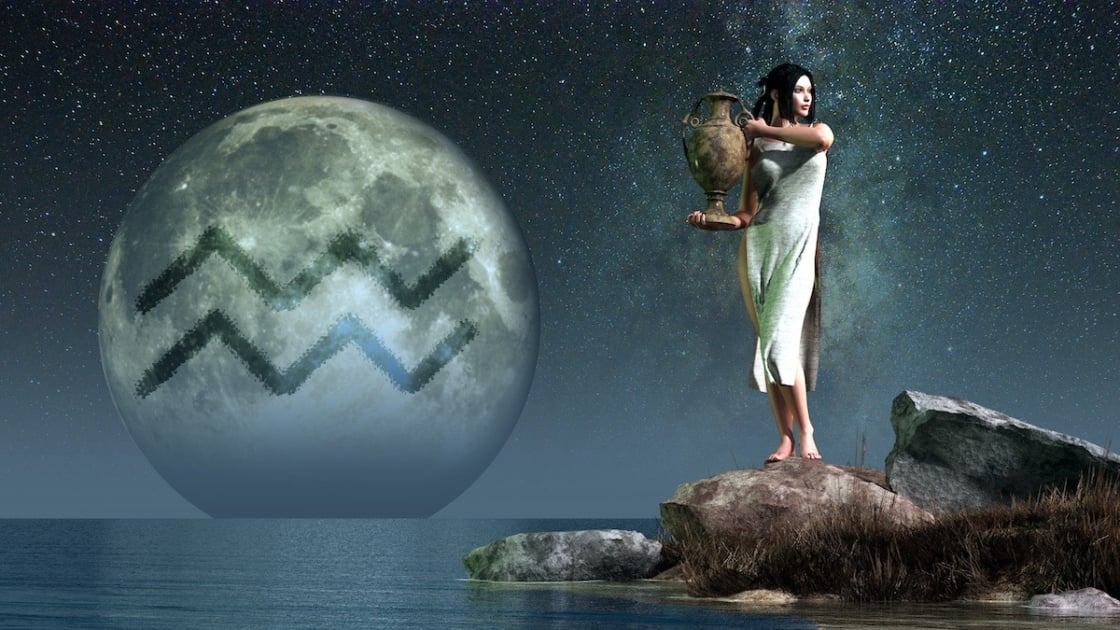
Quick Reference: Aquarius at a Glance
- Dates: January 20 to February 18
- Symbol: The Water-Bearer (♒)
- Element: Air (despite the watery name)
- Quality: Fixed
- Modern ruler: Uranus · Traditional ruler: Saturn
- Birthstones: Garnet (January) and Amethyst (February)
- Constellation: 11th of the zodiac, between Capricornus and Pisces
- Brightest star: Sadalsuud, magnitude 2.91
The Aquarius zodiac sign runs from January 20 through February 18, and it is one of the most quietly misunderstood signs on the wheel. The name sounds like water. The symbol shows water. The element is air. We will sort all of that out, walk through the dates, the Water-Bearer myth, the constellation overhead, the traits the tradition attributes to people born under the sign, and the honest line between astronomy and astrology.
If you want the big picture first, see our overview of all twelve zodiac signs.
When Is Aquarius Season?
In Western tropical astrology, the Sun moves into Aquarius on January 20 and stays there until February 18. The exact handoff shifts by a day in either direction depending on the year and your time zone, but the window holds. If your birthday lands inside it, your Sun sign is Aquarius.
If you were born on the edge, January 20 or February 18 to 19, you sit on a cusp and may want to look up your exact birth time before claiming the sign. A cusp does not change the calendar, only how cleanly your chart sits inside one sign.
The Aquarius Symbol: The Water-Bearer
The glyph for Aquarius is two stacked waves (♒), and the figure behind the glyph is a man tipping a vessel and pouring water out. The Latin word Aquarius means “water bearer.” The image is ancient. Star charts from Babylon show the same figure thousands of years before the Greeks gave him a name we still use.
The two wavy lines have been read as flowing water, as electrical currents, and as the airwaves that carry ideas. All three readings show up in modern descriptions of the sign, which is part of why Aquarius reads as both old and oddly future-facing.
The Mythology of Aquarius
Ganymede, the Cup-Bearer of Olympus
The best-known story behind the constellation is Greek. Ganymede was an unnaturally handsome young Trojan prince. Zeus, taken with him, transformed into an eagle, swept him up to Mount Olympus, and made him cup-bearer to the gods. Ganymede poured nectar for the immortals at their feasts, and Zeus set his likeness in the sky as Aquarius. The eagle was set nearby as the constellation Aquila.
Rivers, the Great Flood, and Service
Aquarius was one of the earliest constellations to be identified, and consequently plays a role in a number of very old myths. Because the waters flowing from the bearer’s vessel are often depicted as rivers, the figure is often associated with the “Great Flood” story told across varied ancient cultures.
In one Greek strand of the flood story, the Water-Bearer is read as Deucalion, the lone righteous man who survived the deluge sent by Zeus and helped reseed humankind. In Babylonian sky lore the same figure was called the “Great One,” tied to the god Ea and to the seasonal rains. Egyptian astronomers linked Aquarius to the annual flooding of the Nile, when the constellation’s pitcher was said to refill the river.
The constellation is also commonly associated with the fifth of Hercules’ Twelve Labors, cleaning the Augean Stables. The disgustingly filthy stables, which housed over 1,000 head of cattle, hadn’t been cleaned in decades, but Hercules was able to clean them in less than one day by simply rerouting the Alpheus and Peneus rivers through them. Service, rerouted water, and a clever fix: a fitting backstory for a sign that the tradition pegs as a problem-solver.
Aquarius Personality Traits
Astrology is a folk tradition, not a science. Two people born under the same Sun sign are not interchangeable, and traits are best read as a starting sketch, not a forecast. With that on the record, here is the picture the tradition paints of an Aquarius:
- Friendly
- Honest
- Loyal
- Unconventional
- Inventive
- Independent
- Intellectual
- Altruistic
- Humanitarian, drawn to causes larger than the household
- Original and eccentric, comfortable being the odd one out
- Detached at times, more at ease with ideas than with feelings
The flip side of independence is distance. The flip side of inventiveness is restlessness. None of this is destiny. Take what is useful, leave the rest.
The Aquarius Constellation
Aquarius is the eleventh constellation of the zodiac, located between Capricornus and Pisces. (Note: Zodiac is a term used by astronomers and astrologers alike, but sometimes there is a difference in spelling between the constellation and the astrological sign. For instance, Capricornus is the name of the constellation whereas Capricorn is the name of the astrological sign. Learn about the difference between astrology and astronomy.)
There are 97 stars in Aquarius, the brightest of which are often depicted as a man pouring water out of a large vessel. Seven Aquarian stars have planets orbiting them, including Gliese 876, the first planetary system found around a red dwarf star. The system contains four planets, including one terrestrial planet about seven times the mass of Earth.
Aquarius is faint by zodiac standards, none of its stars are very bright, so it rewards a dark sky. The brightest is Sadalsuud (Beta Aquarii), magnitude 2.91, a yellow supergiant whose Arabic name translates roughly to “luckiest of the lucky.” The second brightest, Sadalmelik (Alpha Aquarii), means “lucky one of the king.” Both names carry forward an old Arab association of this stretch of sky with good fortune.
Aquarius also includes three Messier Objects, bright deep sky objects identified primarily by French astronomer Charles Messier during the 18th Century: the globular clusters Messier 2, Messier 72, and the open cluster Messier 73. Two other famous objects, the Saturn Nebula and the Helix Nebula, are also visible.
The Helix Nebula (NGC 7293) is one of the closest planetary nebulae to Earth, the cast-off outer shell of a Sun-like star at the end of its life. The Saturn Nebula (NGC 7009) takes its nickname from the faint ring-like extensions on either side that, through a telescope, recall the rings of Saturn. For a deeper look at these objects, the NASA Hubble mission page is a good starting place.
Nearby constellations include Pegasus, Equuleus, Delphinus, Aquila, Piscis Austrinus, Sculptor, and Cetus.
Why Aquarius Is an Air Sign Despite the Water Imagery
The Water-Bearer pours water, but he is not the water. The tradition assigns the elements to the bearer, not to what he carries. Aquarius is one of the three air signs, along with Gemini and Libra. Air signs are associated with thought, communication, and social structure. The water in the picture is the idea Aquarius is offering to the world, poured out and shared.
Aquarius is also a “fixed” sign, meaning it sits in the middle stretch of its season rather than the start or the end. Fixed signs hold steady, sometimes to a fault.
Aquarius Ruling Planets: Uranus and Saturn
Modern astrology assigns Aquarius to Uranus, the planet of sudden change, invention, and breaking pattern. Uranus was discovered in 1781, and once it joined the chart, astrologers handed Aquarius to it. Before that, the traditional ruler was Saturn, the planet of structure, discipline, and long time-frames. You will see both rulers cited, and both fit the sign in different moods: Saturn when Aquarius is the patient builder, Uranus when Aquarius is the disrupter.
Aquarius Compatibility
By the classic element rules, air signs pair smoothly with air signs and with fire signs. For Aquarius that points to:
- Gemini and Libra — fellow air signs, talkative, idea-driven.
- Aries and Sagittarius — fire signs that match the Aquarius appetite for novelty.
- Leo — the opposite sign on the wheel, which the tradition reads as a magnetic, sometimes stormy match.
Water signs (Cancer, Scorpio, Pisces) and earth signs (Taurus, Virgo, Capricorn) can pair well too. Real compatibility lives in the full chart, not the Sun sign alone, so treat the list as a conversation starter.
Aquarius Birthstones
Aquarius straddles two months, so it claims two traditional birthstones.
- January (January 20 to 31): Garnet, the deep red stone of protection and loyalty.
- February (February 1 to 18): Amethyst, the purple quartz long linked to clarity of mind.
Famous Aquarius
Plenty of well-known names share the sign. Birth date is what matters, not how well the description fits.
- Abraham Lincoln (February 12)
- Thomas Edison (February 11)
- Charles Darwin (February 12)
- Oprah Winfrey (January 29)
- Bob Marley (February 6)
- Toni Morrison (February 18)
- Galileo Galilei (February 15)
Inventors, reformers, and originals are over-represented on lists like this, which is part of why the Aquarius reputation for unconventional thinking has stuck.
Aquarius In Pop Culture
You may recall the popular song by 5th Dimension, “Age of Aquarius.” Listen below:
The “Age of Aquarius”
The “Age of Aquarius” is not the same as Aquarius season. The ages come from the slow wobble of Earth’s axis, called the precession of the equinoxes, which shifts the constellation that sits behind the Sun at the spring equinox. The Sun has been backing through Pisces for roughly the last two thousand years, and at some point it will move into Aquarius. Each age lasts about 2,150 years.
When the next age actually begins is a matter of debate. The 5th Dimension sang in 1969 that “this is the dawning of the Age of Aquarius,” and the line became cultural shorthand for a new era. By the standard astronomical reckoning we are still in the Age of Pisces. The 5th Dimension was early. The hope behind the lyric, a turn toward shared progress, is the Aquarius mood in a single phrase.

Astronomy vs. Astrology
The Aquarius constellation and the Aquarius sign are not the same object. The constellation is a pattern of real stars at real distances, mapped and measured by astronomers. The sign is a 30-degree slice of the sky used by astrologers to read meaning into birth dates. The two systems overlap, but they answer different questions. For a fuller treatment, see Astronomy vs. Astrology. For the science-side reference on the constellation itself, the Britannica entry on the Aquarius constellation is a clean primer.
Join The Discussion
What is one of your favorite things about Aquarius?
Are you an Aquarian? Do you believe in the character traits listed above?
Let us know in the comments below!

Aquarius FAQ
What are the Aquarius zodiac sign dates?
Aquarius dates run from January 20 to February 18 each year. The exact start and end can slip by a day depending on the year and time zone, but the window holds across modern Western astrology.
Is Aquarius a water sign or an air sign?
Aquarius is an air sign. The name and the symbol show a Water-Bearer pouring water, but the tradition assigns the element to the bearer himself, not to the water in the pitcher. Aquarius sits with Gemini and Libra as the three air signs.
What is the symbol for Aquarius?
The symbol is two stacked horizontal waves (♒), representing the water flowing from the Water-Bearer’s pitcher. The waves are also read as airwaves and electrical currents in modern descriptions of the sign.
What planet rules Aquarius?
Modern astrology assigns Aquarius to Uranus, the planet of sudden change and invention. The traditional ruler, used before Uranus was discovered in 1781, is Saturn, the planet of structure and discipline. Many astrologers cite both.
What is the Aquarius birthstone?
Aquarius spans two months, so it has two birthstones. People born January 20 to 31 share the garnet, January’s birthstone. People born February 1 to 18 share the amethyst, February’s birthstone.
Who is Aquarius compatible with?
By element, Aquarius pairs smoothly with fellow air signs Gemini and Libra, and with fire signs Aries and Sagittarius. Leo, the opposite sign on the wheel, is a classic high-voltage match. Real compatibility lives in the full birth chart, not the Sun sign alone.
What is the brightest star in the Aquarius constellation?
Sadalsuud (Beta Aquarii) is the brightest star in Aquarius, at magnitude 2.91. Its Arabic name translates roughly to “luckiest of the lucky.” Sadalmelik (Alpha Aquarii) is a close second.
Are we in the Age of Aquarius?
Not yet, by the standard astronomical reckoning. The ages come from precession, the slow wobble of Earth’s axis, and each lasts roughly 2,150 years. By that measure we are still in the Age of Pisces. The 5th Dimension’s 1969 lyric “this is the dawning of the Age of Aquarius” reflected hope, not the calendar.
Related Articles


Jaime McLeod
Jaime McLeod is a longtime journalist who has written for a wide variety of newspapers, magazines, and websites, including MTV.com. She enjoys the outdoors, growing and eating organic food, and is interested in all aspects of natural wellness.
- Jaime McLeod

- Jaime McLeod
- Jaime McLeod
- Jaime McLeod





Jan 30th, 1963. Wouldn’t change my birthday for any other. So as we think, so shall the world be in 50 years.
My maternal grandfather, mine and one of my granddaughters birthdays are on February 11th
I am Aquarian! and the traits described are accurate
I was born February 14th, 1959, at 5:44 P.M. I have been a night person my whole life and was just wondering if there have been any studies done on the time a person is born that might make them a morning or night person?
January 21, 1948, 8:48 pm
Feb 2nd 1964
Feb 4th 1974
February 9th 1985 at 7:34 p.m.
Birthday is January 29, 1954
Hello fellow lady Aquarian. You are 3 days my senior, give or take a few hours or so! February 1, 1954. I’m comfortable in my Aquarian “skin.” Hope you are enjoying life!
well, you are born 3 days after me! I don’t know the time because they told me, ‘they got the day!’
03-11-1984
@ time
11:11pm