

Why Leaves Change Color: Algonquin Bear Legend Meets Science
Learn what the Algonquin tribes believed was the cause behind the changing colors of fall.
Quick Reference
- The legend: Algonquin tradition says a sky-bear is wounded by warriors each fall. The bear’s blood drips onto the trees below, turning the leaves scarlet.
- The bear in the sky: the Big Dipper (part of Ursa Major). The Algonquin story identifies the dipper’s bowl as the bear and the handle as the warriors.
- The science of red: anthocyanins, water-soluble pigments produced in leaves in autumn as chlorophyll breaks down. Triggered by cool nights and bright days.
- Yellow and orange: caused by carotenoids and xanthophylls, which were always present in the leaf but masked by chlorophyll until autumn.
- Best fall color years: warm sunny days, cool but not freezing nights, and adequate but not excessive moisture during late summer and early autumn.
Every autumn, North American forests put on one of the world’s most reliable color shows. The reasons for the show are well understood by modern plant science. They were also explained, long before the science arrived, by the Algonquin peoples who lived from New England to Wyoming. Their explanation involved a great bear in the sky, a band of warriors with bows, and a wound that bleeds into the autumn forest below. Both stories (the legend and the science) explain something true about why leaves turn red. Here is how each one tells it, and how the two fit together.
The Algonquin Legend of the Great Bear
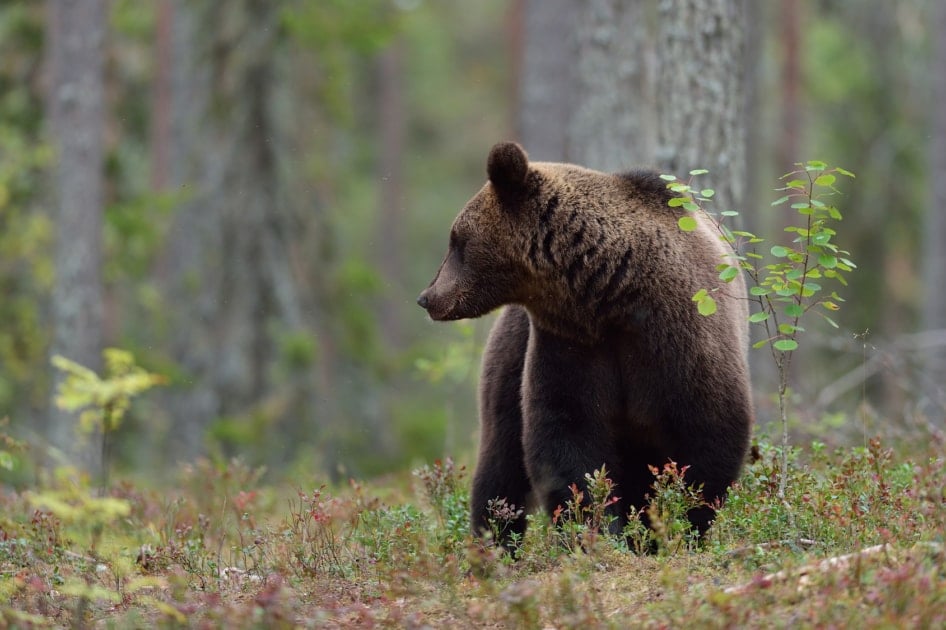
The Algonquin peoples (a language family covering much of eastern North America from the Maritimes south to the Carolinas and west to Wyoming) shared a story about a great bear who roamed the forests in spring and summer terrorizing the people. The bear was too powerful for any one warrior to kill. So the bravest warriors from several tribes banded together to hunt it down.
When the bear saw the warriors approaching, it ran. The warriors chased the bear over the mountains and across the seas, firing their arrows at it as they ran. Most arrows fell short, but one arrow finally found the bear’s side. The wound was not deep enough to kill, but it was deep enough to draw blood. In pain and rage, the bear leaped into the sky to escape. The warriors followed.
To this day, says the legend, the warriors continue to chase the bear in circles around the heavens. In the fall, when the bear rises above the horizon, blood from the still-fresh wound drips down onto the trees of the forest below, turning their leaves scarlet. The bleeding only happens in the fall. By the spring, the wound has scabbed over, and the leaves return to green.
The Bear in the Big Dipper
The bear in the Algonquin legend is the Big Dipper, the seven-star asterism that forms part of the constellation Ursa Major (Latin for “the Great Bear”). In the Algonquin reading:
- The bowl of the Dipper is the bear’s body.
- The handle of the Dipper is the line of warriors chasing the bear, with the lead warrior closest to the bowl.
- The whole asterism rotates around the celestial pole each night, which is the basis for the Algonquin observation that the warriors continue chasing the bear “in circles around the heavens.”
The Greeks recognized the same constellation as a bear, with the handle as a long tail rather than a band of warriors. The convergence (different cultures looking at the same seven stars and seeing a bear) is one of the older puzzles in cross-cultural astronomy. Many anthropologists believe the bear-association predates the migration of peoples across the Bering land bridge, meaning it may have arrived in North America with the first peoples, more than 15,000 years ago.
The Science: What Actually Happens to Leaves in Fall
Modern plant science has a thorough explanation of fall color, with no bears involved. The story involves three groups of pigments and a seasonal shift in the leaf’s chemistry.
- Chlorophyll: the green pigment that handles photosynthesis during the growing season. Chlorophyll is the dominant pigment in summer leaves; it masks all the others.
- Carotenoids: yellow and orange pigments that are always present in the leaf but invisible while chlorophyll is dominant. As chlorophyll breaks down in autumn, the carotenoids become visible.
- Anthocyanins: red and purple pigments. Unlike carotenoids, anthocyanins are not present in the leaf during summer. They are produced specifically in autumn, in response to bright sunlight and cool temperatures, after sugars accumulate in the leaf when the tree begins to seal off the leaf vein from the rest of the tree.
The trigger for autumn color is a combination of shorter daylight and cooler nighttime temperatures. As days shorten, trees prepare for winter dormancy. They begin to form an abscission layer (a corky barrier) at the base of each leaf stem. The abscission layer cuts off water and nutrient flow into the leaf. Chlorophyll, which requires constant maintenance, breaks down quickly once the supply chain stops. The carotenoids that were always present become visible, producing yellow and orange. In some species (sugar maple, sumac, dogwood, red oak), the leaf’s accumulating sugars trigger anthocyanin production, producing red and purple.
Which Trees Turn Which Colors
Different species have different pigment profiles, which is why a New England forest in October produces such varied color:
- Sugar maple: orange to brilliant red, often with all three colors on the same tree.
- Red maple: deep red, leaning purple in cooler regions.
- White oak: rich brown to deep red.
- Red oak: deep red to russet brown.
- Birch: bright yellow.
- Aspen and poplar: bright yellow to gold.
- Hickory: golden yellow to bronze.
- Sassafras: orange, red, yellow on the same tree.
- Sumac: brilliant scarlet, often the first species to color in late August.
- Dogwood: deep purplish red.
The mix produces the layered tapestry effect that makes Vermont, New Hampshire, and the southern Appalachians the most-photographed fall foliage destinations in North America. Areas with mostly conifers (most of the Pacific Northwest and the boreal North) have less dramatic fall color because most conifers do not shed their needles annually.
Why Some Falls Are Better Than Others
The intensity of fall color varies year to year. The conditions that produce the most intense color, especially the deepest reds:
- Warm, sunny autumn days: drive sugar production in the leaf.
- Cool but not freezing nights: trap the sugars in the leaf and trigger anthocyanin production.
- Adequate late-summer moisture: keeps the leaves on the tree long enough to color rather than dropping prematurely.
- No early hard freeze: a freeze before color peaks turns leaves brown and drops them, ending the show.
- No major windstorms: mature leaves are loosely attached and a storm can strip them from the trees in hours.
The “perfect fall” combines all of those (warm dry days, crisp cool nights, no early freeze, no windstorm). Years that hit all five tend to produce New England’s banner foliage seasons. Years that miss two or three (drought summer, early freeze, late September windstorm) produce muted color or a short window before the leaves drop.

When and Where to See the Color
For the broader weather context that drives the fall color season, see the Farmers’ Almanac long-range forecast. For the spring half of the leaf cycle, see April weather lore. Peak color moves south across North America starting in late September and finishing in early November. Approximate timing for the eastern U.S. and Canadian regions:
- Northern Maine, Quebec, New Brunswick: peak last week of September.
- Vermont, New Hampshire, southern Maine: peak first to second week of October.
- Massachusetts, Connecticut, southern New York: peak third week of October.
- Pennsylvania, Ohio, southern New England: peak last week of October.
- Virginia, West Virginia, the southern Appalachians: peak first week of November.
- Georgia, Tennessee, North Carolina (low elevations): peak second to third week of November.
Higher elevations color earlier than lower elevations within the same region. The U.S. Forest Service and most state tourism boards publish weekly foliage reports during peak season; the USDA also tracks fall color and forest health on its fall foliage observation page. For more on the broader weather-folklore tradition, see our animal weather folklore piece. For another fall-anchored prediction tradition, see persimmon seed weather prediction.
Two Stories, One Forest
The Algonquin legend and the modern science are not in competition. The legend describes the world as it appears: red leaves arrive each fall, year after year, like clockwork, regardless of what the trees themselves are “doing.” The legend gives the cycle a story, a culprit, and a place in a larger sky-narrative that includes the visible constellations. The science describes the mechanism: how chlorophyll breaks down, how anthocyanins are produced, what conditions favor the brightest color. Both are doing the same job (explaining the cycle), and both can be true at the same level of analysis they care about.
The Algonquin reading is also a useful reminder that the autumn forest is not a backdrop. It is a participant in the year. The bear bleeds, the warriors keep chasing, and the leaves turn. The science is right that anthocyanins are produced by sugar accumulation. The legend is right that the cycle is unfailing. Walk into a Vermont forest on the third Saturday of October and look up. You can read it either way.

Frequently Asked Questions
Why do leaves turn red in fall?
Red comes from anthocyanins, water-soluble pigments produced in the leaf during autumn as chlorophyll breaks down and sugars accumulate. Bright sunny days plus cool nights produce the most intense red.
Why do leaves turn yellow and orange?
Yellow and orange come from carotenoids and xanthophylls, which are present in the leaf year-round but are masked by chlorophyll during the growing season. They become visible as the chlorophyll breaks down in autumn.
What was the Algonquin legend about fall colors?
A great bear had been wounded by a band of warriors who continue chasing it through the heavens. The bear is the Big Dipper. In the fall, when the bear rises above the horizon, blood from the wound drips down onto the trees below, turning the leaves scarlet.
When is peak fall color in New England?
Northern Maine, Quebec, and New Brunswick peak in the last week of September. Vermont, New Hampshire, and southern Maine peak in the first to second week of October. Massachusetts, Connecticut, and southern New York peak in the third week of October.
What weather makes the best fall color?
Warm sunny days plus cool but not freezing nights, with adequate late-summer moisture and no early hard freeze or windstorm. Years that hit all of those conditions produce the most vivid color.
Why do some maples turn red while others turn orange?
Different species and individual trees produce different ratios of anthocyanins (red) to carotenoids (orange and yellow). Sugar maples often show all three colors on a single tree. Red maples and dogwoods produce mostly anthocyanins.
Are anthocyanins useful to the tree?
Yes. Anthocyanins protect leaves from sunburn during the late-season window when chlorophyll is breaking down but sugars are still being moved out of the leaf. The pigment may extend the leaf’s working life by a few critical days, allowing the tree to recover more nutrients before the leaf drops.


Jaime McLeod
Jaime McLeod is a longtime journalist who has written for a wide variety of newspapers, magazines, and websites, including MTV.com. She enjoys the outdoors, growing and eating organic food, and is interested in all aspects of natural wellness.
- Jaime McLeod

- Jaime McLeod
- Jaime McLeod
- Jaime McLeod



Almanac Almanac where are thou?
My dad always bought the almanac,back in the 50ds
What a wonderful article – the tales and beliefs of our Indian nation is intrigue
Some say a drought year wil mean more color, and a wet year will mean less. We live in Michigan, which has had one of the wettest summers ever, and the reds,olds,and oranges are starting 2-3 weeks early!.
Very informative and cleared up a lot of misinformation about leaf color change.
Will never look at the big dipper the same way again without the seeing the bear and his pursuers. Love the science and folklore.
I found this article informative and educational. Thanks! Famer’s Almanac is the best!
I found this article very interesting. Thank you!
hey just read the bear story and enjoyed it thanks.
I also like the bear story Thanks
I like the bear story better.