

Halloween Pet Safety: 6 ASPCA-Backed Steps (Plus the Candy-Bowl Toxicity Chart)
Halloween can be a fun time for the family, but truly scary for pets. Read these helpful tips for managing pets on Halloween to keep them safe.
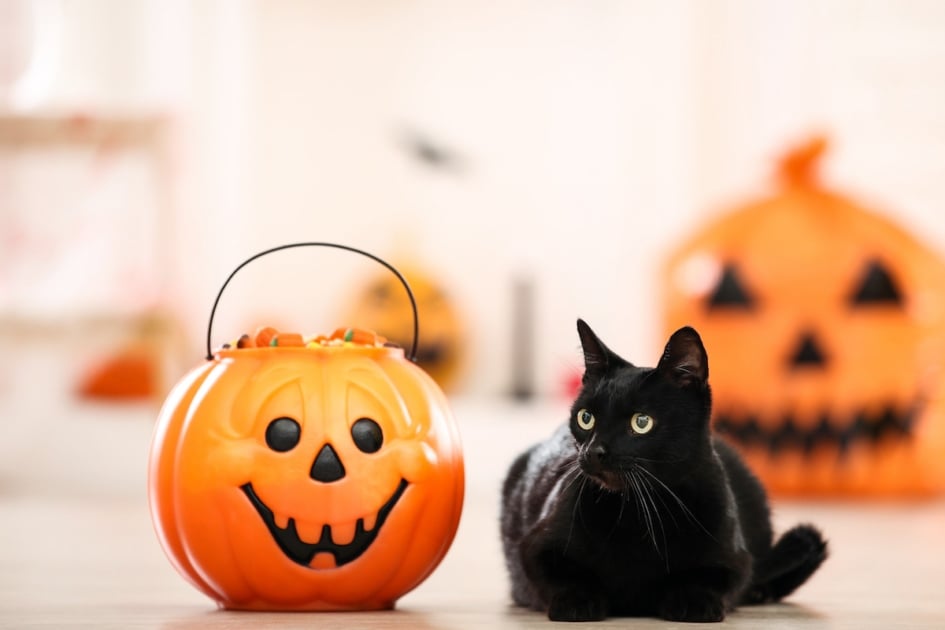
Halloween Pet Safety at a Glance
- Most common Oct 31 emergency: chocolate ingestion, followed by xylitol-sweetened candy ingestion.
- Single most useful step: keep pets in a quiet back room with the door closed, water, a chew, and soft white noise during the trick-or-treat window.
- Top 6 steps: skip the costume, check the ID and microchip, keep indoors, watch open flames, lock up the candy bowl, leave the dog at home.
- Toxic top of the candy bowl: chocolate (theobromine), xylitol gum and mints, raisins, grapes, macadamia nuts.
- If your pet swallows candy: call your vet or the ASPCA Animal Poison Control (888-426-4435) immediately.
On Halloween, it may seem like a lot of fun to jump out in a scary costume and shout “boo,” though most of us know who’s underneath it. Halloween pet safety is different, however, and dressing up beyond recognition can cause a cat to panic and run for cover (or streak out the door), or cause a dog to act aggressively to defend himself and his family. Experts say even the most tolerant dog can find this kind of activity stressful, overwhelming, and difficult to comprehend and handle. The following ideas from the ASPCA, HSUS, and the American Veterinary Medical Association (AVMA) on Halloween pet safety will help ensure the holiday remains enjoyable and safe for all species.
According to the ASPCA Animal Poison Control Center, call volume spikes 12 percent on Halloween, with chocolate the single biggest cause. If your pet swallows candy, the ASPCA’s 24-hour hotline is 888-426-4435, save it in your phone before the doorbell starts ringing.
Pet Halloween Safety Tips
1. Skip the costumes
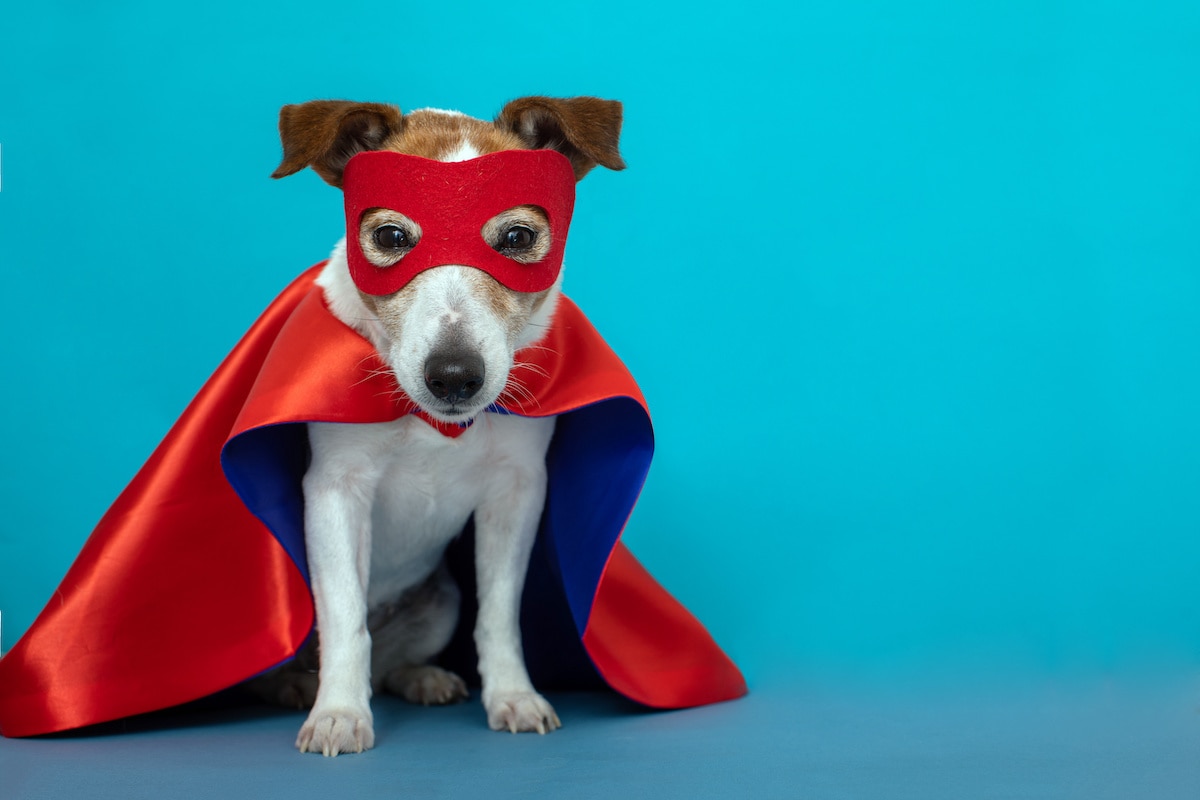
As a rule, dressing pets up in costumes can cause a lot of discomfort and stress, according to the ASPCA, as animals do not naturally wear clothing. If you choose to do so, take extra care that the costume is not restrictive in terms of movement, breathing, hearing, barking, or meowing, and that there are no strings, ropes, sashes, ribbons, or the like in which they may become entangled, or pieces they can chew off, swallow, and/or choke on. And do not force your pet to remain in a costume if she is clearly panicked or distressed, or showing abnormal behavior in any way. Signs of these include, though are not limited to, ears folded back or down; eyes looking off to the side, back, or down; a tucked tail; hunching over; frequent shuddering; and shaking of head and body, as if shaking off water.
2. Wear the ID
Pets should always wear an identification collar and be microchipped, but on a day or night when the door may be opened repeatedly and a harried pet can escape, make extra sure identification is up to date.
3. Keep them indoors!
It’s also best to keep pets, especially cats, indoors while people are out trick-or-treating. Confine animals in a quiet den or bedroom with a favorite toy or treat and some water (or a crate with the same if it is familiar and he considers it his safe place), and with soft, not blaring, music. While the goal is to mitigate the constant commotion at the door, loud music will only stress your pet. An isolated room will help calm him and make sure he cannot run outside when you may be handing out candy.
4. Watch those flames
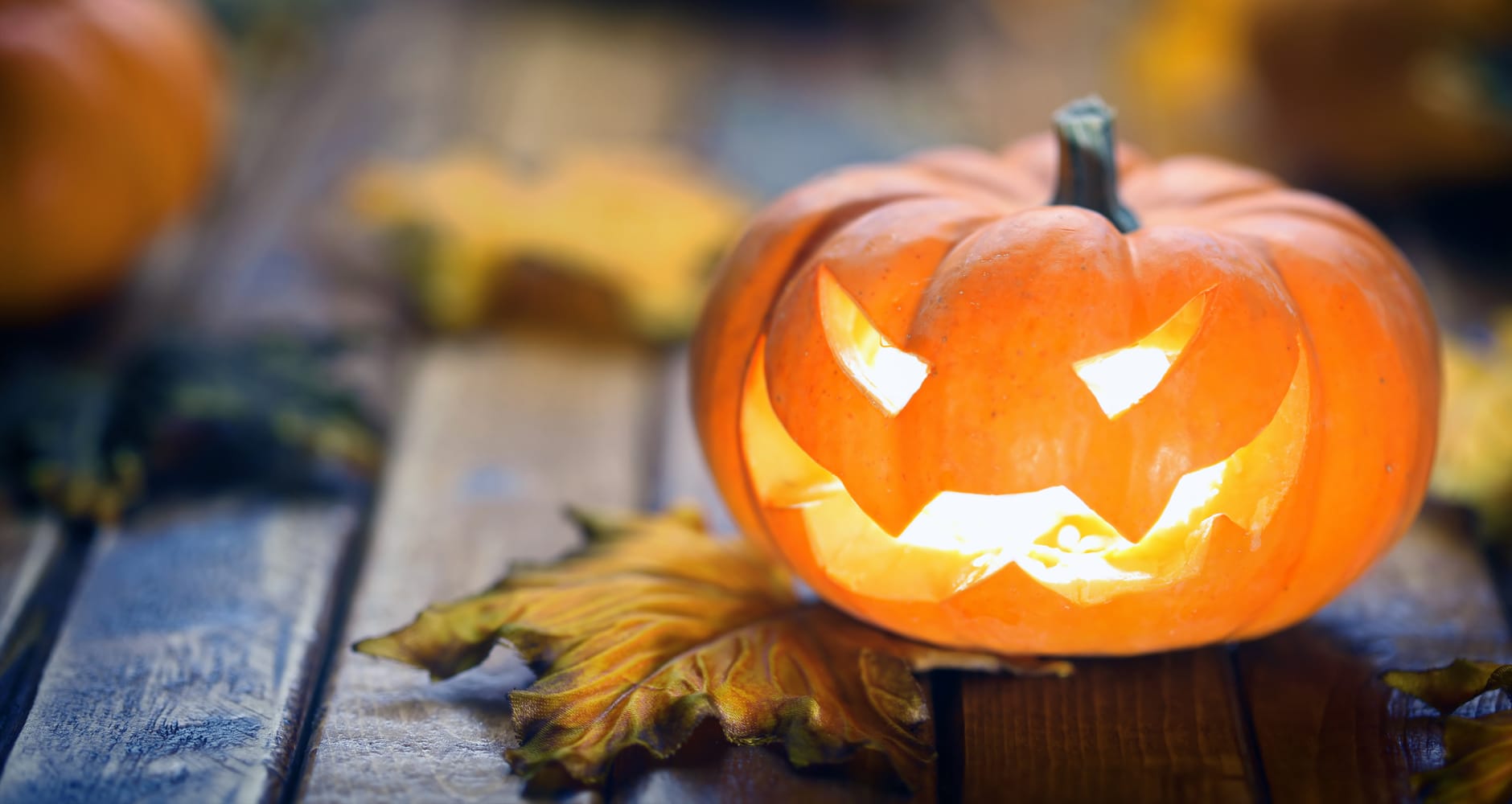
There’s nothing that says Halloween like a scary jack-o’-lantern with a flickering candle inside. Just make sure it is out of reach of curious dogs or cats who may accidentally knock it over and become burned or start a fire. The same rule applies to decorations, which may be ingested or puncture paws if not placed out of reach. Battery LED candles solve the problem entirely.
5. No-no on the cocoa
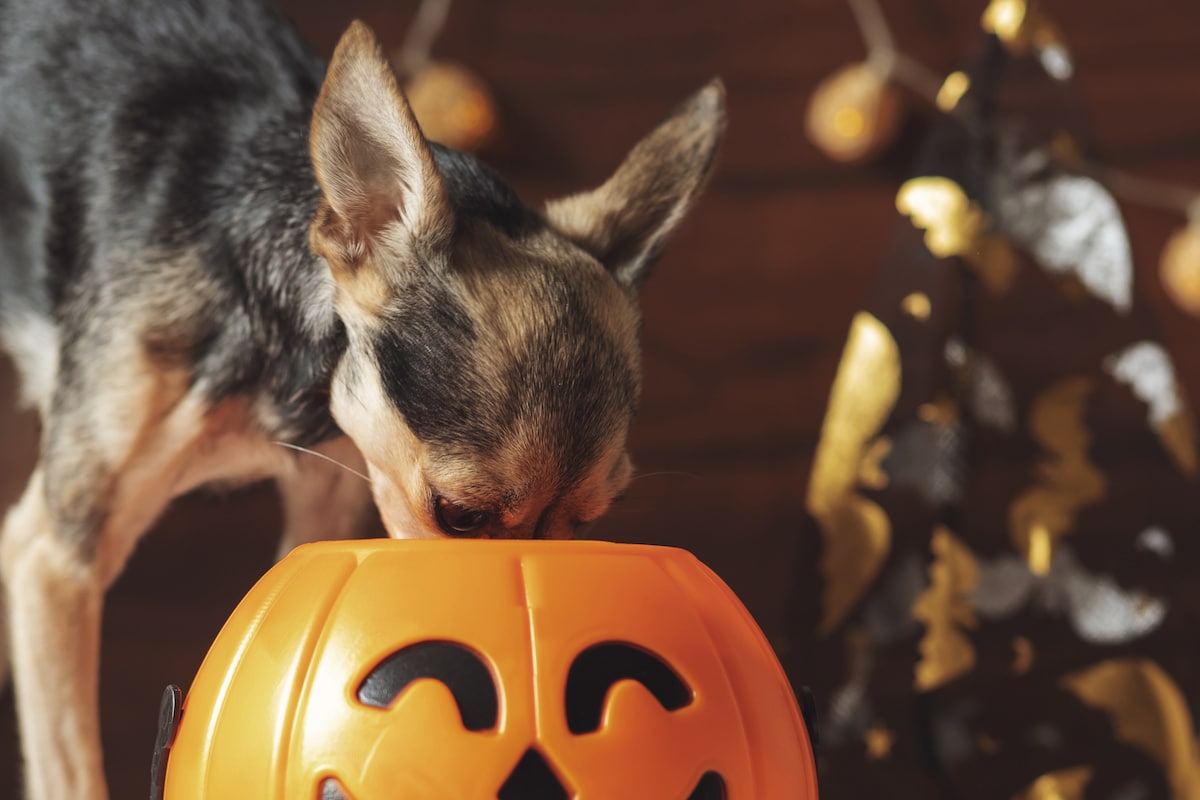
Chocolate candy contains theobromine, which is toxic to dogs and cats. Pet parents should be vigilant about monitoring and putting away bags of trick-or-treat goodies. Xylitol, an artificial sweetener found in some candies and gums, can be fatal if ingested by a pet. Lollipop sticks and candy wrappers can become choking hazards or obstructions.
6. Trick-or-treating is no treat
Experts say even if you are tempted to take your dog trick-or-treating with you, it’s best to reconsider. In the dark, dogs can step on broken glass, firecrackers, sharp objects from costumes, or other Halloween-party debris. Also, with trick-or-treaters dressed in frightening masks and costumes, and making a lot of noise as is customary, this can shift your pet into anxious guard mode, which is highly stressful for her and even dangerous for all involved.
The Halloween Candy Bowl: What’s Toxic, and What to Do
| Substance | Found In | Toxic To | What to Do |
|---|---|---|---|
| Theobromine (chocolate) | All chocolate; darker = more dangerous. White chocolate is lowest risk | Dogs and cats (dogs far more commonly exposed) | Call your vet or ASPCA Poison Control (888-426-4435) immediately; do not wait for symptoms |
| Xylitol | Sugar-free gum, sugar-free candy, some peanut butters | Dogs (causes rapid insulin release, liver failure in large doses); toxic to cats too | Emergency vet visit; xylitol poisoning can be fatal within hours |
| Raisins and grapes | Raisinets, trail mix candies, any grape product | Dogs (cats appear less susceptible but avoid) | Even small amounts can cause acute kidney failure in dogs; call vet immediately |
| Macadamia nuts | Chocolate-covered macadamias, trail mix | Dogs | Causes weakness, vomiting, tremors, fever; call vet if any amount consumed |
| Candy wrappers / foil | All wrapped candy | Dogs, cats | Can cause intestinal blockage; call vet if large amounts ingested or pet shows vomiting or lethargy |
| Candy corn, hard candy | Standard Halloween candy | Not acutely toxic, but high sugar load causes GI upset | Monitor for vomiting or diarrhea; restrict access going forward |
ASPCA Animal Poison Control Center: (888) 426-4435. Available 24 hours a day. A consultation fee may apply.
Three “Quiet Room” Setup Tips
- Pick the back-of-the-house room. Bedroom, basement den, anywhere two walls away from the front door. Less doorbell, fewer footstep vibrations.
- Run soft white noise. A box fan or a 30-minute looped white-noise track masks the worst of the costume-chatter and doorbell shocks.
- Put two things they love in the room. One long-lasting chew or a puzzle feeder for dogs; one familiar blanket and a hiding box for cats.

Frequently Asked Questions About Halloween Pet Safety
How much chocolate is dangerous for a dog?
It depends on the dog’s weight and the chocolate type. As a rough rule, dark chocolate is toxic at about 0.1 ounce per pound of body weight; milk chocolate at about 0.5 ounce per pound. A 20-pound dog can be in danger after one or two Hershey’s bars. Always call the vet rather than guess.
Why is xylitol so dangerous to dogs?
In dogs, xylitol triggers a rapid, large release of insulin, which causes severe low blood sugar (hypoglycemia) within 30 to 60 minutes. Liver failure can follow. As little as 0.1 g per kg body weight (about a single piece of sugar-free gum for a small dog) can cause hypoglycemia.
What should I do if my pet eats candy?
Call your vet or ASPCA Animal Poison Control (888-426-4435) immediately. Note the brand, what was eaten, how much, and when. Do not try to induce vomiting unless instructed; some candies (especially with chocolate or xylitol) are more dangerous coming back up than going down.
Are pumpkins safe for dogs and cats?
Plain, cooked pumpkin flesh is safe in small amounts and is sometimes recommended for GI upset. The candle, the wax, the toxic-paint decorations, and a moldy week-old jack-o’-lantern on the porch are not safe. Bring carved pumpkins in promptly.
Should I dress my dog in a Halloween costume?
If your dog tolerates it cheerfully, a simple no-strings vest can be fine for photos. If your dog freezes, tucks the tail, or tries to back out of it, the costume is causing stress; skip it.
What about indoor-only cats on Halloween?
Cats are especially prone to running out the open front door. The ASPCA recommends closing the cat in a back room well before the first knock, with food, water, a litter box, and a hiding spot, until the porch is dark and quiet again.
Is fog-machine fog harmful to pets?
Most commercial party fog is a glycol/glycerin water mix and is mildly irritating at high concentrations. Run fog machines briefly, in well-ventilated areas, and keep pets out of the fog plume. Asthmatic pets should be in a separate room.
For a safe, fun, and uneventful celebration (who wants to spend the evening at the vet emergency hospital?), keeping your pet safe and feeling secure with these easy steps will make for a Happy Halloween for the whole family.
For more pet-and-holiday reading, see backyard chickens, when’s the best day to wean, and our wider animal weather forecasters piece.


Beth Herman
Beth Herman is a freelance writer with interests in healthy living and food, family, animal welfare, architecture and design, religion, and yoga. She writes for a variety of national and regional publications, institutions, and websites.
- Beth Herman

- Beth Herman
- Beth Herman
- Beth Herman




Important to remember. ..
Yes very good info. While Halloween is fun for us and we like interacting with our pets Please remember that your Pet’s don’t quite understand Halloween like we do. They may get scared of costumes or try to defend you from another costumed person who they may see as a threat to you or them. Happy Halloween with your Pets!