

What Are Sun Halos, Sun Dogs, and Sun Pillars?
Learn more about what causes these unusual visions in the sky!
Quick Reference
- Halo: A 22-degree (or rarer 46-degree) ring around the Sun or Moon. Sunlight refracts through hexagonal cirrus crystals.
- Sun dog: Bright spots on either side of the Sun at the same elevation, just outside the halo.
- Sun pillar: Vertical shaft of light from the rising or setting Sun, caused by reflection off flat-falling crystals.
- Sailor’s lore: Halo around the Sun or Moon means unsettled weather is 18-24 hours away.
- Common cause: All three need ice crystals at high altitudes (above 20,000 feet).
Sometimes there are sights in the sky that will grab your attention because they are so unusual and obvious. And such is the case when a halo forms around the Sun or Moon. You have most likely seen such a halo, but what about a Sun pillar or Sun dog? Each of these sights is caused by the state of our atmosphere, and appearance-wise, they look quite different. But they all have one thing in common: ice crystals.

Sun Halos
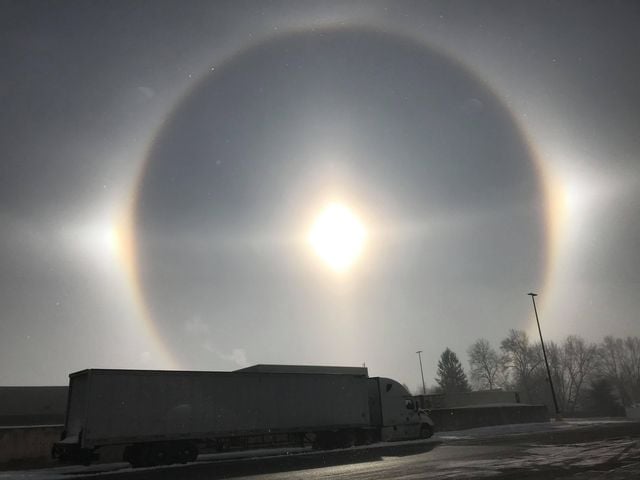
Halos (pictured) are the result of the refraction or bending of sunlight or moonlight by thin, high, icy cirrus clouds. These clouds appear at altitudes above 20,000 feet, where air temperatures are always below freezing, even during the middle of the summer.
The most commonly seen halo is the single one making a 22-degree circle around the Sun or Moon, often brighter on the top and bottom. This you will find by stretching out your arm and fingers; when your thumb covers the Sun or Moon, your pinky will touch the halo. When looking for solar halos you must, of course, be careful to shield your eyes from the direct sunlight.
All ice crystals are basically six-sided (hexagonal). The differences in crystal shapes account for some of the variety of phenomena that are observed. This type of halo is caused by crystals that are the shape of small columns or plates.
Halos play a big role in weather lore. Sailors who saw a halo or ring around the Sun or Moon often believed that unsettled weather was 18 to 24 hours away.
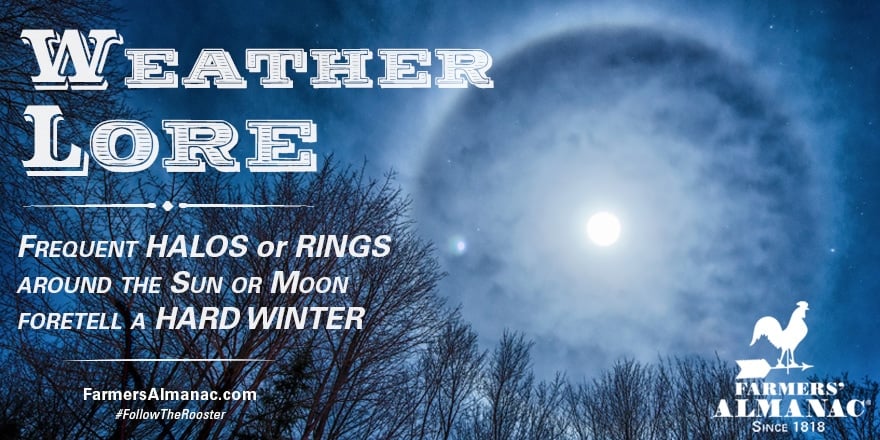
Halos are for the most part colorless but sometimes they appear like pale rainbows with red on the inside.
Sun Dogs
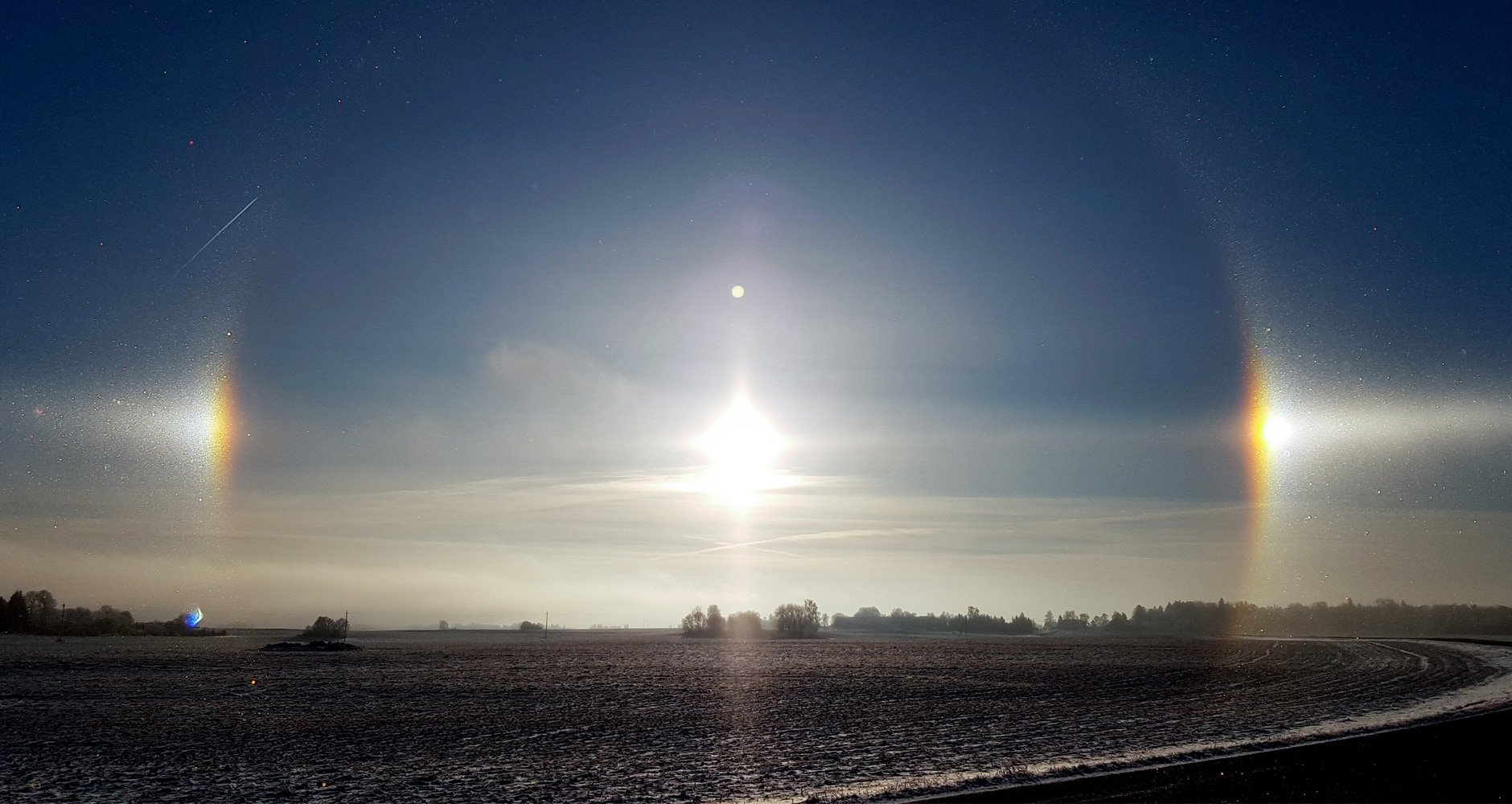
On rare occasions, a second, larger, 46-degree circle may also form, and if the ice crystals in the clouds are just right, one may also sight other curious effects such as arcs and brightly colored blobs of light on either side and at the same elevation as the Sun and lying outside the halo, called parhelia, mock Suns, or “Sun dogs.”
Sun Pillars
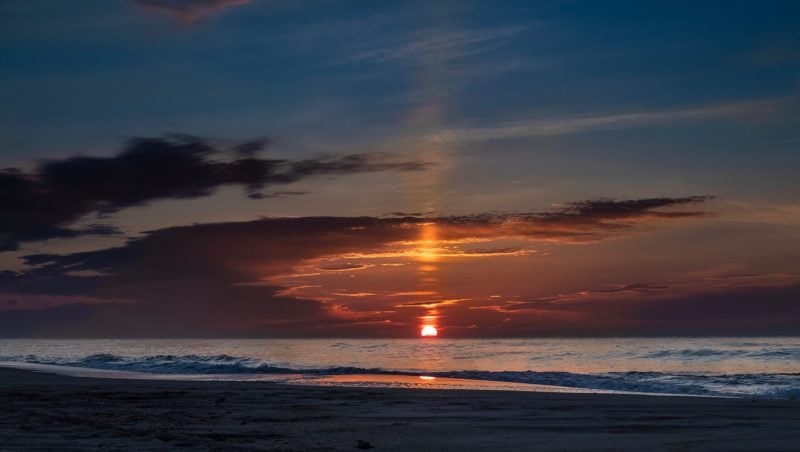
Sometimes, right around sunrise or sunset, you will see a narrow, vertical shaft of light extending straight up from where the Sun (low on the horizon). On rare occasions, the same phenomenon might be seen with rising or setting of the Moon, though the vertical light shaft is not as bright or pronounced. Such a spectacle is referred to as a Sun pillar.
Pillars are not actually vertical light rays. They develop as a result of ice crystals slowly falling through the air; the collective glints of countless millions of crystals. Air resistance causes these crystals to lie nearly flat much of the time as they flutter down to the ground. Unlike halos, the crystals do not refract or bend light, rather they reflect the rays of the Sun (or Moon) off of them. Those crystals that are properly aligned create the pillar effect.
They usually appear 5 to 10 degrees tall and sometimes even higher. Your clenched fist, held at arm’s length, measures roughly 10 degrees. Pillars can sometimes appear even longer and brightest in the moments just prior to sunrise or just after sunset. They can take on the colors of the Sun and clouds, they can appear white and at other times shades of yellow, red, or (infrequently) purple.
Look for Sun pillars when either the Sun or Moon are low on the horizon when cirrus clouds are present. They are, however, rather uncommon.
Reader Image – Sun Dog/Sun Halo Combo
Take a look at this amazing image shared with us by Facebook fan Kristy Marie Silvestro of Ohio. Kristy captured this image of a classic 22-degree halo, accompanied by two Sun dogs embedded within the halo on either side of the Sun. Amazing.
Quick Reference Comparison
| Phenomenon | Position | Crystal action |
|---|---|---|
| 22-degree halo | Full ring around Sun or Moon | Refraction through randomly oriented crystals |
| 46-degree halo | Outer ring, much rarer | Refraction through specific column crystals |
| Sun dog (parhelion) | Bright spot 22 degrees left/right of Sun | Refraction through plate crystals |
| Sun pillar | Vertical shaft above setting/rising Sun | Reflection off flat-falling crystals |
The National Weather Service includes optical phenomena in its public-education guides because the same ice crystals that produce them often signal an approaching warm front.

Frequently Asked Questions
What is a sun halo?
A 22-degree (rarely 46-degree) ring of light around the Sun or Moon, formed when light refracts through hexagonal ice crystals in cirrus clouds above 20,000 feet.
What is a sun dog (parhelion)?
A bright, often colorful spot 22 degrees to the left or right of the Sun at the same elevation. Caused by sunlight refracting through plate-shaped ice crystals.
What is a sun pillar?
A narrow vertical shaft of light that appears above (or below) the Sun at sunrise or sunset. Caused by sunlight reflecting off flat-falling ice crystals.
Does a halo really predict bad weather?
Often. Halos form in the cirrus clouds at the leading edge of an approaching warm front. Rain or snow typically follows within 18 to 24 hours.
What is the difference between the 22-degree and 46-degree halos?
The 22-degree halo is the common, smaller ring. The 46-degree halo is much rarer, fainter, and farther out. Different crystal shapes refract light at the two angles.
How do I see a sun pillar?
Look low at the horizon at sunrise or sunset on a cold day with cirrus clouds present. Pillars are most visible in the few minutes before sunrise or after sunset.
Are halos and dogs more common in winter?
Slightly. The cold air that produces ice crystals close to the ground occurs more often in winter. But high-altitude cirrus exists year-round, so halos and dogs can appear in any season.
Tell Us
Have you photographed a halo, dog, or pillar? Tell us in the comments. For more sky-watching reads, see our moonbow and sun dog entries.


Joe Rao
Joe Rao is an esteemed astronomer who writes for Space.com, Sky & Telescope, and Natural History Magazine. Mr. Rao is a regular contributor to the Farmers' Almanacand serves as an associate lecturer for the Hayden Planetarium in New York City.
- Joe Rao

- Joe Rao
- Joe Rao
- Joe Rao


lp records are on the way back.