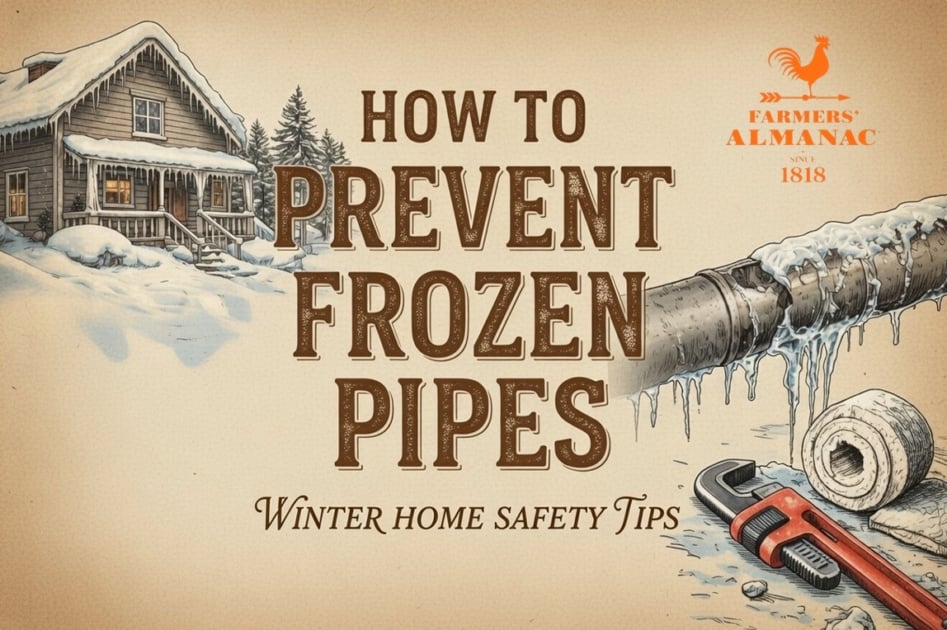
How To Prevent Frozen Pipes This Winter
Quick Reference
- Danger threshold: pipes start to freeze around 20 degrees F when the pipe is exposed and unheated.
- Where the break happens: between the ice plug and a closed faucet, not at the ice itself.
- Cheapest fix: foam sleeve insulation or heat tape on exposed lines, from any hardware store.
- Thermostat rule: keep the house at or above 55 degrees F, day and night, during a hard freeze (American Red Cross guidance).
- Leaving town: shut the main valve and bleed the lines by opening every faucet until they run dry.
- Cabinet trick: open the sink cabinets on outside walls so warm room air reaches the pipes.
- Drip only if you must: a pencil-lead trickle on the coldest lines can relieve pressure; use as last resort.
- If they freeze: open the tap and warm the pipe with a hair dryer. Never use an open flame.
A burst pipe is the fastest way to turn a cold snap into a five-figure insurance claim. The American Red Cross puts frozen-pipe damage among the top five causes of winter property loss, and the Insurance Institute for Business & Home Safety reports that a single burst 1/2-inch supply line can release up to 250 gallons of water a day. This guide keeps every original tip in the Almanac’s frozen-pipe playbook, adds the temperature thresholds you need to plan around, a regional breakdown for the United States and Canada, and answers the seven questions readers ask most.

Why Frozen Pipes Burst: The Physics In One Paragraph
If you’ve ever had your pipes burst in the winter, you already know it can be devastating to your home. Far beyond the cost of replacing the pipes is the expense and heartache of restoring or replacing the structure and personal belongings damaged by the deluge. As you probably learned in science class as a kid, water expands roughly nine percent when it freezes. That is a big problem inside an enclosed metal or PEX line with nowhere for the extra volume to go. What most homeowners get wrong is where the break happens. Most ruptures do not occur at the ice plug itself. The pipe usually splits between the ice and a closed faucet, because the ice pushes water toward the tap, the tap is shut, and pressure builds up until, KABLOOEY, the weakest joint gives way. Water then gushes out and soaks floors, walls, carpeting, furniture, and family heirlooms until you can get to the main valve.
The Temperature Thresholds That Actually Matter
The University of Illinois Building Research Council coined the phrase “temperature alert threshold” for pipe freezing, and put it at 20 degrees F. Below that, exposed pipes in unheated spaces are at real risk. A few numbers worth committing to memory:
- 32 degrees F: water freezes, but a full pipe rarely freezes solid this quickly. Interior lines are usually still safe.
- 20 degrees F: the alert threshold. Exposed pipes in attics, crawl spaces, garages, and outside walls start to freeze within hours.
- Below 0 degrees F: even insulated pipes in unheated spaces can freeze overnight. Drip the coldest taps.
- Wind chill matters for exposed pipes: a 15 degree F day with a strong wind through a crawl-space vent freezes a pipe faster than a still 5 degree F day.
Cross-reference these against the Almanac’s long-range forecast the week before a cold snap. If two or more nights below 20 degrees F are on the board, treat the house the way you would treat a bad storm: prep the day before, not the night of.
Insulate Your Pipes
Many newer homes have their supply lines securely concealed within insulated walls and floors. If you have exposed pipes, wrap them with electrical heating tape or slip-on foam or rubber sleeve insulation. For runs through the coldest spaces, cover the whole length with a strip of fiberglass insulation for good measure. Foam sleeves cost about a dollar per linear foot at any hardware store, run about twenty dollars for a whole small basement, and pay for themselves the first time they save a pipe. Focus on the four rooms where damage claims cluster: unheated garages, crawl spaces, attics, and any exterior-wall run behind a kitchen or bath.
Turn Off Your Water When You Leave
If you plan to be away from home for more than a day, or even overnight during a brutal cold spell, shut off the main valve and bleed the pipes dry by opening every faucet until they run empty. The minimal amount of water left behind cannot expand enough to cause a break. This is the single cheapest prevention step and the one most homeowners skip. Know where your main shutoff is before you need it. It is usually near the water meter or where the supply line enters the house from the street.
Leave Your Heat Up
As costs for heating fuel rise, many people try to save money by lowering the temperature in their homes while they are out, or by turning off the heat in unused rooms. Those are excellent strategies most of the year, but don’t take them too far during a hard freeze. The Red Cross recommends keeping the thermostat at 55 degrees F or higher at all times when temperatures dip below freezing outside. Turning your heat down much below the upper 50s indoors is a recipe for trouble. The thermostat measures the room it sits in. The outlying spaces of your home, especially unheated rooms, closets, and crawl spaces, can run much colder than that. If you know an unused room has supply lines running through it, don’t seal it off. Open the door and let the heat circulate.
Open Your Cabinet Doors
Much kitchen plumbing abuts outside walls, which can be very cold. To keep the temperature around those pipes up, open the cabinet doors beneath your sinks so warm room air can reach them. If your bath or shower pipes are accessible through a closet on an exterior wall, keep that door open overnight or when you’re out. Move any cleaning chemicals up to a shelf where kids and pets cannot reach them before you leave the cabinet open.
Let Your Faucets Drip
You may have heard that a running faucet will not freeze because moving water can’t freeze. This is not strictly true. Even a roaring river will freeze when the temperature is cold enough, and a little drip from your tap will not make much difference by itself. What a drip does do is relieve pressure. If ice is already forming somewhere in the line, a slightly open faucet gives the water somewhere to go, and the pipe is far less likely to burst. Aim for a stream about the width of a pencil lead on the tap furthest from your main shutoff, on the coldest wall. Do this only when you are worried the pipes may freeze and you have not had time to insulate them. It wastes water and money, so use it as a last resort.
If Pipes Freeze But Have Not Burst Yet
If you find that your pipes have frozen but have not yet burst, you can try to thaw them with a hair dryer. Open the tap first so melting water has somewhere to go, then blow hot air along the length of the pipe, starting at the faucet end and working back toward the ice plug. The tap should start dripping, then flowing, within a few minutes. Never use a lighter, blowtorch, or other open flame to heat a frozen pipe. Open flames are the leading cause of house fires during cold snaps, and they can ignite insulation, wood framing, and PEX supply lines. If the hair dryer does not work within twenty minutes, shut the water at the main valve and call a plumber before the thaw releases into a room.
Regional Breakdown: US And Canada
| Region | Freeze risk | What to do |
|---|---|---|
| Deep South and Gulf Coast | Occasional, and the most damage per event | Pipes are often uninsulated and run through unheated crawl spaces. A single hard night does real harm. Know where your shutoff is |
| Mid-South and Southern Plains | Several nights a winter | Insulate exposed runs and outdoor spigots. Drip a tap on the coldest nights |
| Mid-Atlantic and Ohio Valley | Regular through midwinter | Insulate the garage and crawl space runs. Open cabinet doors under sinks on exterior walls |
| Midwest and Great Lakes | Sustained deep cold | Homes are usually built for it. Watch unheated additions, garages and vacation properties |
| Northeast and New England | Sustained, plus wind chill on exposed walls | Heat tape on vulnerable runs. Keep the thermostat above 55F even when away |
| Mountain West and Pacific Northwest | Sharp inland, milder on the coast | Coastal homes are the least prepared and often the worst hit in a cold snap |
Prevention Checklist Before The First Hard Freeze
- Detach garden hoses. Close the interior shutoff valves for every hose bib and drain the line by opening the outside spigot.
- Insulate every exposed pipe in the basement, crawl space, garage, and attic. Foam sleeves for straight runs, heat tape for elbows.
- Seal air leaks around dryer vents, sill plates, and rim joists where cold air pours in near pipes.
- Locate the main water shutoff valve. Show every adult in the house where it is and how to turn it off.
- Set the thermostat to 55 degrees F or higher, night and day, throughout any freezing spell.
- When the forecast shows two or more nights below 20 F, open sink cabinets on exterior walls and drip the coldest tap.
- If you are leaving for more than a day, shut the main and bleed every faucet dry.
- Program a phone reminder to check pipes the morning after the coldest night. Small drips found early save whole ceilings.
External Guidance
For a deeper technical read, the American Red Cross frozen-pipes guide covers the same steps plus emergency-thaw procedures and property-loss statistics. Their guidance backs the 55 degree F thermostat rule and the “open a cabinet, drip a tap” playbook used in this article.

FAQ
At what temperature do pipes actually freeze?
Exposed pipes in unheated spaces start to freeze around 20 degrees F, the University of Illinois “temperature alert threshold.” Interior pipes inside a heated wall usually hold up to lower temperatures, but a strong wind or a long overnight cold spell can drop the temperature inside a crawl space or garage well below the outdoor reading.
How long can pipes stay frozen before they burst?
There is no fixed clock. A pipe can burst within minutes of freezing solid if the pressure has nowhere to go, or hold for hours if the ice plug is small and a tap somewhere downstream is dripping. The safe assumption: as soon as you notice a tap has stopped flowing during a freeze, shut the main and start thawing.
Should I drip every faucet or just one?
Drip the faucet furthest from the main valve on the coldest exterior wall. That keeps water moving through the greatest length of vulnerable pipe. If the house has multiple exterior-wall runs, drip one tap on each. A pencil-lead stream is enough. A full-open tap wastes water without buying any extra safety.
What is the best way to thaw a frozen pipe?
Open the tap first, then apply gentle heat to the pipe with a hair dryer, a heat gun on low, or towels soaked in hot water. Start at the tap and work back toward the ice plug. Never use a lighter, blowtorch, propane torch, or any open flame; those are the leading cause of house fires during cold snaps.
Do PEX pipes freeze and burst like copper?
PEX will still freeze at the same temperature as copper, but it flexes as the ice expands and is much less likely to split. That does not mean PEX is freeze-proof. A PEX line under enough pressure can still burst at a fitting. Insulate PEX runs in unheated spaces the same way you would insulate copper.
What thermostat setting is safe when I’m out of town for a week?
Set the thermostat no lower than 55 degrees F and shut the main water valve before you leave. Bleed the lines by opening a couple of faucets after the shutoff so the standing water can drop. Ask a neighbour to check the house after any cold snap of 20 F or lower.
Does homeowners insurance cover a burst frozen pipe?
Most policies cover the resulting water damage if the homeowner took reasonable care, meaning heat on, house occupied, or main shut off. Insurers routinely deny claims where the house was left cold and unheated during a freeze. Read your policy and take pictures of your thermostat setting before any winter trip.

- Tim Konrad

- Tim Konrad

- Tim Konrad

- Tim Konrad