Daylight Gain in February: How Much Light by State

Quick Reference: Daylight Gain in February
- Biggest gainer: Alaska picks up about 2h 27m of daylight over the month.
- Smallest gainer: Hawaii adds about 0h 28m, the least in the country.
- Northern tier: most far-north states gain around 1h 19m; the middle latitudes gain about 1h 6m.
- The rule: the farther north you live, the more daylight you gain, thanks to Earth’s tilt.
- How measured: approximate change from February 1 to March 1, based on each state capital’s latitude.
As the chill of winter begins to loosen its grip and we edge closer to the promise of spring, one of the most welcome changes is the gradual lengthening of our days. February, that quirky month with its extra day every leap year (and 2024 was one, folks), marks a turning point where the sun starts to linger a bit longer in the sky. For farmers, gardeners, and anyone who lives by the rhythms of nature, knowing how much daylight your state gains can help you plan everything from starting seeds to simply soaking up those extra rays.
Related: Spring Equinox 2026: When Is It, and What is It?

How We Figured the Gain
Here at the Farmers’ Almanac, we are all about practical wisdom rooted in the stars and seasons. Daylight gain varies by latitude. The farther north you are, the more dramatic the increase, thanks to Earth’s tilt. We crunched the numbers based on approximate calculations for each state’s capital city, rounded to the nearest latitude band.
These figures represent the rough difference in daylight hours from the start to the end of February, roughly February 1 to March 1 for a full month’s gain. Keep in mind that exact amounts can shift slightly depending on your precise location, elevation, and even the year, but this gives a solid overview. We sorted the states from the biggest gainers, up in the northern latitudes, down to the more modest increases in the South. Find where your home state lands.
Daylight Gain in February for Major US Cities
If you would rather size up the month by city than by state, the chart below breaks the gain out for a spread of major population centers from the Sun Belt to the northern border. The pattern is the same one that runs through the whole article: a city in Minneapolis or Seattle stretches its evenings far faster than one in Miami or Houston.
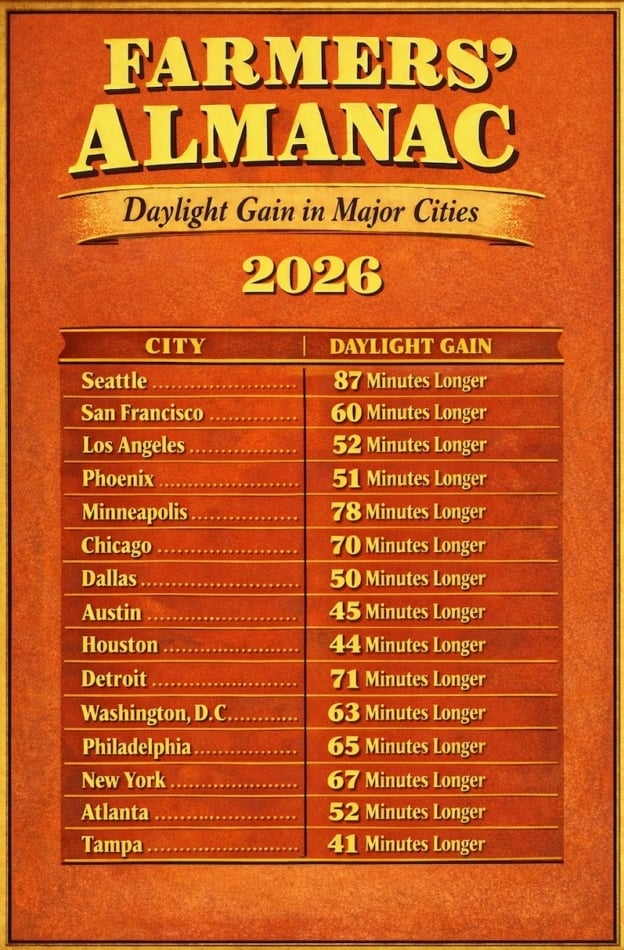
Daylight Gain in February by State
| City / state | Latitude | Daylight on Feb 1 | Daylight on Feb 28 | Total gain in February | Average daily gain rate |
|---|---|---|---|---|---|
| Miami, FL | 25 N | 10:59 | 11:37 | 38 min | ~1.4 min per day |
| Houston, TX | 30 N | 10:46 | 11:30 | 44 min | ~1.6 min per day |
| Atlanta, GA | 33 N | 10:35 | 11:27 | 52 min | ~1.9 min per day |
| Los Angeles, CA | 34 N | 10:34 | 11:26 | 52 min | ~1.9 min per day |
| Raleigh, NC | 36 N | 10:22 | 11:19 | 57 min | ~2.0 min per day |
| Washington, DC | 39 N | 10:12 | 11:15 | 63 min | ~2.3 min per day |
| Denver, CO | 40 N | 10:08 | 11:13 | 65 min | ~2.3 min per day |
| New York, NY | 41 N | 10:05 | 11:12 | 67 min | ~2.4 min per day |
| Chicago, IL | 42 N | 10:01 | 11:11 | 70 min | ~2.5 min per day |
| Boston, MA | 42 N | 9:58 | 11:03 | 65 min | ~2.3 min per day |
| Minneapolis, MN | 45 N | 9:46 | 11:04 | 78 min | ~2.8 min per day |
| Seattle, WA | 47 N | 9:32 | 10:59 | 87 min | ~3.1 min per day |
| Anchorage, AK | 61 N | 7:41 | 10:08 | ~147 min (2 hr 27 min) | ~5.3 min per day |
Isn’t it something how Alaska tops the chart with over two hours of extra light? That is enough time to chop a cord of wood or dream up your spring garden plans. Down in Hawaii the gain is smaller, but with those tropical days, every minute counts. North Dakota comes in second at 1h 36m, and from there a big block of northern states clusters at 1h 19m before the totals ease south toward Hawaii’s 0h 28m.

Why the North Gains More Light
The reason Alaska stretches its days five times faster than Hawaii comes down to one number: 23.5 degrees. That is the tilt of Earth’s axis, and it is what gives us seasons at all. As the National Weather Service explains in its plain-language guide to the seasons, the hemisphere tipped toward the sun gets longer, more direct days, while the one tipped away gets shorter ones.
In February the Northern Hemisphere is swinging back toward the sun on its way to the spring equinox in March. The higher your latitude, the sharper that swing feels day to day, so a February morning in Fairbanks gains far more minutes than one in Honolulu. Near the equator the sun’s path barely changes through the year, which is why Hawaii’s gain stays modest no matter the season.
The gain also speeds up as the month goes on. Daylight lengthens fastest right around the equinox and slowest around the solstices, so the last week of February hands most states a bigger daily bump than the first week did. That is the quiet engine behind every number in the table above.
What Longer Days Mean for Farmers and Gardeners
Why does this matter for farmers and Almanac readers? Longer days mean more time for chores, better conditions for early crops like peas and spinach, and a real boost to your mood after those short winter days. Remember, these are averages. Use a sunrise and sunset calculator for your exact spot to fine-tune your plans. And if you are in a leap year like 2024, that extra February 29th gives you one more day to enjoy the stretch.
The extra light is a planning tool, not just a pleasant surprise. Gardeners in the northern tier can use the lengthening afternoons to start seeds indoors, prune dormant fruit trees, and get beds ready before the ground fully thaws. To time that work with the sky, our long-range forecast pairs naturally with a look at the daylight you are about to gain.
A Note for Our Northern Neighbors
Readers in Canada see the same effect turned up even further. Because so much of the country sits at Alaska’s latitude and beyond, cities from Winnipeg to Whitehorse gain daylight at least as fast as the top of our chart, often two hours or more across the month. The rule holds across the border: the higher the latitude, the longer the February stretch, and the more noticeable the swing toward spring.
Stay tuned to the Farmers’ Almanac for more seasonal insights, from moon phases to planting guides. What is your favorite way to celebrate the return of the light? Drop us a line in the comments. We love hearing from our readers.
Note: Data approximated using capital city latitudes, rounded to 5-degree increments. Actual daylight can vary by location and year.

Daylight Gain in February: Frequently Asked Questions
How much daylight do we gain in February?
It depends on your latitude. Across the month, from about February 1 to March 1, Alaska gains roughly 2h 27m, most northern-tier states gain around 1h 19m, the middle latitudes gain about 1h 6m, and Hawaii gains only about 0h 28m. The farther north you live, the more daylight you pick up.
Which state gains the most daylight in February?
Alaska, with about 2h 27m of added daylight over the month, thanks to its far-northern latitude. North Dakota is next at roughly 1h 36m, followed by a cluster of northern states near 1h 19m. Hawaii gains the least at about 0h 28m.
Why do northern states gain more daylight than southern states?
It comes down to Earth’s 23.5-degree axial tilt. As the Northern Hemisphere swings back toward the sun heading into the March equinox, higher latitudes see the day length change more sharply. Near the equator the sun’s path barely shifts, so places like Hawaii gain far less than Alaska.
How was the daylight gain for each state calculated?
The figures are approximated using each state capital’s latitude, rounded to 5-degree increments, measuring the change in daylight hours from about February 1 to March 1. Actual daylight can vary by your precise location, elevation, and the year, so treat the numbers as a solid overview rather than an exact figure.
How can I find the exact daylight gain for my town?
Use a sunrise and sunset calculator such as the one from NOAA, which lets you enter your precise location and compare day length between two dates. Check the daylight on February 1 and again on March 1 and subtract to find your local gain for the month.
Does a leap year change how much daylight February gains?
A leap year adds February 29th, which gives you one extra day of the seasonal stretch to enjoy, but it does not change the daily rate at which daylight lengthens. The gain is driven by latitude and Earth’s tilt, not by the number of days on the calendar.

- Tim Konrad

- Tim Konrad
- Tim Konrad
- Tim Konrad