When Will Fall Colors Peak Near Me? See the 2026 Fall Foliage Map
When will fall colors peak near you in 2026? Our new U.S. map shows how peak foliage progresses from the northern mountains in late September through New England, the Midwest, Appalachians and South into November.
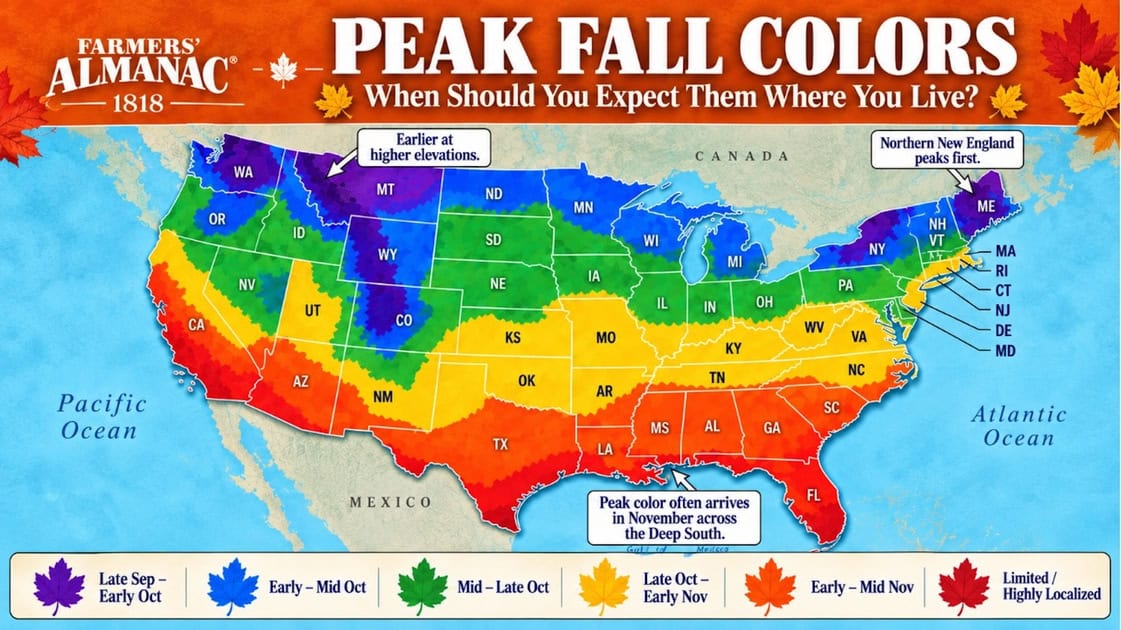
Wondering when fall colors will peak near you in 2026? Our new map shows the typical progression of autumn foliage across the United States—from the first brilliant colors in northern mountains to the final displays of the season across the South.
Few sights announce autumn quite like the first hillside turning red, orange, yellow, and gold.
But fall color doesn’t arrive everywhere at once.
While the highest mountains of northern New England can approach peak color around the end of September, trees along the southern New England coast may remain green for several more weeks. Farther south, some areas won’t see their best autumn color until November.
So, when will fall colors peak near me?
Our 2026 fall foliage map offers a quick guide.
In general, peak fall foliage progresses from north to south and from higher elevations to lower elevations, beginning in late September in northern and mountainous areas and continuing into November across parts of the South.
For a closer look at this year’s conditions, see our 2026 Fall Foliage Forecast, where we’re tracking the regions that could have the most impressive color this autumn.
2026 Fall Foliage Peak Dates at a Glance
Here is the broad progression shown on our map:
| Typical Peak | Areas to Watch |
|---|---|
| Late September–Early October | Northern Maine, highest elevations of Vermont and New Hampshire, northern Rockies and other high western mountains |
| Early–Mid October | Much of northern New England, northern Great Lakes, northern Midwest and higher western elevations |
| Mid–Late October | Much of the Northeast, southern New England, Great Lakes, Midwest and portions of the central Plains |
| Late October–Early November | Ohio Valley, central U.S., interior Mid-Atlantic and Appalachians |
| Early–Mid November | Much of the Southeast, lower South and Gulf states |
| Limited or highly localized | Southern Florida, warm Gulf Coast locations, desert Southwest lowlands and Hawaii |
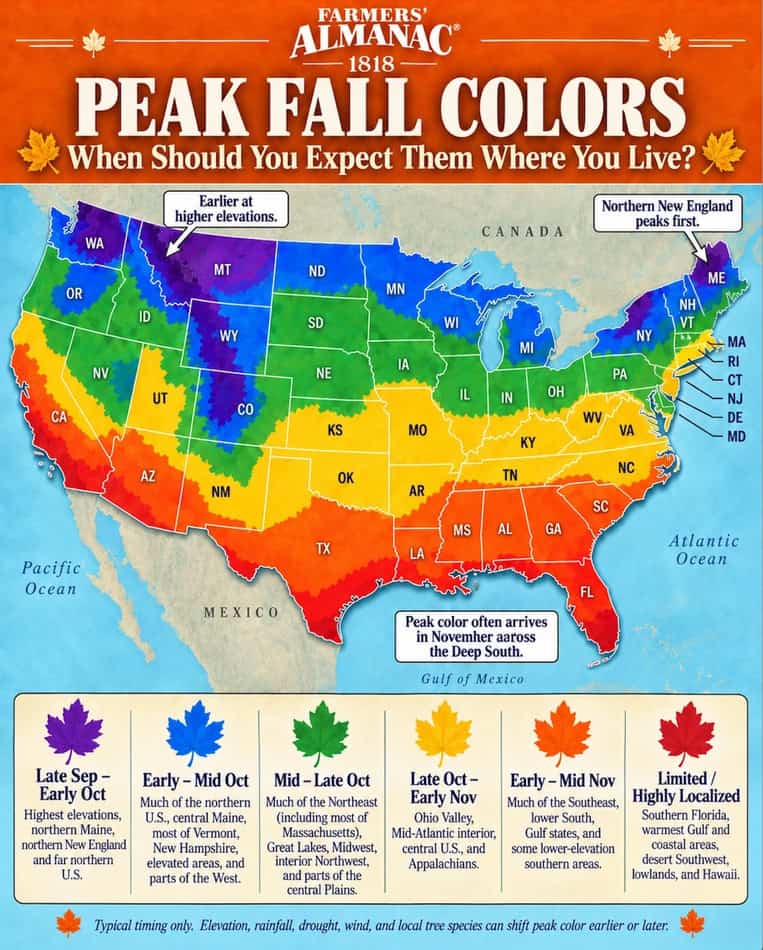
These are typical windows, not exact deadlines.
Elevation, temperature, rainfall, drought, wind and local tree species can all move peak color earlier or later. You can also compare individual states and regions in our Fall Foliage Dates by State guide.
Why Does Fall Color Move From North to South?
Look closely at a fall foliage map and you’ll notice something important:
Autumn doesn’t simply arrive state by state.
It moves across the landscape.
Shortening days are one of the major signals that cause deciduous trees to stop producing as much chlorophyll. As the green chlorophyll breaks down, yellow and orange pigments become visible, while some trees produce the reds and purples associated with spectacular fall color.
The Smithsonian’s explanation of why leaves change color offers an excellent overview of the science.
But latitude is only part of the story.
Elevation can be just as important.
A mountain ridge may approach peak color while the valley below is still predominantly green. That’s why fall foliage can sometimes appear to move down a mountain over the course of several weeks.
Vermont’s official Foliage Forecaster specifically notes that color generally starts at higher elevations before sweeping into the valleys.
That is why our map should be read as a moving wave of autumn color, rather than a collection of hard state boundaries.
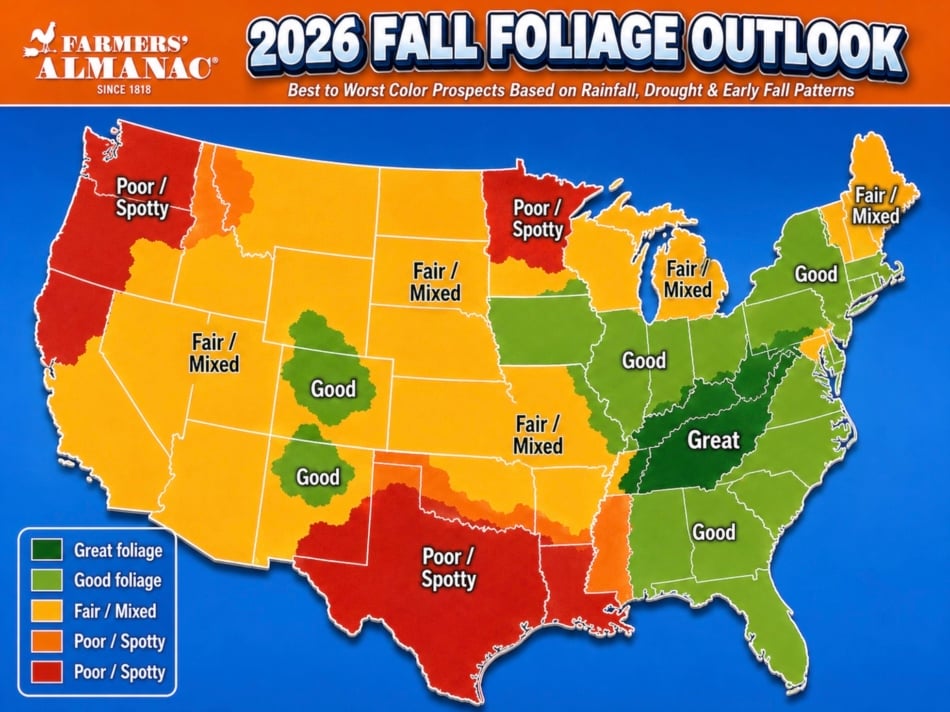
The 2026 fall foliage season is shaping up to be strongest in the central Appalachians, where favorable moisture and cooler mountain nights could produce some of the most vivid color in the country. Much of the Northeast, Mid-Atlantic, Ohio Valley, and Southeast should also enjoy good fall color, while parts of the Upper Midwest, Pacific Northwest, northern tier, and Deep South may see more uneven or short-lived displays due to heat and drought stress. Peak color begins in the northern mountains in late September and gradually moves south through October and November.
New England: Peak Fall Color Can Vary by Weeks Within the Same State
Nowhere is this progression more obvious than New England.
Northern New England is famous for spectacular early foliage, but there can be several weeks between peak color in the northern mountains and peak color along the warmer southern coastline.
Maine
Northern Maine is typically one of the first places in the eastern United States to reach peak fall color.
According to the Maine Forest Service’s fall foliage guidance, northern Maine typically reaches peak during the last week of September into the first week of October.
Central Maine and the western mountains generally follow around Indigenous Peoples’ Day weekend, while coastal and southern Maine commonly reach peak or near-peak conditions from mid-October through the end of the month.
That distinction is important.
Portland should not be expected to peak at the same time as Fort Kent.
Vermont
Vermont’s highest elevations and northern areas can become colorful surprisingly early.
The state’s foliage guidance shows higher elevations filling with color first, followed by valleys and lower elevations later in the season.
The Vermont Foliage Forecaster describes the last week of September and first week of October as an important period for peak color, while valleys can remain brilliant into mid and late October.
You can also follow Vermont’s weekly foliage tracker as the season develops.
New Hampshire
New Hampshire follows a similar mountain-to-coast pattern.
The Great North Woods and White Mountains typically turn before southern New Hampshire and the Seacoast.
The state’s official New Hampshire Peak Foliage Map uses observations from recent foliage seasons to estimate when different regions normally reach peak.
For current conditions as October approaches, travelers can also check New Hampshire’s Foliage Tracker.
Massachusetts
Most of Massachusetts belongs firmly in the mid-October to late-October portion of the foliage season—not the early-November category.
Higher elevations in western Massachusetts, including portions of the Berkshires, generally turn before central and eastern Massachusetts.
The Massachusetts Department of Conservation and Recreation has historically found that most of the state reaches peak color around mid-October, with some western locations peaking slightly earlier. See the state’s Massachusetts fall foliage information for viewing resources.
Boston and eastern Massachusetts generally follow somewhat later, while Cape Cod and the Islands can hold onto color toward the end of October.
Connecticut
Connecticut demonstrates the north-to-south progression especially well.
The state’s foliage season can stretch through much of October and into early November, but the timing changes considerably from the northern hills to Long Island Sound.
Connecticut’s week-by-week Fall Foliage Finder shows color developing first in northern parts of the state and gradually moving south.
The state’s Connecticut Fall Foliage Report similarly places peak color in the northeastern and northwestern corners first, followed later by the Connecticut River Valley and shoreline.
Rhode Island
Rhode Island generally reaches its best color during the middle to latter part of October.
Interior areas tend to turn before the immediate coastline, where the moderating influence of the Atlantic can delay the seasonal change.
Taken together, this means autumn can make roughly a three-to-four-week journey from the northern New England highlands to the warmest portions of the southern New England coast.
New York and the Mid-Atlantic: Mountains First, Cities Later
New York provides another excellent example of why a fall foliage map can’t simply color an entire state the same way.
The Adirondacks and other high northern terrain can reach peak relatively early, sometimes on a timetable closer to Vermont than New York City.
Lower elevations and areas farther south follow.
Across Pennsylvania, New Jersey, Maryland and neighboring regions, mid to late October is generally the heart of the fall foliage season, although higher Appalachian terrain can peak before surrounding valleys.
For more detailed timing, see our Fall Foliage Dates by State: When Leaves Peak.
Midwest and Great Lakes: October Is the Big Month
Across Minnesota, Wisconsin and Michigan, northern forests often begin their strongest transformation during early October.
Color then progresses south through the Great Lakes and Midwest during the middle and latter portions of the month.
Sugar maples can provide spectacular reds and oranges, while birches, aspens and other species add yellow and gold.
By late October, some of the northernmost locations may already be past peak while areas farther south are reaching their best display.
Rockies and the West: Watch Elevation as Much as Latitude
Out West, elevation becomes especially important.
High mountain valleys and slopes in Colorado, Wyoming, Montana, Idaho and Utah can reach peak color surprisingly early—even while lower-elevation communities are still experiencing relatively mild autumn weather.
Aspens are one of the great stars of the western foliage season, transforming entire mountainsides into brilliant gold.
The basic rule is simple:
The higher you go, the earlier you should start watching for fall color.
Appalachians: One of America’s Best Places to Chase Fall Color
The Appalachian Mountains can produce an unusually long foliage season because of their enormous range in elevation.
High ridges may turn well before nearby valleys.
That means travelers can sometimes effectively chase peak foliage by changing elevation.
The region is particularly interesting in 2026. Our Farmers’ Almanac 2026 Fall Foliage Outlook currently points to the central Appalachians as one of the more promising areas for strong autumn color this season, with generally good prospects across much of the East and Southeast.
The South: Fall Color Doesn’t End With October
If October passes and you’ve missed peak foliage farther north, don’t assume the show is over.
Across portions of Tennessee, North Carolina, Virginia and West Virginia, differences in elevation can extend the season from October into early November.
Farther south, November can bring autumn color to portions of Georgia, Alabama, Mississippi and neighboring states.
Color becomes more localized toward the warmest sections of the Gulf Coast and Florida, where climate and forest composition are very different from those of New England and the Great Lakes.
What Makes Fall Colors Especially Bright?
Knowing when the leaves will turn is only half the question.
The other is whether they’ll actually put on a good show.
Healthy trees with adequate moisture followed by sunny autumn days and cool nights tend to favor brilliant displays. Extended drought, unusual warmth, an early hard freeze or a powerful windstorm can reduce the intensity or duration of fall foliage.
The Smithsonian notes that dry, sunny and cool fall weather tends to favor better color.
We’ve gone deeper into those factors in our guide to what makes fall foliage bright.
How to Know When Fall Colors Are About to Peak Near You
Our map provides the typical window, but once you’re within about a week or two of expected peak color, local conditions become increasingly important.
Watch the trees around you.
Early color begins when individual maples and other trees start flashing red, orange and yellow while most of the surrounding landscape is still green.
Near peak occurs when large portions of the canopy have changed, but enough green remains to create a broad mixture of colors.
Peak color is the period when the greatest concentration of mature fall color is visible at the same time.
Don’t necessarily wait until every tree has changed.
By then, early-turning trees may already be losing their leaves.
And keep an eye on the weather. A windy storm arriving at exactly the wrong moment can bring down large numbers of colorful leaves in just a day or two.
Don’t Forget the First Frost
The first frost of fall doesn’t determine peak foliage by itself, but it is another sign that the seasonal transition is accelerating.
Our 2026 First Frost Dates guide shows how dramatically frost timing varies across the country, from September freezes in northern and high-elevation regions to much later first frosts near the Gulf Coast.
It’s another reason fall doesn’t move according to state lines.
So, When Will Fall Colors Peak Near Me in 2026?
Start by finding your location on the map above, then adjust for elevation and your local climate.
The simplest rule of thumb is:
Farther north = earlier.
Higher elevation = earlier.
Farther south = later.
Lower elevation and warmer coastline = later.
Northern mountain country can begin reaching peak around the end of September.
Much of the northern United States follows during the first half of October.
Large portions of the Northeast, southern New England and Midwest reach their best color in mid to late October.
The Appalachians, interior Mid-Atlantic and central states can continue into late October and early November.
And across portions of the South, the show may continue well into November.
But autumn ultimately keeps its own calendar.
A stretch of cool nights can accelerate the transformation. Warm weather may slow it. Drought can affect color. A powerful windstorm can suddenly strip trees that looked spectacular only a day earlier.
That’s why the best strategy is to use our map to identify your typical peak foliage window, then pay close attention to local trees and weather as that window approaches.
Because once peak color arrives, it rarely waits around for long.
More Fall Guides From Farmers’ Almanac
Planning your autumn? Explore our 2026 Fall Foliage Forecast to see where color may be strongest this year, or check our Fall Foliage Dates by State for more detailed regional timing.
You may also enjoy our guide to why some years produce brighter fall foliage and our new look at when fall really begins where you live.


- Farmers' Almanac Staff
- Farmers' Almanac Staff
- Farmers' Almanac Staff

- Farmers' Almanac Staff