The Fourth of July Heat Wave: What NOAA’s July 2026 Warnings Taught Us About Extreme Summer Heat

Quick Reference
- What happened: NOAA’s Climate Prediction Center flagged a High Risk of extreme heat over the Mid-Atlantic from June 30 to July 2, 2026, plus Moderate and Slight Risk zones stretching to July 6.
- Peak reading zones: Washington, D.C. climbed to 95 degrees F with heat-index values near or above 105; the Texas Panhandle and western Oklahoma pushed triple digits.
- Why nights matter: record-warm overnight lows in the high 70s to low 80s left the body no cool window to recover, the classic amplifier of heat-related illness.
- NWS heat categories: Heat Advisory, Extreme Heat Watch, Extreme Heat Warning; each triggers a different level of outdoor-work adjustment.
- NOAA July normals: average US July is the hottest month on record and gets hotter every decade since 1980, per the National Centers for Environmental Information climate record.
- Six-step July safety plan: hydrate before you feel thirsty, front-load activity before 10 a.m., use the buddy system for kids and older adults, know the signs of heat exhaustion, precool your car and home, check on neighbors without air conditioning.
On June 22, 2026, the National Oceanic and Atmospheric Administration’s Climate Prediction Center published Key Message 2026 006, warning of dangerous heat spilling across the Central, Southern, and Eastern United States around the Fourth of July. The forecast held. Washington to Charlotte to the Texas Panhandle spent the week reading temperatures and heat-index numbers that pushed cookouts, parades, and fireworks crowds into the yellow zone for heat-related illness. This post preserves what happened, then hands you the evergreen July-heatwave safety guide the Almanac wishes every reader kept next to the grill.
The forecast was rooted in a straightforward pattern the Almanac has been tracking through our own long-range formula for two centuries: strong mid-level high pressure parking itself over the Southeast, then sliding westward and pumping heat north. That is the setup that turns a normal warm week into a headline heat wave. What made 2026 memorable was not just daytime highs but overnight lows sitting in the high 70s. The National Weather Service heat-safety page is unambiguous: extreme heat kills more Americans in an average year than tornadoes, hurricanes, floods, and lightning combined, and the risk rises when the body cannot cool at night.

What Happened: NOAA’s Fourth of July 2026 Heat Wave, Summarized
A powerful heat wave blanketed large portions of the Central, Southern, and Eastern United States around the Fourth of July holiday, and federal forecasters warned of extreme heat conditions that posed serious health risks.
The National Oceanic and Atmospheric Administration’s Climate Prediction Center reported that a strong mid-level high pressure system, initially centered over the Southeast, shifted westward and expanded north and northwest in the days leading up to the holiday, driving dangerous heat across a broad swath of the country.
The most immediate threat fell on parts of the Mid-Atlantic, where NOAA issued a High Risk designation. That category indicates greater than a 60 percent chance of extreme heat. The window ran from June 30 through July 2. Washington, D.C. was among the areas under that elevated alert. Temperatures climbed toward 95 degrees Fahrenheit and heat-index values pushed 105 or higher.
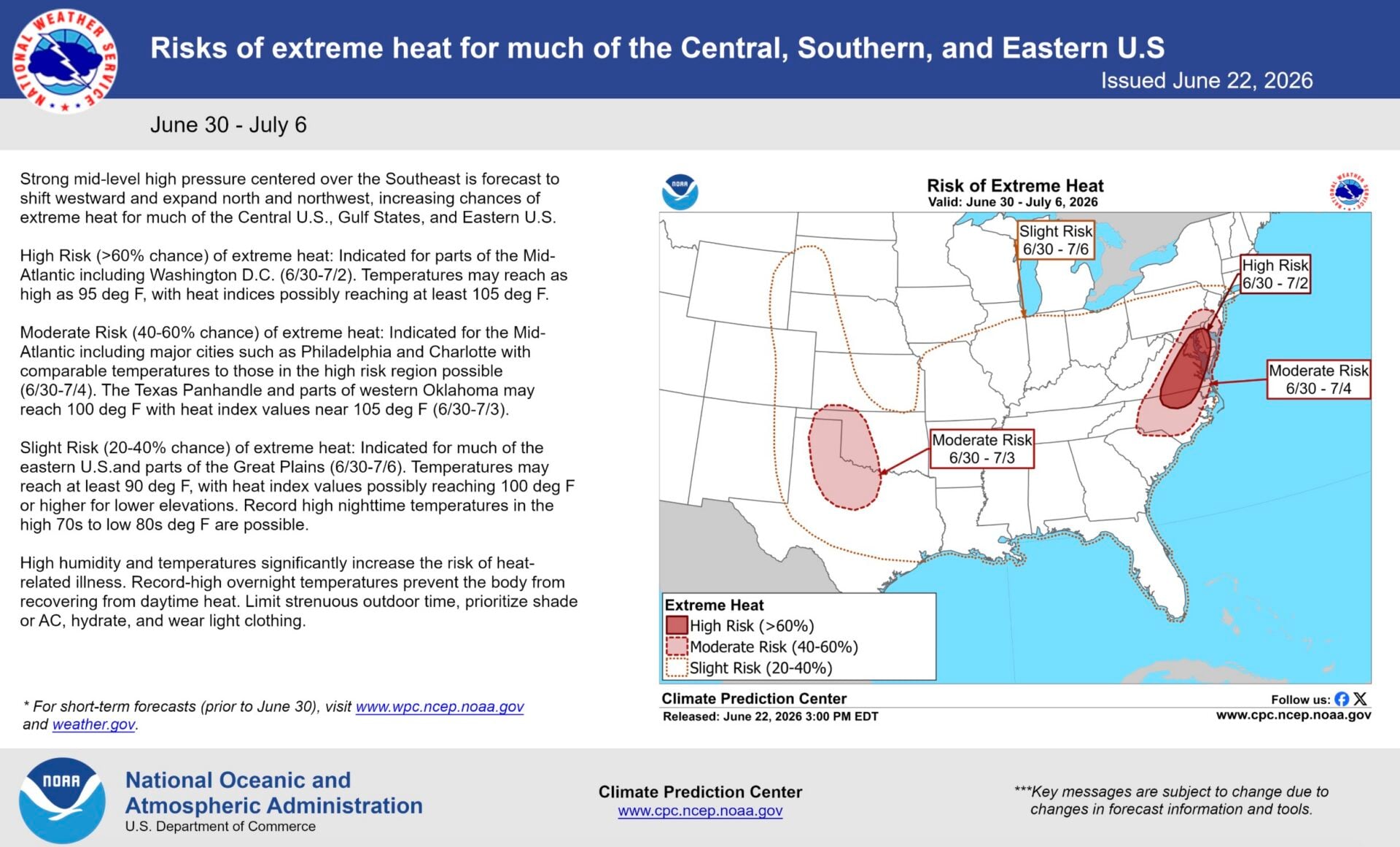
A Moderate Risk covered a wider Mid-Atlantic corridor. Philadelphia and Charlotte fell inside that zone. The window ran through July 4 with similarly dangerous temperatures possible. The Texas Panhandle and parts of western Oklahoma saw triple-digit heat and heat-index values near 105 through July 3.
A broader Slight Risk of extreme heat stretched across much of the eastern United States and parts of the Great Plains through July 6. Temperatures in those areas reached at least 90 degrees, with heat-index values topping 100 at lower elevations. Record-high overnight lows in the high 70s to low 80s appeared in multiple cities. That is particularly dangerous because the body needs cooler nighttime temperatures to recover from daytime heat stress.
NOAA advised limiting strenuous outdoor activity, seeking shade or air conditioning, staying well hydrated, and wearing lightweight clothing throughout the days surrounding the holiday. That advice held then and holds every July since.
The July Climatology: Why the Fourth Runs Hot Every Year
July is the hottest month of the calendar year across most of the United States. The NOAA National Centers for Environmental Information put July 2024 as the second-warmest July on record for the contiguous US, with July 2020, 2021, 2022, and 2023 each sitting inside the ten warmest ever measured. The trend is not opinion. It is the 130-year continental temperature record NOAA maintains.
The typical Fourth of July also sits inside the North American Monsoon window for the Southwest and the peak of the Bermuda High for the East. Both patterns pump humid air across the country. Humid air blocks the body from cooling through sweat evaporation. That is why heat-index numbers, which combine temperature and humidity, matter more on July 4 than raw thermometer readings alone.
- Mid-Atlantic and Southeast: July normal highs run 88 to 94 degrees; heat-index values above 100 are common during any late-June ridge.
- Southern Plains (Texas, Oklahoma, Arkansas): normal highs 95 to 100; triple-digit reads and heat-index values near 110 are the July default, not the exception.
- Desert Southwest: July normal highs 100 to 110; low humidity keeps heat-index numbers closer to raw temperature, but overnight lows in the high 80s during monsoon breaks strain older adults hard.
- Great Plains and Midwest: normal highs 85 to 92 with sudden 100-degree pushes when a Southwest ridge slides east.
- Pacific Northwest: normal highs 78 to 85; the region rarely designs homes for air conditioning, so a 95-degree afternoon is a bigger public-health event than the number suggests.
NWS Heat Categories, Translated: Advisory, Watch, Warning
The Fourth of July 2026 alert used the phrase High Risk of extreme heat. That is NOAA’s Climate Prediction Center language for medium-range guidance. Once a heat wave is 24 to 48 hours out, your local National Weather Service forecast office switches to its own three-tier system. Learn the tiers once, use them every July for the rest of your life.
- Heat Advisory: heat-index values of 100 to 104 for two or more hours across two consecutive days (varies slightly by region). Reduce strenuous outdoor work; check on older neighbors.
- Extreme Heat Watch: conditions favorable for dangerous heat within 24 to 72 hours. Prep now: precool the house, move activities before 10 a.m., top up medications and hydration supplies.
- Extreme Heat Warning: dangerous heat is imminent or occurring. Heat-index values above 105 to 110 for two consecutive days. Cancel or move outdoor events to indoor cooling. This is the tier that killed hundreds of Chicagoans in July 1995 and hundreds more Oregonians in June 2021, both extensively documented in CDC after-action reviews.
Your Six-Step Fourth of July Heat Safety Plan
The CDC extreme-heat guidance is short, blunt, and worth reading before every July heat wave. Here is the version we hand to Almanac readers each summer.
- 1) Hydrate before you feel thirsty. Thirst is a lagging indicator. Drink 8 ounces of water every 20 minutes during outdoor activity, more if you are sweating heavily.
- 2) Front-load the day. Move mowing, gardening, walks, and setup for cookouts to before 10 a.m. The 3 p.m. to 6 p.m. window is the daily heat peak.
- 3) Buddy system for kids and older adults. Anyone under 12 or over 65 needs a check-in every 20 minutes. Watch for flushed skin without sweat, confusion, or a headache; those are heat-exhaustion signs.
- 4) Precool the house and the car. Run the AC or open windows on both sides of the house at 5 a.m. to purge overnight heat, close everything by 9 a.m. Precool the car for five minutes before loading kids or pets.
- 5) Learn the difference between heat exhaustion and heat stroke. Heat exhaustion is heavy sweating and cool clammy skin; move to shade, sip cool water. Heat stroke is hot dry skin, confusion, and a body temp above 103; call 911, cool aggressively.
- 6) Check on neighbors without air conditioning. The CDC after-action review of the 1995 Chicago heat wave found that neighborhood check-ins were the single strongest predictor of survival for isolated older adults.
Regional Notes: How Fourth of July Heat Waves Look Where You Live
The 2026 event was Mid-Atlantic and Southern Plains led. The map changes almost every year. Here is what to expect regionally when the CPC flags July heat risk.
- Northeast and New England: the risk is heat-index days above 100 with poor overnight recovery in urban heat islands (Boston, Hartford, New York City).
- Mid-Atlantic (DC, Philadelphia, Baltimore, Richmond): the historic hot spot; heat-index runs above 105 during Bermuda High expansions.
- Southeast (Charlotte, Atlanta, Nashville, Jacksonville): humid heat all July; watch for heat-index above 110 when a ridge stalls.
- Gulf Coast: a heat wave here often means poor air-quality days on top of heat; the 90-degree threshold is the tell.
- Southern Plains (Texas, Oklahoma): triple-digit heat is normal; danger jumps when overnight lows will not drop below 80.
- Desert Southwest (Phoenix, Las Vegas, Tucson): monsoon breaks pair with 115-degree afternoons; watch for asphalt-burn injuries and cactus wildfires.
- Pacific Northwest: heat waves are shorter but hit homes without AC; the 2021 heat dome killed hundreds across Oregon, Washington, and British Columbia.

Frequently Asked Questions
When was the Fourth of July 2026 heat wave forecast?
NOAA’s Climate Prediction Center issued Key Message 2026 006 on June 22, 2026, flagging High Risk of extreme heat for the Mid-Atlantic from June 30 to July 2 and Slight to Moderate Risk zones stretching through July 6.
How hot did it actually get on July 4, 2026?
Washington, D.C. climbed to about 95 degrees F with heat-index values near 105. The Texas Panhandle and western Oklahoma pushed triple digits. Overnight lows across the Mid-Atlantic sat in the high 70s to low 80s, a rare and dangerous pattern.
What is the difference between a Heat Advisory and an Extreme Heat Warning?
A Heat Advisory covers heat-index values of 100 to 104 for two hours across two days. An Extreme Heat Warning is issued when heat-index values top 105 to 110 for two consecutive days, or when death and heat illness are imminent. The Warning tier triggers school cancellations, event moves, and cooling-center activations in most cities.
Why are hot overnight lows the most dangerous part of a heat wave?
The human body sheds heat overnight by radiating warmth to cooler air. When lows stay in the high 70s or low 80s the body cannot recover, and cumulative heat stress builds day by day. The 1995 Chicago and 2021 Pacific Northwest heat waves both featured multiple nights without cool-down.
How much water should I drink during a heat wave?
The CDC recommends 8 ounces of water every 15 to 20 minutes during outdoor activity in extreme heat. Skip alcohol and heavy caffeine, which speed dehydration. Watch urine color; pale yellow is the target.
Are July heat waves getting worse in the United States?
NOAA’s climate record shows the ten warmest US Julys have all occurred since 2011. The number of days with heat-index values above 100 is rising in every US region, per National Centers for Environmental Information data.
Where can I find the Farmers Almanac summer weather outlook?
The Farmers Almanac publishes a long-range summer forecast every spring, mapped to seven US regions and rooted in our 200-year-old math-based formula. Members see the full daily breakdown; a public overview is on the main site each May.
What should I do if I see someone showing signs of heat stroke?
Call 911. Move the person to shade or air conditioning. Cool aggressively with wet cloths, a cool shower, or ice packs at the neck, groin, and armpits. Do not give fluids if the person is confused or unconscious. Heat stroke has a survival window of minutes, not hours.

- Tim Konrad

- Tim Konrad
- Tim Konrad

- Tim Konrad