What Are Those Tiny Threads Floating Through the Air in Fall?

The silvery strands drifting across your yard may be carrying some of autumn’s smallest travelers.
Have you ever walked through the yard on a sunny fall afternoon and felt a nearly invisible thread brush your face? Look toward the light and you might see more of them floating over the grass or caught on a fence.
Those threads are often spider silk, known as gossamer. Small spiders use it to travel through the air in a behavior called ballooning. It is a natural sight that can become especially noticeable in autumn. Texas A&M AgriLife Extension describes fall displays of silk conspicuous enough to prompt reports of mysterious material falling from the sky. citybugs.tamu.edu
How do spiders float through the air?
A small spider climbs to an exposed spot, such as the tip of a grass stem or a fence post. It releases fine strands of silk from its abdomen. Air moving around those strands can lift the spider and carry it to a new location.
This is especially common among young spiders, called spiderlings, though some small adults balloon as well. As NC State Extension explains, ballooning allows spiderlings to disperse on wind currents. content.ces.ncsu.edu
There may be another force at work, too. In a study published in Current Biology, University of Bristol researchers found that atmospheric electric fields can prompt spiders to balloon and affect their movement in experimental conditions. Wind still matters; scientists continue to study how the forces work together outdoors. research-information.bris.ac.uk
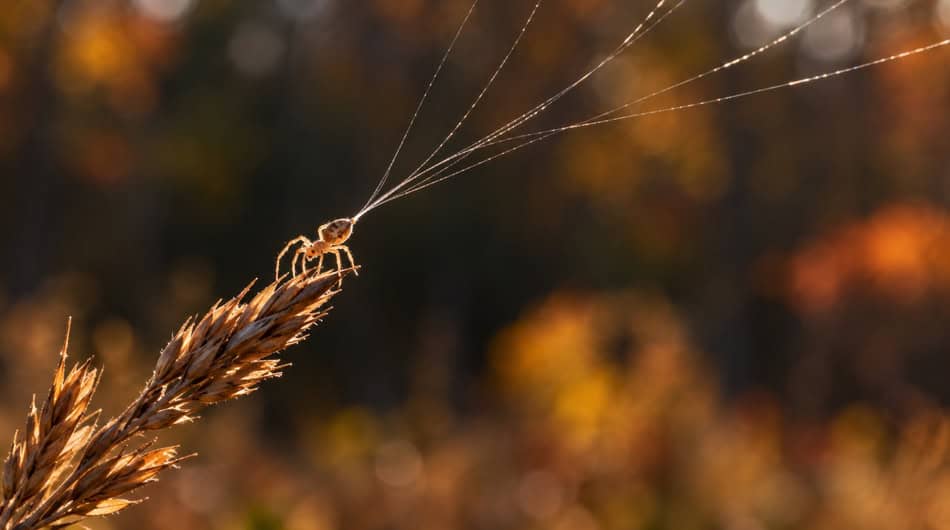
Why do you see gossamer in fall?
Ballooning is not limited to autumn. But fall can bring large numbers of small spiders dispersing at once, and their silk may collect on grass, shrubs, fences, or other strands. A single thread is hard to see until low sunlight catches it. Then an ordinary field can appear to shimmer.
You may notice more large stationary spiderwebs in fall, too, but those are a different sight. The broad, wheel-shaped web beside your porch is built to catch prey. Learn more about the spiders behind those webs in our guide to orb-weaver spiders and their role in the garden. ucanr.edu
Is a spider attached to every floating thread?
No. A tiny spider might be traveling on a strand you see drifting past, but silk can also remain caught on a plant after its maker has gone. Looking at a thread alone usually will not tell you which species produced it.
Nor is floating silk proof that a Joro spider has reached your neighborhood. Many spiders balloon. If you have spotted a large yellow-and-black spider rather than just a few fine threads, use our Joro spider identification guide to compare what you saw. ucanr.edu
Do you need to get rid of the threads?
A little gossamer outside calls for no treatment. You can brush silk away from a doorway or walkway if it bothers you. There is no need to spray your lawn because you see floating threads. Spiders help control other insects, and NC State Extension advises that outdoor pesticide applications for spiders are generally unnecessary. content.ces.ncsu.edu
If spiders are making their way inside your home, our guide to natural ways to keep spiders out of the house covers steps you can take around doors, windows, and other entry points.
The next time a silver thread flashes in the autumn sun, take a second look. You may be watching a tiny spider’s journey to a new home.

- Tim Konrad

- Tim Konrad
- Tim Konrad
- Tim Konrad