

14 Popular Foods Named After Real People (And the Stories Behind Them)
Is there a person behind your favorite food? We're dishing on these popular classics. Read on, but watch out, it may make you hungry!
Many of the foods on a Wednesday-night menu carry the names of real people. Some were chefs honoring patrons, some were patrons demanding their own dish, and a few were newspaper stories that ran away with the credit. Here are fourteen of the most familiar, with what the historical record actually says (and where the story gets fuzzy).
Quick Reference
- Why these names stuck: most were coined by chefs honoring patrons, customers immortalizing favorites, or newspapers tagging a fad.
- Oldest entry here: the sandwich, attributed to John Montagu, 4th Earl of Sandwich, in the 1760s.
- One myth busted: “Baby Ruth” candy bar was named after President Cleveland’s daughter Ruth, not the ballplayer Babe Ruth (so says the manufacturer; the timing is debated).
- The Italian-American invention: Caesar salad came out of a hotel kitchen in Tijuana, Mexico, in 1924.
- The royal cocktail: the Bloody Mary is most often traced to Fernand Petiot at Harry’s New York Bar in Paris in the 1920s.
- The hot debate: historians still argue whether General Tso’s chicken honors the 19th-century Hunan general or just borrowed his name in a New York kitchen in the 1970s.
1. Sandwich
The most famous of all. The sandwich is generally attributed to John Montagu, 4th Earl of Sandwich, an 18th-century English politician. The story goes that during long card games he asked for meat between two slices of bread so he could eat without grease on the cards. A traveler named Pierre-Jean Grosley wrote down the tale in the 1760s, which is the earliest known printed account. Modern historians point out that bread-and-filling combinations existed in many cultures long before, but the English-language name stuck to the Earl.
2. Caesar Salad
Despite the Latin pedigree of the name, this salad is named after Caesar Cardini, an Italian-American restaurateur. Cardini ran a hotel restaurant in Tijuana, Mexico, where Americans crossed during Prohibition. On July 4, 1924, the kitchen was running low on supplies for a busy holiday rush. Cardini assembled romaine, garlic, croutons, parmesan, eggs, lemon, oil, and Worcestershire, and tossed it tableside. The salad became a signature, then spread north. The original did not contain anchovies; modern versions usually do.
3. Earl Grey Tea
Earl Grey is a black tea flavored with bergamot oil. The name traces to Charles Grey, 2nd Earl Grey, British Prime Minister from 1830 to 1834. A common story says a Chinese envoy gave the recipe in thanks for a rescued son, although no archival evidence supports that meeting. What is documented is that Grey served the blend at home, his family kept the recipe, and tea companies licensed the name in the 1830s and 1840s. Twinings sells it as their flagship to this day.
4. Granny Smith Apples
Real granny, real Smith. Maria Ann “Granny” Smith, a settler in New South Wales, Australia, found a chance seedling in her orchard around 1868. The fruit was tart, green, and an excellent keeper. Local growers propagated it, and within decades the variety was a fixture of Australian export. Granny Smith died in 1870, before her apple became famous; the original tree is long gone, but a memorial marks the site at Eastwood, in greater Sydney.
5. Bloody Mary
The cocktail is most often traced to Fernand Petiot, a bartender at Harry’s New York Bar in Paris in the 1920s, who mixed tomato juice with vodka for American expatriates. The drink crossed back to New York at the King Cole Bar in the 1930s. The “Mary” of the name is variously identified as Mary I of England (Bloody Mary, for executions of Protestants), a Hollywood actress, or a regular at Petiot’s bar. The bartender himself credited the bar customers and never settled the question.
6. Peach Melba
Pastry chef Auguste Escoffier invented this dessert in 1893 at London’s Savoy Hotel for the Australian opera singer Dame Nellie Melba. The original was a swan ice carving filled with vanilla ice cream, ripe peaches, and raspberry sauce, served in honor of her performance in Lohengrin. Escoffier simplified the dish for restaurant service a decade later, dropping the swan and adding the now-standard raspberry-sugar coulis (sauce Melba) over the peaches.
7. Beef Wellington
Almost certainly named for Arthur Wellesley, 1st Duke of Wellington, the British general who defeated Napoleon at Waterloo in 1815. The Duke was famously not interested in food. The pastry-wrapped beef tenderloin appeared in cookbooks decades after his death, and the link to Wellington may be no more than a Victorian-era kitchen tribute. The dish became a dinner-party showpiece in the 20th century and remains one for skilled home cooks.
8. Pavlova
A meringue dessert with whipped cream and fruit, named for the Russian ballerina Anna Pavlova, who toured Australia and New Zealand in 1926. Both countries claim its invention. New Zealand cookbook entries date to 1929; Australian to the early 1930s. Historians at Te Papa Tongarewa in Wellington argue convincingly that the Kiwi version is older. The Australian view is no less heated. Either way, Pavlova herself never got to taste her dessert.
9. Fettuccine Alfredo
Roman restaurateur Alfredo di Lelio invented this dish around 1907 for his pregnant wife, who could only stomach plain butter-and-cheese pasta. He whisked the egg-rich fettuccine tableside with butter and parmesan and added “Alfredo” to the menu. American actors Mary Pickford and Douglas Fairbanks ate it on their 1927 honeymoon in Rome and brought the recipe home. American versions now lean on heavy cream, which the original recipe never used.
10. General Tso’s Chicken
Named for Zuo Zongtang (anglicized “General Tso”), a 19th-century Qing Dynasty military leader from Hunan. The dish itself is not Chinese-Chinese. It was created by Hunanese chef Peng Chang-kuei in Taiwan in the 1950s, then introduced to New York in the 1970s. American restaurants sweetened the sauce heavily; Peng disliked the result and refused to call it his own when he visited New York later. The general never tasted a piece.
11. Salisbury Steak
Named for Civil War-era American physician James H. Salisbury, who promoted a meat-heavy diet for digestive health in the 1880s. Salisbury believed minced beef was easier to digest and prescribed his pattied version to soldiers and patients. The dish entered American institutional cooking through schools, hospitals, and the military, and remains a TV-dinner staple.
12. Baby Ruth Candy Bar
The Curtiss Candy Company introduced this bar in 1921 and named it, the company insists, for Ruth Cleveland, daughter of President Grover Cleveland. Ruth had died in 1904, which makes the timing odd. Baseball historians have long argued the name was a wink at Babe Ruth, who was the most famous American athlete of the moment. The company denied the connection. Babe Ruth even tried to launch a rival “Ruth’s Home Run Candy Bar” in 1926; Curtiss successfully sued him to stop it.

13. Carpaccio
Invented by Venetian restaurateur Giuseppe Cipriani at Harry’s Bar in 1950 for the Countess Amalia Nani Mocenigo, whose doctor had ordered raw beef. Cipriani sliced top-round paper-thin and drizzled it with mustard-mayonnaise sauce. He named it for the Venetian painter Vittore Carpaccio, whose 1490s work was on exhibit in the city that year, and whose paintings used the same deep red as the raw beef. The name carried over to thin-sliced raw fish and vegetables in later decades.
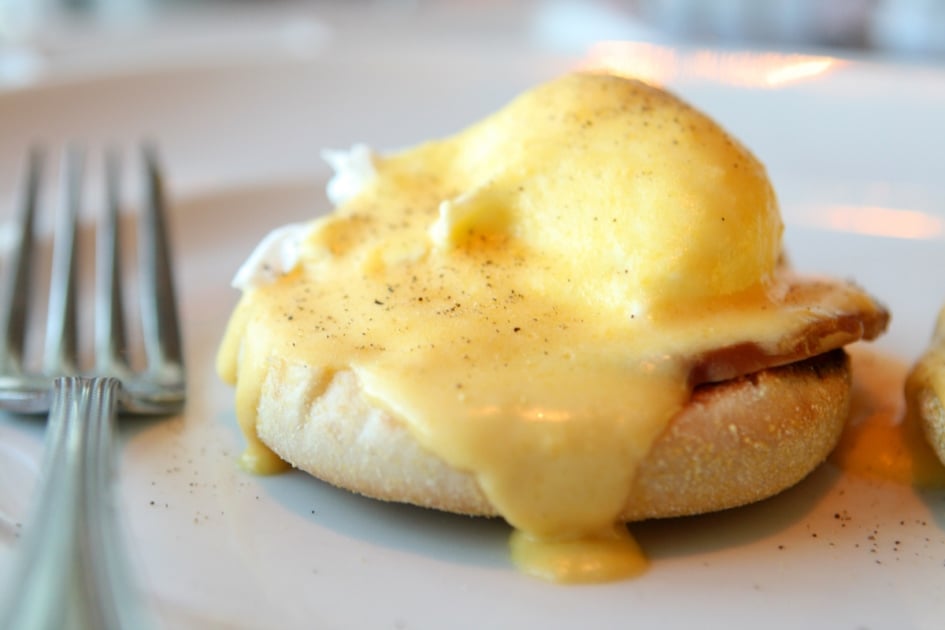
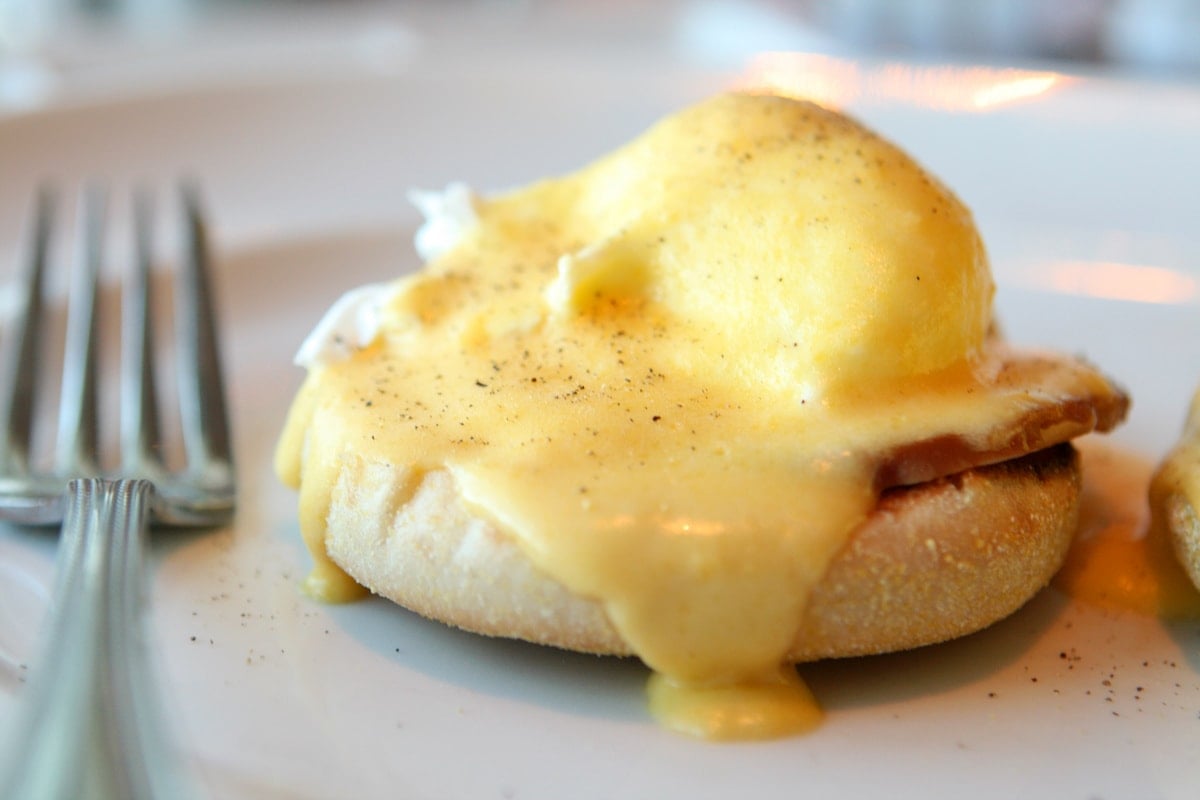
14. Eggs Benedict
Several Americans claim authorship. The most common story credits stock broker Lemuel Benedict, who, in 1894, walked into the Waldorf Hotel’s Palm Room hungover and asked for buttered toast, bacon, poached eggs, and hollandaise. The maître d’hôtel Oscar Tschirky liked the dish, swapped the toast for an English muffin and the bacon for ham, and added it to the menu. A second version credits Mr. and Mrs. LeGrand Benedict, regulars at Delmonico’s; Mrs. Benedict reportedly tired of the menu and asked for something new.

A Note on the Stories
Food origin stories are notoriously slippery. They get prettier over time, dishes get reattributed when the original chef’s name fades, and newspapers run with whichever version reads best. Most of the entries here have at least two competing accounts. Where the historical record is clear (sandwich, Caesar, Pavlova, peach Melba, fettuccine Alfredo), the story is solid; where it gets murky (Bloody Mary, Baby Ruth, General Tso), reasonable people still argue. The names stuck regardless.
Frequently Asked Questions
Was the sandwich really invented by the Earl of Sandwich?
Probably not invented, but named for him. Bread-and-filling combinations existed in many cultures long before John Montagu’s lifetime. What he did was popularize the format in 18th-century England, where the name caught.
Where was Caesar salad invented?
In a hotel kitchen in Tijuana, Mexico, on July 4, 1924, by Italian-American restaurateur Caesar Cardini.
Did Babe Ruth get a candy bar named after him?
The Curtiss Candy Company always insisted the Baby Ruth bar honored President Cleveland’s daughter Ruth, not Babe Ruth, and successfully sued the ballplayer when he tried to launch a rival bar in 1926. Historians remain skeptical of the official story.
Did General Tso ever eat General Tso’s chicken?
No. Zuo Zongtang died in 1885. The dish was created in Taiwan in the 1950s by chef Peng Chang-kuei, then adapted heavily for American tastes in New York in the 1970s.
Did Anna Pavlova ever try the pavlova dessert?
There is no clear evidence she did. The Australian and New Zealand cookbook entries that name the dessert after her appeared between 1929 and the early 1930s; Pavlova died in 1931.
Who invented fettuccine Alfredo?
Roman restaurateur Alfredo di Lelio around 1907 in Rome. American versions are not the original; di Lelio’s recipe used only butter and parmesan, never heavy cream.


Larry Fleury
Larry Fleury is a writer and outdoor photographer who has a background in atmospheric science, marketing, astrophotography, creative writing, and all things outdoors. His photography has been featured by The Weather Channel, Midwest Living Magazine, and National Geographic Your Shot. Larry lives on the edge of the Ozark Mountain Range in Southeast Kansas, where he spends his free time fishing, camping, hunting, hiking, storm chasing, and playing guitar on the porch.
- Larry Fleury

- Larry Fleury
- Larry Fleury
- Larry Fleury

Best news
GREAT