
Weather Sticks Explained: How Balsam Fir Predicts Rain
How can a simple stick made of balsam fir be an accurate weather predictor? Do they really work? Learn the science behind nature and see for yourself!
Quick Reference
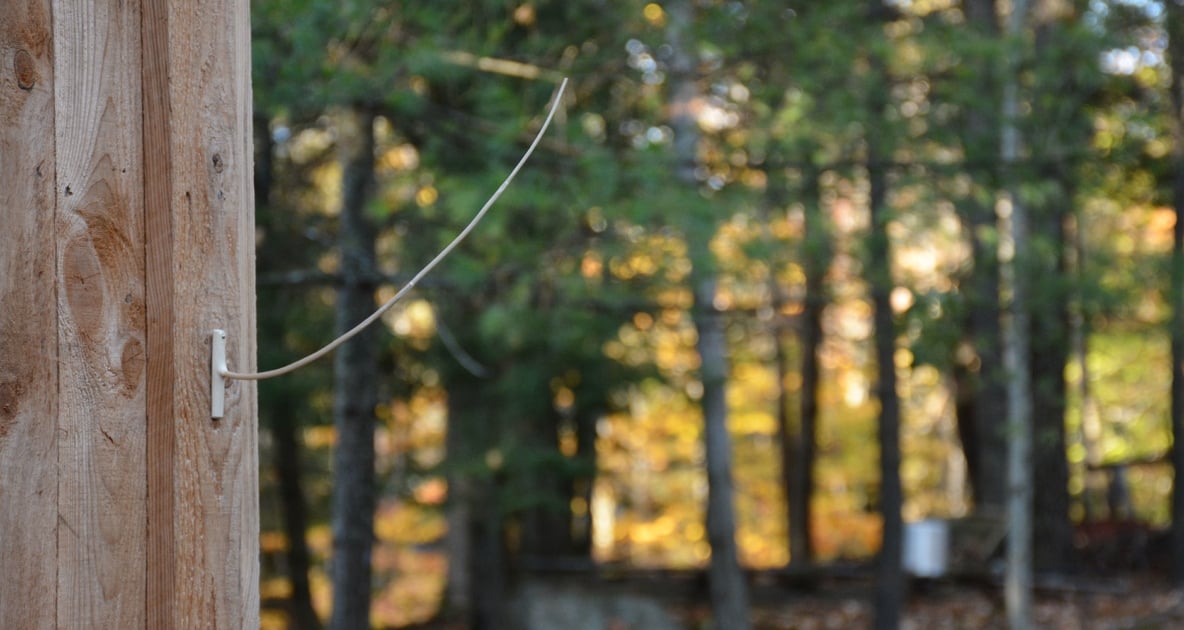
- What it is: A 15 to 16 inch dried balsam fir twig with the bark stripped off. Hung outside, it bends with the humidity.
- How to read it: Stick points up means dry weather and clear skies. Stick points down means rain, snow, or a humid front coming in.
- Why balsam fir: Fir branches grow special compression-side fibers that shrink in dry air and swell when humid. Most other woods do not work.
- Where it came from: The Abenaki of the northeastern coast used balsam fir twigs as weather indicators for centuries before the practice spread through New England.
- Hang it correctly: Mount the stick upside down from how it grew on the tree, on a sheltered porch wall or kitchen window casing.
- Lifespan: Years of forecasting if kept out of direct rain.
The weather stick has always been popular in the New England States, and it is growing in popularity elsewhere too. People have used them for centuries to predict the weather. It is said that the Abenaki American Indians who lived along the northeastern coast of the United States and Canada were the first to use them.
So what exactly is a weather stick? More importantly, how does it work, and how accurate is it? This guide walks through the wood science, the right way to hang one, the patterns to watch for, and the way the Almanac pairs the stick with our long-range forecast.

The World’s Simplest Weather Prediction Device
Weather sticks are made from the dried twigs of balsam fir trees and they are usually between 15 and 16 inches long. Looking at one, you will see it is incredibly simple, just a stick with the bark removed and a little piece of the tree’s trunk left on so you can nail it to a wall, fencepost, or a pillar on your porch.
The weather prediction is in the way the stick moves. The stick curls upward sharply when good weather is headed your way and downward when the weather is about to take a turn for the worse.
They are very accurate, and they last a long time. Hang one outside your kitchen window or on your porch and it will keep forecasting the weather for years.
But How Does It Work?
It might seem like a bit of woodsy folklore that does not stand up to modern meteorology, but there is actually quite a lot of science behind a weather stick. The stick bends with the relative humidity in the air around it.
Higher humidity, which is often a signifier of bad weather, makes a balsam fir stick curl downward. When the stick dries out, it straightens out or curves upward.
The interesting thing is that there are not many kinds of wood that can be used this way. You cannot simply cut a twig from any old tree and expect it to predict the weather. Most trees produce what is known as reaction wood.
Reaction wood is the tree’s structural answer to a constant load. If a tree is always exposed to winds coming out of the west, that tree will develop stronger wood fibers on its eastern side to brace itself against high winds.
Balsam fir, however, develops its reaction wood a little differently. Live balsam fir trees develop reaction wood on the undersides of their branches so that in dry weather, the fibers shrink to conserve water and bend the branch toward the ground. When rains come along and the fir tree starts drawing more water, those same fibers expand and the branch unfurls.
Dried balsam fir sticks retain those properties, but since they are no longer attached to a root system, they rely on the amount of humidity in the air to curl and uncurl. The USDA Forest Service profile of balsam fir describes the same compression-wood biology that makes the stick respond.
That is one reason why weather sticks have the bark removed. The wood can soak up more water and dry out more quickly, which makes it bend more than it would if a layer of bark were in the way.
Using A Weather Stick
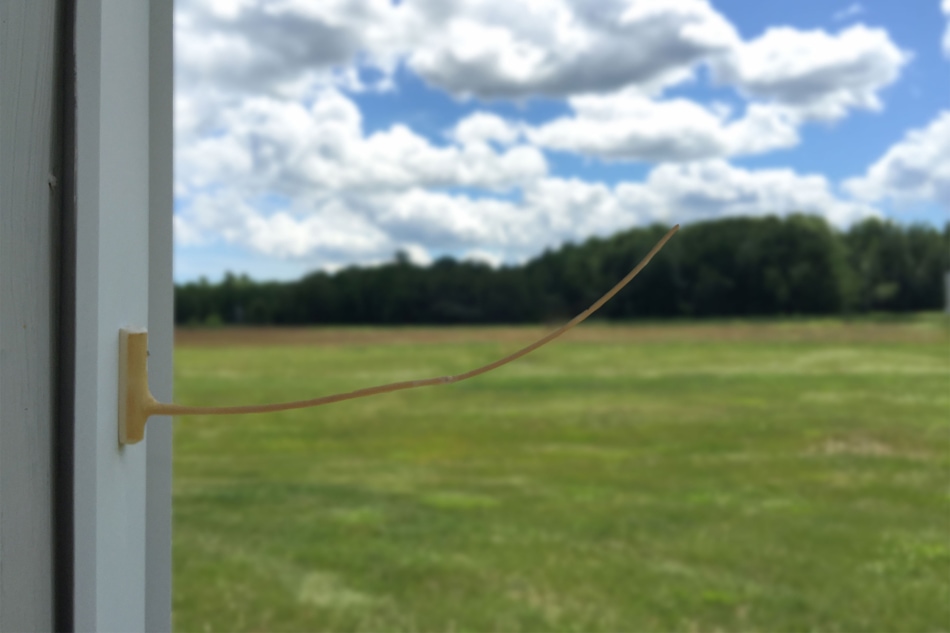
The best weather sticks make weather prediction easy. They have an obvious curve upward or downward depending on the humidity. To install one, make sure that the stick is oriented upside down from the way that it grew on the tree.
Traditionally, weather sticks point up for good weather and down for bad weather. If you install yours right side up, the way it would have grown on the tree, it will still work, but it will point upward as wet weather approaches instead of downward. Either way is fine. Pick one orientation, learn it, and stick with it.
Where to Mount It
- Outside, on a porch or under an eave so it gets fresh air but not direct rain.
- Outside the kitchen window, where you walk past it every morning.
- On a porch column or a fencepost at eye level for easy reading.
- On a north-facing wall in hot regions so it does not bake in summer sun.
How to Read the Movement
| Stick position or movement | What it indicates |
|---|---|
| Pointing up (above horizontal) | Fair weather; low humidity; dry air |
| Pointing down (below horizontal) | Rain or snow likely; high humidity building |
| Roughly horizontal | Transitional or average humidity; no strong weather signal |
| Moving upward over hours | Conditions improving; air drying out |
| Moving downward over hours | Moisture increasing; wet weather likely building |
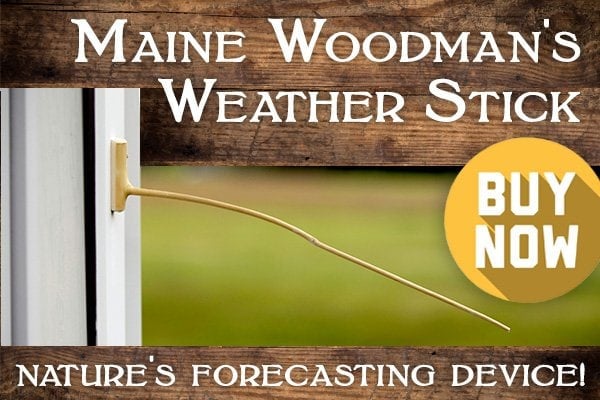
Who would have thought you could predict the weather with something as simple as a stick? If you are looking for a no-batteries way to forecast the weather at home, a weather stick is the simplest tool there is.
Where to Buy an Authentic Balsam Weather Stick
The SERP for “weather stick” is thick with mass-market listings, most of which are decorative twigs, not the real balsam-fir branch tip that actually responds to humidity. Here is what to look for and where to source one that works.
What to look for
- Species: balsam fir (Abies balsamea). Some vendors substitute Douglas fir or spruce, which barely move. Read the listing.
- Origin: harvested in the Northeast US (Maine, Vermont, New Hampshire, upstate New York) or eastern Canada. That is where balsam fir grows wild.
- Length: 10 to 15 inches. Shorter sticks flex less; longer sticks are too whippy.
- Cure: a properly cured stick should feel dry and slightly springy, not brittle. Ask the seller if it has been kiln-dried (too dry) or air-dried (right).
- Bark on the base: a small collar of intact bark is a good sign of a hand-harvested stick.
Where to source one
- Small Maine and Vermont makers sell direct online. Search “Maine balsam weather stick” or “Vermont weather stick” and pick a listing with clear species and origin claims.
- General stores in fir country (Kittery Trading Post, Vermont Country Store, local farm shops in the Adirondacks and White Mountains) usually carry them fall through spring.
- Farmers’ markets in New England, especially in balsam-wreath season (October to December).
- Amazon and Etsy: works if you filter for balsam fir specifically and read reviews for “actually moves”. Many mass listings are decorative-only.
How Accurate Is a Weather Stick?
A balsam fir weather stick is not a barometer. It does not give you a number, a pressure trend, or a 7-day outlook. What it gives you is a fast, dependable read on relative humidity, which often shifts a few hours before a front arrives. In long-running weather-stick households across Maine, New Hampshire, and Vermont, the rule is simple: when the stick swings sharply downward overnight, the next twenty-four hours are usually wet.
For a deeper read, pair the stick with the day’s barometric pressure trend, the cloud type overhead, and our Long-Range Forecast. The stick handles the next few hours. The forecast handles the next two months. Together they cover most of what a small farm or backyard gardener needs.
Care and Lifespan
- Hang it under cover. Direct rain shortens its life.
- Do not paint, varnish, or seal it. Sealing the wood ends its sensitivity to humidity.
- Wipe off pollen or dust with a dry cloth once a season.
- Replace if it stops responding for two weeks straight, after years of service.
- If the bend gets stuck in one position, soak it in water for ten minutes to reset, then let it dry in shade.
Time Lapse of a Weather Stick in Action
Purchase a weather stick here:
Make Your Own Balsam Weather Stick (Free, if You Have the Tree)
If you have a balsam fir on your property or camping-lease land, you can harvest and cure your own weather stick in about six weeks. The tree does not notice a single branch tip.
- Choose the branch. Find a healthy balsam fir. Pick a branch tip about 10 to 15 inches long from the outer edge of the crown, ideally on the shaded north side (thinner, more flexible wood).
- Cut cleanly. Use sharp bypass pruners and cut back to a small collar of bark near the trunk. Do not tear or twist.
- Strip the side needles. Rub off the small needles along the length, leaving the tip needles and the base bark intact if you can.
- Air-dry indoors. Hang the stick in a warm dry place (attic, boiler room, or a corner of the garage) for four to six weeks. Do not use a heater; slow drying is what keeps the wood springy.
- Test the movement. Take it into a humid bathroom right after a hot shower. The tip should curve downward within an hour. Bring it back to a dry room and it should straighten within a day. If it barely moves, it is over-dried; hang it outside on a rainy day to recover moisture.
- Mount. Nail or screw the base flat against an exterior wall in a sheltered spot (under an eave), or in a well-ventilated porch. Point the tip outward, level to horizontal in average humidity.
A homemade stick lasts three to five years before it dries out permanently. When it stops moving, harvest a new one.
Farmers’ Almanac Weather Stick
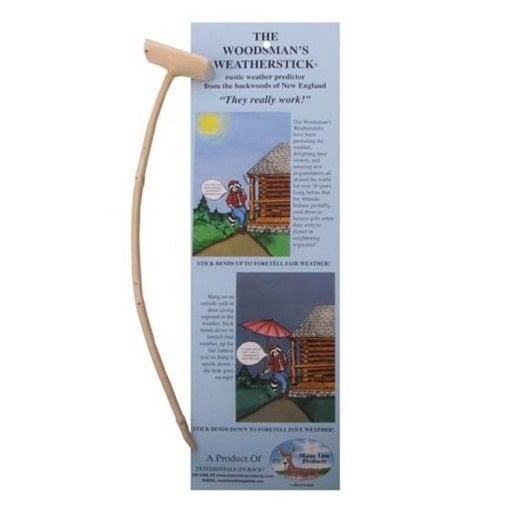
Straight from the Maine woods, this balsam fir weather forecaster really works!
Hang it from an outside wall or a door casing and watch it bend down to predict foul weather, up to predict good weather!
Frequently Asked Questions
Why does the stick only work with balsam fir?
Balsam fir grows compression wood on the undersides of its live branches. Those fibers shrink and swell with moisture far more dramatically than the reaction wood in most other trees. Once dried and stripped, the same fibers respond to ambient humidity, which is what makes the stick bend.
Can I cut my own weather stick?
Yes, if you have access to balsam fir on land you can cut on. Choose a healthy live branch around 15 to 16 inches long, leave a small bit of the trunk nub at one end, strip the bark, and let it dry indoors in a warm dry spot for two to three weeks before mounting outside.
How accurate are weather sticks compared to a barometer?
A barometer reads pressure. A weather stick reads humidity. Both can flag an incoming front, but they answer different questions. For backyard use within the next few hours, the stick is reliable. For longer planning, pair it with a forecast.
How long does a weather stick last?
Hung properly under cover and not painted or sealed, a balsam fir weather stick will keep responding for many years. Some New England households report sticks still bending fifteen and twenty seasons after they were first mounted.
Does it matter which way I hang the stick?
It does, but only for the convention. Mount the stick upside down from how it grew on the tree and it points up for fair weather and down for wet weather, which is how most folks read it. Mount it the other way and the meaning flips. Either works as long as you stay consistent.
Should I bring it inside in winter?
Leave it outside in a sheltered spot. Cold dry winter air gives a strong upward read on settled days and a sharp drop when a humid front arrives. Indoors, the relative humidity is too steady for the stick to do anything interesting.
Where can I buy a Farmers’ Almanac weather stick?
Straight from the Maine woods. The Farmers’ Almanac store carries balsam fir weather sticks. See it in the store.
Keep Learning
How Does Farmers’ Almanac Predict The Weather?
A Review Of Old Farmers’ Almanac Predictions
Join The Discussion!
Used a weather stick before? Tell us where you hang yours, how it has held up, and the times it called the weather right when the radar was still calling for sun.
Let us know in the comments below.


Amber Kanuckel
Amber Kanuckel is a freelance writer from rural Ohio who loves all things outdoors. She specializes in home, garden, environmental, and green living topics.
- Amber Kanuckel

- Amber Kanuckel

- Amber Kanuckel
- Amber Kanuckel




I have one of these and it works great!
Should the weather stick be installed in any specific direction, i.e., north, east, south, west? Also, you are stating to install the weather stick pointing downward?
Where do you obtain one of these sticks?
We sell them in our store! Check it out https://www.farmersalmanac.com/product-category/weather
I believe that in the jungle-like humidity of Fla the stick will be down all the time!
I have had weather sticks for over 40 years and they have never failed once. I would like to find the original legend of the native girl who always predicted the weather but there is nothing about it on Google.
The second half of this article seems to contradict the other. Which is correct?
They do work and I was devastated when mine broke renently. I’ve had it for over 12 yrs!!!
I live in East Tx where the humidity is high through the summer rain or no rain. I’m wondering if the weather stick would be accurate for areas of higher humidity?
A stick that predicts the weather? My immediate thought was, “Well, a cigar, of course” because humidity, high or low, has a huge impact on them, and they are often referred to as “sticks”.
Does anyone know if it will still work if you stain it?