

2026 Maple Helicopter Season: Why So Many This Year? (Plus 7 Other Trees With Helicopter Seeds)
Maple seeds have been swirling everywhere this spring. Find out what it means and the science behind their flight!
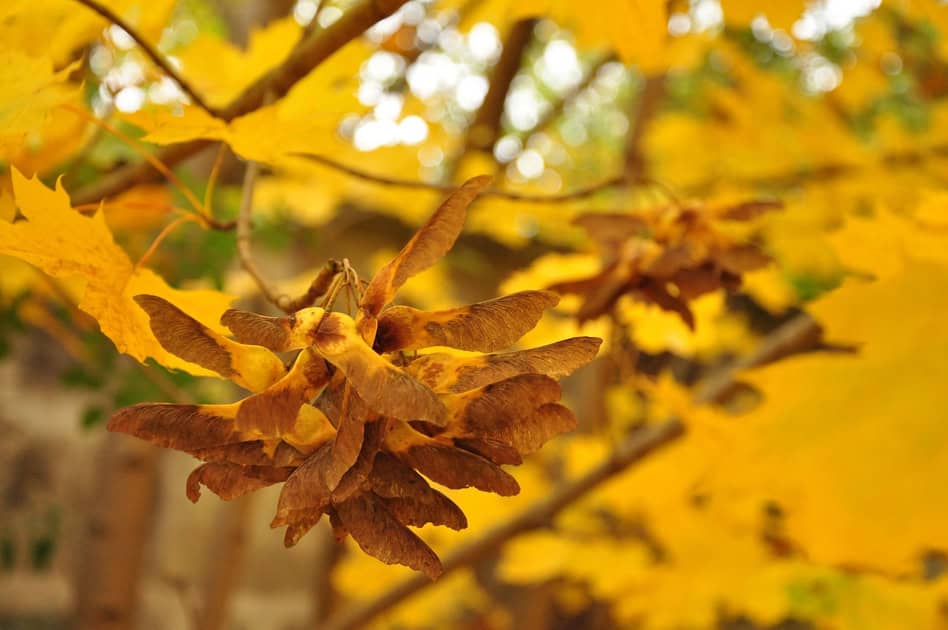
2026 Maple Helicopter Season at a Glance
- What they are: samaras — single-winged seed pods that spin as they fall.
- Peak drop: late April through mid-June, varying by species and region.
- 2026 outlook: above-average mast year for silver maple and Norway maple across the eastern US.
- Updated: July 14, 2026.
Quick Reference: Maple Copters (Samaras)
- Real name: samara, a winged single-seed fruit. Also seen on ash, elm, ailanthus, and hop hornbeam.
- Why they spin: the wing widens away from the seed; air over the wide end moves faster, generating lift, like a tiny helicopter rotor.
- Tiny tornadoes: in wind-tunnel tests, samaras form a leading-edge vortex that adds extra lift. Hummingbirds and insects use the same trick.
- A bumper year: a tree that drops a heavy crop is often responding to stress from the previous season, drought, late frost, or heavy pruning.
- When you’ll see them: silver maple late spring; red maple late spring/early summer (and again in fall); sugar maple early summer into autumn.
- Why we care: NASA and university aerodynamicists are copying samara geometry for Mars rotorcraft and palm-sized drones.
Updated September 10, 2026
Have you ever picked up one of those winged maple seeds, tossed it into the air, and watched it twirl toward the ground like a tiny aircraft?
You’re looking at what millions of people call a maple helicopter.
They’re also known as maple copters, whirlybirds, spinning seeds, or helicopter seeds, but botanists have another name for them: samaras.
And if you’re noticing maple helicopters hanging from trees or beginning to fall in September, there’s a good reason. Different species of maple release their seeds at very different times of year. Some drop their helicopters in spring, while others wait until late summer or autumn.
Here’s what those fascinating flying seeds are doing—and what a big crop of maple helicopters may actually mean.
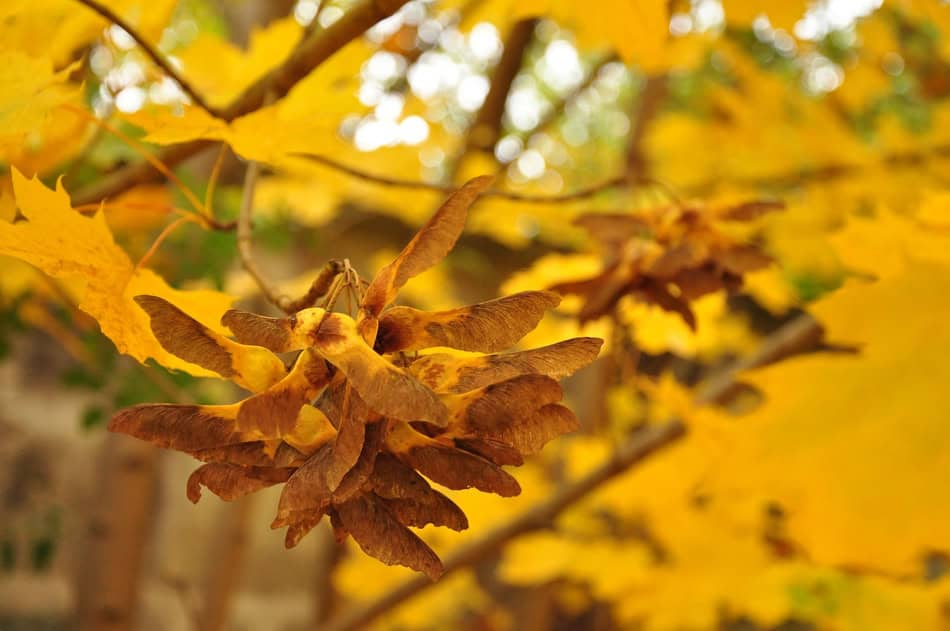
What Is a Maple Helicopter?
A maple helicopter is the winged fruit of a maple tree, known scientifically as a samara.
What looks like a seed with a wing attached is actually a specially adapted fruit designed to carry the seed away from its parent tree.
Maples commonly produce paired samaras. When they separate and fall, their unusual shape causes them to rotate rapidly through the air.
That’s where the nickname “helicopter” comes from.
The spinning motion isn’t just entertaining. It is an extraordinarily effective method of seed dispersal.
Why Do Maple Helicopter Seeds Spin?
A maple helicopter is essentially a tiny natural flying machine.
Most of its weight is concentrated near the seed, while a lightweight wing extends outward from it. As the samara falls, its shape causes it to rotate—a process known as autorotation.
Instead of dropping straight to the ground, the spinning seed falls more slowly.
That extra time in the air allows wind to carry it farther away from the parent tree, where the young maple has a better chance of finding sunlight, moisture, and room to grow.
Scientists studying maple samaras have even found that their spinning wings generate a small leading-edge vortex, helping create additional lift.
Nature figured out helicopter flight long before humans did.
Why Are Maple Helicopters Falling in September?
This is where things get interesting.
There isn’t one universal “maple helicopter season.”
Different maple species produce and release their seeds at dramatically different times.
Red maple: Red maple fruits mature early. USDA Forest Service records indicate that their samaras generally ripen from April through June and are dispersed during a relatively short period from spring into early summer.
Silver maple: Another early producer, silver maple generally ripens and releases its helicopters between April and June.
Sugar maple: Sugar maple is much more of an autumn seed producer. Its samaras mature later in the growing season and generally begin falling shortly before the leaves themselves fall.
Norway maple: Norway maple helicopter seeds mature in early to mid-autumn and can remain attached to the tree considerably longer. Its paired wings are often spread almost straight across from each other.
Boxelder: Although its leaves look very different from the classic maple leaf, boxelder is actually a maple. Its samaras ripen from roughly August through October and can continue falling throughout autumn and winter.
That means September 10 is actually an excellent time to notice maple helicopters in many parts of the country—but they may not be coming from the same maple trees that covered sidewalks with helicopters back in May.
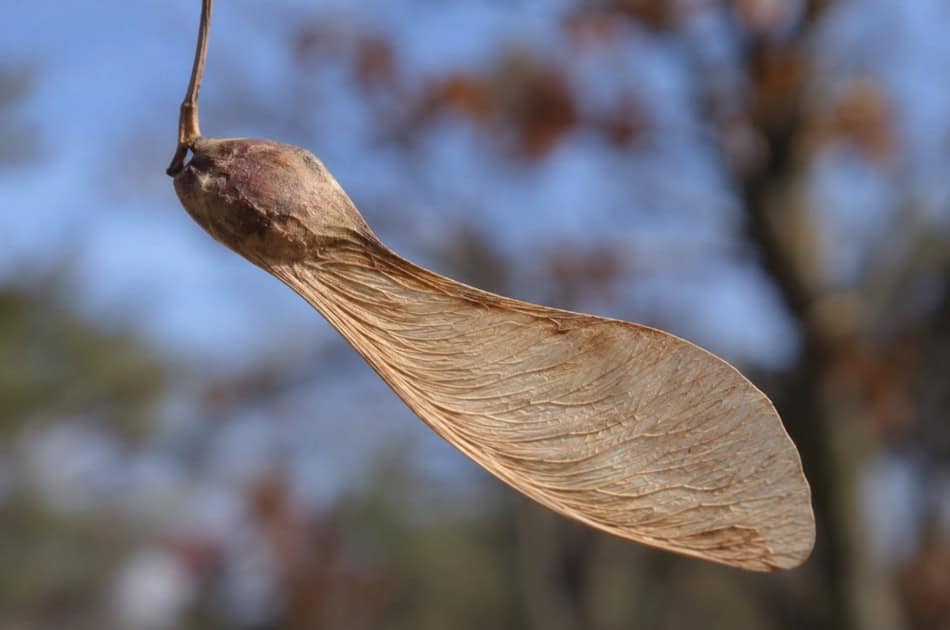
Maple Helicopter Season By Tree
| Maple Tree | Typical Seed Timing |
|---|---|
| Silver maple | Spring, generally April-June |
| Red maple | Spring into early summer |
| Sugar maple | Late summer into fall |
| Norway maple | Early to mid-autumn |
| Boxelder | September through winter in many locations |
Exact timing varies with latitude, elevation, weather, and local growing conditions.
Why Are There So Many Maple Helicopters Some Years?
Some years you barely notice them.
Other years your lawn, gutters, driveway, flower beds, and patio seem to disappear beneath thousands of maple helicopters.
Trees often experience years of unusually heavy seed production called mast years.
The phenomenon isn’t unique to maple trees. Oaks, beeches, hickories, and other trees also periodically produce enormous quantities of seeds.
Weather can play a role. Favorable conditions when a tree flowers can result in excellent pollination and a large crop of developing seeds. Tree health, available resources, environmental conditions, and natural reproductive cycles can also influence the number produced.
Stress can sometimes contribute to increased seed production, but a bumper crop of helicopters does not automatically mean that your maple tree is dying.
In fact, Iowa State University Extension documented exceptionally heavy maple seed production during a 2025 mast year and noted that affected trees could temporarily look thin or unhealthy while devoting resources to producing seeds, then return to a more normal appearance later in the season.
Do Lots of Maple Helicopters Mean a Hard Winter Is Coming?
It’s one of those old-fashioned questions that seems perfectly suited to an Almanac:
Does an unusually heavy crop of maple seeds mean nature is preparing for a severe winter?
It’s a wonderful piece of weather folklore—but there is no reliable scientific evidence that maple trees produce more seeds because they somehow know what the coming winter will bring.
Heavy seed production is much more closely connected with a tree’s reproductive cycle and conditions that have already occurred.
In other words, a maple tree’s seed crop can sometimes tell us something about the tree and its recent growing conditions.
It isn’t a dependable winter forecast.
Still, people have watched trees, nuts, berries, animal behavior, and other signs of nature for generations in hopes of finding clues about the season ahead. That’s part of what makes weather folklore so enduring.
Are Maple Helicopters Actually Seeds?
Technically, they’re fruits containing seeds.
The botanical term samara describes a dry fruit with a flattened wing that helps the seed travel on the wind.
Maples aren’t the only trees that use this strategy.
Ash trees also produce samaras, while tree-of-heaven and several other plants produce their own versions of winged fruits.
But the paired, spinning samaras of maple trees are probably America’s best-known “helicopter seeds.”
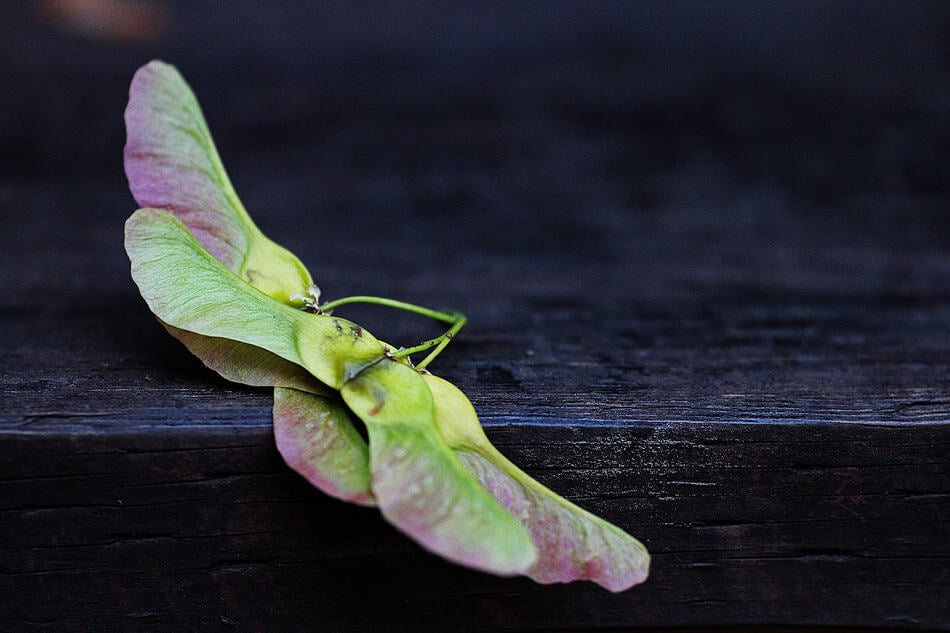
How Can You Tell What Kind of Maple Helicopter You Have?
The helicopter itself can provide clues.
Silver maple helicopters are among the largest produced by common maples and appear early in the season.
Red maple helicopters are smaller and often appear reddish or pinkish before turning brown.
Sugar maple helicopters mature much later and typically have a narrower angle between the two wings.
Norway maple helicopters have distinctive widely spreading wings that may form nearly a straight line. University of Maryland Extension notes that this wide angle is one way to distinguish Norway maple seeds from sugar maple seeds.
Boxelder helicopters grow in drooping clusters and may remain hanging from female trees well into winter.
If you aren’t sure, look at the leaves as well as the seeds. The combination usually makes identification much easier.
Can You Grow a Maple Tree From a Helicopter?
Yes.
Those little helicopters aren’t decorative—they contain viable maple seeds, and many can grow into trees.
The method depends heavily on the maple species.
Red and silver maple seeds mature in late spring or early summer and can often be planted shortly after they fall. Seeds from many other maple species mature in autumn and require a period of cold, moist conditions before germinating.
That’s why you may discover tiny maple seedlings appearing naturally in garden beds and lawns the following spring.
If you want to experiment, collect mature helicopters from a healthy tree once they have changed from green toward yellow or brown.
Just remember that a seedling grown from a landscape maple won’t necessarily look exactly like its parent—especially if the parent is a cultivated variety.
Should You Remove Maple Helicopters From Your Lawn?
Usually there is no urgent need.
A modest scattering of maple helicopters can simply be chopped up with a mower or allowed to break down naturally.
If you have an exceptionally heavy crop, however, raking or removing thick piles can prevent them from collecting in gutters, drains, garden beds, or other unwanted locations.
And yes—some will sprout.
Young maple seedlings are much easier to pull while they’re small than after they’ve established a larger root system.
A Tiny Sign That Fall Is Getting Closer
By September, we naturally begin watching maple trees for something else entirely: their spectacular autumn leaves.
But before many maples put on their familiar red, orange, and gold display, another seasonal change may already be hanging overhead.
Look closely at the branches.
Those clusters of little winged fruits are preparing for their own autumn journey.
Soon a gust of wind will loosen one.
It will tumble from the branch, begin to spin, catch the air—and a maple helicopter will take flight.

Maple Copters FAQ
What is the proper name for a maple copter?
A samara: a single-seeded winged fruit. Ash, elm, ailanthus, and hop hornbeam also produce samaras, but maples make the showiest, longest-traveling versions.
Does a heavy maple seed year mean a hard winter?
The folklore links acorn and samara abundance to a coming winter. A heavy seed crop follows the previous season’s conditions, such as drought or a late frost, and the saying is still passed along every big samara year.
Why do maple seeds spin?
The wing widens away from the seed, so the outer edge moves through air faster than the inner edge. That speed difference generates lift, the same way a helicopter rotor does. A leading-edge vortex along the wing adds another boost.
Are maple seeds safe to eat?
For humans, yes, in small amounts. Foragers strip the wings and either eat the seed raw or roast it. Bitter samaras (silver maple, mostly) are best soaked first. For dogs, however, red maple and some related samaras are toxic to horses, and large amounts can upset dogs. Keep that in mind around pets.
When do maple copters fly?
Silver maple drops in late spring. Red maple drops in late spring and again in fall. Sugar and Norway maples drop from late summer into October. Box elder holds samaras into winter.
Should I rake samaras off my lawn?
Yes, if you do not want a lawn full of seedlings next year. A thick samara blanket can also smother grass. A mulching mower handles light coverage. Heavy drops need a leaf rake or a leaf blower set on vacuum.
Can I grow a maple from a samara?
Yes. Most species need a cold stratification period (12 weeks in a damp bag in the fridge) before they will sprout. Plant them about a half inch deep in a pot of seed-starting mix once spring soil hits 50°F.
Now that you know more about the maple’s flying seeds, you will be even more fascinated by the hundreds of them you see swirling toward the ground each year. For more on the maple genus, read our companion pieces: backyard maple sugaring, maple syrup facts, and why leaves change color in fall.


Amber Kanuckel
Amber Kanuckel is a freelance writer from rural Ohio who loves all things outdoors. She specializes in home, garden, environmental, and green living topics.
- Amber Kanuckel

- Amber Kanuckel
- Amber Kanuckel
- Amber Kanuckel




We have a Maple tree that had helicopters in the spring. However, this fall we had dark helicopters in October. This was the first time since we have lived here since 2005. I am waiting to see what our winter will be like. I feel that this was done for the animals to have extra food during a bad winter. I have found nothing in any books that prove this yet. So I will see.
I’m trying to find out if this is a mast year for Norway Maples. This is the first time in 30 years that our Norway Maple has had “noses” still hanging on and dropping in January! They are EVERYWHERE and there are so many. It seems to be only Norway Maples. Our Sugar Maple has no seeds at all.
What month specifically in the fall do the seeds drop? We have a couple sugar maples but its almost the middle of October and I haven’t seen a single seed from them. They are also very green still. I’m worried they are diseased.
Hi Kat, it depends on the tree variety. Some don’t drop until fall, others drop in the spring.
Are maple trees the only one that have these
We have two maples in the backyard of the house we just moved into and they are both losing whirlybirds but one in particular is dumping tons of them. Quite the mess but I’m glad to find out it’s normal for this time of year.
Our neighbors have a 200 year old maple. It is majestic. Every 3-4 years we get the dumping of the keys. We have a pool and try to coordinate opening with the tree.
We have had layers deep from the tree. Last year we were lucky with the wind. It went the other way.
This is life and nature… what can we do but enjoy it! ( and skim and vacuum).❤️
Thanks for sharing, Chuck. We agree!
Send me some of the seeds !!!
We have lived in our house for 23 years and I have NEVER seen so many helicopters on my lawn and garden! What a mess. Ours is a silver maple.
This year the “polynoses” are smal l, abundant, dry and pale yellow. Any significance?
Mine are as well..I actually thought the tree might be dying until I googled it and found that many maples are doing that this year! What a mess on the lawn tho.
I also hate the whirlybirds, my neighbor has two giant silver maple trees in their backyard, the builder gave one to each new home, we got rid of ours and never planted it. But now 35 years later we get the blunt of all the mess that comes with the whirlybirds, our flower garden has to be weeded once the wings take root, they are all over our yard, deck and the gutters are full. Very messy trees, not to be planted in a neighborhood!
Agree! My neighbor also has 2 growing 15 ft from my house. What a mess every year. If it’s not the whirlybirds it’s the leaves in the fall. And the wind blows towards me so her mess lands in my yard, on my $ 600 worth of rubber mulch,
in my garage and along the fence line killing all the grass and in my gutters.. These trees have no business being planted in neighborhoods. And people who have these trees should cut them down and replace them with a more appropriate tree for the yard.
Maple trees support many insects and birds. Instead of cutting them down, we should be adapting the other plantings in the yard to be more environmentally friendly. We have a maple tree near our pool, we simply wait until after the seeds are shed to take the cover off and open it.
I hate whirlybirds! I have spent countless hours picking them out of my flower beds! And, then cutting out miniature maple trees growing where other plants are located! They are a nuisance in Iowa!
No tree is a nusience
So I came here by looking around for an answer to a question I have. The helicopters started dropping 2 days ago. They got all in my flower bed since. I went to put a fresh layer of dirt in my flower bed but I left the helicopters in the bed and put dirt over them.
Do I have to worry that these hundreds of maple seeds will sprout? I really didn’t think much of it because my wife pointed out that if they were seeds we would have maples growing everywhere but now seeing this maybe putting dirt over them was a bad idea?
Yes, you will have tiny maples in your landscape. Although I doubt more than normal as squirrel and chipmunk love to plant them for you even if you do nothing.