

Remembering The Great Ice Storm of ‘98
Anyone remember the ice storm from January 1998? Editor Peter Geiger discusses his perspective on this memorable storm.
Quick Reference
- When: January 4-10, 1998. Worst day: January 8.
- Where: Maine, New Hampshire, Vermont, upstate New York, Quebec, Ontario, New Brunswick.
- Ice depth: Up to 5 inches clinging to trees and power lines.
- Without power: 4 million people. Some out for 16 days.
- Fatalities: 35.
In the 2000 edition of the Farmers’ Almanac, we chronicled the 100 Worst Weather Events of the past 100 years. And if you lived in Maine, New Hampshire, Vermont, or Canada, you remember January 8, 1998 as a date which will live in weather infamy. It was the date of the Great Ice Storm which cut power to over 700,000 of the people who lived in the state. For some people it was an inconvenience and for others (who were powerless for up to 16 days) it was a life or death situation.

The Forecast Calls For…
The Farmers’ Almanac called for rain in early January. To say it would be ice would be a stretch. One or two degrees in either direction, or depending upon where you lived, meant rain, snow, or ice. On the 8th, managing editor Sandi Duncan and I were scheduled to fly to NYC in the early morning to start planning the 1999 edition. Sandi lived “in the woods a bit” and called me at 4 am to say she lost power. Twenty minutes later I lost electricity and, within the hour, the Portland Jetport was closed for the same reason.
It was work as usual at Geiger Bros. (our parent company) but by 11 am I was doing a phone or TV interview on CNN. Before the day was over I was fielding calls from as far away as Alaska. Maine had become the weather story for national media, and with good reason.
Five Inches of Ice
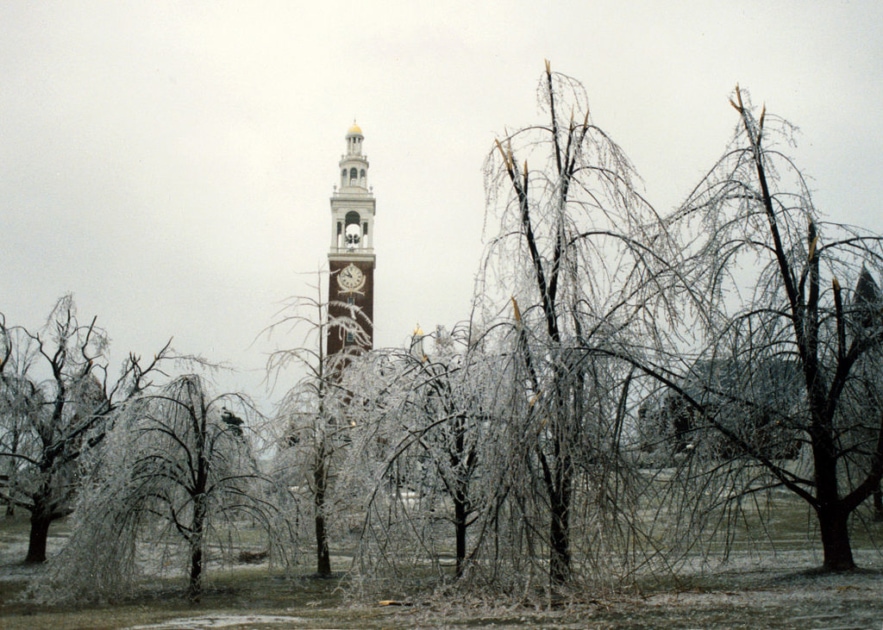
It was January, and no power usually means frozen pipes. But, Maine is the most treed state in the US (89% of our surface has trees). So, when 5 inches of ice clung to trees, limbs snapped and thousands of miles of electric wire came down with it. When one connection was made, another tree took it down again. The power workers worked around the clock for a month to restore power.
Neighbors Helping Neighbors
While it was warm on January 8th (30 degrees F.) the temp started dropping as the calendar pages turned. The ice storm lasted January 8-10th but the clean-up took weeks. Utility crews from states as far away as Hawaii helped with the endless task of line repair. What I remember best was the genuine warmth and compassion neighbors showed neighbors. People who owned generators would go house to house to warm one before moving on to the next. If you owned a chainsaw, you helped clear trees off roofs.
The sound of branches snapping sounded like gunshots or being in a war zone. The “shots” went on through the night and through the week. Today, we have lost many trees that were damaged that day. But Mother Nature replaces what she takes away.
Today, our power company has an aggressive tree trimming program. When there is the next ice storm (we are expecting one on Sunday, January 12, 2020), some lines will come down but not as many. We are much better prepared today than we were even back then.
Ice Storm 1998 At-A-Glance
Dates of storm: Storm formed January 4th and lasted through the 10th
Total without power: 4 million
Fatalities: 35
Photo: Ice coated trees on the University of Vermont campus. Courtesy of Vermont Department of Forests, Parks and Recreation
How an Ice Storm Forms
Freezing rain is a thin-sandwich phenomenon. The middle layer of the atmosphere is above freezing, so snow falling from the cloud melts into rain. The lowest hundred or so feet near the ground is below freezing, so the rain drops freeze on contact. The two-layer setup needs to hold for hours, and the cold layer needs to be shallow enough that the drops do not refreeze into sleet pellets in the air. The 1998 storm held that exact configuration for three straight days.
| Ice depth | Effect |
|---|---|
| ¼ inch | Slick roads and walkways. Few branches break. |
| ½ inch | Tree limbs start to break. Some power outages. |
| 1 inch | Major branches snap. Widespread outages. |
| 2-3 inches | Mature trees uproot. Multi-day power outages. |
| 5 inches (1998) | Forest-scale destruction. Multi-week outages. |
The National Weather Service issues Ice Storm Warnings ahead of accumulations expected to reach a quarter inch or more. Pair the warning with our long-range outlook and you can plan tree work, generator fueling, and travel days in advance.

Frequently Asked Questions
When was the Great Ice Storm of 1998?
January 4 to 10, 1998. The most damaging accumulation came January 8 across northern New England and southeastern Canada.
How much ice fell?
Up to 5 inches of glaze ice on trees and power lines in the worst-hit areas of Maine, Vermont, and Quebec.
How many people lost power?
About 4 million across New England and Canada, including over 700,000 in Maine. Some households were without electricity for 16 days.
How many people died?
35 across the affected region. Most deaths involved hypothermia or carbon monoxide poisoning from improperly vented generators and stoves.
Why was Maine so hard-hit?
Maine is the most heavily wooded state in the U.S., with 89% of its surface in forest. When 5 inches of ice loaded the canopy, branches and entire trees came down, taking thousands of miles of overhead wire with them.
How does freezing rain form?
Snow melts in a warm middle layer of the atmosphere, then refreezes on contact with the ground in a shallow sub-freezing layer near the surface. The two-layer sandwich is unstable, which is why ice storms are so hard to forecast.
How can I prepare for an ice storm?
Trim trees near power lines, fuel a generator, fill water containers, charge devices, stockpile 72 hours of food, and never run a generator or grill indoors. Treat downed lines as energized.
Tell Us
Lived through 1998 in Maine, Vermont, or Quebec? Tell us in the comments. For more historic-storm reads, see our historic blizzards and storm of the century entries.


Peter Geiger
Peter Geiger is the Editor Emeritus of the Farmers' Almanac. Read his full biography.
- Peter Geiger

- Peter Geiger
- Peter Geiger
- Peter Geiger





I worked at Colby College in Waterville Maine during the ice storm that year. Many people were thankful for how everyone worked together and opened their doors to neighbors. Some people were lucky and had wood stoves while others had no heat at all. It will definitely linger in the minds of the people that lived it. That storm just proved that everyone working together can make all the difference.